
Last updated: 20 August 2026 · 13 min read
A stone chip the size of a coin can usually be repaired for a fraction of a new windscreen — but in Saudi heat you may have days rather than weeks before it runs, and the single fastest way to turn a chip into a full crack is to blast cold air at a windscreen that has been baking in the sun. Repair is cheap, quick and keeps the original factory seal. Replacement is expensive, and on a modern car it triggers a second bill most owners never see coming: recalibrating the cameras mounted behind the glass.
A chip is a repair. A crack is a replacement. In this climate the distance between the two can be one afternoon in a car park.
- Act within days, not weeks. Heat cycling and thermal shock spread chips far faster here than in temperate climates. A repairable chip has a short shelf life.
- Never aim cold AC straight at a hot windscreen. The temperature difference across the glass is what drives an existing chip into a running crack. Cool the cabin gradually.
- Rough rule: a chip smaller than a coin, not in the driver's direct line of sight and not touching the edge, is usually repairable. Long cracks, edge damage and anything obstructing the driver's view mean replacement.
- Replacement can trigger ADAS recalibration. If your car has lane-keep assist, adaptive cruise or automatic emergency braking, cameras behind the glass must be recalibrated afterwards — a significant additional cost.
- Damage in the driver's field of view is a resale and inspection problem, not just a cosmetic one. Fix it before you list the car.
Why windscreens fail faster in Saudi Arabia
Windscreen damage in Saudi Arabia is the result of two forces acting together: physical impact from road debris, and thermal stress from extreme heat. Neither is unusual on its own. The combination is what turns a minor chip into a replacement job unusually quickly here.
The impact side is straightforward. Long highway routes, heavy truck traffic and loose aggregate at the roadside mean stones get thrown at speed. The thermal side is the part drivers underestimate: laminated glass sitting in direct sun reaches temperatures far above the air temperature, then cools sharply at night or the moment the air conditioning starts. Glass expands and contracts through every one of those cycles, and any existing flaw concentrates that stress at its tip.
Key takeaway: the stone makes the chip, but the heat decides how long you have. That is why the same damage that a driver in a mild climate might ignore for months needs attention here within days — the same accelerated-ageing logic behind clear-coat failure and tyre degradation in the Kingdom.
Thermal shock: the mistake that spreads the crack
Thermal shock is the stress created when one part of the glass changes temperature much faster than the part next to it. It is the single most common reason a stable chip suddenly runs across a windscreen in Saudi Arabia, and it is almost always self-inflicted.
Picture the usual sequence. The car has been parked in the sun and the windscreen is extremely hot. The driver gets in, starts the engine and directs the air conditioning at full cold straight onto the glass. The inner surface cools rapidly while the outer surface stays hot. That difference across the thickness of the laminate puts the existing chip under exactly the kind of load it cannot absorb, and the crack travels.
The same applies in reverse: pouring cold water on a hot windscreen to clean it, or running the demister at full heat against cold morning glass. Both create the same differential.
- Open the windows first and let the trapped superheated air out before you switch anything on.
- Start the AC low and aimed at the footwell, not at the glass, and raise it as the cabin comes down in temperature.
- Only direct air at the windscreen once the difference is modest — the vent setting matters more than the temperature dial.
- Never pour cold water on hot glass, however tempting after a dust storm. Let the car cool in shade first.
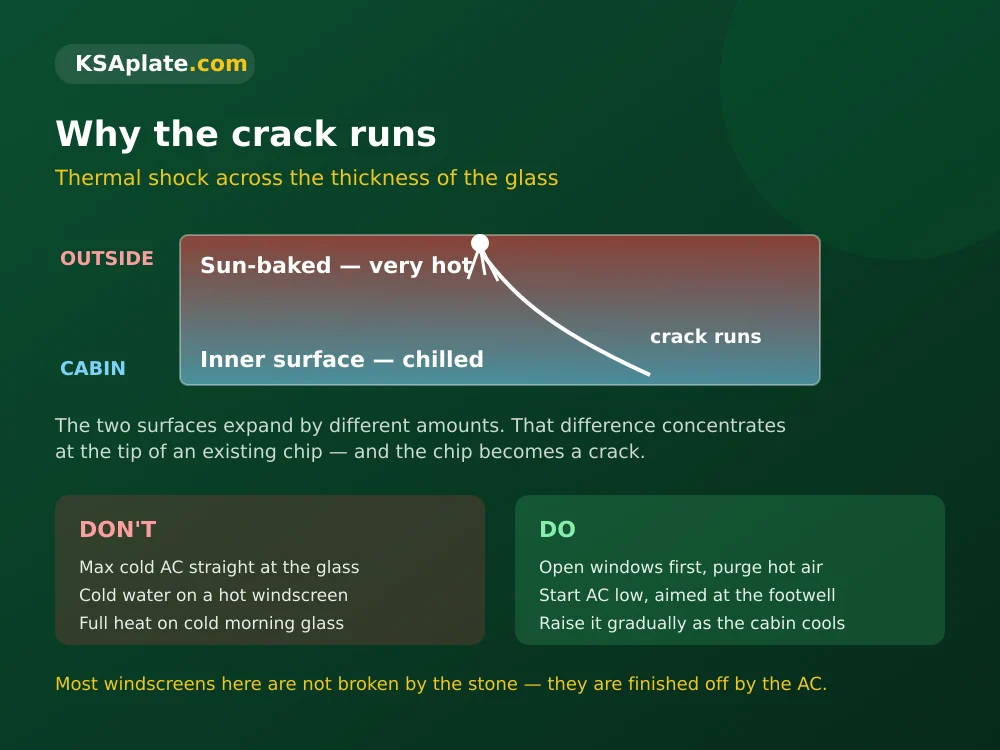
Most windscreens in the Kingdom are not broken by the stone that hit them. They are finished off by the air conditioning ten minutes later.
Key takeaway: if you already have a chip, treat your windscreen as fragile until it is repaired. Cool the cabin gradually, using the technique in our guide to car air conditioning in Saudi Arabia, and park in shade wherever possible.
Repair or replace: the decision rule
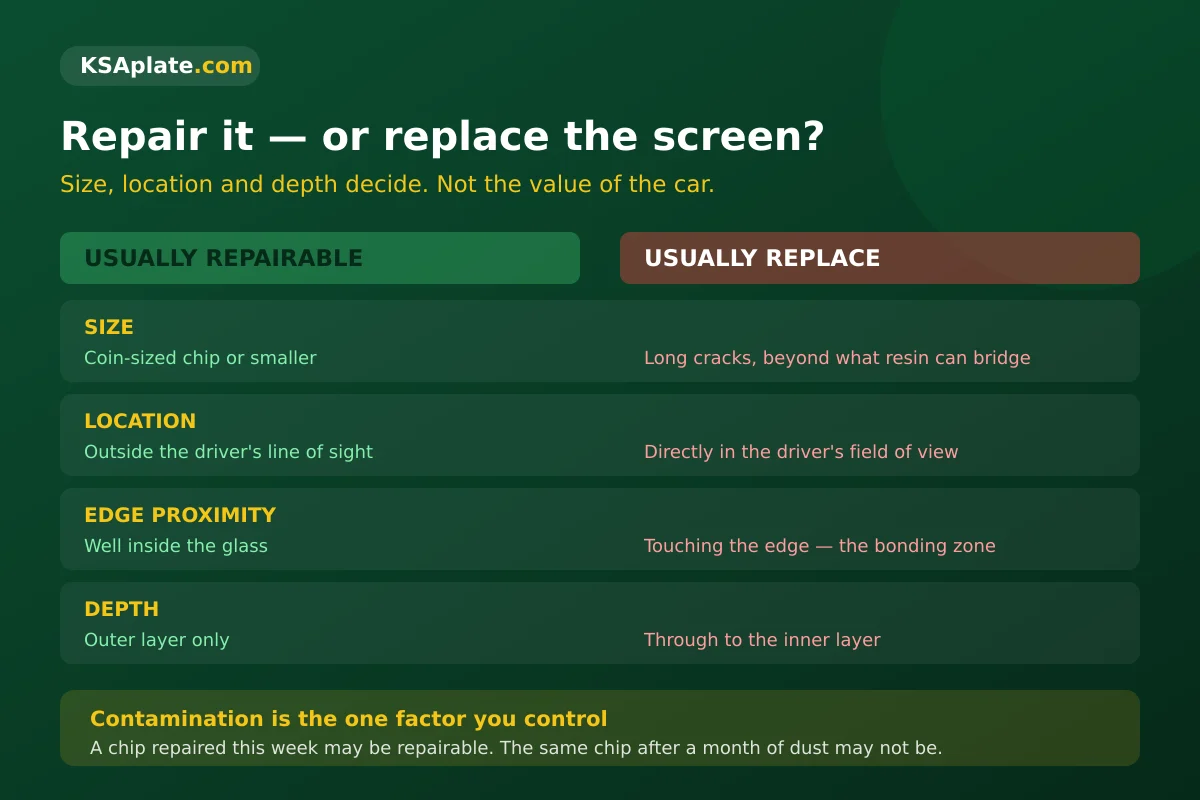
Whether damaged glass can be repaired depends on three things only: the size of the damage, where it sits on the screen, and how deep it goes. Cost, car value and the age of the vehicle do not enter into it — a repairable chip on an expensive car is still a repair.
| Factor | Usually repairable | Usually needs replacement |
|---|---|---|
| Size | Chip roughly coin-sized or smaller | Long cracks, or damage bigger than the repair resin can bridge |
| Location | Outside the driver's direct line of sight | Directly in the driver's field of view, where a repair leaves visible distortion |
| Edge proximity | Well inside the glass, away from the border | Touching or near the edge — the structural bonding zone |
| Depth | Outer layer only | Damage through to the inner layer, or from the inside |
| Contamination | Fresh damage, still clean | Old damage filled with dust and moisture — resin bonds poorly |
Two rules cause most disputes with workshops, and both are legitimate. Damage in the driver's line of sight is refused for repair not because it cannot be filled, but because a filled chip always leaves some optical distortion, and distortion in front of the driver is a safety issue. Damage at the edge is refused because the perimeter is where the glass is bonded to the body and contributes to structural rigidity.
Key takeaway: get it looked at while the damage is fresh and clean. Contamination is the one factor entirely within your control — a chip repaired this week may be repairable, the same chip after a month of dust may not be.
What's your plate worth?
Get an instant, free estimate with our plate value calculator.
Calculate My Plate's ValueWhat a chip repair actually does
A windscreen chip repair is the injection of a clear resin into the damaged cavity, which is then cured hard so it bonds the glass back together. It is a structural repair, not a cosmetic filler: the goal is to stop the crack spreading and restore strength, and the improvement in appearance is a side effect.
The process is short. The technician cleans the cavity and draws out trapped air and moisture, injects resin under pressure so it reaches the tips of the cracks, cures it, then scrapes and polishes the surface flush. On fresh, clean damage the result can be close to invisible; on older damage a faint mark usually remains.
Expectations matter here, because this is where customers feel misled. A repair is judged on whether the damage stops spreading, not on whether the mark disappears entirely. Any workshop promising a completely invisible result on month-old contaminated damage is overselling.
Key takeaway: repair preserves the original factory-bonded seal, which is a real advantage. A windscreen that has never been removed cannot leak, whistle or be fitted badly.
ADAS: the second bill nobody quotes
ADAS stands for Advanced Driver Assistance Systems, and on most modern cars the camera that powers them is mounted on the windscreen itself, behind the mirror. When the glass is replaced, that camera moves — and it must be recalibrated so the system knows exactly where it is pointing.
This is the cost that surprises people. Recalibration is a separate procedure requiring specific equipment, and industry figures commonly put it in the range of several hundred US dollars on top of the glass, depending on the vehicle and how many systems are involved. On some cars it approaches the cost of the windscreen itself, which can make a borderline repair-versus-replace decision tip firmly toward repair.
Features that typically depend on that camera include lane departure warning and lane-keep assist, automatic emergency braking, forward collision warning, adaptive cruise control and traffic-sign recognition. Skipping recalibration does not usually produce a warning light — the system simply operates on a false reference, which is precisely why it matters.
| Chip repair | Full replacement | |
|---|---|---|
| Original factory seal | Kept intact | Broken and re-bonded |
| Typical time | Under an hour | Half a day, plus curing time |
| ADAS recalibration | Not required | Required on ADAS-equipped cars |
| Relative cost | Lowest | High — and higher again with recalibration |
| Visible result | Faint mark may remain | Clear, as new |
Key takeaway: before authorising a replacement, ask two questions — does my car have a camera behind the windscreen, and is recalibration included in this quote? A quote that omits it is not a complete quote.
OEM, OEE and aftermarket glass
Replacement glass comes in three broad grades, and the difference matters more on a modern car than it used to. OEM glass is made by the manufacturer's original supplier and carries the car maker's branding. OEE glass is made to the same specification, often by the same factory, without that branding. Aftermarket glass is produced independently and can vary in thickness, tint band and optical quality.
For an older car without driver assistance systems, good OEE glass is usually a sensible balance of cost and quality. For a car with a windscreen-mounted camera, optical accuracy stops being cosmetic: distortion in the camera's viewing area can prevent a clean calibration, and some systems are sensitive to the exact glass specification. Automotive components sold in the Kingdom fall under the standards regime administered by the Saudi Standards, Metrology and Quality Organization.
Ask what is being fitted before work starts, and ask whether the installer can complete the calibration afterwards or will send the car elsewhere. Fitting quality also matters in this climate — a poorly bonded screen in extreme heat is a future leak and wind-noise complaint.
Key takeaway: match the glass to the car. Cheap aftermarket glass is a false economy on any vehicle with a camera behind the screen.
Insurance, inspection and the law
Glass cover in Saudi Arabia depends entirely on your policy: comprehensive policies may include windscreen damage, sometimes as a specific benefit or optional add-on, while third-party cover does not. Check the wording rather than assuming, because glass is one of the most commonly excluded or separately-priced items.
Two practical points are worth knowing before you claim. Many insurers treat a chip repair more favourably than a replacement, since it is far cheaper for them, and some waive the excess for repair specifically to encourage early fixing. And a claim history has consequences at renewal, so for a small chip it is worth comparing the repair cost against the effect of claiming — details we cover in our guide to car insurance in Saudi Arabia.
On inspection: damage that obstructs the driver's view is a legitimate roadworthiness concern, and glass condition can be raised at the periodic technical inspection. Confirm the current criteria directly with Fahes (MVPI) or via our Fahes inspection guide before booking a test with a cracked screen. Note that windscreen tint is a separate matter governed by the tinting and modification rules — the front screen is treated differently from side glass.
Key takeaway: read your policy wording for a glass clause before you need it, and fix view-obstructing damage before an inspection rather than after a failed one.
Preventing chips on Saudi highways
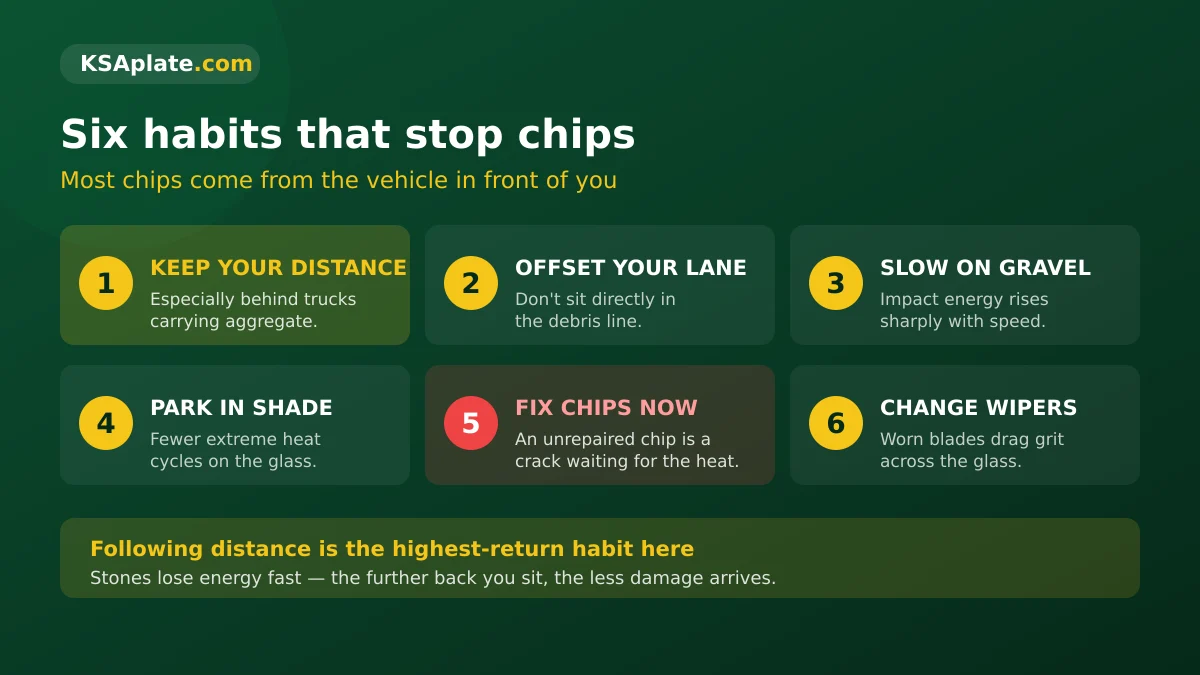
Most windscreen chips are thrown by the vehicle in front, which makes following distance the single most effective prevention available to a driver. Stones lose energy quickly, so the further back you sit, the less damage arrives.
- Increase your following distance behind trucks and any vehicle carrying aggregate, gravel or construction material. This is the highest-return habit on this list.
- Avoid sitting directly behind a vehicle in the same lane on loose-surface stretches — offset slightly where it is safe and legal to do so.
- Slow down on gravel shoulders and roadworks. Impact energy rises sharply with speed.
- Park in shade so the glass is not cycling to extreme temperatures every day.
- Fix small chips immediately — an unrepaired chip is a crack waiting for the next hot afternoon.
- Replace worn wiper blades so grit is not dragged across the glass, which creates the fine scratching that scatters light at night.
Build these into the same seasonal routine as your other checks — the pre-trip inspection in our Saudi road trip guide is the natural place for a quick glass check, and glass belongs in the wider maintenance schedule alongside filters and paint.
Cracked glass and what your car is worth
A cracked windscreen is one of the most visible defects on a used car, and buyers treat it as a bargaining anchor rather than a minor blemish. It sits directly in front of the person evaluating the vehicle, which is why it carries weight out of all proportion to its cost.
The economics run one way. A crack rarely reduces the true value of a car by much, but it reliably invites a deduction larger than the repair or replacement would have cost — and on a car with driver assistance systems, an informed buyer will also price in the recalibration. Fixing it before listing removes the anchor entirely and photographs far better, which matters because the first judgement is made on images.
Buyers should look at glass carefully in daylight and from an angle. Check for a mismatched brand marking between the windscreen and the side windows, which can indicate a previous replacement, and ask why. Replaced glass is not itself a problem, but combined with other signs it can point to accident history worth checking against a proper vehicle history check — one of the standard checks in our used-car inspection guide and among the warning signs in used-car scams.
Key takeaway: repair or replace before you list, and keep the invoice. Like paint, glass is a defect buyers can see instantly, so it costs more in negotiation than it does at the workshop — the same asymmetry that drives ordinary depreciation discounts against any valuation. Budget it as routine running cost, not an emergency, using our cost-of-ownership breakdown.
Glass sorted? List the car while it shows well
Sell on the only Saudi marketplace that is also a plate market — and check what your distinctive plate is worth before it leaves with the car.
List my car Value my plateFrequently asked questions
How long can I drive with a chipped windscreen in Saudi Arabia?
Why did my crack suddenly grow overnight?
Can a crack in the driver's line of sight be repaired?
Does replacing the windscreen affect my car's safety systems?
Is aftermarket windscreen glass a problem?
Will a cracked windscreen fail the Fahes inspection?
Does car insurance in Saudi Arabia cover windscreen damage?
Can I use a DIY windscreen repair kit?
Will a repaired chip still be visible?
Should I repair a chip before selling the car?
Reviewed by Khalid Al-Rashid, Saudi Car & License Plate Market Expert. Repairability rules are general industry guidance, and cost comparisons are relative rather than quotes — have the damage assessed in person and confirm inspection criteria with Fahes.
Sources: Fahes / MVPI (mvpi.com.sa) for periodic technical inspection; Saudi Standards, Metrology and Quality Organization (saso.gov.sa) for the standards regime covering automotive components; published industry guidance on windscreen repairability limits and ADAS recalibration after glass replacement; KSAplate listing observations, 2026.