


Last updated: 13 September 2026
A seller sends you a screenshot of a plate ownership document, says the plate is his and asks for a deposit "to hold it". In Saudi Arabia there is no public page where a buyer can check whether that document is genuine. What you can check is Absher itself: when a plate transfer request is started, Absher sends a verification code to the phone of the other plate's owner. This guide shows exactly how to use that check, with annotated screenshots of Absher's own service pages, and how to recognise the deposit, "I'm travelling" and code scams before any money moves.
A document someone sends you is a claim. The code Absher sends to the owner's phone is the check. The money waits until the transfer is on the screen in front of you.
TL;DR
- Screenshots, PDFs and ID copies prove nothing. They are easy to edit, and we found no public service that lets a private buyer verify a Saudi plate ownership document or another person's ID.
- The real check is the Absher transfer request. In the service for exchanging plates with another owner's vehicle, Absher sends a verification code to the phone of the other plate's owner.
- Start the request yourself. The code then goes to the seller's registered phone, the seller reads it to you, and you never have to give anyone a code of your own.
- Know the official conditions before you meet. Both of you must own a vehicle, both vehicles need valid insurance, periodic inspection and registration, and neither may be stolen, wanted, seized, mortgaged, exported or registered as spare parts.
- No deposit, no advance, no "I'm travelling, send it first". Pay only at the transfer itself, face to face, and never give an Absher password or code to someone who contacts you.
Why a Screenshot, a PDF or an ID Copy Proves Nothing
A file is only a file. Names, plate letters, digits and dates can be changed with ordinary software, and a logo, stamp or code pattern is just an image that can be copied onto a new document. A photo of a National ID or an Iqama shows that someone has a picture of a card. It does not show that the person messaging you owns the plate.
Saudi Arabia does have a real ownership document for plates. Since November 2024, owners can keep plates in Absher's digital plate wallet (محفظة لوحات المركبات الرقمية), and the Public Security Q&A confirms that the service lets the owner print a plate ownership document (وثيقة ملكية اللوحة). But we found no official description of what that document shows, no published reference-number or QR check, and no public service that lets a buyer confirm it. Dubai's RTA runs a public certificate validation page; we could not find a Saudi equivalent.
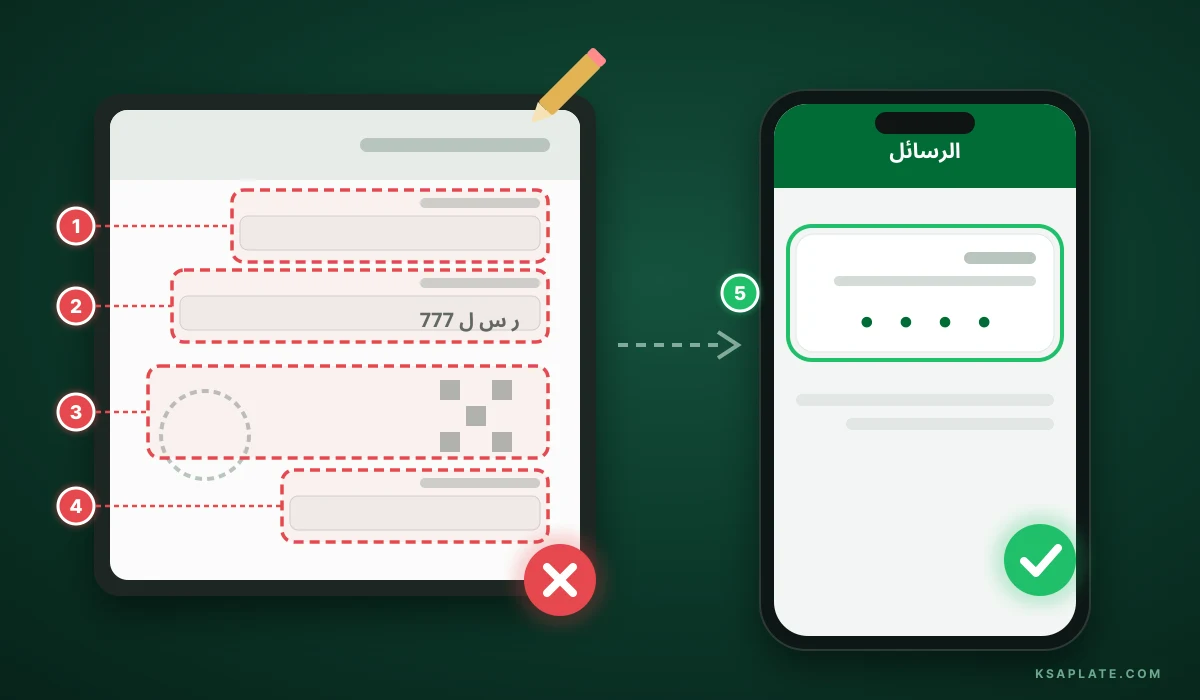
- Name and ID number. Typed text. Changing it takes seconds.
- Plate letters and digits. Also editable. Compare them with the listing character by character anyway.
- Logos, stamps and code patterns. Images can be copied from a genuine document onto a forged one.
- Dates. Even a genuine document only describes the day it was printed. The plate may have been sold since.
- The Absher verification code. Sent by Absher to the phone of the plate's owner when a transfer request is made. This is the part a forger cannot produce.
Key takeaway: documents sent to you are claims. The transfer request in Absher is the only step that tests them against the government record.
The Check That Works: Absher's Plate Transfer Service
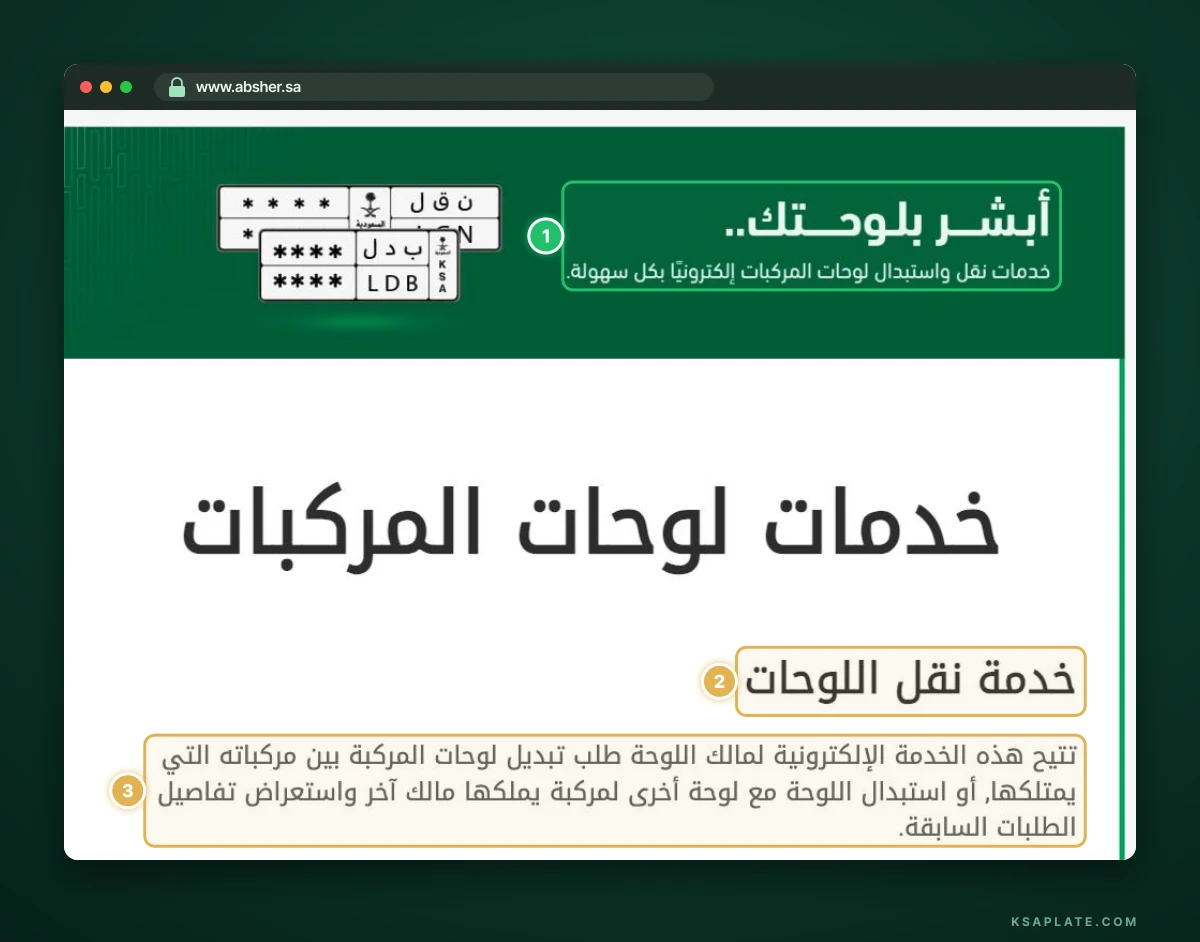
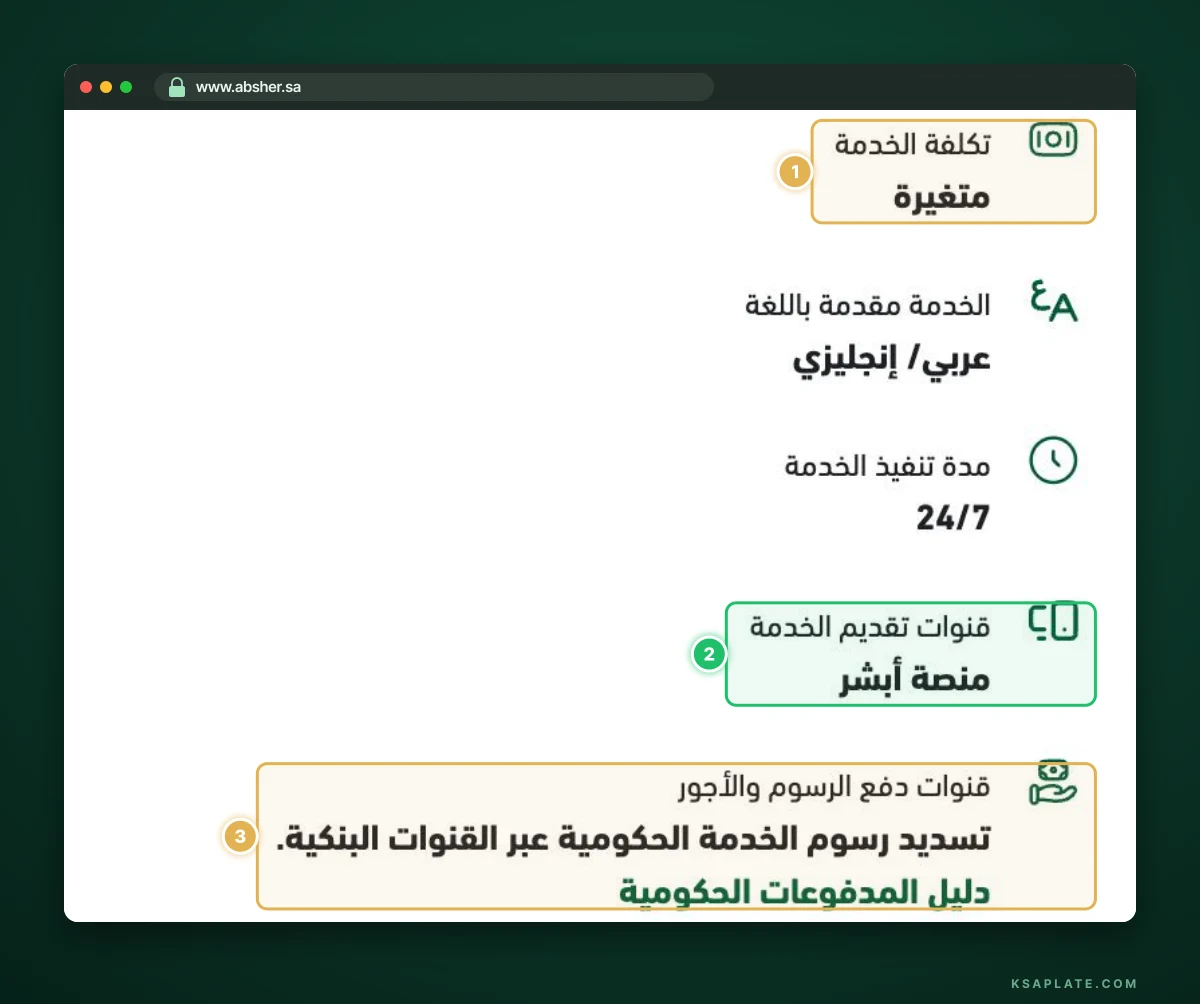
The service is called نقل اللوحات (plate transfer) and sits under the Traffic Department (المرور) in Absher. According to Absher's service guide, it lets a plate owner swap plates between their own vehicles or exchange a plate with another owner's vehicle. The guide lists it as available to citizens and residents, 24/7, in Arabic and English, launched in 2024. The screenshots below were taken from Absher's public service pages on 13 September 2026. We did not log in or start a request.
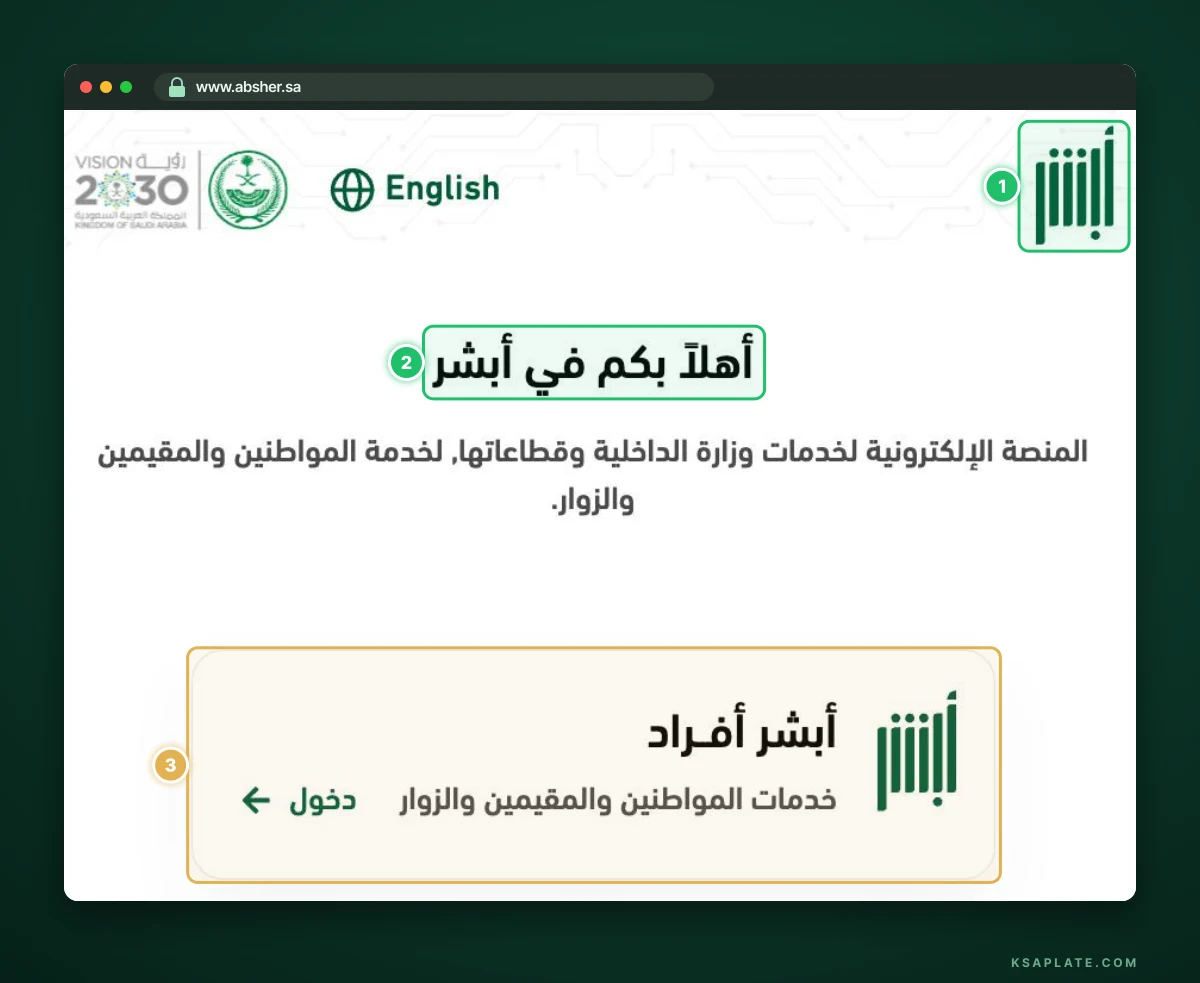
Step 1: Open Absher yourself and check the address
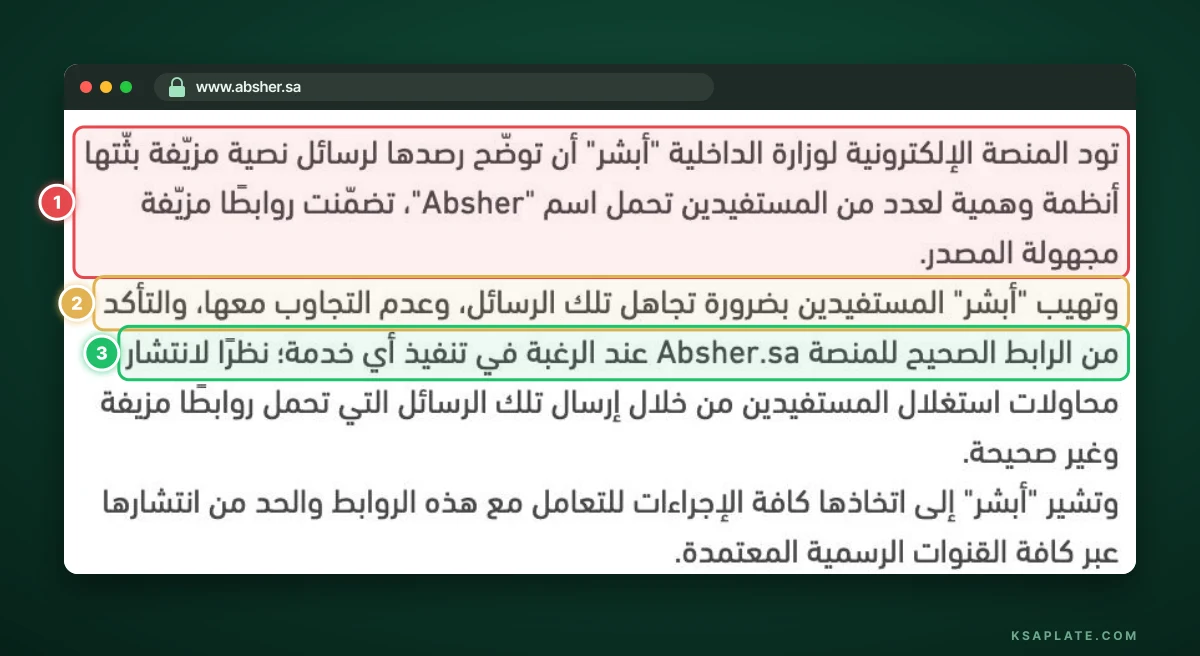
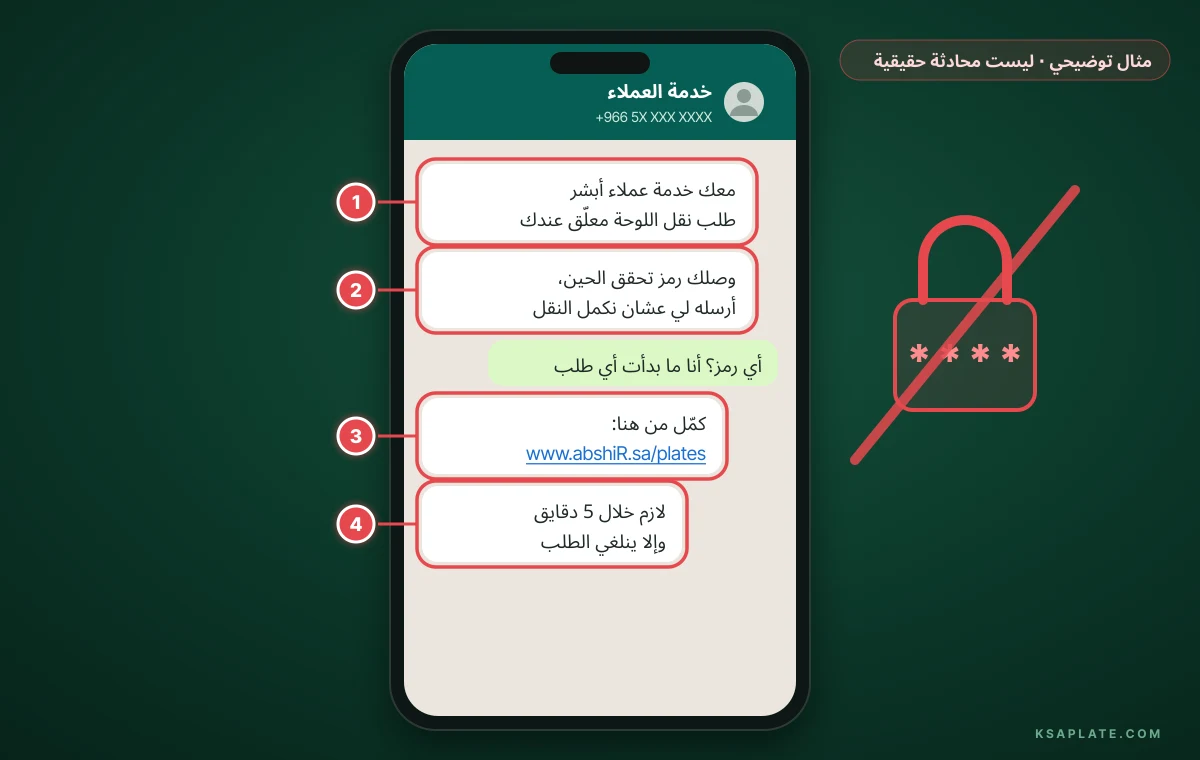
Type absher.sa into your browser or open the official Absher app. Do not open a link a seller, a "broker" or a text message sends you. Absher has publicly named fake addresses such as www.abshiR.sa and www.absher.com, and on its own website it warns about fake text messages that carry the name "Absher" and contain fake links, telling users to ignore them and to check that the address is Absher.sa before using any service.
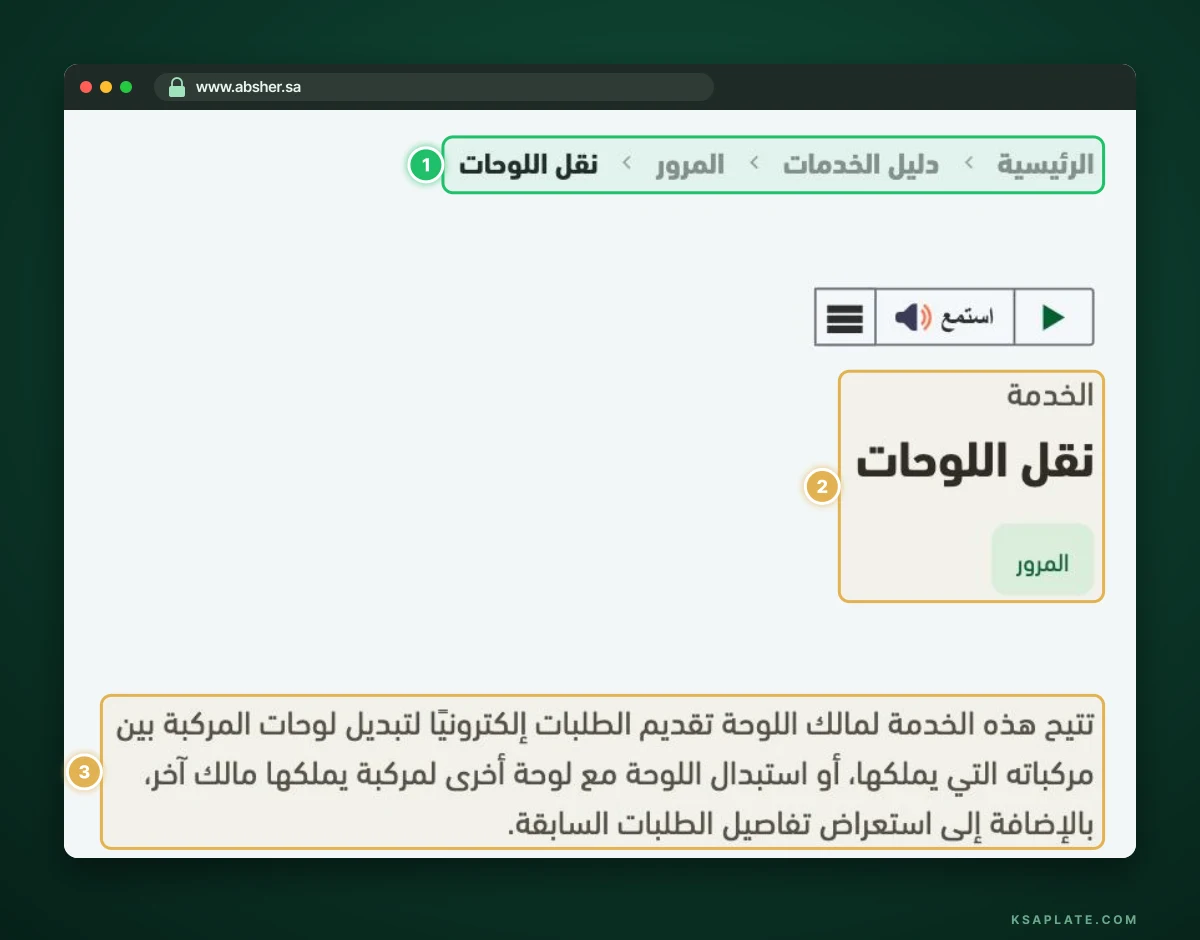
Step 2: Check the conditions before you meet
Absher's service card lists what must be true for the request to go through. If one item fails, the transfer cannot complete, so a seller who cannot meet these conditions cannot sell you the plate today, whatever the price.
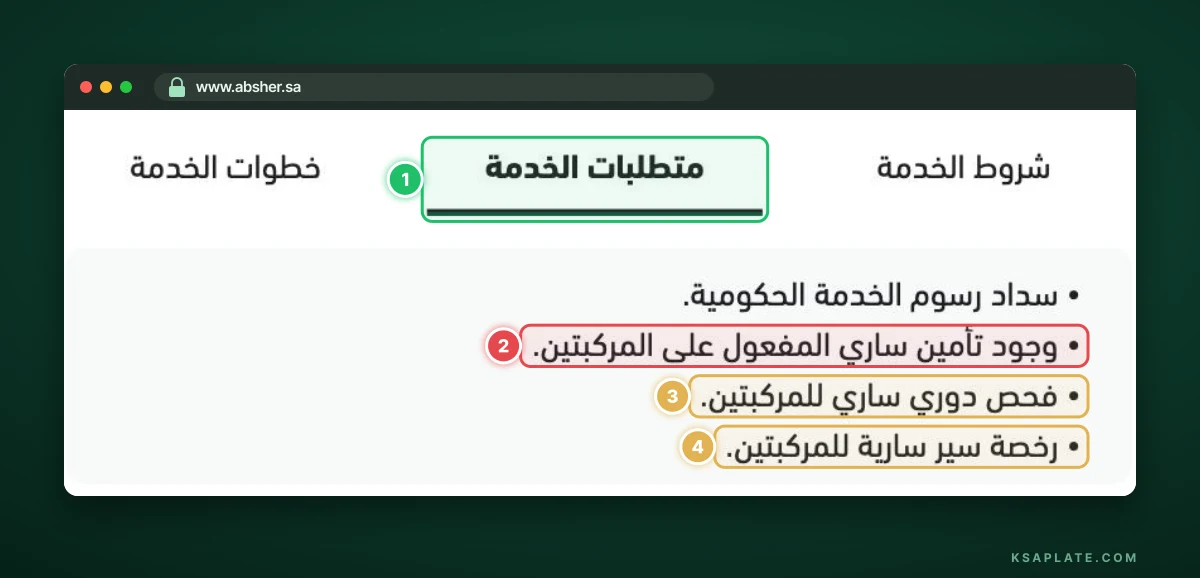
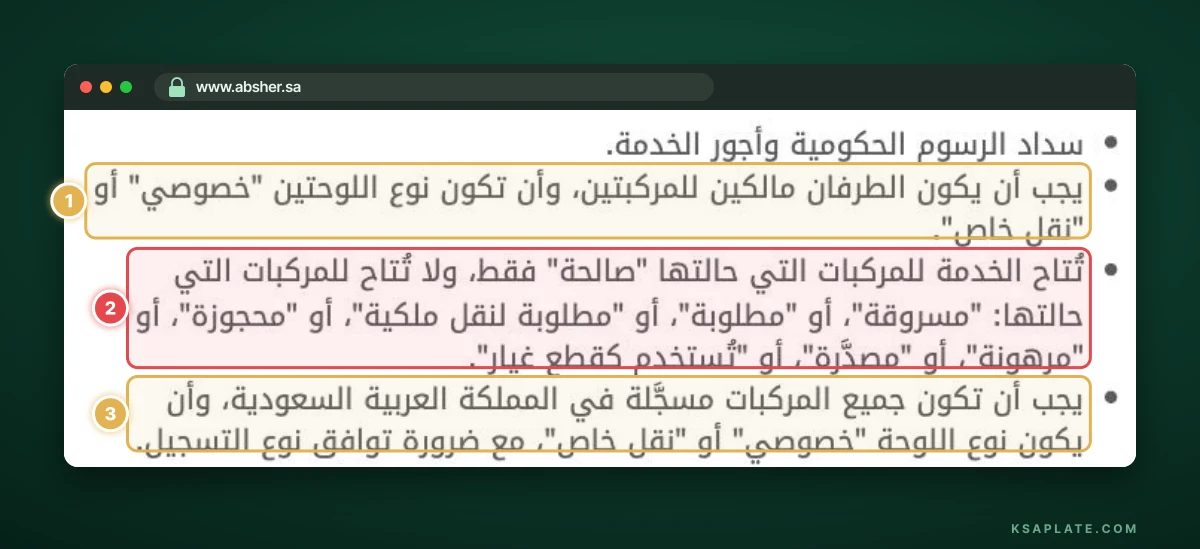
- You need your own vehicle. The published person-to-person route exchanges plates between two vehicles, so the buyer must own a registered vehicle too.
- A financed car can block the deal. Vehicles registered as mortgaged (مرهونة) are excluded, which matters when the seller's car is still under finance.
- Traffic fines. When the Traffic Department explained the service in May 2024, it listed "no violations" among the conditions. Absher's current service card does not mention fines. Ask the seller to clear any fines before you meet.
- Plates held in the digital wallet. The wallet lets an owner register a stored plate onto a vehicle. We found no published service that sends a wallet plate directly to another person. Ask the seller to show you inside Absher how the plate will reach you, before you pay anything.
If a request has already been refused, our guide to why a Saudi plate transfer gets refused goes through each blocker and its fix.
Step 3: Start the request from your own Absher account
Absher's published service journey for an exchange with another owner runs in this order:
- Pay the government service fee. Absher lists the payment path as المدفوعات › المدفوعات الحكومية › خدمات المركبات › تغيير لوحة مركبة (Payments › Government payments › Vehicle services › Change vehicle plate).
- Log in to Absher and choose Vehicles (المركبات).
- Choose Vehicle management (إدارة المركبات).
- Choose Plate transfer (نقل اللوحات).
- Choose New request (طلب جديد).
- Choose "نقل اللوحات بين مركبتي ومركبة مالك آخر" (transfer plates between my vehicle and another owner's vehicle).
- Enter the other party's details.
- Enter the verification code sent to the other plate owner's phone.
- Review the request and pay.
- Absher confirms the transfer and issues the vehicle registrations.
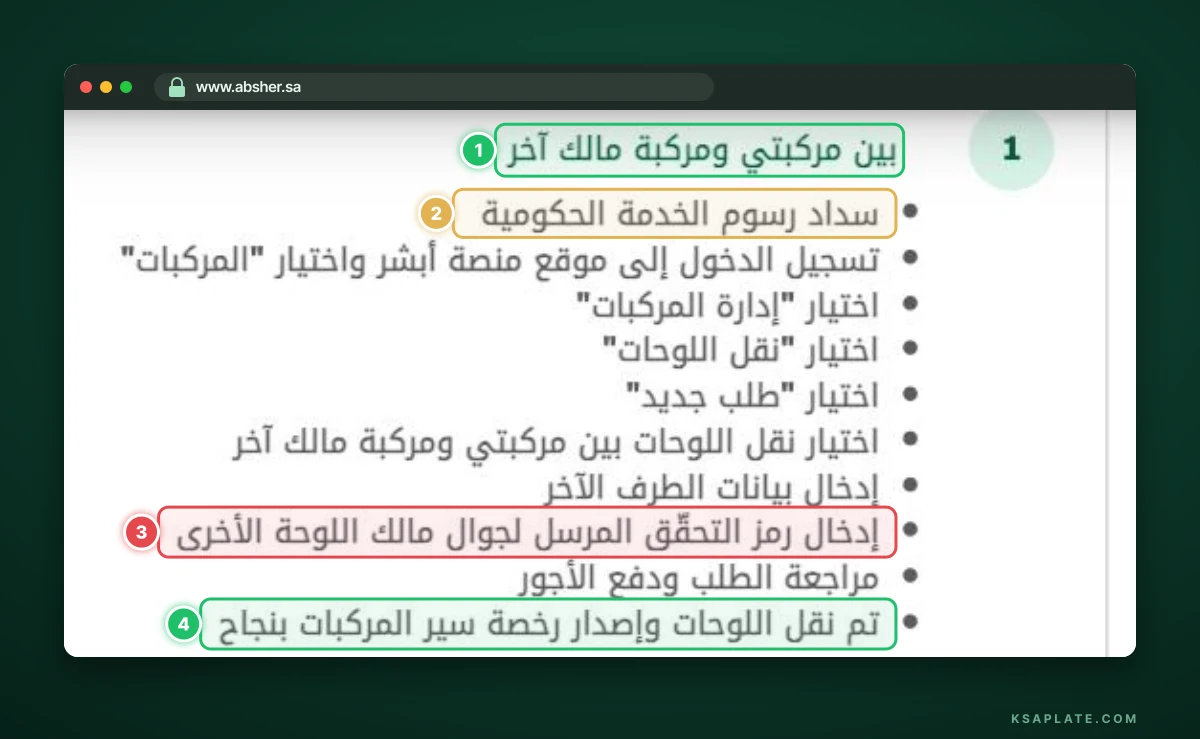
Step 4: The code is the test
When you start the request, the code goes to the phone registered to the other plate's owner, not to whoever is chatting with you. Ask the seller to read the code to you. Someone who controls the owner's registered phone can do that. Someone holding a forged document cannot.
Starting the request yourself has a second advantage: you only ever receive a code from the seller. You never have to give anyone a code that arrived on your phone.
Key takeaway: "the code went to my brother", "my number changed" or "I'll send the code after your deposit" all end the deal. A genuine owner loses nothing by letting Absher send the code.
What's your plate worth?
Get an instant, free estimate with our plate value calculator.
Calculate My Plate's ValueWhat Each Result Means
Every outcome leads to one of two actions: carry on carefully, or stop.
| What happens | What it means | What you do |
|---|---|---|
| The seller reads you the code, the request shows the plate you agreed on, and Absher lets you continue | The seller controls the owner's registered phone, and both vehicles pass Absher's checks | Complete it together and pay at that moment (see the rules below) |
| No code arrives, or the seller cannot give it to you | The phone registered to that plate is not in the hands of the person you are dealing with | Stop. Pay nothing |
| Absher refuses the request: status, insurance, inspection, registration or plate type | The transfer cannot happen today | Pay nothing. The seller fixes it first, then you start again |
| The seller will not let a request be started at all | Nothing can be checked | Walk away |
Even a perfect result proves only that the seller controls the owner's phone and that the vehicles qualify. It does not make the price fair, so the payment rules still apply. Before you agree a number, check what the plate is worth with the Plate Value Calculator.
What the Transfer Costs
Absher's service card lists the cost as variable and says the government fee is paid through bank channels. Two figures are on record. Absher has stated a service fee of SAR 230 for transferring plates between different owners. The Traffic Department has given SAR 400 per private vehicle, or SAR 700 per private-transport vehicle, for changing plates. With two private cars that comes to SAR 400 per vehicle plus SAR 230. Confirm the exact amount in Absher before you pay, and see our complete plate transfer guide for the details.
The Rules: Deposits, Codes and Paying at the Transfer
The check tells you whether the seller controls the plate. These four rules make sure your money moves only when the plate does.
Rule 1: No deposit to a private seller
Not to hold the plate, not because "other buyers are interested", and not a "small" or "refundable" amount. In April 2026, Public Security described exactly this pattern for vehicles offered on social media. The price is low, sometimes as low as half the market price. The victim is asked to transfer a deposit to "prove the intention to buy". Then the fraudster disappears. The same script works for plates.
Rule 2: Travel is not a reason to pay first
"I'm abroad, send the money and I'll transfer it when I'm back" asks you to pay for a transfer nobody can check. Absher's plate transfer runs online, around the clock, from the owner's own account. A genuine owner who is travelling can still receive the verification code and complete the transfer from their phone. If they cannot, you wait. You do not pay.
Rule 3: Never give your Absher password or a code to someone who contacts you
Absher tells users to reach it only through absher.sa or the official app and to ignore messages with links. In a plate deal, the only code that moves between people is the plate transfer code. It travels from the plate owner to the person who started the request, for a transfer both have agreed to in front of each other. If you are the buyer and you start the request, you never give a code at all. Anyone who calls you asking for "the code you just received" is not part of a plate deal.
Rule 4: Pay at the transfer, face to face
Meet in person. You start the request, the seller gives you the code, you review the request and pay the fees, and Absher confirms the transfer. The price moves at that same moment, by an instant bank transfer that both of you watch arrive. For large amounts, a private escrow service can hold the money until the transfer completes. Waffy, for example, says on its own website that it charges 4% and releases the money after the transfer is confirmed. We could not verify any escrow provider's licence with the Saudi Central Bank (SAMA), so check that yourself before you use one.
The one exception: the official plate auction. Absher's electronic plate auction takes its subscription fee through the platform itself, and a won plate is added to the winner's digital wallet automatically. Money for an auction plate goes through Absher only, never to a person who offers to "reserve" or "resell" an auction plate. See how the Absher plate auction works.
Scam Scripts Decoded
Scams around plates follow a small number of scripts. The illustrations show how the messages usually read, in Arabic, with each red flag numbered.
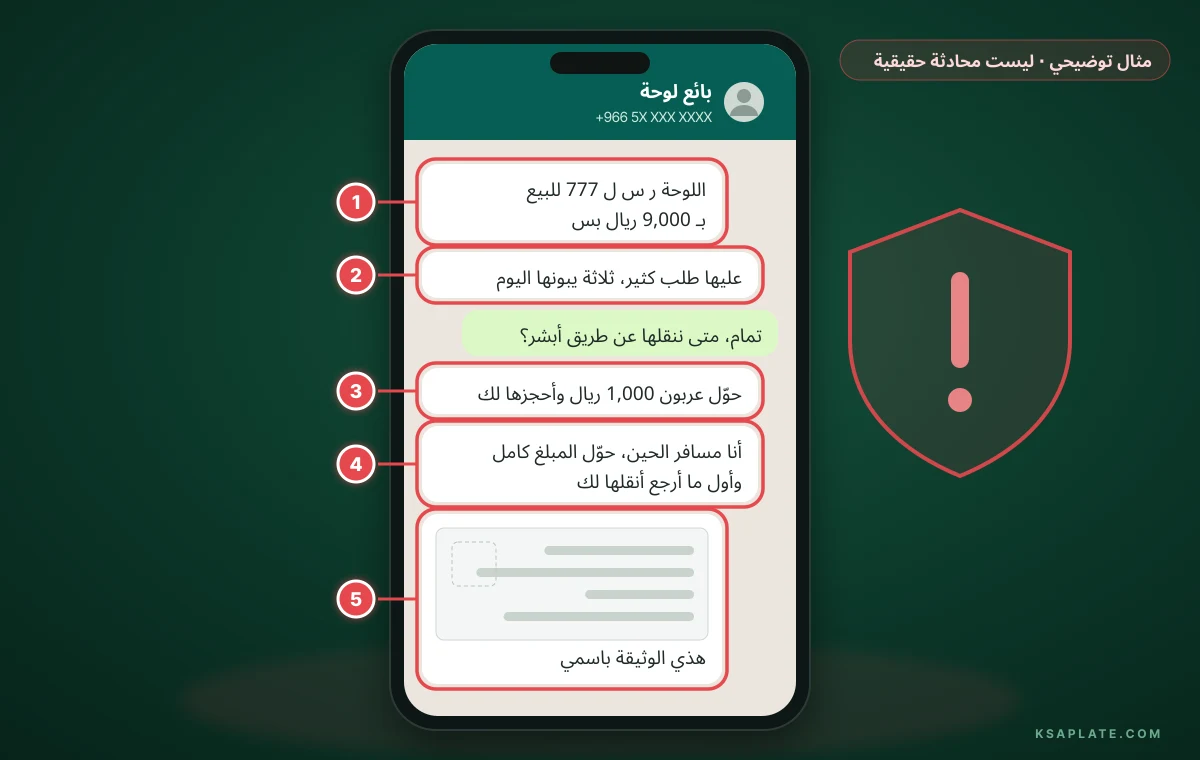
- The deposit hold. A good price, many "interested buyers", and a deposit to reserve the plate. The goal is the deposit, and the plate never existed for you.
- The traveller. The owner is "abroad" or "at work", so you should pay now and the transfer happens later. The transfer does not need anyone to be in the country.
- The screenshot seller. Plenty of documents, ID photos and "proof", but always a reason not to start the Absher request.
- The code request. A caller or chat posing as Absher, a bank or a broker asks for a code that just arrived on your phone. That code can open your account or approve something you never agreed to.
- The look-alike link. A "government" or "escrow" page at an address that is not absher.sa. The page looks right; the address is wrong.
- The auction reseller. Someone offers to reserve or pass on a plate "from the auction" for a fee. Auction payments go through Absher only.
Warning Signs: Walk Away If You See These
- A deposit is requested before anything has been checked.
- "Many buyers are interested, decide today."
- The seller sends screenshots, PDFs or ID photos but will not let the Absher request be started.
- The verification code "goes to someone else" or will be shared only after payment.
- The seller is "travelling" and wants the money first.
- The price is far below comparable plates. Check it with the calculator before you reply.
- Anyone asks for your Absher password or a code that arrived on your phone.
- A link to a "government" or "escrow" page whose address is not absher.sa.
- The seller does not own a registered vehicle, or their vehicle is financed, seized or uninsured, yet insists the plate can be transferred today.
More patterns and how to deal safely with both sides of a sale are in our guide to buying and selling Saudi plates safely.
Buying a Car? The Same Rules Apply
The Public Security warning from April 2026 was about cars: vehicles advertised on social media at prices far below market, a deposit to "prove intent", and a seller who disappears. The countermeasure it pointed to is the vehicle display card (بطاقة عرض المركبة), which a seller issues in Absher to show the vehicle's ownership and the seller's identity when listing on accredited platforms. We could not find how a buyer checks that card, so the rules above still apply: no deposit, and payment only at the official transfer. For a car, the ownership transfer itself runs through Absher, and traffic fines on the owner do not block it as long as the registration and periodic inspection are valid, according to the Traffic Department. The full process is in how to transfer car ownership in Saudi Arabia.
If You Have Already Paid or Shared a Code
- Stop all further payments. A request for a "release fee" or a second amount is part of the same scam.
- Call your bank immediately and ask whether the transfer can be stopped or recalled.
- If you shared an Absher password or code, open absher.sa or the official app yourself, change your password and review your account's recent activity.
- Report it. Absher has a financial fraud report service under My services › Public Security › Financial fraud reports (خدماتي › الأمن العام › بلاغات الاحتيال المالي). It was presented for bank-card fraud, so also report to the police. Public Security's numbers are 911 in Riyadh, Makkah, Madinah and the Eastern Province, and 999 in all other regions.
- Keep everything. Chats, phone numbers, screenshots, receipts and bank references. Do not delete the conversation.
- Tell us. If the listing was on KSAplate, email support@ksaplate.com with the listing link so we can act on it.
What We Could Not Verify
- Which details and security features the plate ownership document carries, and whether any official service lets a third party verify it.
- Exactly which details Absher's form asks for about "the other party", and what the review screen shows before payment. We read Absher's public service pages and did not log in or start a request.
- Whether a plate held in the digital wallet can be sent directly to another person.
- What the Traffic Department means by "secure receipt of the amount" (ضمان استلام المبلغ بأمان), which it lists as a benefit of the service. No official source says Absher holds the plate price in escrow, so do not treat it as escrow.
- The current government fee. SAR 400 per private vehicle comes from a 2021 Traffic Department statement, and Absher's service card lists the cost as variable.
- Whether traffic fines currently block a plate transfer between owners. The 2024 Traffic Department conditions say so; Absher's current service card does not.
- Whether any private escrow provider is licensed by the Saudi Central Bank.
- Absher's official plate auction site could not be opened from outside Saudi Arabia.
Frequently Asked Questions
How do I check if a Saudi plate ownership document is real?
Can I verify a plate ownership document with a QR code or reference number?
How do I know the seller really owns the plate?
Who should start the Absher plate transfer request, the buyer or the seller?
Is it ever safe to share a verification code?
Is it safe to pay a small deposit to reserve a plate?
The seller says he is travelling and asks me to send the money first. What should I do?
What blocks a plate transfer between two owners?
Do I need my own car to buy a Saudi plate from another person?
What should I do if I have already sent money to a scammer?
Check the price before you reply
A price far below the market is the most common first sign of a scam. See what a plate is actually worth, then browse genuine listings and deal directly with sellers.
Check Plate Value Browse PlatesConclusion
In Saudi Arabia, the proof is not a document someone sends you. The proof is whether the plate's owner can complete an Absher transfer with you. Start the request yourself, let Absher send the code to the owner's phone, and let the money move only when Absher confirms the transfer. No deposit, no advance for a traveller, and no code for anyone who contacts you. Follow that order and a forged screenshot costs you nothing.
How the facts were checked: Absher's public service pages for vehicle plate services and the plate transfer service card (conditions, requirements, service journey, fees and channels) were read directly on 13 September 2026, and the screenshots come from those pages. Traffic Department and Public Security statements were checked in Ajel, Okaz and Sabq reports (May 2024, November 2023, July 2024, November 2025, April 2026, July 2026). Waffy's terms were read on its own website. No Absher account was logged in and no transfer was started.
Reviewed by Khalid Al-Rashid, Saudi License Plate Expert.
Sources: absher.sa (plate transfer service pages); Ajel, Traffic Department plate transfer conditions (May 2024); Ajel, Public Security digital plate wallet Q&A (November 2025); Ajel, Absher warning on fake links (November 2023); Okaz, Public Security on vehicle sale fraud and the vehicle display card (April 2026); Ajel, Public Security warning and reporting numbers (July 2026); Sabq, Absher financial fraud reports (July 2024); Ajel, Traffic Department on fines and vehicle ownership transfer (June 2026); Waffy, plate escrow terms.