


Last updated: 17 October 2026
A dashboard warning light tells you two things before you even recognise the symbol: its colour says how urgent it is, and whether it is steady or flashing says how serious. Red means stop. Amber means get it checked soon. Green and blue only confirm that something is switched on. This guide covers the lights Saudi drivers actually meet, the names they are known by here, what the Gulf heat does to them, and the two-second test that tells a used-car buyer whether a dashboard has been tampered with.
Most people try to identify the symbol first. Look at the colour first. By the time you have worked out what a red symbol means, you should already be pulling over.
TL;DR
- Red = stop safely and switch off. Oil pressure, engine temperature and the red brake light are not lights you drive home on.
- Amber = book it. A steady engine light (لمبة المكينة) usually still lets you drive, but the fault is real and it is stored in the car's computer.
- Flashing changes the meaning. A flashing engine light warns of a fault that can quickly damage the catalytic converter. A tyre light that flashes for about a minute and then stays on means the warning system itself is faulty.
- Green and blue are information. Headlights, indicators, cruise control — nothing to fix.
- Buying used? Turn the key to ON before you start the engine. Every warning light should come on briefly and then go out. A light that never comes on at all is a reason to walk away or to get the car scanned.
- Symbols differ between makes. Your owner's manual is the final word for your car.
Read the colour before the symbol
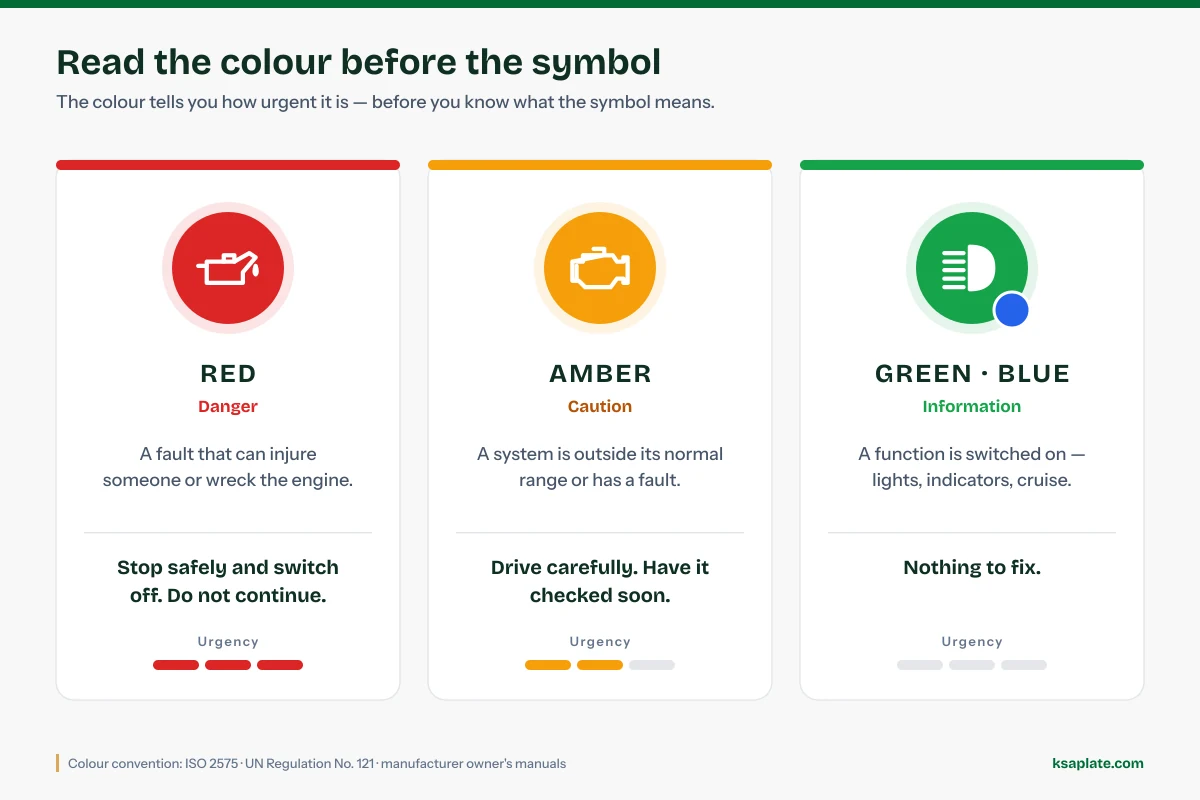
Warning lights are not decorated at random. The international convention behind them, ISO 2575, groups dashboard lights by colour, and UN Regulation No. 121 — the rule most car makers build to — fixes the colour for the safety-critical ones. In practice nearly every car you can buy in the Kingdom follows the same three-step logic:
| Colour | What it means | What you do |
|---|---|---|
| Red | A fault that can injure someone or wreck the engine | Stop where it is safe, switch off, do not continue |
| Amber / yellow | Something is outside its normal range or a system has a fault | Drive carefully and have it checked soon |
| Green / blue / white | A function is switched on | Nothing — it is information |
The exceptions are worth knowing. Some makers show the same symbol in amber first and red later as a problem gets worse — engine temperature is the usual example. And a few red lights are reminders rather than faults: the red brake symbol also appears whenever the handbrake is on, and the red seat-belt symbol simply means someone is not buckled in.
The red lights: stop, don't negotiate
These are the lights where continuing to drive turns a repair into a replacement. The instructions below are taken from a current manufacturer's owner's manual, and they match what other makers print for the same lights.
- Oil pressure (the oil can — إبريق الزيت). The engine has lost oil pressure. The manual's instruction is to stop, switch the engine off as soon as possible and not drive the vehicle until the cause is fixed. This light does not tell you how much oil is in the engine — it tells you the oil is not reaching where it needs to go, which is why minutes matter.
- Engine temperature (the thermometer in waves — لمبة الحرارة). The engine is overheating. Pull over safely, switch the air conditioning off, and let the engine idle in neutral; if the reading does not come back to normal, switch off and call for help. Never open the radiator cap while the engine is hot. Our overheating guide has the full roadside routine.
- Brake (the circle with an exclamation mark — لمبة الفرامل). Either the handbrake is on or the brake fluid level has dropped. If the handbrake is fully released and the light stays on, the manual is blunt: driving with the red brake light on is dangerous. If it comes on together with the ABS light, the system that balances braking between the front and rear wheels has failed as well.
- Charging (the battery — لمبة البطارية or لمبة الدينمو). The battery is not being charged. The car is now running on stored power, and it will stop when that runs out. Switch off what you do not need and head straight to a workshop. Heat is the main reason batteries fail early here — see our car battery guide.
- Airbag (a seated figure with a circle in front — لمبة الإيرباق). The airbag system has detected a fault. The car still drives normally, which is exactly why people ignore it. Treat it as urgent: until it is checked, you cannot assume the airbags will work in a crash.
What's your car worth?
Get a free instant estimate based on real Saudi market data — then sell it on KSAplate with direct WhatsApp contact.
Value My Car — FreeThe amber lights: book it, don't ignore it
- Engine / check engine (the engine outline — لمبة المكينة). The engine management system has stored a fault. When it stays on steadily, most cars still drive normally and do not need towing; the manual's advice is to have the car serviced if the light remains on over several normal drives. A loose fuel cap is a known, harmless trigger — check it first.
- ABS (the letters ABS in a circle). The anti-lock function is off. Your normal brakes still work, as long as the red brake light is not on at the same time, but the wheels can lock in an emergency stop. Get it checked soon.
- Tyre pressure (a tyre cross-section with an exclamation mark — لمبة الكفرات). At least one tyre is low. In the US, where the rule is written down precisely, the system must warn once a tyre is 25 % or more below the pressure the car maker specifies — so when this light comes on, the tyre is already well down. Stop and check all four.
- Stability / traction (a car with wavy lines — لمبة الثبات). If it flickers while you accelerate on sand or a wet road, the system is working. If it stays on, the system is off or faulty.
- Low fuel, low washer fluid, low coolant level. Reminders. The low-coolant light deserves more respect than the other two in Saudi summers, because the next thing that follows is usually the red temperature light.
Flashing changes the meaning
The same symbol can mean two different things depending on whether it is steady or flashing. Three cases matter:
- A flashing engine light is the most important one. The owner's manual describes it as a serious condition that could cause sudden loss of power or severe catalytic converter damage, and asks for service as soon as possible. Ease off, avoid hard acceleration and get the car to a workshop — or call for recovery.
- A tyre light that flashes for about a minute and then stays on is not about air pressure. It means the warning system itself is faulty — for example a sensor battery has died, which is common after a tyre change. Until it is fixed, the car cannot warn you about a genuinely flat tyre.
- A flickering stability light is the system doing its job on a slippery surface. Flickering is good news; staying on is not.
Same light, different name: the Saudi vocabulary
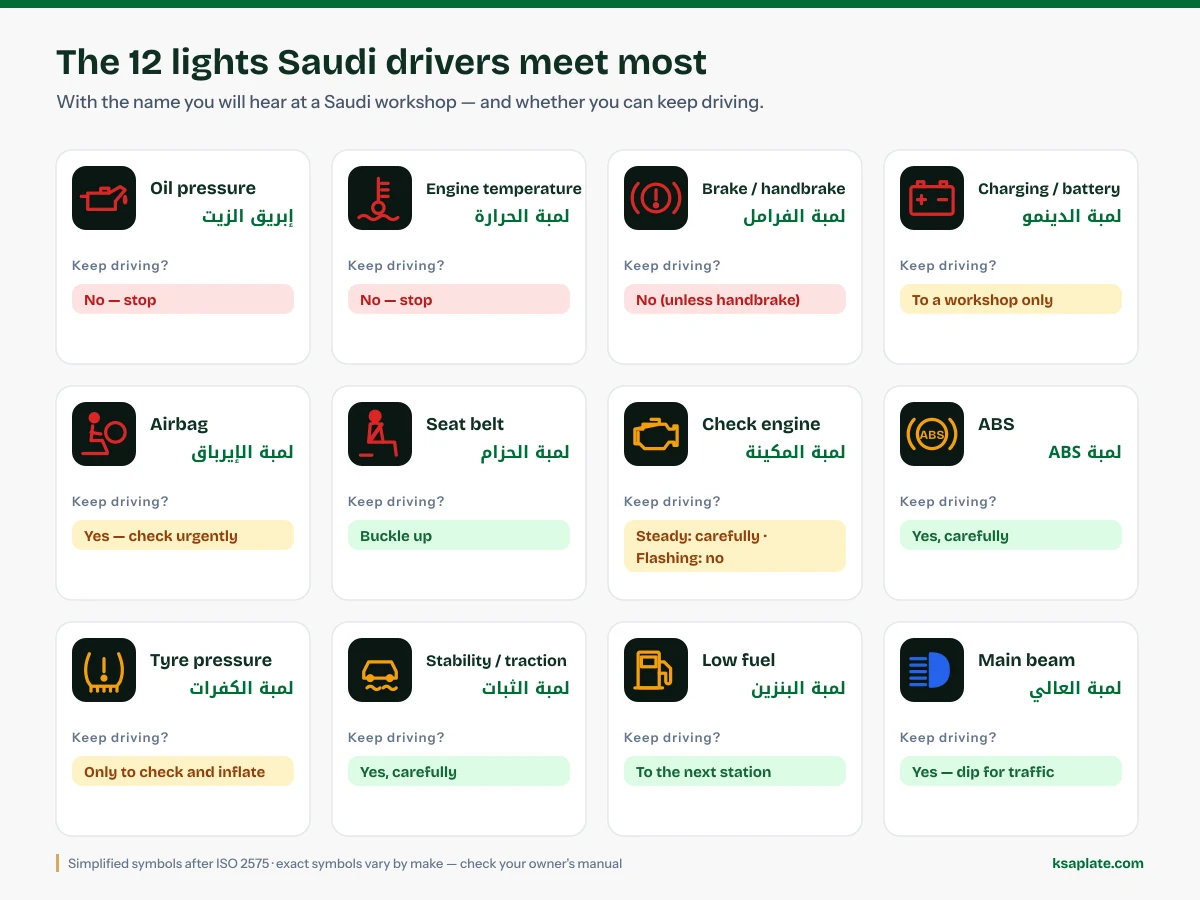
Workshops, sellers and car-forum posts in the Kingdom rarely use the manual's names. If a mechanic on the phone asks which light is on, these are the words you will hear:
| Light | Colour | What people in Saudi Arabia call it | Keep driving? |
|---|---|---|---|
| Check engine | Amber | لمبة المكينة / لمبة المحرك | Steady: yes, carefully · Flashing: no |
| Oil pressure | Red | إبريق الزيت / لمبة الزيت | No |
| Engine temperature | Red | لمبة الحرارة / لمبة الماء | No |
| Charging / battery | Red | لمبة البطارية / لمبة الدينمو | Only to the nearest workshop |
| Brake / handbrake | Red | لمبة الفرامل / الهندبريك | No, unless it is only the handbrake |
| ABS | Amber | لمبة ABS | Yes, carefully |
| Airbag | Red | لمبة الإيرباق / الوسادة الهوائية | Yes, but check it urgently |
| Tyre pressure | Amber | لمبة الكفرات / ضغط الإطارات | Only to check and inflate |
| Stability / traction | Amber | لمبة الثبات / التزحلق | Yes, carefully |
| Seat belt | Red | لمبة الحزام | Buckle up |
| Low fuel | Amber | لمبة البنزين | To the next station |
| Main beam | Blue | لمبة العالي | Yes — dip it for oncoming traffic |
What the Saudi summer does to the dashboard
Three lights come on far more often in a Gulf summer than in a mild climate, and they are linked to each other:
- Temperature. Standing traffic in 45–50°C air leaves the radiator with very little cooling headroom. A needle that climbs in traffic and drops on the motorway usually points to airflow — a dust-blocked radiator or a failing fan — rather than missing coolant. Our overheating guide explains how to tell them apart.
- Charging and battery. Heat shortens battery life, and a weak battery can make other lights flicker, especially in the morning. If several unrelated lights come on together after a hard start, test the battery before you assume three separate faults.
- Tyre pressure. Hot air expands, so pressure rises as you drive and falls overnight. Check it cold, first thing in the morning, against the figure on the driver's-door sticker — never let air out of a hot tyre. Details in our tyre guide.
The air conditioning connects them all: it loads the engine, the cooling system and the electrical system at the same time. That is why the manual's first step for an overheating warning is to switch it off — and why a weak car AC is sometimes the first sign of a cooling problem rather than an AC fault.
The 60-second roadside routine
- Look at the colour. Red: plan to stop now. Amber: plan a workshop visit.
- Check whether it is flashing. A flashing engine light is treated like a red one.
- Stop somewhere safe. As far right as possible, hazard lights on, warning triangle well behind the car.
- Switch off for oil pressure or temperature. Do not restart the engine "to see if it goes away".
- Call the right number. For a breakdown, your insurer's or manufacturer's roadside assistance; for a fire, an injury or a car stopped somewhere dangerous, the unified emergency number 911.
If the car cannot be driven, our guides to breakdowns on Saudi roads and towing and recovery cover what to expect and what it costs.
Does a warning light fail Fahes?
The honest answer is that the official list does not say so directly. The periodic inspection centre's own service page names what it checks: an external inspection including lights, tyres, seats and seat belts, the brake system and wheel alignment, the underside of the car, the exhaust gases, and the headlights. Dashboard warning lights are not on that list.
The connection runs through the exhaust test. An engine light very often means the engine management has detected a fault that affects combustion or emissions, and a car with such a fault is the car most likely to fail the exhaust test. So the practical advice is the same either way: get an engine light diagnosed before the appointment, not after. Our Fahes guide covers booking, fees and what to bring.
Buying used: the ignition test that exposes hidden faults
This is the single most useful thing a used-car buyer can learn from the dashboard, and it takes two seconds.
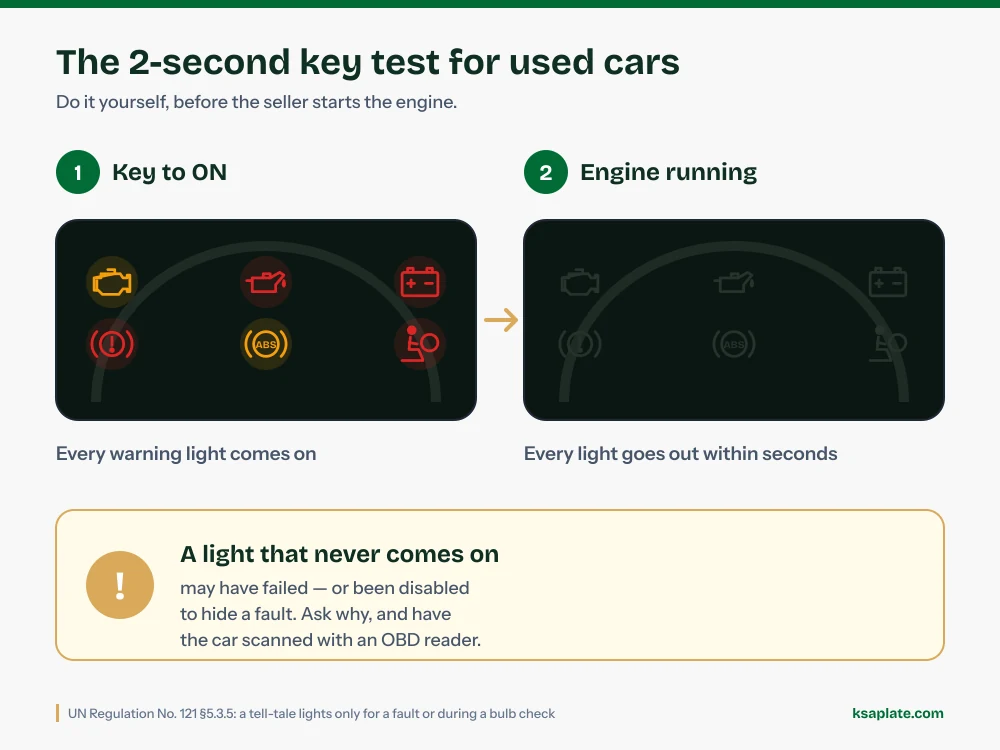
Every warning light is designed to come on briefly when you switch the ignition on, before the engine starts. The UN rule for dashboard lights says a warning light may only light up when it is reporting a fault or during this bulb check. The owner's manual we used gives the airbag light four to eight seconds of bulb check and says plainly that if the engine light does not come on when the ignition is switched on, the car should be checked promptly.
That gives a buyer a simple test:
- Before the seller starts the car, ask to switch the ignition to ON yourself.
- Watch the dashboard. The engine, oil, battery, brake, ABS and airbag lights should all appear.
- Start the engine. They should all go out within a few seconds.
A light that stays on is a fault the seller should explain. A light that never comes on at all is more worrying: the bulb or display segment may have failed — or it may have been disabled to hide a fault. Mechanics in other markets have documented sellers covering warning lights with tape behind the instrument panel; the ignition test catches exactly that.
Then go one step further: have the car's computer read with an OBD scanner at a workshop. A scanner shows stored fault codes even when the dashboard shows nothing. Combine it with a car history check and the steps in our used-car buying guide, and read our list of used-car scams in Saudi Arabia before you pay a deposit.
Selling a car with a light on
A warning light on the dashboard is the first thing a serious buyer will notice, and it rarely costs only what the repair costs: it hands the buyer a reason to negotiate hard and a reason to doubt everything else about the car. You have two honest options.
- Fix it first if the cause is cheap — a fuel cap, a sensor, a battery. Keep the invoice and show it.
- Disclose it if the repair is expensive, and price the car accordingly. A buyer who finds an undisclosed fault after the sale is a dispute you do not want.
What you should not do is clear the code just before a viewing. The light can return within a few drives, and a buyer who scans the car will see that the system was reset recently. Use our free car value calculator to see where your car sits, read how to sell a car in Saudi Arabia, and when it is ready, list it on KSAplate.
Frequently asked questions
What do the colours of dashboard warning lights mean?
Can I keep driving with the engine light (لمبة المكينة) on?
What should I do if the oil light comes on while driving?
Why did my temperature light come on in traffic but not on the motorway?
Is it safe to drive with the ABS light on?
Why does my tyre pressure light come on in the morning and go off later?
Will a dashboard warning light fail the Fahes inspection?
How can I tell if a used car's warning lights have been hidden?
Do all cars use the same warning light symbols?
Conclusion & next steps
A dashboard light is a short message, and the colour is the most important word in it. Red asks you to stop. Amber asks you to book a workshop. Flashing turns an amber warning into an urgent one. In the Saudi heat, the temperature, battery and tyre lights are the ones you will meet most, and they tend to arrive together. And if you are buying, the two seconds between switching the ignition on and starting the engine tell you more about a dashboard than anything the seller says.
Keep the car in shape with our car maintenance guide, check what it is worth with the car value calculator, and when it is time to move on, list your car on KSAplate.
Sources: Owner's manual, Ram 2022 — Warning Lights and Messages (Stellantis); UN Regulation No. 121 — tell-tales and indicators (UNECE); ISO 2575 — symbols for controls, indicators and tell-tales; US FMVSS No. 138 — tire pressure monitoring systems; Periodic Technical Inspection (MVPI) — services; ABC7 Chicago — warning lights hidden with tape.