
TL;DR:
- Most breakdowns in Saudi Arabia trace back to five causes — overheating, tires, batteries, fuel, and AC failure — and almost all of them are caught early by routine maintenance and a five-minute pre-trip check.
- Safety comes before the phone call: pull fully right, hazards on, exit away from traffic if you can get clear, warning triangle well behind the car — then call for help.
- The Kingdom's unified emergency number is 911 for genuine emergencies; for a routine breakdown, your insurer's or manufacturer's roadside assistance line is usually the right first call — check what your policy includes before you need it.
- Heat is the real danger while you wait. Water in the car, shade discipline, and staying with the vehicle turn a breakdown from a risk into an inconvenience.
- On desert and intercity roads the rules tighten: tell someone your route, never stretch a fuel tank, and treat the remote stretch between towns as its own planning problem.
Quick answer: If your car breaks down in Saudi Arabia, pull as far right as possible, switch on your hazard lights, get out on the side away from traffic only if you can move fully clear, place your warning triangle well behind the car, and then call for help — 911 for genuine emergencies, or your insurer's or manufacturer's roadside assistance line for a routine breakdown. Stay hydrated and stay with the vehicle, especially in summer heat. Most breakdowns here come from overheating, tires, batteries or running out of fuel — and a five-minute check before driving prevents the majority of them.
Why cars break down here
Breakdowns in Saudi Arabia aren't random bad luck — they cluster around a handful of causes, and the climate is a factor in almost all of them. Knowing the short list matters because it turns "hope it doesn't happen" into a checklist you can actually work through.
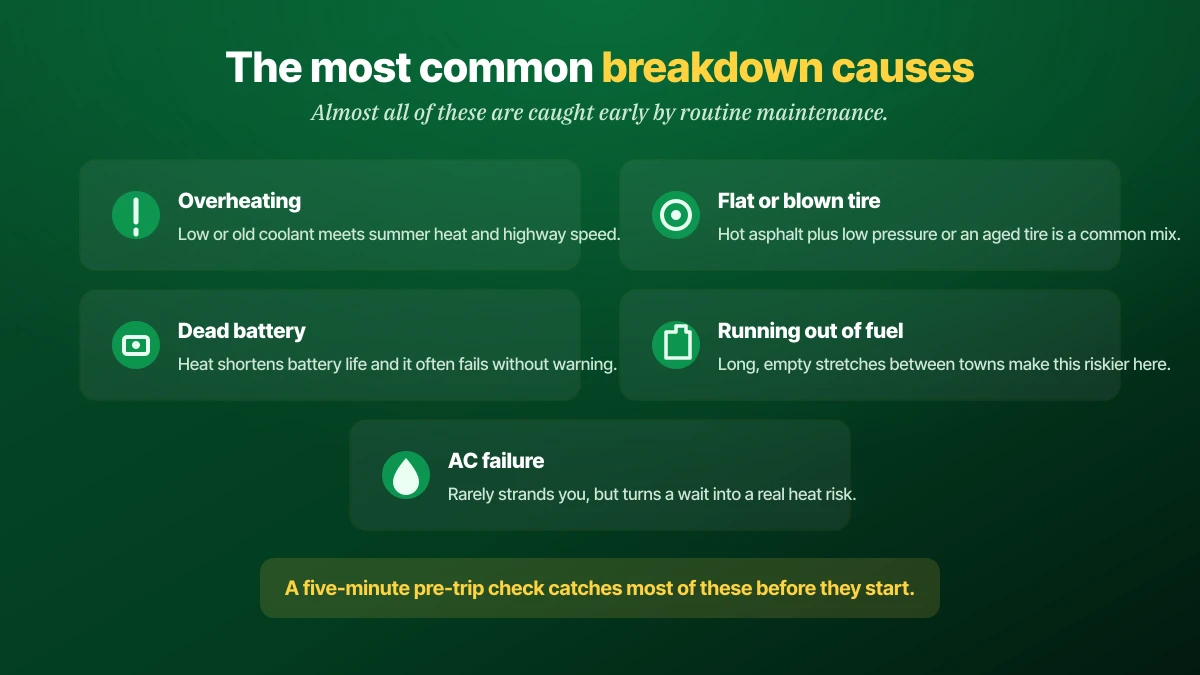
Overheating leads the list: coolant that was never tested meets a 45-degree afternoon and sustained highway speed, and the temperature gauge does the rest. Tires come next — hot asphalt magnifies the effect of low pressure or aged rubber, which is why summer highway blowouts follow such a predictable script. Batteries in Gulf heat often last only two to three summers and typically fail suddenly rather than gradually. Running out of fuel is more dangerous here than in most countries simply because the empty stretches between towns are longer. And AC failure deserves its place on the list not because it strands the car, but because it turns any other breakdown's waiting time into a genuine heat problem.
If that list sounds familiar, it should — it's nearly identical to the systems our car maintenance guide tells you to watch, because a breakdown is usually just deferred maintenance arriving at the worst possible time.
The five-minute pre-trip check
Before any long drive — and periodically even for city driving — a short check catches most breakdowns before they start. None of this needs tools or mechanical knowledge.
| Check | What you're looking for | What it prevents |
|---|---|---|
| Tire pressures (cold), including the spare | All at the recommended pressure; no visible bulges or cracks | Highway blowouts, a useless spare |
| Coolant level and temperature gauge behavior | Level between min/max; gauge settling normally after startup | Overheating events |
| Fuel plan | Enough for the leg plus a reserve; know your refuel stops | Running dry between towns |
| Battery age and starting behavior | Instant, confident starts; battery under 2–3 summers old | The classic no-warning dead battery |
| AC performance | Cooling hard within a minute or two | A dangerous wait if anything else fails |
This is deliberately the same territory as the monthly habits in our maintenance guide — the pre-trip check is just the compressed version, run at the moment it matters most. If the car is due or overdue for its Fahes inspection, treat that as a signal too: the same items Fahes tests (tires, brakes, lights) are the ones that strand people.
What to pack before you drive
A small kit costs little, lives in the trunk, and changes what a breakdown means — especially outside the city.
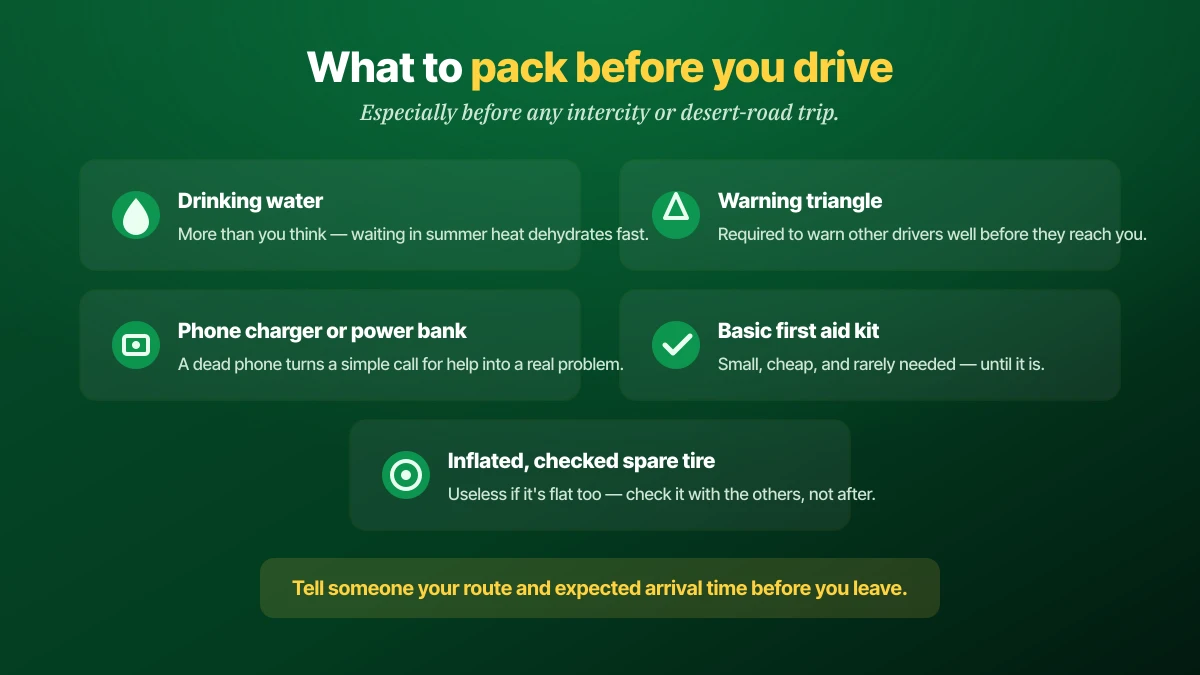
The priorities, in order: drinking water — more than feels necessary, because waiting in summer heat dehydrates fast and it's the one item you can't improvise; a warning triangle, which is standard equipment you're expected to carry and the difference between traffic seeing you at 200 meters versus 20; a phone charger or power bank, because a dead phone converts a routine breakdown into a genuine problem; a basic first aid kit; and a spare tire that's actually inflated, checked whenever you check the others — a flat spare is the most common unpleasant surprise in this whole topic. For intercity trips, add the habit that costs nothing: tell someone your route and expected arrival time before you leave.
What's your car worth?
Get a free instant estimate based on real Saudi market data — then sell it on KSAplate with direct WhatsApp contact.
Value My Car — FreeThe first minutes on the shoulder
What you do in the first two minutes matters more for your safety than anything that happens afterward. The sequence is short and worth knowing cold.
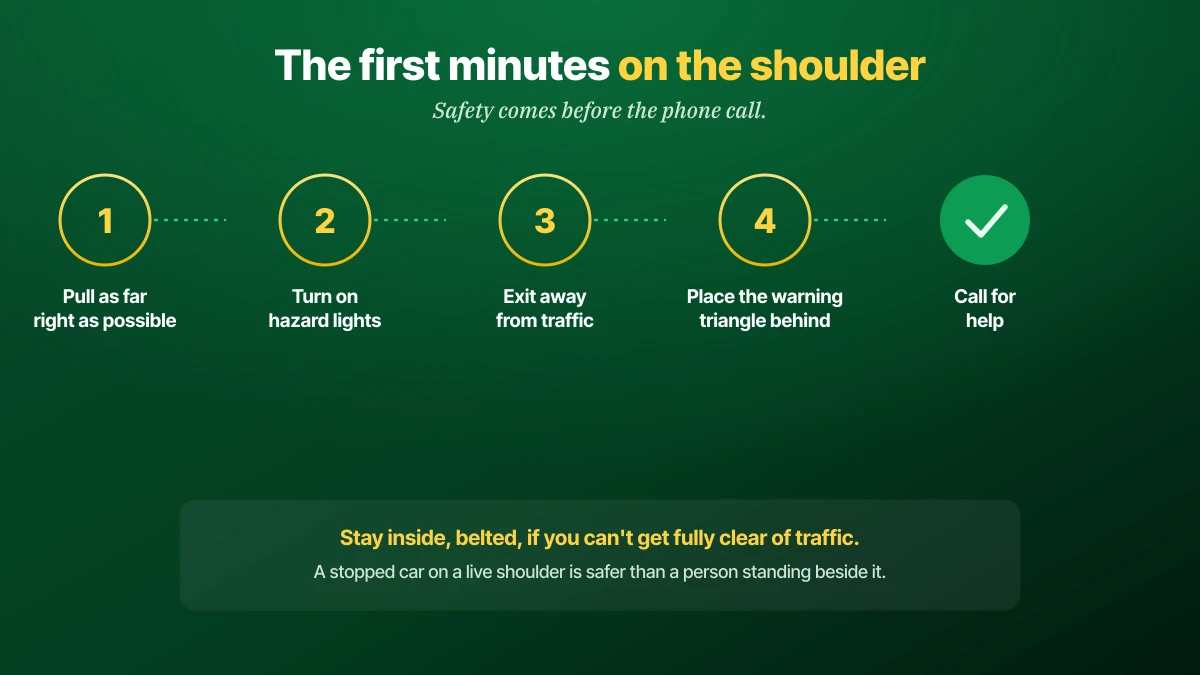
- Get as far right as the road allows. Momentum is your friend — if the car is dying, use what's left of it to reach the widest, most visible part of the shoulder rather than stopping in a lane.
- Hazard lights on immediately, day or night. At highway speeds, other drivers need every second of warning you can give them.
- Exit away from traffic — but only if you can get fully clear. If there's a barrier or open ground to wait behind, use it. If there isn't, stay inside with your seatbelt on: a stopped car on a live shoulder is safer than a person standing next to it.
- Place the warning triangle well behind the car — far enough that highway-speed traffic sees it before they see you. Placing it two meters behind the bumper protects nobody.
- Then call for help. The order matters: every step above makes you safer while you wait; the phone call doesn't.
One more habit that prevents disaster: never stand between your car and traffic, and never work on the traffic side of the vehicle unless there's genuinely no alternative. Most serious harm in breakdown situations comes from the roadside exposure, not the mechanical problem — the same logic behind the speed-camera discipline our Saher guide covers applies here in reverse: assume traffic around you isn't slowing down.
Getting help: who to call
Who you call depends on what's happened, and having the numbers sorted before you need them is the whole game.
- Genuine emergency — injury, fire, or a car stopped somewhere dangerous: the Kingdom's unified emergency number, 911, is the right call. Don't hesitate to use it when safety is actually at stake.
- Accident rather than breakdown: if another vehicle is involved or there's damage, the accident process applies — our guide to reporting an accident through Najm covers that path, which is separate from a mechanical breakdown.
- Routine breakdown: your first call is usually your insurer's roadside assistance line (commonly bundled with comprehensive policies) or the manufacturer's assistance program if the car is newer — many new-car warranties include roadside assistance for the warranty period, which owners routinely forget they have.
- Rental car: call the rental company, not a tow service — their agreement covers how breakdowns are handled, and arranging your own tow can create billing problems. Our car rental guide covers the details.
The preparation step that makes all of this work: find out today whether your insurance policy or warranty includes roadside assistance, and save the actual number in your phone. Discovering you had free towing after you've paid for a private one is a common and entirely avoidable annoyance.
Surviving the wait in extreme heat
In most countries, waiting for a tow is boring. In a Saudi summer, it's the genuinely risky part of the breakdown — cabin temperatures climb fast in a stopped car, and dehydration arrives sooner than people expect.
- Drink water early and steadily, not when you feel thirsty — thirst lags dehydration, especially in dry heat.
- Use shade intelligently. If the engine still runs and it's safe to idle, the AC is your best tool. If not, a window cracked on the shaded side, sunshades up, and waiting on the shaded side of the car (away from traffic) beat sitting in a sealed cabin.
- Stay with the car. It's visible in a way a person walking isn't, it's where help is coming, and it carries your water and shade. Walking to "the station up the road" in summer heat is how a car problem becomes a medical one.
- Watch for heat symptoms — dizziness, headache, confusion, or when sweating stops in severe cases. Any of these upgrade the situation from breakdown to emergency: that's a 911 call, not a longer wait.
- Never leave children or anyone vulnerable in a car that isn't cooling. Not for minutes, not with a window cracked. If the AC is gone and the wait is long, everyone waits in the shade outside.
Flat tire, dead battery, overheating: what you can do
Some breakdowns are fixable on the spot — if conditions allow it and you know the honest limits.
Flat tire. Change it yourself only when the situation is genuinely safe: car fully off the road, ground firm and level, and you're working away from traffic. On a narrow shoulder with highway traffic passing, calling for help isn't weakness — it's the correct read of the risk. If you do change it, remember the spare is usually a temporary tire with its own speed limit, and the flat goes to a shop promptly, not into the trunk for a year. Tire age matters more here than most owners assume — the maintenance guide covers why heat kills tires that still look healthy.
Dead battery. A jump start is routine if cables are connected correctly — positive to positive, negative to a ground point rather than the dead battery's negative post, connect dead car last, disconnect in reverse order. Two honest caveats: modern cars with sensitive electronics deserve a careful read of the manual before jumping, and a battery that needed one jump in Gulf heat will need another soon — treat the jump as a trip to the battery shop, not a repair.
Overheating. The moment the gauge climbs into the red zone: AC off, windows down, heater on full (it pulls heat away from the engine), and pull over as soon as it's safe. Then the two absolute rules — never keep driving on a rising gauge "to reach the next exit," because that's how a hose failure becomes an engine replacement, and never open a hot radiator cap; the system is pressurized and the burn risk is real. Let it cool, top up coolant only when the engine has genuinely cooled, and treat the event as a workshop visit even if the gauge settles — overheating always has a cause.
Overheating is the one of these three that gets worse the longer you drive on it. Our guide to an overheating engine in Saudi conditions covers what to do in the first two minutes.
Towing: options and what's covered
If the car isn't fixable where it sits, the question becomes who moves it and who pays.
| Option | When it applies | Cost reality |
|---|---|---|
| Insurer roadside assistance | Commonly bundled with comprehensive policies — check yours | Usually included up to a distance or usage limit |
| Manufacturer assistance program | Newer cars within the warranty period | Often free — one of the most forgotten warranty benefits |
| Independent tow service | No coverage, or outside your program's limits | You pay directly — agree the price and destination before the hook goes on |
Three practical rules regardless of which path applies. Agree the destination before the tow starts — workshop, dealer, or home — because changing it mid-tow is where surprise charges appear. If you're paying privately, confirm the price before the car is hooked, not after. And photograph the car before it's loaded, exactly like the pickup photos in a rental: if damage appears during the tow, that photo is your evidence. If the breakdown turns out to be accident-related, loop in your insurance before authorizing repairs — the order of calls affects what gets covered.
Desert and remote-road breakdowns
The Riyadh–Dammam and Jeddah–Makkah runs are well-traveled, but plenty of Saudi driving crosses genuinely remote stretches where the normal advice needs tightening.
- Fuel discipline is absolute. Refuel at the last major station before a long empty stretch even if the tank is half full — "enough to make it" leaves no margin for detours, AC load, or headwinds.
- Tell someone the route and your expected arrival, and check in when you arrive. This single habit is what turns "overdue" into "searched for" hours earlier.
- Signal can be patchy. Know that before you rely on calling for help — on genuinely remote routes, the prevention half of this article stops being advice and becomes the whole plan.
- Stay with the car, always. Everything the heat section said applies double in the desert: the car is shade, visibility, and the place rescuers check. Nobody finds a person who walked away from a visible vehicle.
- Double the water for remote routes. The trunk has room; the wait might be long.
After the breakdown
Once the car is moving again — or towed — a few follow-ups protect you from a repeat performance.
Find the cause, not just the symptom. A jump start, a coolant top-up, or a tire change got you home; none of them fixed anything. The underlying cause — an aging battery, a cooling-system fault, a tire past its safe age — needs a workshop visit, or the same breakdown is simply rescheduled. Keep the repair documented like any other service record; our maintenance guide covers why that paper trail pays at resale.
Be honest about a pattern. One breakdown is an event; three in a year is the car telling you something about where it is in its life. If repair bills are arriving faster than the car's value justifies, run the numbers with our used car value guide, and remember that a car sells better before the next breakdown than after it — listing it on KSAplate while it runs and cools beats selling a car with a fresh war story. And if you're replacing it, browse the marketplace with reliability at the top of your checklist rather than the bottom — the pre-trip check section above doubles as a decent test-drive checklist for whatever you buy next.
Frequently asked questions
What number do I call for a car breakdown in Saudi Arabia?
Does car insurance in Saudi Arabia include towing?
Is it safe to change a flat tire on the highway shoulder?
What should I do first when my car breaks down?
Should I stay in the car or get out while waiting for help?
My temperature gauge is rising — can I keep driving to the next exit?
How do I jump start a car safely?
What should I keep in my car for emergencies in Saudi Arabia?
What if my car breaks down in the desert or on a remote road?
What happens if a rental car breaks down?
Is a breakdown different with an electric car?
Conclusion & next steps
A breakdown in Saudi Arabia is rarely about the car alone — it's about heat, traffic exposure, and distance, which is why the preparation half of this guide carries more weight than the response half. Keep the five-minute pre-trip check, keep water and a triangle in the trunk, know today whether your insurance or warranty includes roadside assistance, and if the day comes: position the car safely, protect yourself first, and make the calls in the right order. Almost every breakdown that becomes a story worth telling skipped one of those steps.
And if the breakdowns are becoming a pattern rather than an event, listen to what the car is saying: get an honest valuation, list it on KSAplate while it still drives like a car someone wants, and browse the marketplace for its successor with reliability as the first filter, not the last. The cheapest breakdown is the one that belongs to a car you no longer own.