
TL;DR:
- A car warranty covers the cost of repairing manufacturing faults — engine, transmission, electrics and factory defects — it is not insurance for accidents or theft.
- A new car from the official agent comes with a manufacturer (agency) warranty, usually defined by a number of years or a mileage cap, whichever comes first.
- Wear-and-tear items, accident damage, misuse and unapproved modifications are not covered — and skipping scheduled servicing or using the wrong parts can void the warranty.
- Remaining agency warranty usually transfers to the next owner, which is a real advantage when buying a used GCC-spec car — imported cars often have no agency cover.
- Extended and third-party warranties exist to prolong protection, but read the exclusions carefully before paying.
Quick answer: In Saudi Arabia, a car warranty is the manufacturer's promise to repair covered faults free of charge for a set period. A new car bought from the authorized agent comes with an agency (factory) warranty, typically lasting a number of years or up to a mileage limit. It covers manufacturing defects — engine, gearbox, electrics, air-conditioning — but not wear items, accident damage or misuse, and it can be voided by skipping scheduled service or fitting non-approved parts. Remaining warranty usually transfers when you sell, which matters most for GCC-spec cars.
What a car warranty is (and isn't)
A car warranty is a promise from the manufacturer (or a warranty provider) to repair certain faults free of charge for a defined period. If a covered part fails because of a manufacturing or material defect, the warranty pays for the parts and labour to fix it. That's the whole idea: it protects you against the car breaking through no fault of your own.
The most important thing to understand up front is what a warranty is not. A warranty is not insurance. The two are completely different and cover opposite situations:
- A warranty covers faults — a part that fails because it was badly made. It costs you nothing extra (it comes with the car or is bought once).
- Insurance covers incidents — accidents, collisions, fire and theft. It's a separate, ongoing policy you renew each year.
You need both, because they protect against different risks. If your gearbox fails on its own, that's a warranty matter; if you crash into another car, that's insurance. For the insurance side, see our full car insurance in Saudi Arabia guide. This article is about the warranty side — the protection most people understand least.
The four types of car warranty
Not all warranties are the same. In Saudi Arabia you'll encounter four kinds, and knowing which one is protecting a given car tells you how much faith to put in it.
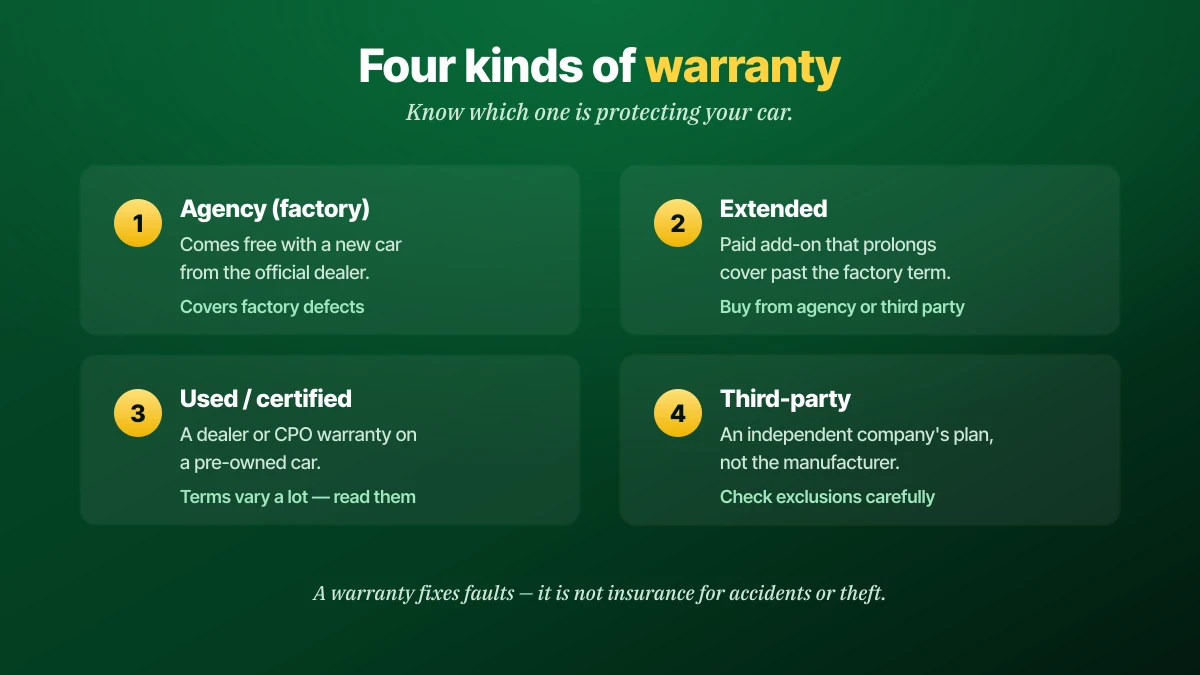
| Type | Who provides it | Best for |
|---|---|---|
| Agency (factory) | The manufacturer, via the official dealer | New cars — the gold standard |
| Extended | The agency or a warranty company | Keeping cover past the factory term |
| Used / certified (CPO) | The selling dealer | Pre-owned cars from a dealer |
| Third-party | An independent warranty firm | Older cars with no agency cover |
The agency warranty is the strongest because it comes straight from the manufacturer and is honoured at the official dealer with genuine parts. The other three are useful in the right situation, but they vary enormously in what they actually pay out — so the golden rule with extended, used and third-party warranties is always the same: read the contract before you trust it.
The agency (factory) warranty
When you buy a new car from the brand's authorized agent in Saudi Arabia, it comes with a manufacturer warranty — usually called the agency warranty (كفالة الوكالة). This is the protection most people mean when they say "the car is still under warranty."
The agency warranty is defined by two limits, whichever comes first: a number of years from the purchase date, and a mileage cap. The exact figures depend on the brand and model — some offer longer terms than others as a selling point — so always confirm the precise period and mileage with the agent for your specific car. Saudi consumer-protection rules also set baseline warranty obligations for new vehicles, but the headline terms still vary by manufacturer.
Within those limits, the agency repairs covered defects at no cost to you, using genuine parts, at the official service centre. It also covers recalls — if the manufacturer identifies a safety or quality issue across a model, the fix is done free regardless of your warranty status. The catch, covered below, is that this protection comes with conditions you have to keep.
The agency warranty is the single biggest reason a new, dealer-bought car gives peace of mind: for years, a covered failure simply isn't your bill.
What's your car worth?
Get a free instant estimate based on real Saudi market data — then sell it on KSAplate with direct WhatsApp contact.
Value My Car — FreeWhat's covered vs not covered
The most common warranty disputes come from a simple misunderstanding of its scope. A warranty covers faults, not wear and not damage. Here's the practical split.
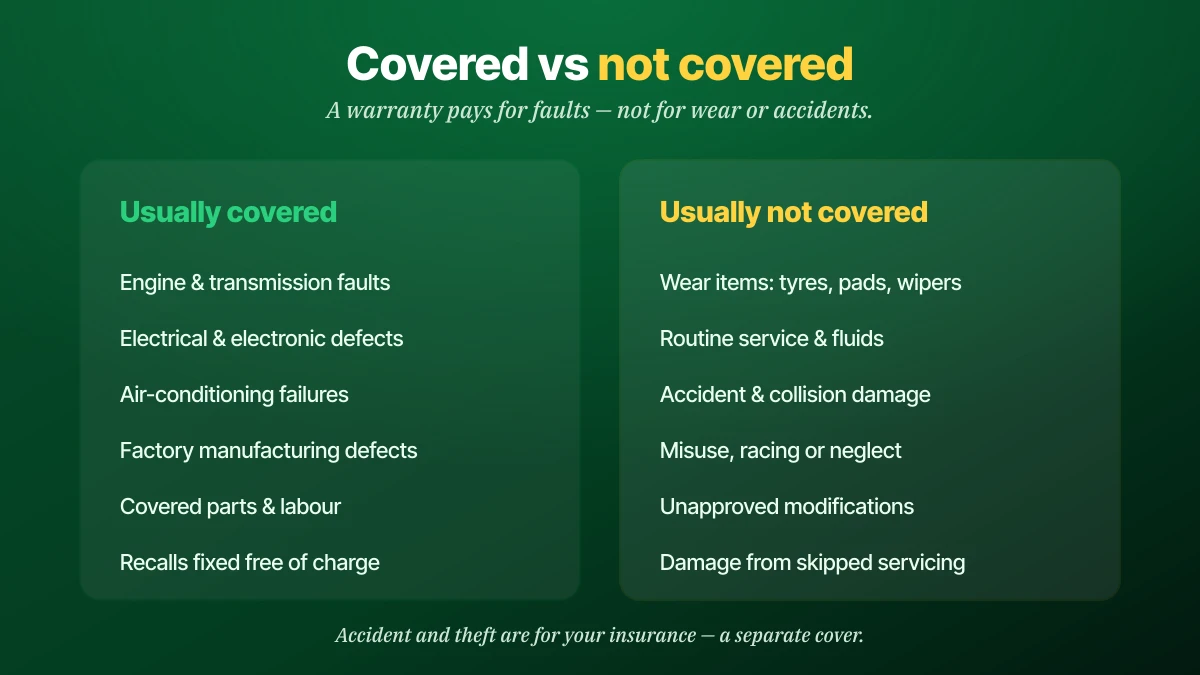
| Usually covered | Usually not covered |
|---|---|
| Engine & transmission faults | Wear items: tyres, brake pads, wipers |
| Electrical & electronic defects | Routine service, oil & fluids |
| Air-conditioning failures | Accident & collision damage |
| Factory manufacturing defects | Misuse, racing or neglect |
| Covered parts and labour | Unapproved modifications |
| Recalls (free of charge) | Damage from skipped servicing |
The logic is consistent: if a part fails because it was badly made, the warranty pays. If it wears out from normal use, needs routine replacement, or is damaged by an accident or misuse, it doesn't. Air-conditioning is worth singling out — in the Saudi climate a failing AC compressor is a real concern, and on a car still under warranty a genuine defect there is typically covered, which is a meaningful benefit.
How to keep your warranty valid
A warranty is a contract with conditions, and breaking them can void your cover — meaning the agency can refuse a claim. The good news is that the conditions are straightforward and mostly come down to looking after the car properly.
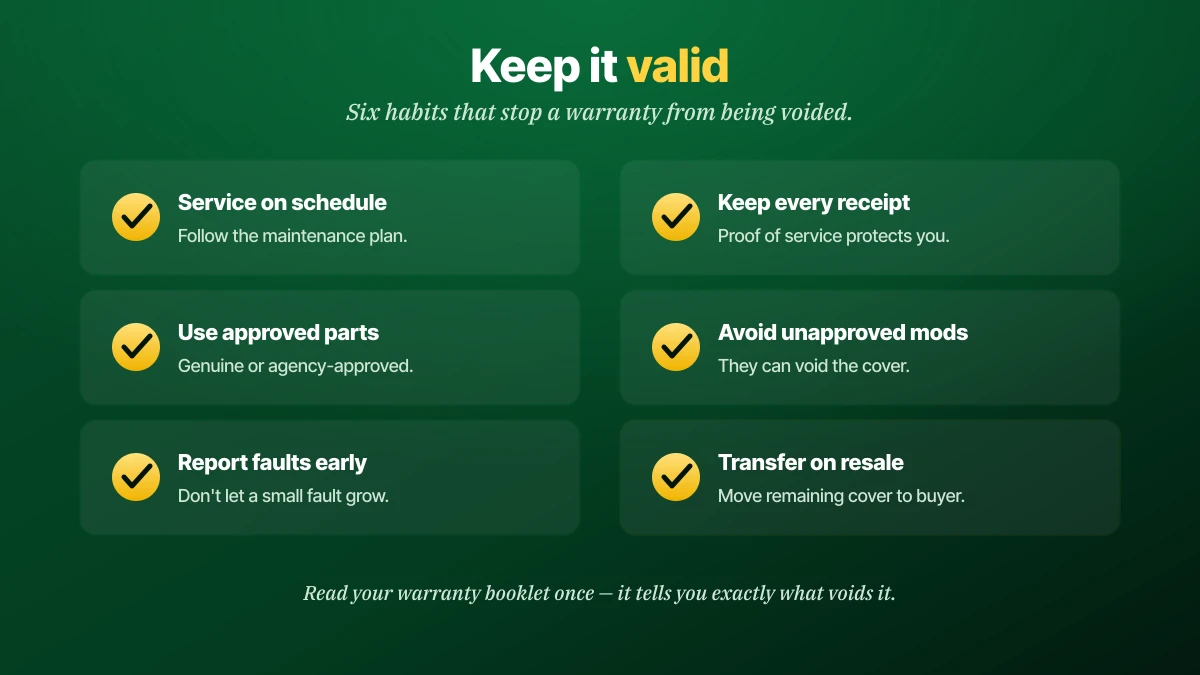
- Service on schedule. Follow the manufacturer's maintenance plan and don't miss the service intervals — skipped servicing is the most common reason a claim is rejected.
- Keep every receipt. Proof that you serviced the car on time, with the right work done, is what protects you if a claim is questioned.
- Use approved parts. Genuine or agency-approved parts and fluids; non-approved parts can give the agency grounds to decline.
- Avoid unapproved modifications. Engine tuning, non-standard electronics or altered systems can void cover on related components.
- Report faults early. Don't let a small, covered fault turn into major damage — raise it while it's still simple.
- Transfer it on resale. If you sell, move the remaining warranty to the new owner so it stays valid (see below).
Read your warranty booklet once, properly. It lists exactly what voids the cover for your car, and ten minutes of reading can save you a five-figure repair bill later. Part of keeping a car healthy is also keeping its registration (Istimara) and periodic inspection current — a well-documented, properly maintained car is the easiest one to claim on.
Warranty transfer when buying or selling
One of the most valuable and least understood facts about car warranties is that the remaining agency warranty usually transfers to the next owner. When you buy a used car that's still within its factory warranty period and mileage, that protection generally comes with it — sometimes automatically, sometimes after a simple transfer step at the agency.
This has two big implications:
- If you're buying used, a car still under agency warranty is worth more and safer — confirm the remaining period and that it will transfer to your name before you pay.
- If you're selling, a transferable remaining warranty is a genuine selling point that supports your price.
There's a crucial catch tied to import status: only GCC-spec cars sold through the local agent carry a transferable agency warranty. An imported American-spec car usually sits outside the agency system, so there's no agency warranty to transfer — one of the core trade-offs explained in our guide to GCC spec vs American spec cars. Before buying any used car, confirm both the spec and the warranty status, and run a car history check so you know exactly what you're getting.
Extended warranties: worth it?
An extended warranty prolongs cover beyond the original factory term — either bought from the agency or from an independent warranty company. As your new-car warranty nears its end, you'll often be offered one. Whether it's worth it depends on a few honest questions.
- What exactly does it cover? Some extended plans match the original warranty; others cover only the powertrain or a short list of major components. The narrower the cover, the less it's worth.
- Who honours it, and where? An agency-backed extension serviced at the official centre is stronger than a third-party plan with limited approved garages.
- What are the exclusions and conditions? Read them — wear items, claim caps and servicing requirements all shape the real value.
- How reliable is the car likely to be? On a model with a strong reliability record, the odds you'll claim enough to justify the cost are lower.
For a car you'll keep well past the factory term — especially a complex, expensive-to-repair model — a good extended warranty can pay for itself with a single major claim. For a simple, reliable car you'll sell soon, it often isn't worth it. The decision is the same logic as the rest of car ownership costs, which we break down in our cost of owning a car guide.
Warranty on a used car
Used cars sit in three different warranty situations, and knowing which one you're in is essential before you buy.
- Still under agency warranty. The best case — a relatively new used car whose factory warranty hasn't expired. Confirm the remaining term and that it transfers to you.
- A dealer or certified pre-owned (CPO) warranty. Some dealers add their own limited warranty to used cars they sell, and certified pre-owned programmes offer manufacturer-backed cover after an inspection. Terms vary widely, so read what's actually included and for how long.
- No warranty at all. Most older private-sale cars come "as is" — once the factory period is gone and there's no dealer cover, repairs are entirely on you. Here, a third-party warranty can add protection, but check the exclusions and the provider's reputation.
Because warranty status is part of a used car's value, factor it into the price. A car with transferable agency warranty justifiably costs more than the same car with none. Before committing, value it properly with our used-car value guide, weigh the bigger picture in new vs used, and when you're ready, browse cars on KSAplate or sell your current one.
On a used car, "is it still under warranty?" is one of the most valuable questions you can ask — and the answer should be in writing.
How to make a warranty claim
If something covered fails, the claim process is usually simple — as long as you've kept your side of the contract. The steps are consistent across brands.
- Stop and note the fault. Don't keep driving a car with a serious fault; continuing can cause further damage that isn't covered.
- Take it to the authorized service centre. Warranty work is done by the official agency, not an independent garage.
- Bring your documents. The warranty booklet, your service records and receipts, and the vehicle registration.
- Let them diagnose it. The agency confirms whether the fault is a covered defect or an excluded cause (wear, accident, misuse).
- Approve the covered repair. Once accepted, covered parts and labour are done at no cost; you only pay for anything outside the warranty.
If a claim is refused, ask for the reason in writing. Most rejections come down to a missed service, a non-approved part, or a cause that was never covered — which is exactly why the habits in the section above matter so much.
Mistakes to avoid
A handful of avoidable mistakes cause most warranty problems. Steer clear of these and your cover stays solid.
- Confusing warranty with insurance. A warranty won't pay for an accident, and insurance won't pay for a faulty gearbox — you need both.
- Skipping or delaying scheduled service. The fastest way to have a claim rejected.
- Assuming an imported car has agency warranty. Usually it doesn't — confirm the spec and warranty before buying.
- Not checking warranty transfer on a used car. Get the remaining cover and its transfer confirmed in writing.
- Buying an extended warranty without reading it. A cheap-sounding plan with heavy exclusions can be worthless.
- Modifying the car, then claiming. Unapproved modifications can void cover on the affected systems.
Frequently asked questions
What does a car warranty cover in Saudi Arabia?
Is a car warranty the same as car insurance?
How long does a new car warranty last in Saudi Arabia?
Does the warranty transfer when I sell my car?
What voids a car warranty?
Do imported (American-spec) cars have a warranty in Saudi Arabia?
Is an extended warranty worth buying?
Can I service my car anywhere without voiding the warranty?
Does a car warranty cover the air-conditioning?
Conclusion & next steps
A car warranty is one of the most valuable — and most misunderstood — parts of owning a car in Saudi Arabia. Remember the essentials: it pays to repair manufacturing faults, not accidents (that's insurance) and not wear; a new agency car is covered for a set period or mileage; the protection can be voided by skipped service, wrong parts or unapproved modifications; and the remaining cover usually transfers when you sell, which is a real edge for GCC-spec cars. Keep your service records, read your warranty booklet once, and always confirm warranty status before buying a used car. When you're ready to buy or sell, value the car first with our used-car value guide, read up on buying a used car the right way, then browse the KSAplate marketplace or list your car.