
TL;DR:
- Tinting is legal in Saudi Arabia — within limits. Side and rear windows may be tinted up to the darkness limit set by the traffic authority (Muroor); the front windshield must stay untinted, and mirror-style reflective films aren't permitted.
- Changing your car's colour is a paperwork event, not just a workshop visit. Wraps and resprays need traffic-authority approval, and the recorded colour on your Istimara must match the car.
- Structural and performance modifications need approval too. Unapproved lifts, body changes and light modifications are the classic reasons a modified car fails Fahes.
- Enforcement is real: illegal tint and unapproved modifications carry fines under the traffic law, and the paperwork mismatch follows the car until it's corrected.
- Modify like a future seller. Reversible, approved and documented changes protect your insurance, your warranty and your resale price; permanent unapproved ones become a discount the buyer asks for.
Quick answer: In Saudi Arabia you may tint side and rear windows up to the darkness limit set by the General Department of Traffic (Muroor) — the front windshield must remain clear and reflective films are not allowed. Changing the car's colour with paint or a wrap requires approval and an updated Istimara, and structural or performance modifications need sign-off before they'll pass Fahes. Unapproved changes risk fines, inspection failure, insurance complications and a weaker resale price, so verify the current rule before you modify anything.
What counts as a modification here
In Saudi Arabia, your car isn't just a machine — it's a registered record. The Istimara documents the vehicle's identity: its colour, its body type, its plates. The moment the physical car stops matching that record, or stops matching the traffic law's equipment rules, you've "modified" it in the sense that matters — regardless of whether the change cost fifty riyals or fifty thousand.
That's the single most useful mental model in this guide. The system cares about two questions: does the car still match its paperwork? and does it still meet the safety and equipment rules? Tint that's darker than the limit fails the second test. A wrap nobody registered fails the first. A lift kit without approval can fail both. Everything in this article is a variation on those two questions.
The rules themselves come mainly from the General Department of Traffic (Muroor) and are enforced at three points: on the road (patrols and cameras), at the periodic Fahes inspection, and at ownership transfer when the buyer's paperwork has to reconcile with the car. One honest caveat up front: equipment rules get updated from time to time, so treat this guide as the map, and verify the current limit through official channels (Absher or a Muroor office) before you spend money on film, paint or parts.
Window tinting: what's allowed
Tint is the most common modification in the Kingdom, and the rules are more permissive than many newcomers expect — with hard edges where they're strict.
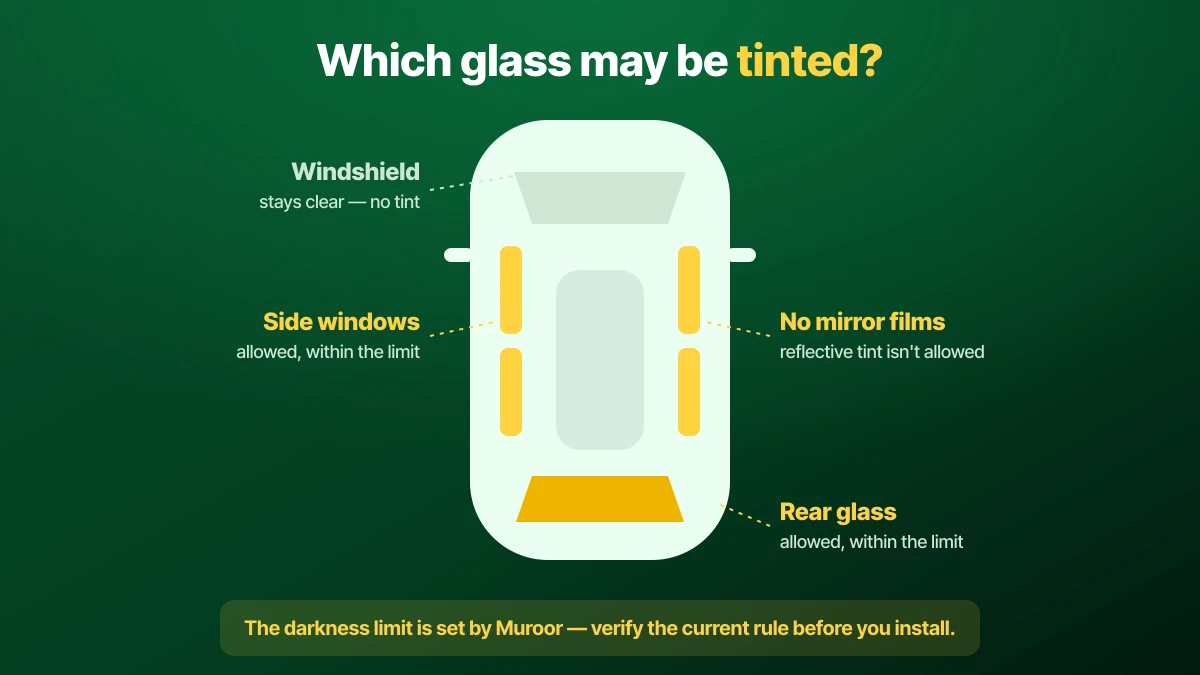
| Glass area | Tint allowed? | Notes |
|---|---|---|
| Front windshield | No | Must stay clear — only the manufacturer's built-in shading at the top edge |
| Front side windows | Yes, within the limit | Darkness capped at the level set by Muroor; driver must remain visible enough for enforcement |
| Rear side windows | Yes, within the limit | Same darkness cap applies |
| Rear glass | Yes, within the limit | Keep the third brake light unobstructed |
| Any window | No mirror films | Reflective, mirrored and metallic-look films are not permitted |
The darkness limit itself is the detail to verify on the day you buy film, because it's the one that has changed over the years — the figure most drivers will hear quoted in recent years is up to 50% darkness on the permitted windows, but the current rule is whatever Muroor says it is, not what a tint shop remembers. A reputable installer will know the enforced limit and will put it in writing on your invoice; a shop that shrugs and offers "any shade you like" is telling you who'll be paying the fine later — and it won't be them.
Two more edges worth knowing. First, tint must not extend to the windshield beyond any factory shade band, and smoked or heavily tinted headlight and taillight covers are a separate violation — lights are safety equipment, not styling surfaces. Second, films that turn your glass into a mirror are treated differently from dark film: they dazzle other drivers and defeat identification, and they're not allowed at any darkness level.
Choosing tint for Saudi heat. Inside the legal limit, tint in Saudi Arabia isn't cosmetic — it's climate equipment. Chosen well, it's one of the highest-comfort-per-riyal upgrades a car here can get.
- Heat rejection and darkness are different numbers. Darkness (how much visible light the film blocks) is what the law limits. Heat rejection (how much infrared energy the film blocks) is what makes August bearable — and modern ceramic films reject far more heat at the same legal darkness than cheap dyed film. If comfort is the goal, spend on the film technology, not on extra darkness you're not allowed anyway.
- Cheap film ages badly here. Dyed films fade to purple, bubble in the heat and need redoing within a couple of years; quality ceramic film survives Saudi summers by design. The sun that ages every other part of a car here ages tint too.
- UV protection is a real benefit, not marketing. Good film blocks nearly all UV, which protects the dashboard, upholstery and your skin on long highway drives — one reason tint within the limit is worth doing properly even if you don't care how it looks.
- Keep the paperwork. A dated invoice naming the film and its darkness rating is your answer if the shade is ever questioned at a checkpoint or inspection.
The windscreen is also where a small chip turns into a Fahes failure. Our guide to windscreen chips and cracks explains when a repair is enough and when the glass has to be replaced.
Colour changes & wraps
A full respray and a full vinyl wrap are treated the same way by the system: the car's colour is part of its registered identity, so changing it is a two-step process — approval, then execution, then making sure the Istimara reflects the new colour. Skipping the paperwork doesn't make the wrap illegal to buy; it makes the car mismatch its record, which surfaces at every checkpoint, every Fahes visit and every attempt to sell.
The practical sequence that keeps you clean: request the colour-change approval through the official channel first (the service is accessible via Absher/Muroor), have the work done, then complete the update so the record shows the car as it now looks. Partial wraps, racing stripes and small accents live in a grey zone — the working rule of thumb is that if the car's overall registered colour is still obviously true, small accents are tolerated, but a two-tone transformation or colour-shift wrap is a colour change and needs the full process.
One caution specific to wraps: chrome and mirror-finish wraps sit in the same category as mirror window film — reflective surfaces attract enforcement attention, and several finishes that are sold abroad are simply not approvable here. Ask the question before the material is on the car.
What's your car worth?
Get a free instant estimate based on real Saudi market data — then sell it on KSAplate with direct WhatsApp contact.
Value My Car — FreePerformance & structural modifications
This is where the approval system has real teeth, because these changes affect safety, not just appearance.
- Suspension changes — lift kits and lowering — alter the vehicle's geometry and require approval; unapproved ones are among the most common Fahes failures for modified cars.
- Body and chassis changes — added structures, bumper replacements that change dimensions, roll cages — need sign-off for the same reason.
- Exhaust modifications that raise noise beyond limits invite both fines and inspection failure; "sports sound" is a violation with a receipt.
- Engine swaps and forced-induction additions change the car against its record and its type approval — this is the deepest end of the approval pool and the one most likely to be refused for a road car.
- Lighting changes — colour bulbs, underglow, smoked lenses, aftermarket LED bars used on public roads — are equipment violations rather than "mods" in the styling sense, and they're checked both on the road and at inspection.
If you're weighing a serious build, the honest advice is to decide what the car is for. A dedicated desert or track toy that lives on a trailer plays by different practical rules than a daily driver that has to pass Fahes every cycle and survive a traffic stop every week. Most regret in this category comes from building a weekend car out of the vehicle you also need on Monday morning.
Plates, lights & small accessories
The small stuff catches more people than the big builds, because nobody thinks of it as modification.
Plates are untouchable. They must stay exactly as issued — no tinted covers, no frames that hide any digit or the wording, no repositioning, no decorative screws that obscure characters. The full rulebook lives in our Saudi plate rules guide, but the short version is that anything between a camera and your plate's legibility is a violation — and plate tampering is treated far more seriously than dark tint. If a plate is damaged and hard to read, the fix is a proper replacement, not a cover.
Sunshades are the legal cousin of tint. The removable reflective screens everyone uses while parked are fine precisely because they come off before you drive; fixed curtains or screens on driving glass are not a substitute for legal tint.
Dash cams and phone mounts are broadly accepted as long as they don't obstruct the driver's view through the windshield — mount low or behind the mirror, and route cables so nothing dangles in the sightline.
What Fahes checks on a modified car
The periodic inspection is where modifications meet reality on a schedule. Beyond the standard checks every car gets, a modified car is effectively answering one question: is everything on this car either factory, approved, or within equipment rules?
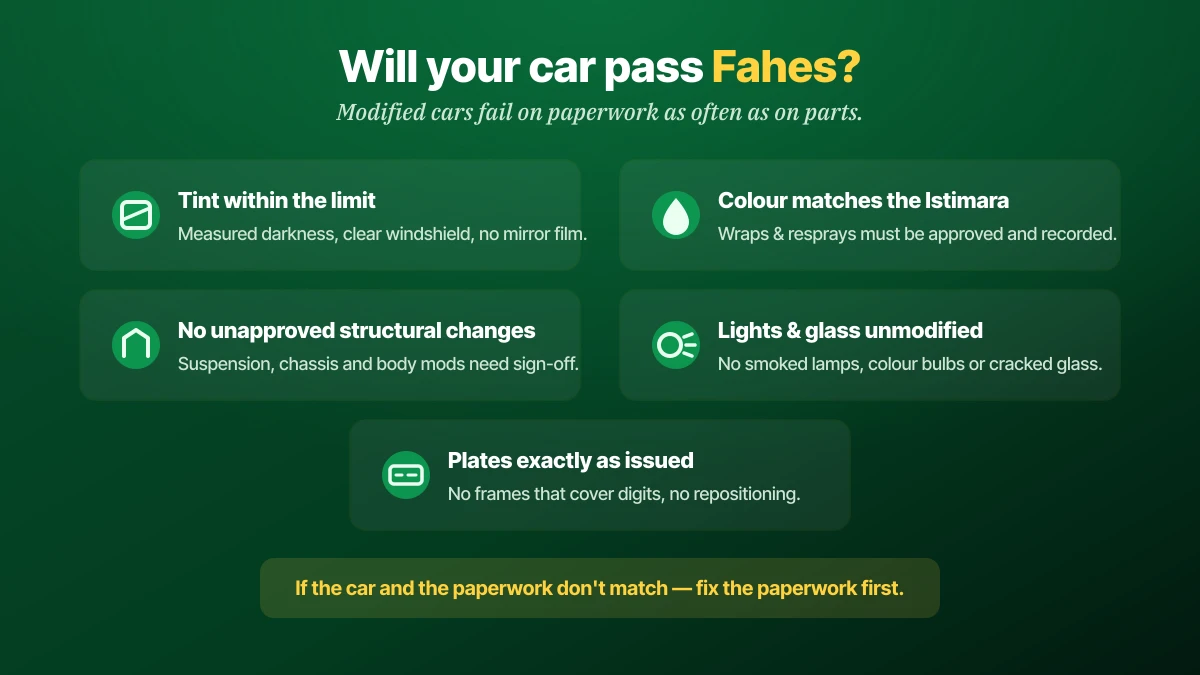
The recurring failure pattern isn't exotic engineering — it's mismatches. The car is blue, the Istimara says white. The tint meter reads darker than the limit. The suspension sits higher than any approval on file explains. The headlights flash a colour the rules don't allow. Each of these is cheap to prevent and tedious to fix after the fact, because the correction loop runs through paperwork offices, not just a workshop.
The preparation logic is the same one our maintenance guide recommends for wear items: walk the car against the checklist before the inspection does. Tint invoice in the glovebox, colour matching the record, approvals on file, lights standard, plates clean — a modified car that's papered properly passes like any other car.
Fines & enforcement
Enforcement happens in layers, and it's worth knowing which layer catches what.
| Change | Approval needed? | If it's not right |
|---|---|---|
| Tint within the limit, legal windows | No — just stay inside the rule | — |
| Tint over the limit / windshield / mirror film | Not approvable | Fine under the traffic law; removal to pass inspection |
| Colour change (paint or wrap) | Yes, plus Istimara update | Record mismatch: checkpoint trouble, Fahes failure, blocked sale |
| Suspension / body / structural changes | Yes | Fine possible; inspection failure until approved or reversed |
| Loud exhaust, colour lights, underglow | Not approvable for road use | Fine; repeat offences escalate |
| Plate covers or alterations | Never | Treated severely — far beyond a styling fine |
On the road, patrols handle what they can see directly — dark tint, loud exhausts, lighting, plates. Fines land in the same system as any other violation, payable through Absher; our guide to checking and paying traffic fines covers the mechanics, and it's worth knowing that Saher's camera network makes "nobody stopped me yet" a poor long-term strategy for anything visible from outside the car. Deliberately avoiding specific riyal amounts here is intentional: the traffic-law fine schedule is revised periodically, and the current figures are always the ones in the official schedule, not in a blog post.
Insurance & warranty implications
Two contracts quietly assume your car is the car described in its papers — and modifications test both.
Insurance: undeclared modifications are a classic claim complication. If a lift kit, performance change or non-standard equipment is relevant to an accident — or simply wasn't declared when the policy was written — the insurer has an argument, and after a crash is the worst time to hand them one. The clean route is boring: declare modifications when you insure, keep the approvals with the policy documents, and confirm in writing that the cover reflects the car as it actually is. Our car insurance guide covers how comprehensive policies treat vehicle condition generally.
Warranty: a modification doesn't void a new-car warranty wholesale, but it gives the manufacturer a defensible reason to reject claims on anything the modification touches — a lifted truck's suspension claim, a tuned engine's drivetrain claim. The same documentation discipline from our warranty guide applies: if you modify a car under warranty, do it with parts and processes you can defend, and accept that you're trading some coverage for the change.
Modifications & resale value
Here's the part enthusiasts skip and regret: the Saudi used market pays for originality. Most buyers are shopping for transport, not projects, and every non-standard item on the car is a question they have to resolve — is it approved, is it reversible, what did it hide?
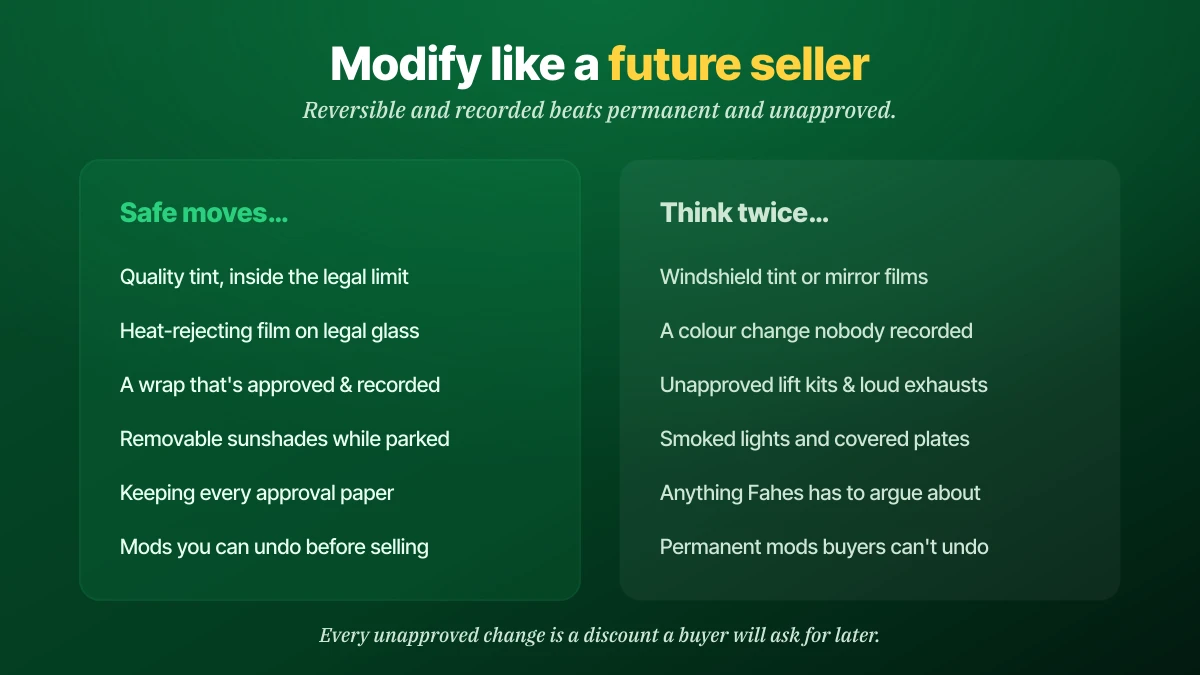
The market logic is asymmetric. Legal tint in good condition is a mild plus — it's climate equipment the buyer would install anyway. An approved, recorded wrap is neutral to slightly negative, because taste varies but the paperwork is clean. Unapproved anything is a straight discount: the buyer prices in the cost and hassle of reversal, the history check raises questions the seller can't answer cleanly, and cautious buyers — trained by every scam guide including ours — simply walk. Meanwhile the transfer itself can stall, because ownership transfer needs the car to reconcile with its record.
So modify like a future seller. Prefer reversible over permanent, approved over tolerated, documented over remembered — and before you list the car, return it as close to its recorded, legal state as you can, with the paperwork folder ready. Our guides to valuing your car and selling it properly pick up from there. When it's time, list it on KSAplate with the approvals photographed alongside the car — and if you're on the buying side, browse the marketplace knowing that "is that tint legal, and is that colour registered?" are now questions you know to ask.
Mistakes to avoid
The same few errors generate most of the fines and failed inspections in this category.
- Letting the tint shop decide the darkness. The shop doesn't pay your fine. Confirm the current Muroor limit yourself and get the installed rating on the invoice.
- Tinting the windshield "just a little." There's no legal version of this — the windshield stays clear beyond any factory band.
- Wrapping first, asking later. Approval before material. An unrecorded colour change follows the car to every checkpoint until it's fixed.
- Buying a modified car without checking approvals. The mismatch becomes your problem at transfer — demand the paperwork or price the reversal into the deal.
- Treating lights as styling. Colour bulbs, smoked lenses and underglow are equipment violations, checked on the road and at Fahes.
- Touching the plates. Covers, frames over digits and repositioning sit in a different penalty category from everything else in this guide. Don't.
- Forgetting the exit. Every permanent modification is a future negotiation. If you can't undo it before selling, assume the buyer will price it against you.
Frequently asked questions
What tint percentage is legal in Saudi Arabia?
Can I tint the front windshield?
Are mirror or reflective tint films allowed?
Is it legal to wrap my car in a different colour?
Do I need to update the Istimara after changing my car's colour?
Will a lift kit or loud exhaust pass Fahes?
Can I be fined for dark tint without being pulled over?
Do modifications affect my car insurance?
Do modifications void the manufacturer warranty?
Does window tint actually help against the Saudi heat?
Should I remove modifications before selling my car?
Conclusion & next steps
The modification rules in Saudi Arabia reduce to two habits. Keep the car matching its paperwork — colour, structure, plates — and keep every change inside the equipment rules: tint within the limit, windshield clear, lights standard, nothing reflective. Do that, and tint, wraps and even substantial builds are all achievable without drama; skip it, and the same changes turn into fines, failed inspections and stalled sales. When in doubt, the sequence is always the same: verify the current rule, get the approval, do the work, update the record, keep the paper.
And think like a future seller before you commit to anything permanent — in this market, originality plus a clean file is worth real money. If you're preparing to sell a car with modifications, start with an honest valuation, reverse what you can, document what stays, and list it on KSAplate with the approvals in the photos. Buying instead? Browse the marketplace with this guide's questions in hand — legal tint, recorded colour, approved changes — and you'll filter out the future headaches before the test drive.