
TL;DR:
- A Saudi license plate must be genuine, fitted to the front and rear, and clearly readable at all times. Anything that hides, dims, alters or fakes the plate is a traffic violation.
- Tinted or smoked plate covers are not allowed — they reduce readability and defeat Saher cameras. A plain, fully transparent frame that hides no character is usually fine.
- Never bend, cut, repaint or "customise" a plate, and never display a fake or another vehicle's plate — these are serious offences, not cosmetic choices.
- If a plate is damaged, faded or unreadable, replace it through the official process before you drive.
- The rules are about presentation, not ownership. Your number stays yours — you just have to display it the way the law requires.
Quick answer: In Saudi Arabia, a license plate is legal when it is the genuine plate issued for your vehicle by the General Directorate of Traffic, mounted on both the front and rear, and fully visible and readable — clean, undamaged, and free of any cover, tint, film or frame that obscures the numbers, letters or emblem. Faking, altering, bending or hiding a plate is a traffic violation that Saher cameras and patrols actively catch.
The one rule behind every plate law
Almost every Saudi license plate rule comes from a single principle: the plate must be readable — by people and by cameras — at all times. Once you understand that, the specific do's and don'ts stop feeling like a random list and start making sense.
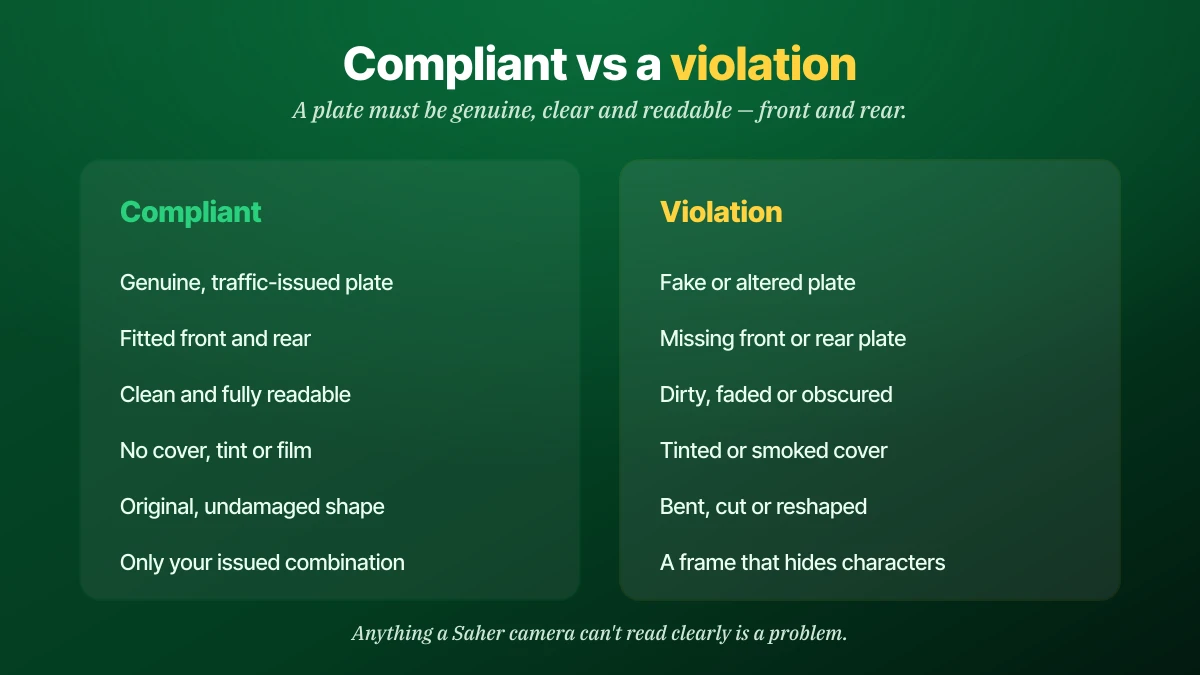
A plate is a legal identifier that links a specific vehicle to its owner in the Ministry of Interior's records. It only does that job if anyone — a traffic officer, a Saher speed camera, an automatic number-plate-recognition (ANPR) system — can read it instantly. So the law protects readability above all. A plate is compliant when it is:
- Genuine — the actual plate issued for your vehicle by the General Directorate of Traffic, not a copy.
- Complete — fitted to both the front and the rear of the vehicle.
- Clear — clean, undamaged, and free of anything that hides or dims it.
- Unaltered — original shape, colours and characters, showing only your issued combination.
If you're new to how the characters and colours work in the first place, our guides on how to read a Saudi license plate and the full Saudi license plates guide cover the basics. This article is about keeping that plate legal on the road.
Where plates must be displayed
The most basic rule is placement: a Saudi vehicle must display its plate on both the front and the rear. A missing plate — front or rear — is itself a violation, even if the other one is perfectly fine.
Plates should be fixed securely in their proper position, upright and flat, where they're designed to sit. They shouldn't be propped on the dashboard, taped inside a window, hung loosely, or mounted at an angle that makes them hard to read. Motorcycles follow their own format and carry a plate at the rear; you can read more in our motorcycle plates guide. The principle is the same across every vehicle class: the plate has to be where cameras and officers expect it, facing out, and easy to read.
Both plates, properly mounted, facing outward. If a camera or officer has to work to read your plate, it isn't displayed correctly.
Are license plate frames allowed?
This is one of the most common questions, and the answer is a conditional yes. A plain, fully transparent frame or a simple holder that does not cover any part of the plate is generally acceptable. The frame's only job is to hold the plate; the moment it starts hiding something, it becomes a problem.
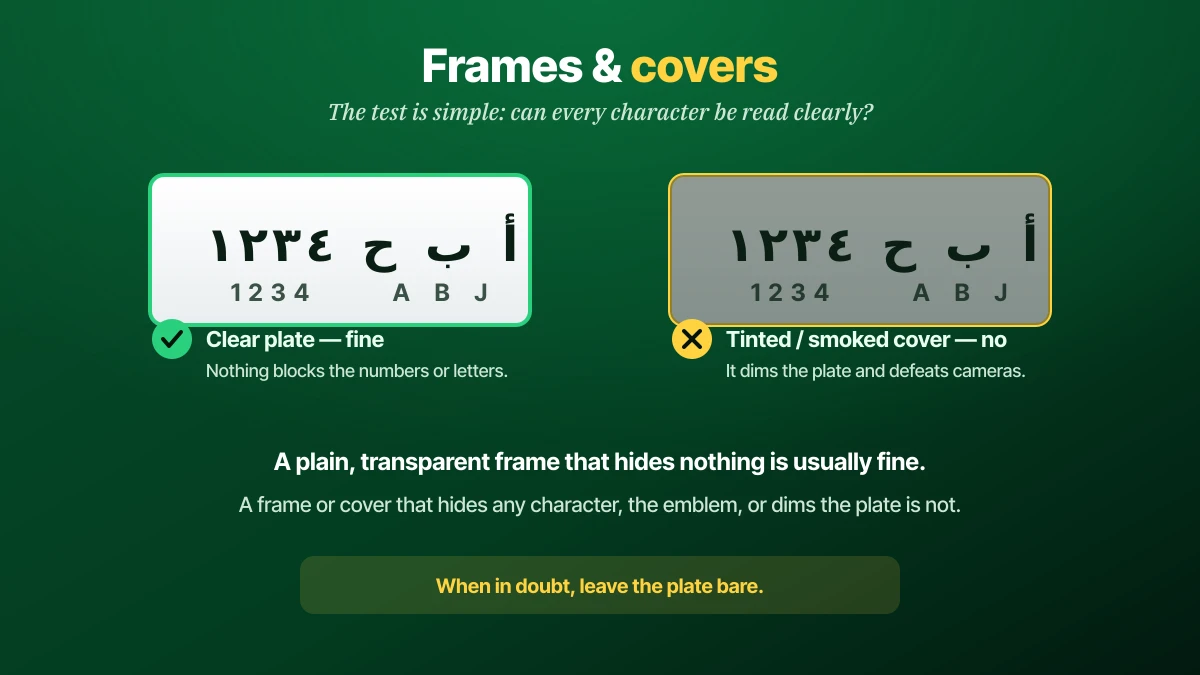
A frame crosses the line when it:
- Overlaps or hides any number, letter or the national emblem.
- Is tinted, smoked or mirrored so it dims the plate.
- Adds decorative text, logos or symbols that could be mistaken for part of the plate.
- Sticks out or reflects in a way that makes the plate hard to read or photograph.
The simple test: can every character and the emblem be read clearly, day and night, from a normal distance and angle? If yes, a basic clear frame is fine. If there's any doubt, the safest choice is to run the plate bare. A decorative frame is never worth a fine.
What's your plate worth?
Get an instant, free estimate with our plate value calculator.
Calculate My Plate's ValuePlate covers, tints & films
Plate covers are a different story from frames, and a much riskier one. A cover sits over the face of the plate, and any cover that is tinted, smoked, mirrored, frosted or reflective is not allowed — its whole effect is to make the plate harder to read, which is exactly what the law forbids.
People sometimes fit these covers believing a "clever" tint will dodge speed cameras. It doesn't work the way they hope, and it backfires: deliberately obscuring a plate to evade detection is treated far more seriously than an ordinary cover, because it shows intent. Saher cameras, toll gates and ANPR systems are built to read plates in real conditions, and a dimmed or distorted plate is a red flag, not a loophole.
Even a clear plastic cover can cause trouble if it yellows, scratches, fogs or reflects glare into a camera. The cleanest, cheapest and most reliable approach is no cover at all — a bare, genuine plate is the one thing no officer or camera can object to.
Altering, bending or obscuring a plate
Tampering with the plate itself is a serious offence, well beyond a cosmetic infraction. You must never:
- Bend, fold or curve a plate so the characters distort at certain angles.
- Cut, trim or reshape the plate.
- Repaint, sticker over, or modify the numbers, letters, colours or emblem.
- Cover characters with dirt, tape or paint, temporarily or otherwise.
- Swap digits or letters to read as a different combination.
All of these defeat the plate's purpose and are read by the authorities as an attempt to avoid identification. Deliberately obscuring or altering a plate is among the more severe plate-related violations, and it can carry penalties heavier than a simple readability fine. Treat your plate as a fixed legal document: you display it exactly as issued, and you change nothing about it.
Fake & non-standard plates
Only the plate officially issued for your vehicle may be displayed. That rules out a whole category of problems:
- Counterfeit or home-made plates — printing or fabricating your own is illegal.
- Another vehicle's plate — displaying a plate that belongs to a different car is a serious offence.
- Novelty or "show" plates — decorative plates with custom fonts, foreign styles or invented numbers are not road-legal in the Kingdom.
- Mismatched combinations — the plate must match the vehicle's registration exactly.
If you want a specific, desirable number, the legal route is to acquire a real, issued plate and transfer it to your vehicle through Absher — not to fabricate one. Our guide to custom plates in Saudi Arabia explains what's actually possible, and you can value any genuine combination on the free plate value calculator before buying it on the marketplace.
A "nice" plate is only valuable when it's real and properly transferred. A fake plate isn't a shortcut — it's a serious violation.
Damaged, faded or unreadable plates
A plate doesn't have to be deliberately tampered with to be illegal — it just has to be hard to read. Over years of sun, heat and washing, a plate can fade, peel, crack or corrode until the characters are no longer crisp. A genuinely unreadable plate is still a violation, even though you did nothing wrong.
The fix is simple: if your plate is damaged, faded, cracked or unreadable, replace it through the official process rather than touching up or repainting it yourself (which would itself be altering it). Our guide on replacing a lost, stolen or damaged Saudi plate walks through how to get a fresh, legal plate while keeping the same number. The same applies after any incident that damages the plate — sort it before you drive again.
How plate violations are caught
Plate rules aren't enforced by chance. Saudi Arabia runs one of the most camera-dense road networks in the region, and plate readability is exactly what that infrastructure depends on.
- Saher cameras photograph plates for speed and signal enforcement; a deliberately obscured plate stands out immediately. See our Saher cameras and speed limits guide.
- ANPR and toll systems read plates automatically at gates and checkpoints.
- Traffic patrols can stop a vehicle whose plate is missing, covered, altered or unreadable.
A plate violation typically results in a traffic fine, and obscuring or faking a plate sits at the more serious end because it implies an intent to evade. Whatever the specific amount, it's recorded against the vehicle — and as with any violation, an unpaid fine can later block a registration renewal or an ownership transfer. You can always check what's outstanding using our guide to checking and paying traffic fines.
Rules when buying or selling a plate
The plate-display rules connect directly to how plates are bought and sold, because a distinctive number is a tradable asset — but only the legal, issued plate behind it has any value. When you trade a plate, the rules that matter are about legitimate transfer, not presentation:
- The plate must be a genuine, issued combination, transferred to your vehicle officially through Absher.
- Ownership moves electronically; the number stays intact and only the registered owner changes. See how to transfer a plate via Absher.
- Before paying, verify the plate is genuine and clear to transfer — our verification guide covers the checks.
In other words, the rules reward doing it properly: buy a real plate, transfer it officially, and display it exactly as issued. To find a legitimate distinctive plate, value a combination first, then browse the marketplace — or list a plate you already own.
Common mistakes to avoid
Most plate-rule fines come from avoidable choices rather than bad luck. Run this quick mental checklist before you drive, then steer clear of the slips below.
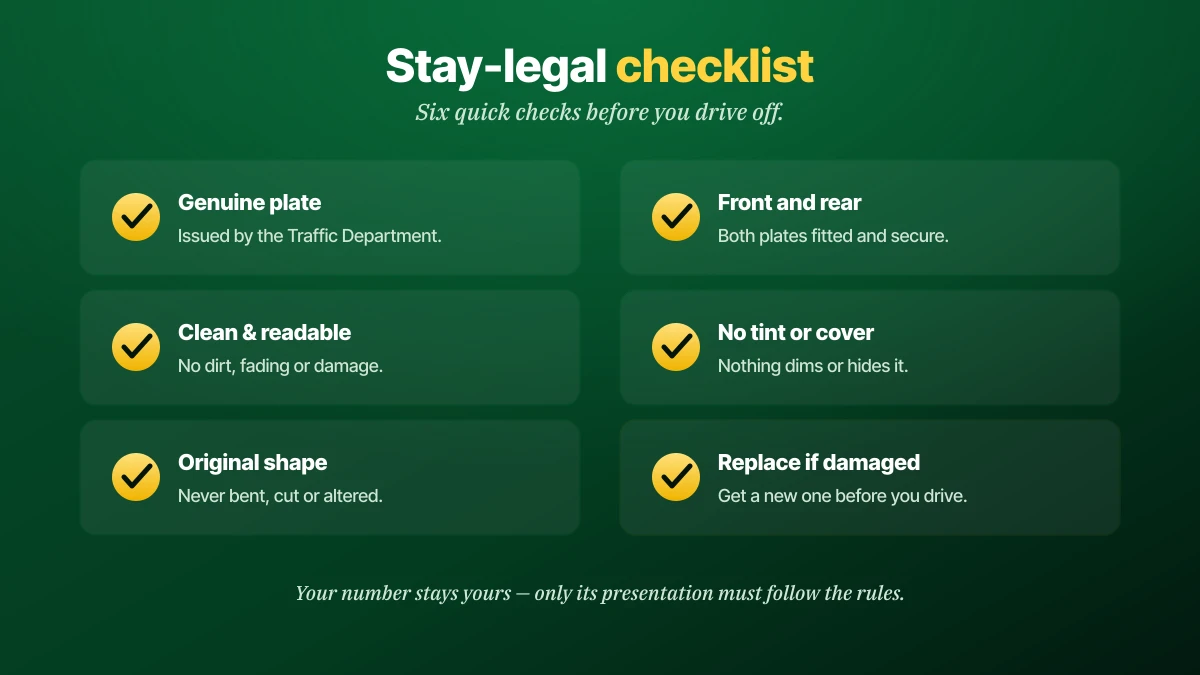
- Fitting a tinted or smoked cover. It dims the plate and is treated as obscuring it — never worth it.
- Using a decorative frame that overlaps a character or the emblem. Even a small overlap can be a violation.
- Driving with only one plate. A missing front or rear plate is its own offence.
- Ignoring a faded or cracked plate. Unreadable is illegal — replace it.
- Bending or "tweaking" a plate to dodge cameras. This is a serious offence, not a clever trick.
- Displaying a fake, novelty or mismatched plate. Only your officially issued combination is road-legal.
Frequently asked questions
Are license plate frames legal in Saudi Arabia?
Are tinted or smoked plate covers allowed?
Can I get fined for a dirty or faded license plate?
What happens if I drive with only one plate?
Is it illegal to bend or alter my license plate?
Can I make or use a custom or novelty plate?
Do plate covers actually beat Saher cameras?
My plate is damaged — can I just repaint it?
Are the plate rules different for expats?
Conclusion & next steps
Saudi license plate rules all trace back to one idea: the plate must be genuine and readable, front and rear, at all times. Skip the tinted covers, the decorative frames that overlap a character, and any temptation to bend, fake or "customise" a plate — none of it is worth a fine, and obscuring a plate is treated as a serious offence. Keep your plate clean, replace it the official way if it's damaged, and display only your issued combination. Do that, and the only thing left to think about is the number itself — and that's the fun part. If you want a distinctive plate the legal way, value any combination on the free calculator, then browse the marketplace or list your plate. For the full picture of how Saudi plates work, start with our complete guide to Saudi license plates.