
TL;DR:
- To let someone legally drive your car in Saudi Arabia, issue a driver authorization (Tafweed) on Absher — it registers them as an approved driver without transferring ownership.
- Inside the Kingdom you can authorize any valid Iqama holder for any period; outside the Kingdom only a family member can drive it, up to the validity of their exit/re-entry visa.
- Fees are tiny: about SAR 1.75 for internal authorization and SAR 35 for international (travel abroad).
- You need: a valid Istimara, valid car insurance, the driver's valid licence and Iqama, no unpaid traffic fines, and the driver present to confirm with an OTP.
- It's quick and reversible — the whole thing takes minutes on Absher, and you can cancel the authorization any time.
Quick answer: The legal way to let another person drive your car in Saudi Arabia is to issue a driver authorization (Tafweed) through Absher. Log in, open My Vehicles, pick the car, choose Issue Driver Authorization, enter the driver's Iqama and date of birth, select inside or outside the Kingdom with start and end dates, pay a small fee (~SAR 1.75 internal, ~SAR 35 international), and the driver confirms with an OTP. You keep ownership; they simply gain the legal right to drive.
What vehicle authorization (Tafweed) is
Vehicle authorization — known in Arabic as Tafweed — is the official service that registers another person as an approved driver of your car. It is the legal answer to a very common question: how do I let my spouse, relative, friend or employee drive my car without breaking the law?
Under Saudi traffic regulations, the person behind the wheel of a car should be linked to it. Authorization creates that link electronically through Absher (and the Tam app), so the driver is recognised by traffic systems as permitted to drive your specific vehicle. Crucially, it is not a sale or an ownership transfer — you remain the owner, and you can end the authorization whenever you like.
Think of it as lending your car the right way: instead of just handing over the keys and hoping for the best, you record the arrangement officially, which protects both you and the driver if a traffic check or incident happens.
Why and when you'd use it
Driver authorization solves everyday situations that nearly every car owner in the Kingdom runs into. You'd use it whenever someone other than you needs to drive your car regularly or for a trip.
- Family sharing: letting your spouse, son, daughter or relative use the car day to day.
- Employees and drivers: authorizing a personal or company driver to operate the vehicle legally.
- Lending to a friend: if a friend borrows your car for a while, authorization keeps it lawful.
- Cross-border travel: a family member driving your car to a GCC country needs international authorization to take it across the border.
- While you're away: if you travel and want someone to use or look after the car.
Authorization is about driving rights, not ownership. The car stays yours — you're simply giving a named person permission to drive it for a set period.
If your real goal is to permanently hand the car over to someone else, that's a different process — see the difference between authorization and a full ownership transfer later in this guide.
What you need before you start
Authorization only goes through smoothly if a short checklist is in order first. Gather these before you log in to avoid a failed attempt.
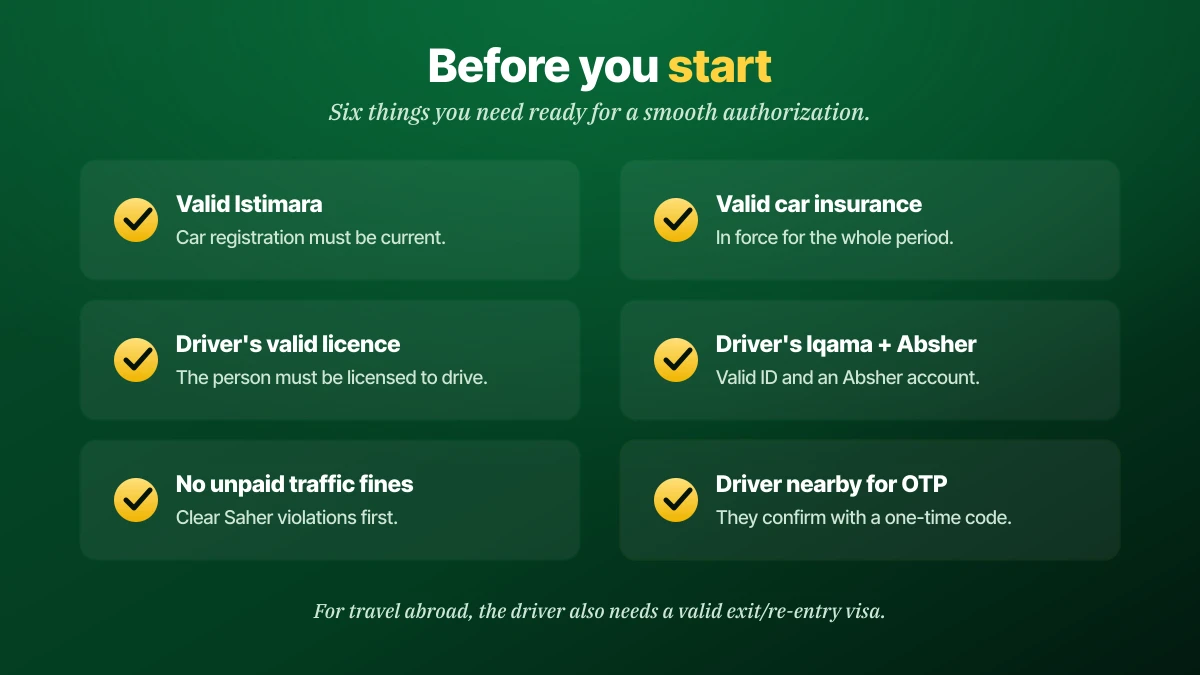
- A valid Istimara (vehicle registration) — renew it first if it's close to expiry; see our Istimara renewal guide.
- Valid car insurance covering the period of authorization — read our car insurance guide if yours needs renewing.
- The driver's valid driving licence — the person must be legally licensed to drive in Saudi Arabia.
- The driver's valid Iqama and an Absher account — you'll enter their ID number, and they confirm from their own account.
- No unpaid traffic violations on the vehicle — clear any Saher fines first with our traffic fines guide.
- The driver nearby — they must enter an OTP sent to their phone to accept the authorization.
For travel outside the Kingdom, add one more: the driver must hold a valid exit/re-entry visa, and they must be a family member.
What's your car worth?
Get a free instant estimate based on real Saudi market data — then sell it on KSAplate with direct WhatsApp contact.
Value My Car — FreeHow to authorize a driver in 5 steps
Once your checklist is ready, the process itself is fast — usually just a few minutes inside the Absher app or website.
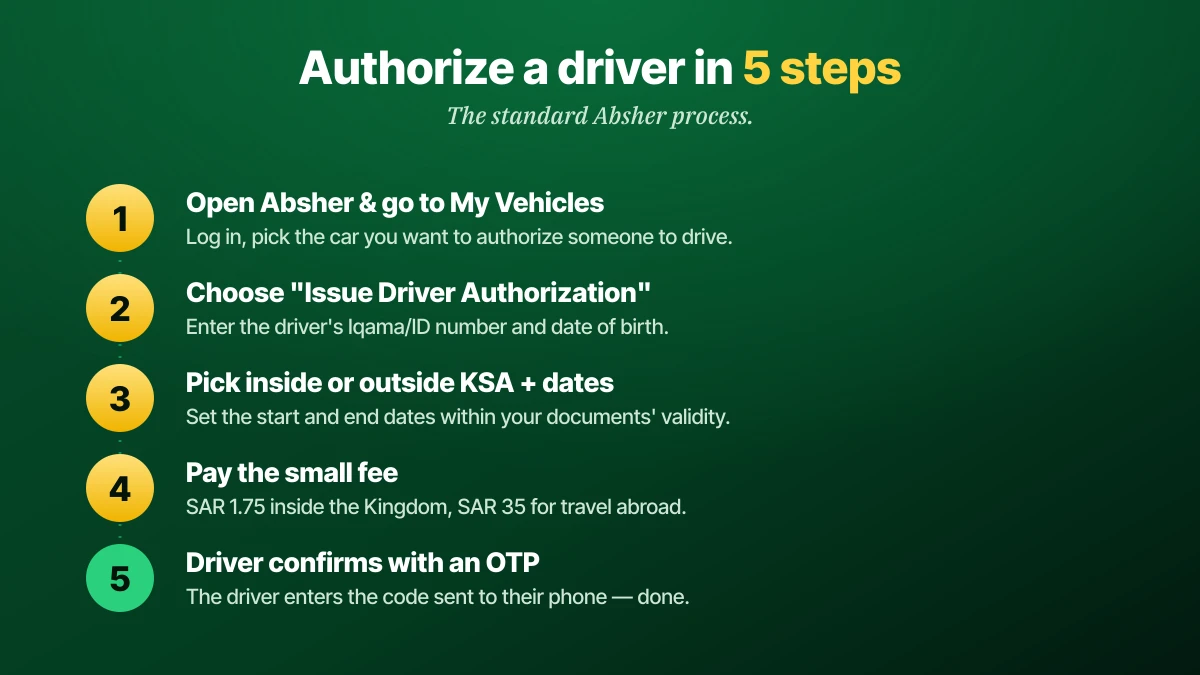
- Open Absher and go to "My Vehicles." Log in to your account and find the list of vehicles registered in your name, then select the car you want to authorize someone to drive.
- Choose "Issue Driver Authorization." Pick the authorization option, then enter the driver's Iqama/ID number and date of birth so the system can identify them.
- Select inside or outside the Kingdom, and set the dates. Choose internal (within Saudi Arabia) or international (travel abroad), then set start and end dates — these can't run past your registration, insurance or the driver's visa validity.
- Pay the small fee. Around SAR 1.75 for internal authorization or SAR 35 for international, paid through the usual Absher/SADAD payment flow.
- The driver confirms with an OTP. An OTP is sent to the driver's registered phone; they enter it to accept, and the authorization becomes active immediately.
That's it — the driver is now recorded as an approved driver of your car, and traffic systems will recognise them. Keep a note of the end date so you can renew if the arrangement continues.
Inside vs outside the Kingdom
The single most important rule to understand is that authorization works differently depending on whether the car stays in Saudi Arabia or crosses the border. The two are not the same, and mixing them up is the most common mistake.
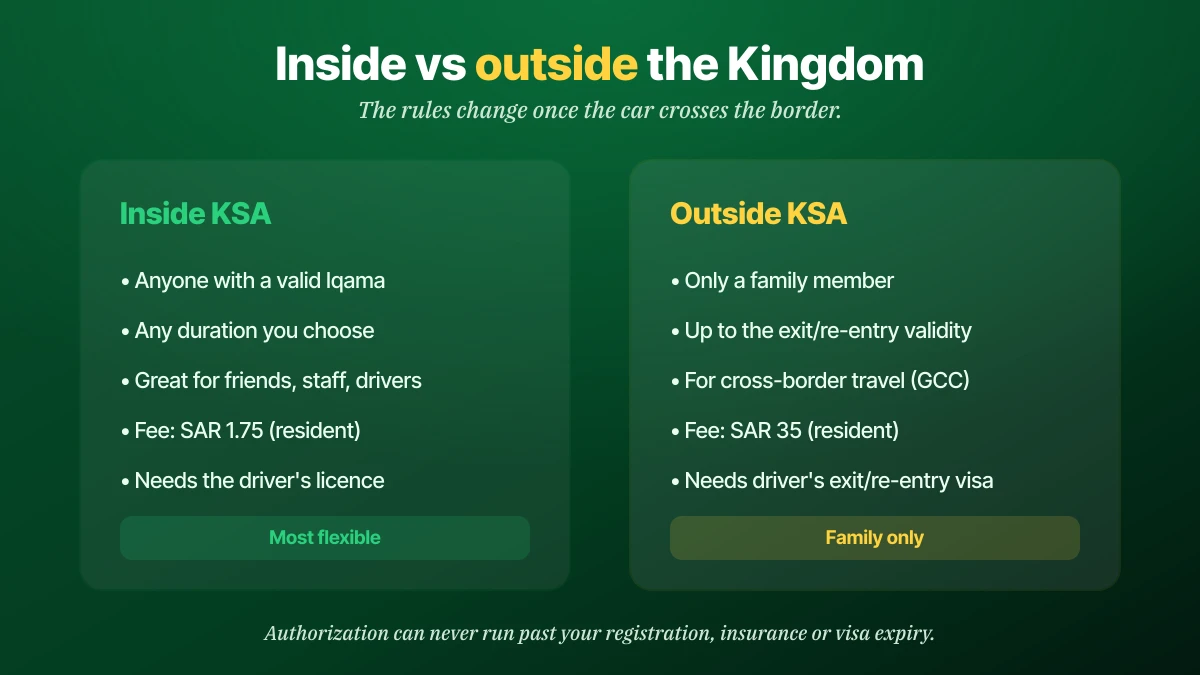
| Factor | Inside KSA | Outside KSA |
|---|---|---|
| Who can be authorized | Any valid Iqama holder | Family member only |
| Duration | Any period you set | Up to exit/re-entry validity |
| Typical use | Family, staff, friends, drivers | Cross-border travel (e.g. GCC) |
| Extra requirement | Driver's licence | Driver's valid exit/re-entry visa |
| Fee (resident) | ~SAR 1.75 | ~SAR 35 |
In short: inside the Kingdom is flexible — almost anyone licensed can be authorized for as long as you want. Outside the Kingdom is restricted — only a family member, and only for as long as their travel visa allows. If you're planning a road trip to a neighbouring country, choose the international option and double-check the visa dates.
Fees & validity
Vehicle authorization is one of the cheapest official services you'll use, which is part of why it's the right way to do this rather than an informal handover.
- Internal (inside KSA): about SAR 1.75 for a resident driver.
- International (travel abroad): about SAR 35 for a resident driver.
- Visitor variants exist too — roughly SAR 3 for internal and SAR 45 for international when the driver is a visitor — and public-transport authorization is higher (around SAR 60).
On validity, the golden rule is simple: an authorization can never extend past the expiry of your vehicle registration, your insurance, or — for international use — the driver's exit/re-entry visa. The system enforces this, so if you want a long authorization, make sure all three documents are valid well into the future. When any of them lapses, renew it and re-issue the authorization if needed.
How to cancel or check an authorization
Because you stay the owner, you remain in full control of the authorization at all times. You can review or end it whenever you choose.
- To check it: open Absher, go to My Vehicles, select the car, and view its active authorizations — you'll see who is authorized and the end date.
- To cancel it: from the same screen, choose to cancel or delete the driver authorization. It ends immediately, and the driver is no longer recorded as permitted to drive the car.
It's good practice to cancel an authorization as soon as it's no longer needed — for example, when an employee leaves or a friend returns the car. Leaving stale authorizations open is untidy and, in rare cases, can complicate matters if the car is involved in an incident while someone you forgot about is still listed.
You're responsible for your car. Cancel an authorization the moment the arrangement ends — it takes seconds and keeps your records clean.
Authorization vs ownership transfer
People often confuse authorization with selling or giving the car away. They are completely different, and choosing the wrong one causes real problems.
- Driver authorization (Tafweed) gives someone the right to drive your car for a period. You keep ownership, registration stays in your name, and you can cancel any time. Cost: a couple of riyals.
- Ownership transfer permanently changes who owns the car. The buyer becomes the registered owner, you no longer control it, and it requires inspection, insurance and the full Absher transfer process. See our ownership transfer guide.
Use authorization when you're lending or sharing; use a transfer when you're selling or permanently handing the car over. If you're actually planning to sell, value the car first with our used-car value guide and then list it on KSAplate — and if you're leaving Saudi Arabia, decide between authorizing a family member, selling, or transferring before you go.
Mistakes to avoid
Most authorization problems come from a handful of avoidable slips. Steer clear of these and the process stays painless.
- Just handing over the keys with no authorization. An unauthorized driver and the owner can both face problems at a checkpoint or after an incident. Always record it.
- Authorizing a non-family member for travel abroad. Only a family member can take the car outside the Kingdom — a friend or employee cannot, no matter the paperwork.
- Ignoring document expiry. If your Istimara, insurance or the driver's visa lapses, the authorization is affected. Keep all three valid.
- Leaving unpaid fines on the car. Outstanding Saher violations can block the authorization — clear them first.
- Forgetting to cancel. When the need ends, cancel it. Don't leave old drivers authorized indefinitely.
- Confusing it with a transfer. Authorization is not ownership — if you mean to sell or give away the car, do a proper transfer instead.
Frequently asked questions
How do I authorize someone to drive my car in Saudi Arabia?
How much does vehicle authorization cost?
Can I authorize a non-family member to drive my car?
What do I need to authorize a driver?
Does authorization transfer ownership of the car?
How long can a vehicle authorization last?
Can I cancel a driver authorization?
Can someone drive my car to another GCC country?
What happens if an unauthorized person drives my car?
Conclusion & next steps
Letting someone drive your car in Saudi Arabia is simple when you do it the official way: a driver authorization (Tafweed) on Absher takes minutes, costs a couple of riyals, and keeps both you and the driver protected — without giving up ownership. Remember the key rule: inside the Kingdom you can authorize almost any licensed Iqama holder, but outside the Kingdom only a family member can drive it, within their visa validity. Keep your Istimara, insurance and the driver's documents valid, clear any fines first, and cancel the authorization when it's no longer needed. And if your plan is actually to sell rather than share, take the next step instead — value your car, then list it on KSAplate or browse the marketplace for your next one.