


TL;DR:
- The car transfer fee in KSA is SAR 380 for a private car: a SAR 150 government fee plus a SAR 230 Absher service fee (VAT included).
- In practice the buyer pays both: the SAR 150 through SADAD in a banking app, the SAR 230 inside the Absher sale.
- The whole transfer runs online in Absher's Vehicle Sale service — no traffic office, no agent, no commission.
- The buyer pays the car price into Absher's escrow account; the seller only gets the money after the buyer hands over the delivery code.
- What blocks a transfer: an expired istimara or Fahes inspection, an unreleased bank loan, or no insurance in the buyer's name. Unpaid fines on their own do not.
Quick answer: Transferring car ownership in Saudi Arabia costs SAR 380 — SAR 150 government fee and SAR 230 Absher fee. The seller opens a sale in Absher, the buyer accepts, pays the price into Absher's escrow account, insures the car in their own name and gives the seller the delivery code when they receive the car. Ownership changes the moment the seller enters that code.
Car transfer fee in KSA (2026): the full breakdown
The official fee to transfer ownership of a private car in Saudi Arabia is SAR 380. It has two parts, and both are listed on the government's own service page for vehicle ownership transfer: a SAR 150 government fee and a SAR 230 Absher service fee, which already includes VAT. There is no percentage of the car price — a SAR 15,000 car and a SAR 400,000 car cost the same to transfer.
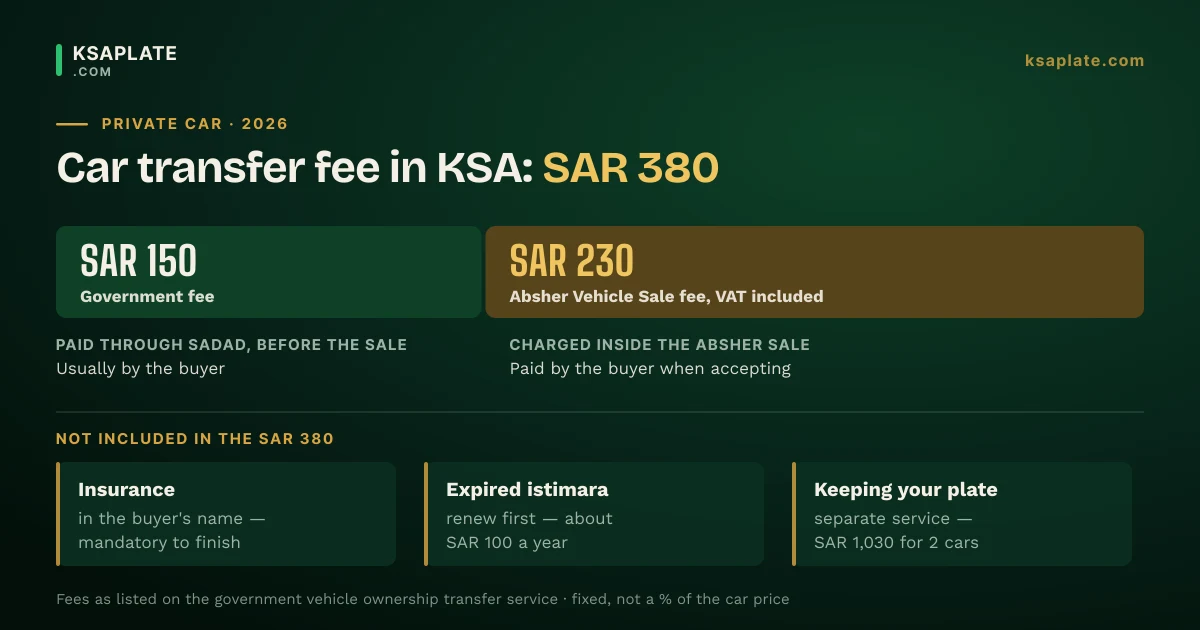
| Fee | Amount | How it is paid |
|---|---|---|
| Government transfer fee | SAR 150 | SADAD (banking app), before the sale |
| Absher Vehicle Sale fee (incl. VAT) | SAR 230 | Inside the Absher sale, by the buyer |
| Total for a private car | SAR 380 | — |
The SAR 150 rate applies to private cars, motorcycles and small buses. Taxis and public-transport vehicles are reported at a SAR 300 government fee, and they are not sold through Absher's Vehicle Sale service at all — that service covers private vehicles.
Costs that are not part of the SAR 380
The transfer fee is the cheap part. These are the costs that decide what the deal really costs you:
- Insurance in the buyer's name — mandatory before the transfer can finish; the price depends on the car, the driver and third-party versus comprehensive cover.
- An expired istimara or inspection — the seller has to renew both before selling. The istimara itself costs about SAR 100 per year for a private car.
- Keeping your number plate — moving a plate to another car is a separate Absher service: SAR 400 per private vehicle plus a SAR 230 service fee, so SAR 1,030 for a move between two cars.
- Unpaid fines — they do not stop the transfer, but they stay on the owner's record and still have to be paid.
Who pays the car transfer fee: buyer or seller?
By default the buyer does. The SAR 230 Absher fee is charged to the buyer inside the sale, and the SAR 150 government fee is normally paid by the buyer through SADAD before the sale is opened. Nothing stops the two parties agreeing otherwise — the seller can simply take the fee off the price — but settle it before the seller opens the sale, not on the day of delivery.
No agent fee and no commission is part of an Absher transfer. If someone asks for a "transfer fee" on top of SAR 380, it is their fee, not the government's.
How to pay the SAR 150 government fee
The government fee is a SADAD government payment, so it is paid in any Saudi banking app rather than in Absher:
- Open your banking app and go to SADAD → Government payments.
- Choose Traffic / Motor vehicles and the service ownership transfer.
- Enter the ID or Iqama number the fee should be registered to and confirm the SAR 150.
The SAR 230 Absher fee is not paid this way — it is part of the Vehicle Sale itself and is shown to the buyer when they accept the sale.
What's your car worth?
Get a free instant estimate based on real Saudi market data — then sell it on KSAplate with direct WhatsApp contact.
Value My Car — FreeRequirements before you start
A transfer only goes through when the car, the seller and the buyer are all in order in the system. Check this list before anyone opens a sale:
- Both parties have an active Absher account, and the buyer's national address is up to date.
- The seller has the buyer's ID or Iqama number and date of birth; both have a Saudi bank account (IBAN) for the payment and any refund.
- A valid istimara (registration) and a valid Fahes periodic inspection.
- Insurance in the buyer's name — the seller's policy does not move with the car.
- No bank loan or lien on the car, and the car is not reported stolen or wanted.
- An agreed price between SAR 500 and SAR 1,000,000 — Absher does not accept a sale outside that range.
- The right vehicle type: residents can buy private vehicles; citizens can also buy private-transport vehicles.
If the istimara has run out, renew the istimara on Absher first — it needs a valid inspection and insurance itself, so start with those.
How to transfer car ownership in KSA on Absher: step by step
The service is called Vehicle Sale (مبايعة المركبات) and works the same for citizens and residents. The money never goes straight from buyer to seller: Absher holds it in an escrow account until the car has changed hands.
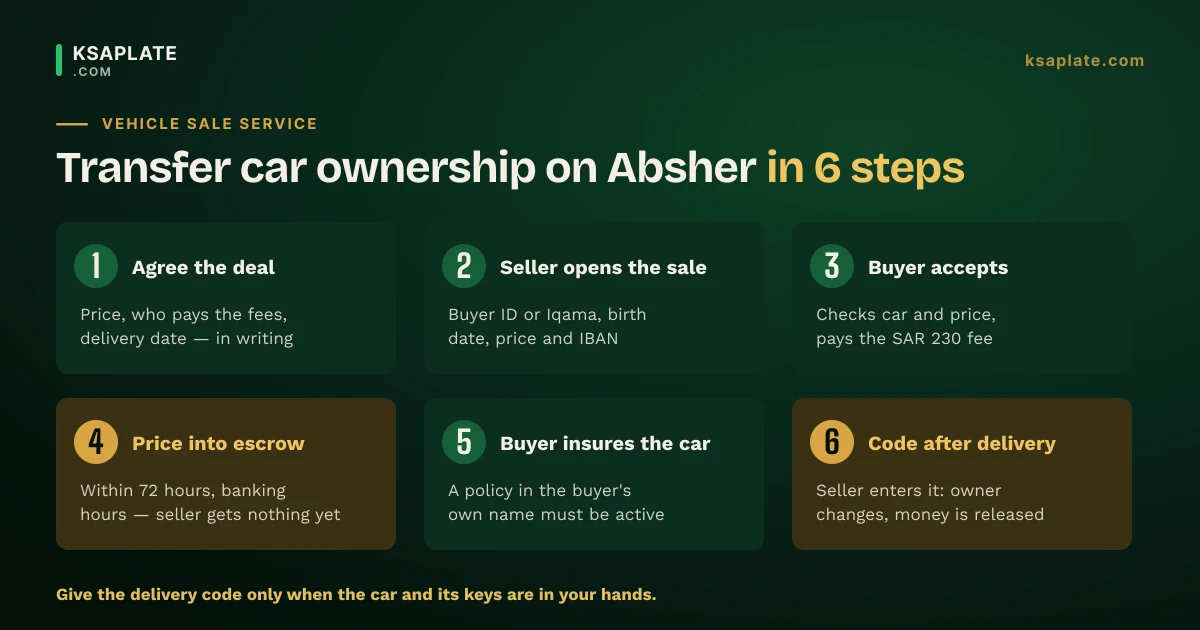
- Agree the deal. Price, who pays the fees, and the delivery date — in writing, before anything is entered in Absher.
- Seller opens the sale. In Absher: Vehicles → Vehicle Sale → Seller. Choose the car, enter the price, the buyer's ID or Iqama number, date of birth and the seller's IBAN.
- Buyer accepts. The buyer logs in, checks the car and the price, enters their IBAN and accepts. The request only stays open for a limited time, so do this while you are together or on the phone.
- Buyer pays into escrow. Absher shows the account to pay the price into. The payment has to arrive within 72 hours of accepting and is processed in banking hours. The seller does not receive anything yet.
- Buyer insures the car. A valid policy in the buyer's name has to be active before the sale can complete.
- Delivery and code. The buyer receives a one-time code by SMS and gives it to the seller only after receiving the car. The seller enters it in Absher: ownership transfers immediately and Absher releases the money to the seller's account, usually within a few hours.
If the sale is cancelled before delivery, the price is returned to the buyer's IBAN. The service is on the official Absher platform and in the Absher app.
Who does what
| Step | Seller | Buyer |
|---|---|---|
| Pay SAR 150 (SADAD) | — | ✔ usually |
| Open the sale | ✔ | — |
| Accept and pay SAR 230 | — | ✔ |
| Pay the price into escrow | — | ✔ within 72 hours |
| Insurance | — | ✔ in the buyer's name |
| Delivery code | ✔ enters it | ✔ gives it after delivery |
How long does a car ownership transfer take?
The transfer itself is instant: ownership changes the moment the seller enters the buyer's delivery code. What takes time is everything around it — the buyer's bank transfer into escrow (up to 72 hours, banking hours only), arranging insurance, and the payout to the seller after delivery. With the paperwork ready, buyer and seller can finish the same day.
Do you need a car transfer office?
No. A private-car sale between two people needs no traffic office, no agent and no appointment — Absher replaced the office visit. You only end up at the traffic department (Muroor) when the case falls outside the Vehicle Sale service, for example a vehicle type the service does not cover; book that appointment through Absher.
One common mix-up: a driver authorization is not a transfer. Letting a relative or employee drive your car with an Absher authorization (tafweed) keeps you as the owner, with your name on the istimara and your liability for fines. If that is all you need, you can authorize someone to drive your car instead of transferring it.
What happens to the license plate?
The plate goes with the car. When ownership transfers, the buyer gets the car with its current plate, and the seller keeps nothing. If the car carries a plate you want to keep — a short number, a pattern, letters that spell something — move it before you open the sale: transfer your plate to another car on Absher first, then sell the car with its new standard plate. A distinctive plate can be worth more than the car it is on.
Expats, financed cars and other cases
Expats and Iqama holders
Residents with a valid Iqama can buy, insure and register a private car exactly like citizens: the buyer needs an Absher account, a Saudi IBAN and insurance in their own name. The Iqama should have enough validity left for the registration to go through.
Financed or leased cars
A car with an outstanding loan or a lease-to-own contract carries a bank lien and cannot be sold through Absher until the bank releases it. If you are buying one, make the bank's release the condition of payment — never pay against a promise to "settle it later."
Transfers inside the family
Selling or giving a car to a son, a spouse or a brother uses the same Vehicle Sale service and the same SAR 380. If a family member only needs to drive the car, an authorization or adding them to the insurance is enough.
What blocks a transfer — and what doesn't
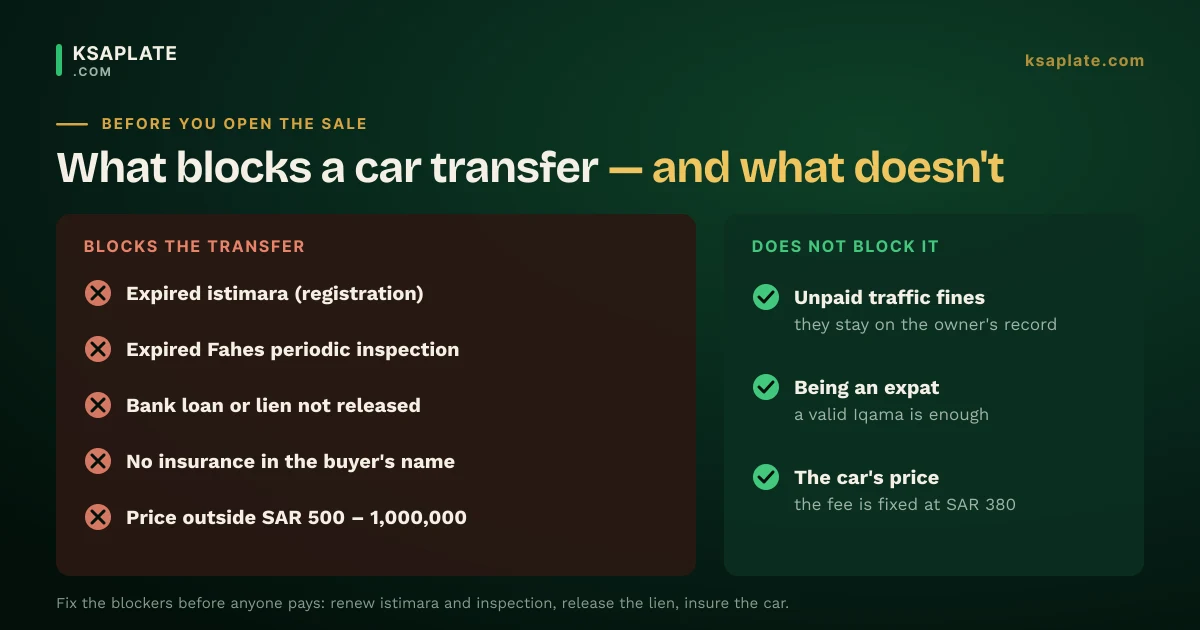
Almost every failed transfer comes down to one of four things: an expired istimara, an expired Fahes inspection, a bank lien that has not been released, or no insurance in the buyer's name. A price outside SAR 500–1,000,000 is the fifth. Unpaid fines are not on the list: the traffic police have confirmed that fines on the owner do not stop the transfer while the istimara and inspection are valid — they simply stay on the owner's record.
Golden rule for buyers: pay only through Absher's escrow, and give the delivery code only when the car and its keys are in your hands.
Selling your car? List it on KSAplate for free
Reach buyers across Saudi Arabia, talk to them directly on WhatsApp, and keep or sell your plate separately.
List your car freeFrequently asked questions
How much is the car transfer fee in KSA?
How much does Absher charge for a car transfer?
Who pays the transfer fee, the buyer or the seller?
How do I pay the vehicle transfer fee?
How long does it take to transfer car ownership?
Do unpaid traffic fines stop a car ownership transfer?
Can I transfer ownership if the istimara or inspection has expired?
Do I need to visit a car transfer office?
Is an Absher driver authorization the same as transferring ownership?
Can an expat transfer car ownership in Saudi Arabia?
What happens to my plate when I sell my car?
Can I sell a financed car?
Conclusion
The car transfer fee in KSA is a flat SAR 380, and the transfer itself takes seconds — the work is in the preparation. Renew the istimara and inspection, release any bank lien, have the buyer's insurance ready, agree who pays the fees, and keep the money in Absher's escrow until the car is delivered. Selling with a valuable plate on it? Move the plate first, then sell the car.