


TL;DR:
- A ride-hailing car is a machine that converts kilometers into riyals — so choose it by cost per kilometer, not by sticker price. Across our real Saudi market curves, the spread between a good pick and a bad one is roughly SAR 0.10 per kilometer, which at full-time driving distances is thousands of riyals every year.
- The counterintuitive data point: age destroys value, kilometers barely dent it. Our valuation curves price an extra 10,000 km at ≈1.1% of a car's value (≈SAR 610 on a five-year Camry), while one extra year of age costs 7–16%. Buy the newest car your cash allows, then drive it without fear.
- The rules come before the car: ride-hailing driving in Saudi Arabia is reserved for Saudi nationals, requires a TGA operating card, comprehensive insurance, and a four-door car inside each app's model-year window — verify your city's current cutoff in the app before you buy anything.
- The default answer is the Camry for a reason, but it is not the cheapest answer: at ≈SAR 0.41 per km all-in it buys comfort-tier eligibility and effortless resale, while an Elantra or Accent does the same job at ≈SAR 0.31–0.33 per km.
- Plan the exit on the day you buy: a three-year ride-hailing career puts ±180,000 km on the odometer, and our curves say that car still holds 55–65% of what a documented, well-maintained example is worth — if you keep the service file and sell it honestly.
Quick answer: The best cars for Uber and Careem in Saudi Arabia are the Toyota Camry (comfort-tier eligibility, strongest resale), Hyundai Elantra and Sonata (best value per kilometer), and Hyundai Accent (lowest cash outlay) — chosen by total cost per kilometer, roughly SAR 0.31–0.41/km on our market data. Requirements: Saudi national, TGA operating card, comprehensive insurance, four-door car inside the app's model-year window.
A car that earns: the per-kilometer mindset
A private car spends its life parked — twenty-two thousand kilometers a year is the Saudi norm our valuation curves are built around. A ride-hailing car is a different species: fifty, sixty, eighty thousand kilometers a year, most of them in city heat with the AC working as hard as the engine. At that intensity, the question "which car should I buy?" stops being about taste and becomes an equation: what does each kilometer cost me in depreciation, fuel and maintenance, and what does each kilometer pay?
Most new drivers get this backwards. They pick the car first — usually whatever a cousin recommends — and discover the economics later, when the fuel receipts and the resale offer arrive. This guide runs the equation first, using the same real Saudi market curves that power our free car value calculator, so every number here is anchored to what cars actually trade for in the Kingdom, not to showroom optimism. The short version, before we get to the per-kilometer math: the spread between a well-chosen and a badly-chosen ride-hailing car is roughly SAR 0.10 per kilometer — which at sixty thousand kilometers a year is six thousand riyals, every year, for choosing with data instead of habit.
One honest note up front: this article is about the car — choosing it, running it, exiting it. Earnings, app commissions and demand hours change city by city and month by month, and any specific promise about income would be stale before you finish reading. The car-side numbers, by contrast, are durable: depreciation follows curves, fuel follows consumption, and both are printed below.
The rules before the car: who and what qualifies
Buy nothing until you clear the regulatory gate, because it is stricter than most people expect:
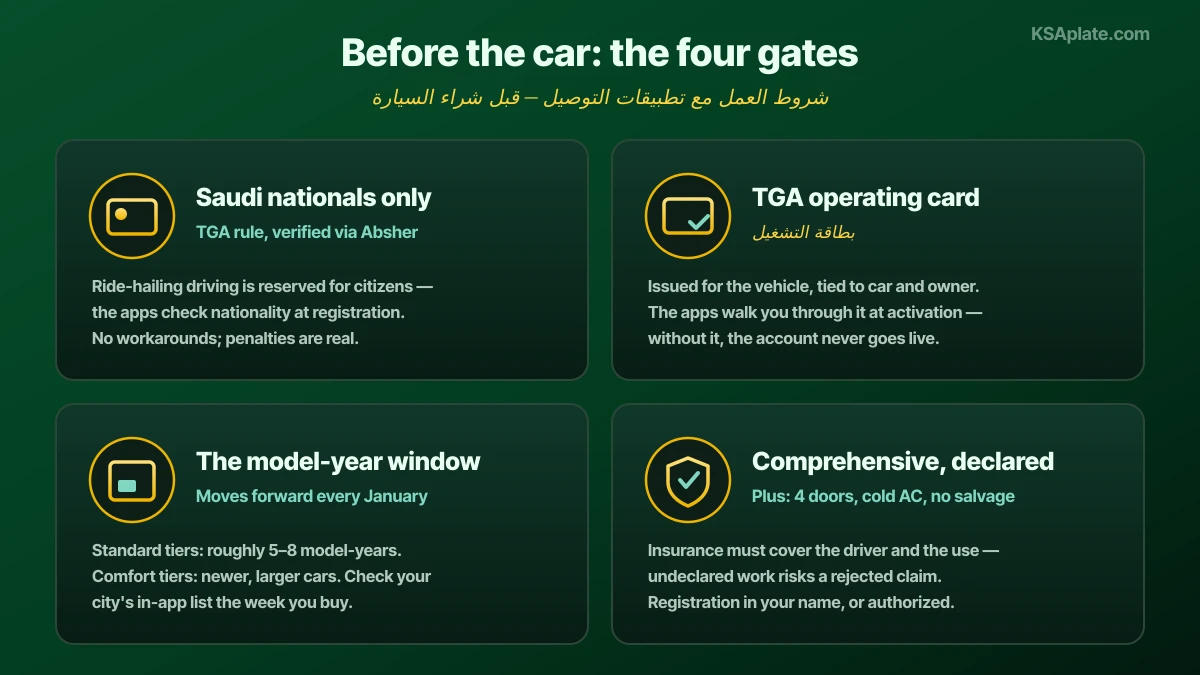
- Saudi nationals only. Ride-hailing driving in the Kingdom is reserved for Saudi citizens under Transport General Authority (TGA) rules — the apps enforce this at registration with Absher verification. If you are an expat reading this: you cannot drive for the passenger apps, and any workaround someone offers you is a violation with real penalties. The used-car economics in this guide still apply to any high-kilometer use, from delivery work to a long daily commute.
- A TGA operating card (بطاقة تشغيل). The vehicle itself needs an operating card issued through the TGA's channels, tied to the car and its owner. The apps walk you through it during activation; without it, the account does not go live.
- The model-year window. Each app publishes a per-city list of accepted model years, and the window moves forward every January. As a working rule, standard tiers accept cars up to roughly five to eight model-years old, and comfort or premium tiers demand newer, larger cars. Check the app's current list for your city the week you buy — not after — because a car that misses the window is just a car.
- Four doors, sound condition, working everything. Activation includes a vehicle check: four-door body, no major cosmetic damage, functioning AC (non-negotiable in this climate), seat belts all around. Salvage-history cars fail.
- The car in your name — or properly authorized. The registration should match the driver, or carry proper authorization. Insurance follows the same logic: the policy must cover the person actually driving, for the actual use.
The real math: cost per kilometer
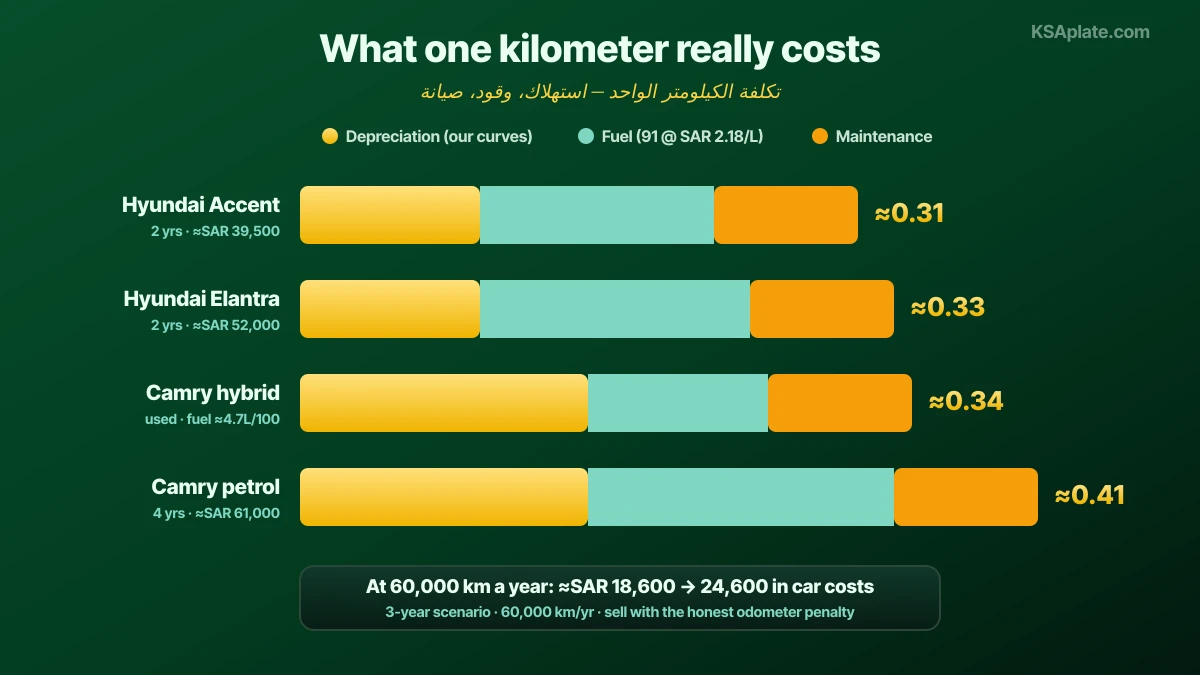
Every ride-hailing car has three meters running at once: depreciation, fuel, and maintenance. Here is the honest arithmetic for a standard scenario — buy a used example at the age shown, drive sixty thousand kilometers a year for three years, sell with the odometer penalty our curves apply. Fuel is priced at Octane 91's regulated SAR 2.18 per liter (the full 91-vs-95 logic is in our fuel guide), and maintenance uses a planning figure of ≈SAR 0.08/km, which the maintenance section further down breaks apart line by line:
| Car (bought used) | Depreciation ≈SAR/km | Fuel ≈SAR/km | Maintenance ≈SAR/km | Total ≈SAR/km |
|---|---|---|---|---|
| Hyundai Accent (2 yrs old, ≈SAR 39,500) | 0.10 | 0.13 | 0.08 | ≈0.31 |
| Hyundai Elantra (2 yrs old, ≈SAR 52,000) | 0.10 | 0.15 | 0.08 | ≈0.33 |
| Toyota Camry hybrid (used, hybrid trim) | ≈0.16 | 0.10 | 0.08 | ≈0.34 |
| Toyota Camry petrol (4 yrs old, ≈SAR 61,000) | 0.16 | 0.17 | 0.08 | ≈0.41 |
Read the totals at working distances: sixty thousand kilometers a year makes the Accent ≈SAR 18,600 a year in car costs and the petrol Camry ≈SAR 24,600 — an SAR 6,000 annual gap between the cheapest and the most comfortable answer. Neither is wrong: the Camry buys comfort-tier eligibility, rear-seat space and the Kingdom's most liquid resale market; the Accent buys the lowest cost of doing business. What matters is choosing the gap on purpose. For the full ownership-cost picture beyond ride-hailing — insurance bands, registration, the lot — see our cost of owning a car guide.
What's your car worth?
Get a free instant estimate based on real Saudi market data — then sell it on KSAplate with direct WhatsApp contact.
Value My Car — FreeThe picks, priced by our market curves
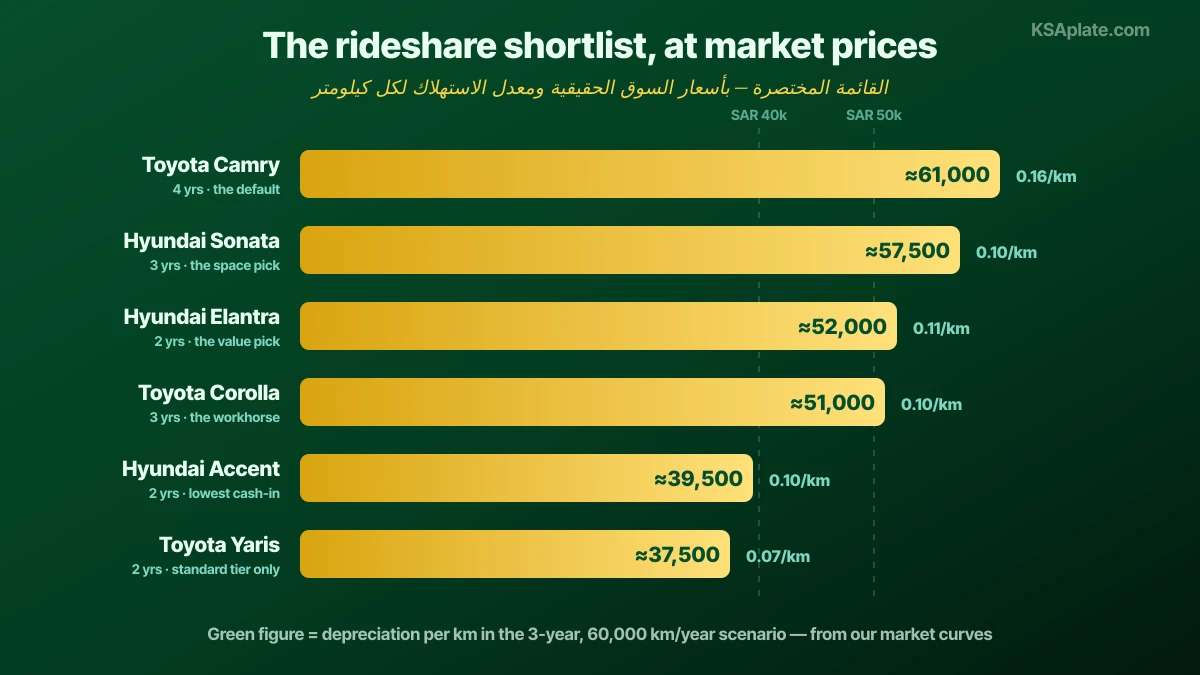
These are the cars that dominate Saudi ride-hailing fleets, with real numbers from our market curves — the same dataset behind our under-SAR-50,000 buying guide. Depreciation per kilometer uses the three-year, 60,000 km/year scenario from the table above:
| Car | Smart buy (age, ≈value) | Dep. ≈SAR/km | Why it fits the job |
|---|---|---|---|
| Toyota Camry | 4 yrs, ≈SAR 61,000 | 0.16 | The Kingdom's default ride-hailing car: comfort-tier eligibility, rear legroom, cold AC, and the easiest resale in the market |
| Hyundai Sonata | 3 yrs, ≈SAR 57,500 | 0.10 | Camry space at a lower buy-in; our curves show it holding value unusually well through years four and five |
| Hyundai Elantra | 2 yrs, ≈SAR 52,000 | 0.11 | The value pick: nearly-new age for mid-size money, strong AC, sedan body that clears app checks |
| Toyota Corolla | 3 yrs, ≈SAR 51,000 | 0.10 | The durability benchmark — boring, unbreakable, and every mechanic in Saudi Arabia knows it |
| Hyundai Accent | 2 yrs, ≈SAR 39,500 | 0.10 | Lowest cash outlay that still passes standard-tier checks; the volume king of our dataset |
| Toyota Yaris | 2 yrs, ≈SAR 37,500 | 0.07 | The lowest depreciation per kilometer in this list — small inside, so standard tier only |
Two honest footnotes. First, the Nissan Sunny belongs in this conversation as the cheapest four-door entry — our dataset shows nearly-new examples under SAR 30,000 — but its curve data is thinner than the cars above, so treat its numbers with wider error bars. Second, every value here is a market median: your specific car's price moves with condition, service history and trim, which is exactly what the calculator adjusts for when you enter the real details.
The hybrid question
The hybrid Camry has quietly become the Kingdom's ride-hailing workhorse, and the math explains why: at ≈4.7 L/100 km against the petrol car's ≈7.8, it saves roughly SAR 0.07 per kilometer in fuel. At sixty thousand kilometers a year that is ≈SAR 4,100 annually — real money that compounds over a three-year career.
The honest counterweights: used hybrids carry a purchase premium over the petrol car, which eats one to two years of the fuel savings depending on the deal you find; the hybrid battery is a genuine inspection point on a high-kilometer used example (test for smooth engine start-stop transitions and check the hybrid system health screen); and battery replacement outside warranty, while rarer than the horror stories suggest, is a four-figure event you should price into a worst case. The break-even logic is simple: the more kilometers you drive per year, the faster the hybrid wins. At full-time distances it usually does; at part-time weekend driving, the petrol car's lower buy-in often keeps it ahead.
Kilometers vs age: what the data actually says
Here is the single most useful thing our data can tell a ride-hailing driver, because it contradicts the market's instinct. Everyone fears the odometer. The curves say the odometer is nearly the cheapest input in the business:
- An extra 10,000 km costs ≈1.1% of the car's value. That is the fitted mileage elasticity inside our valuation engine, measured across thousands of Saudi listings. On a five-year Camry worth ≈SAR 56,500, ten thousand extra kilometers shave off ≈SAR 610. On a four-year Accent, ≈SAR 330.
- An extra year of age costs 7–16%. The same five-year Camry loses ≈14% crossing into year six — roughly SAR 8,000. The four-year Accent loses ≈16% crossing into year five. Year for "distance", aging is roughly ten times more expensive than driving.
- The practical conclusion: buy age, spend kilometers. A newer car with higher mileage is, by the data, a better ride-hailing asset than an older car with a gentle odometer — it clears the apps' model-year windows longer, and its value decays on the slow curve, not the steep one. This is the exact opposite of how most private buyers shop, which is why well-priced newer high-km cars are often the best deals on the lot.
- The penalty is capped by reality. Our engine caps the total mileage adjustment at ±25%, because the market itself stops punishing kilometers past a point — a documented 240,000 km car and a 300,000 km car trade closer together than the gap suggests. What actually separates them at sale time is the service file, which is the subject of its own guide and of the exit section below.
Insurance and paperwork
Three documents decide whether your ride-hailing career is a business or a gamble:
- Comprehensive insurance, declared for the actual use. Third-party-only insurance on a car that works sixty thousand kilometers a year in city traffic is a false economy — one at-fault accident erases years of the premium difference. Just as important: the use itself. An insurer who discovers undeclared commercial use at claim time has grounds to walk away, which converts a repairable accident into a career-ending loss. Declare the activity, pay the correct premium, and the policy becomes what it should be: the floor under the whole business. Our insurance guide covers the comprehensive-vs-third-party decision in full.
- Istimara current, Fahs passed, in the right name. The registration and periodic inspection need to be valid the entire time you drive — the apps check at activation and the TGA card depends on them. Renewal lapses that a private driver shrugs off are suspended-income events for a working car.
- The TGA operating card, kept current. Treat it like the license it is. If you change cars, the card changes with you — factor the admin days into your switchover plan so the income gap stays short.
Buying the car: used, smart, verified
The used market is where the per-kilometer math is won, because the first owner has already paid the steepest depreciation years. The buying discipline for a working car is the same as for any used car — only stricter, because your income rides on it:
- Anchor the price before you look. Run the exact model, year and mileage through the free calculator and walk in knowing the fair range. Sellers quote dreams; curves quote medians.
- Pull the history before you pay. A vehicle history check takes minutes and catches the two career-killers: salvage records (fails app inspection) and odometer mismatches (fails the trust test at your own resale later).
- Inspect for the job, not just the car. AC performance under load, suspension over speed bumps, seat wear, tire dates — a ride-hailing car lives on exactly these components. A SAR 300 workshop inspection before purchase is the cheapest insurance in this entire article.
- Shop where the inventory is. Browse the current used listings with your shortlist and fair-range numbers ready — and when a car matches both, move quickly; well-priced working sedans are the fastest-turning inventory in the market.
Maintenance at ride-hailing intensity
Sixty thousand kilometers a year compresses a decade of private-car maintenance into three years. The ≈SAR 0.08/km planning figure from the math section breaks down like this:
- Oil and filters every 10,000 km — at working distances that is every two months, ≈SAR 150–250 a visit with quality oil. This is the single line item that decides whether the engine reaches 300,000 km or dies at 180,000.
- Tires roughly every 60,000 km (≈SAR 1,600–2,400 a set on these sedans), brakes on a similar rhythm, and an AC service before every summer — in this climate the AC is a revenue component, not a comfort feature.
- The 40,000 km rhythm: transmission fluid checks, coolant, battery test (Saudi heat kills batteries in 2–3 years regardless of kilometers), alignment after the inevitable curb encounters.
- Write everything down. A stamped, dated service file is worth real riyals at exit — it is the one document that lets a 240,000 km car sell near the top of its band instead of the bottom. The full high-heat, high-km schedule is in our maintenance guide.
The exit: selling a 200,000 km car well
Every ride-hailing career ends with a sale, and the exit is where disciplined owners collect their reward. Three years at working intensity leaves you with a five-to-seven-year-old sedan carrying ±200,000 km — and our curves say that car still holds 55–65% of a normal-mileage example's value if the story is documented. The playbook:
- Reprice with data, not hope. Run the real mileage through the calculator — it applies the honest kilometer adjustment, and quoting a data-anchored price in your listing pre-empts the lowball ritual.
- Let the service file do the selling. Photograph the stamped folder, the fresh oil receipt, the tire dates. A documented working car outsells an undocumented private car of the same age more often than the market expects.
- Shoot it like it deserves. A washed car, golden-hour light and the twelve honest frames from our photography guide matter more for a high-km car, because trust is the entire sale.
- List it where working-car buyers look. List it on KSAplate for free — no commission on the sale — with the mileage stated plainly and the file in frame eleven. The next ride-hailing driver is precisely the buyer who understands, from this same math, that your kilometers were the cheap part. The full transfer mechanics — Absher steps, payment discipline, the plate decision — are in the selling guide.
Frequently asked questions
What is the best car for Uber and Careem in Saudi Arabia?
Can expats drive for Uber or Careem in Saudi Arabia?
What are the car requirements for Uber and Careem in Saudi Arabia?
How many kilometers does a full-time ride-hailing driver do per year?
Does high mileage destroy a car's resale value in Saudi Arabia?
Is a hybrid Camry worth it for ride-hailing work?
Should I buy a new or used car for Uber and Careem?
What insurance do I need for ride-hailing work in Saudi Arabia?
How much does a ride-hailing car cost to run per kilometer in Saudi Arabia?
What should I check when buying a used car for ride-hailing work?
How do I sell a high-mileage ex-ride-hailing car?
Conclusion
A ride-hailing car is the rare purchase where the spreadsheet genuinely beats the showroom. The rules narrow the field before taste gets a vote: Saudi national, TGA card, four doors, inside the model-year window. The math then does the choosing — cost per kilometer, where our market curves put the honest spread at SAR 0.31 to 0.41 between an Accent and a petrol Camry, with the Elantra, Sonata and Corolla holding the value middle and the hybrid earning its premium at full-time distances. And the data hands you the one advantage most of the market refuses to believe: age is what destroys value, not kilometers — so buy the newest car your cash allows, drive it hard, service it on rhythm, and write everything down.
Run the sequence like the business decision it is: clear the requirements in your app this week, anchor your shortlist with the free value calculator, buy verified from the current listings, and when the career or the car reaches its exit, list it on KSAplate for free with the file open on the stamps. Somewhere in your city tonight there is a driver in a badly-chosen car paying an extra SAR 0.10 for every single kilometer — and there is no reason it has to be you.