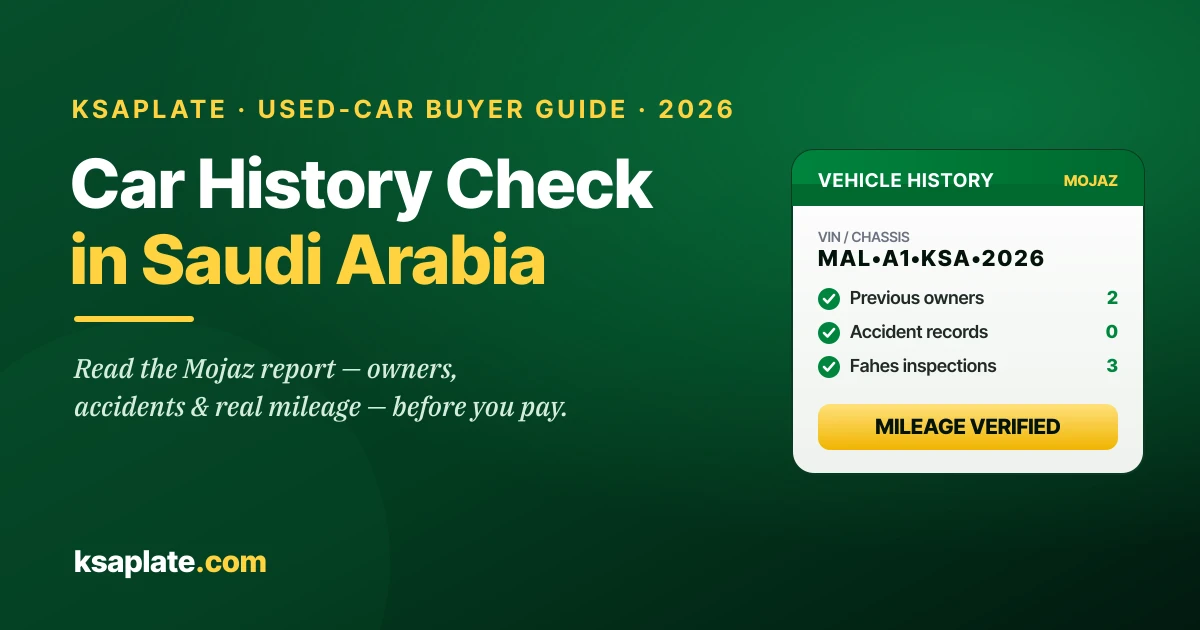
TL;DR:
- A car history check tells you what a used car has really been through — how many owners it had, whether it was in accidents, its true mileage, and its inspection and service record — before you hand over any money.
- The main tool in Saudi Arabia is the Mojaz (موجز) report, an official service you pull with the car's VIN for about SAR 119. It shows owners, accidents (with photos), the odometer trail, Fahes inspections and maintenance.
- The single biggest thing to verify is mileage. Genuine odometer readings only ever climb; a reading that drops or is implausibly low for the year points to a rollback.
- A report is not a substitute for an inspection. It records what was reported — unreported private repairs and accidents won't appear, so still inspect the car and confirm the plate and any finance lien.
- Sellers benefit too: a clean history report builds buyer trust and sells your car faster for a better price.
Quick answer: To check a used car's history in Saudi Arabia, find the car's VIN (on the istimara, windshield base, door pillar or engine bay), then pull a Mojaz report for about SAR 119. Read the number of owners, accident records, the odometer trail and inspection history, and make sure the mileage only ever rises. Confirm the plate and that the car has no outstanding finance, then inspect it in person before paying at the Absher transfer.
What a car history check is
A car history check is a record of everything official that has happened to a specific vehicle: who has owned it, whether it has been in recorded accidents, what its odometer has read over time, and when it passed inspection. In Saudi Arabia this information is gathered into a single digital report you can pull before you buy.
Think of it as the car's CV. A clean-looking car in a photo tells you nothing about its past; the history report fills that gap with data the seller cannot easily fake. It turns "trust me, it's never had a problem" into something you can verify in minutes.
The check is built around the car's VIN — the unique 17-character vehicle identification number stamped on every car. Enter that number, and the report returns the recorded history tied to it.
Why it matters before you buy
The used-car market rewards sellers who know more than buyers. A history check closes that gap and is the cheapest insurance you can buy against an expensive mistake.
Two cars can look identical and be advertised at the same price, yet one was rolled back 60,000 km and rebuilt after a major crash while the other is genuine. Without a report you are guessing. With one, you pay the right price for the right car — or walk away before losing a deposit. For the wider picture of how scams are run, read our guide to used-car scams in Saudi Arabia, and to judge a fair figure see how much a car is worth.
The report costs about SAR 119. A hidden accident or a wound-back odometer can cost you tens of thousands. No check in the buying process has a better return.
The Mojaz report explained
Mojaz (موجز) is the main vehicle-history service in Saudi Arabia. You request it with the car's VIN, pay a fee of roughly SAR 119, and receive a report that consolidates the data recorded against that vehicle.
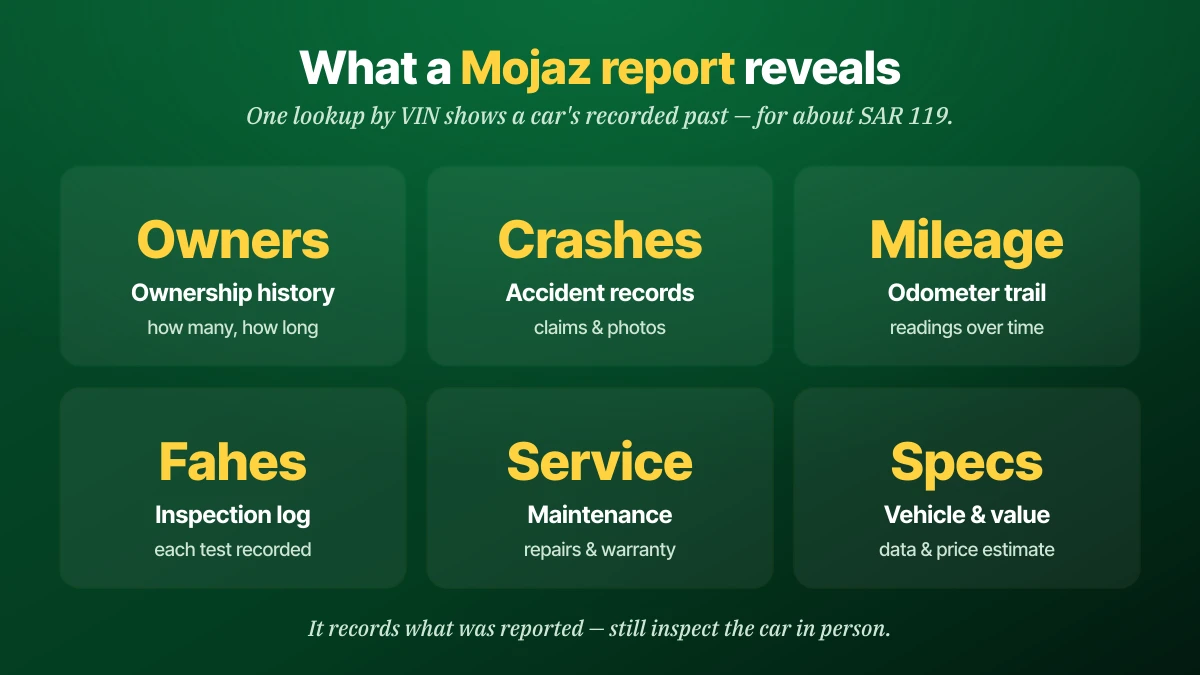
A Mojaz report typically includes:
- Ownership history — how many previous owners and how long each kept the car.
- Accident records — reported accidents, often with photos and repair-estimate details.
- Odometer trail — mileage readings captured over time, the key to spotting rollback.
- Fahes inspections — the periodic technical inspection history. See our Fahes inspection guide.
- Maintenance & warranty — recorded service and repair entries where available.
- Specs & value — vehicle data and an estimated price.
The report is only as complete as what was reported to official channels — a powerful starting point, but read alongside a physical inspection, never instead of one.
What's your car worth?
Get a free instant estimate based on real Saudi market data — then sell it on KSAplate with direct WhatsApp contact.
Value My Car — FreeFinding the VIN
The VIN (chassis number) is a 17-character code unique to the car, and you need it to pull any history report. It appears in several places, so you can confirm it matches across them.
- The istimara (vehicle registration card) — the easiest source.
- Windshield base — visible through the glass at the bottom of the windscreen on the driver's side.
- Door pillar sticker — on the frame when the driver's door is open.
- Engine bay — stamped on the chassis or a plate under the bonnet.
- Insurance papers — listed on the policy documents.
Always check the VIN on the car matches the VIN on the istimara and the report. A mismatch is a serious red flag — never buy a car whose numbers don't line up.
How to check a car's history in 5 steps
Checking a used car's history is a short, repeatable process. Doing it before you view the car — or at least before you pay — keeps you in control of the deal.
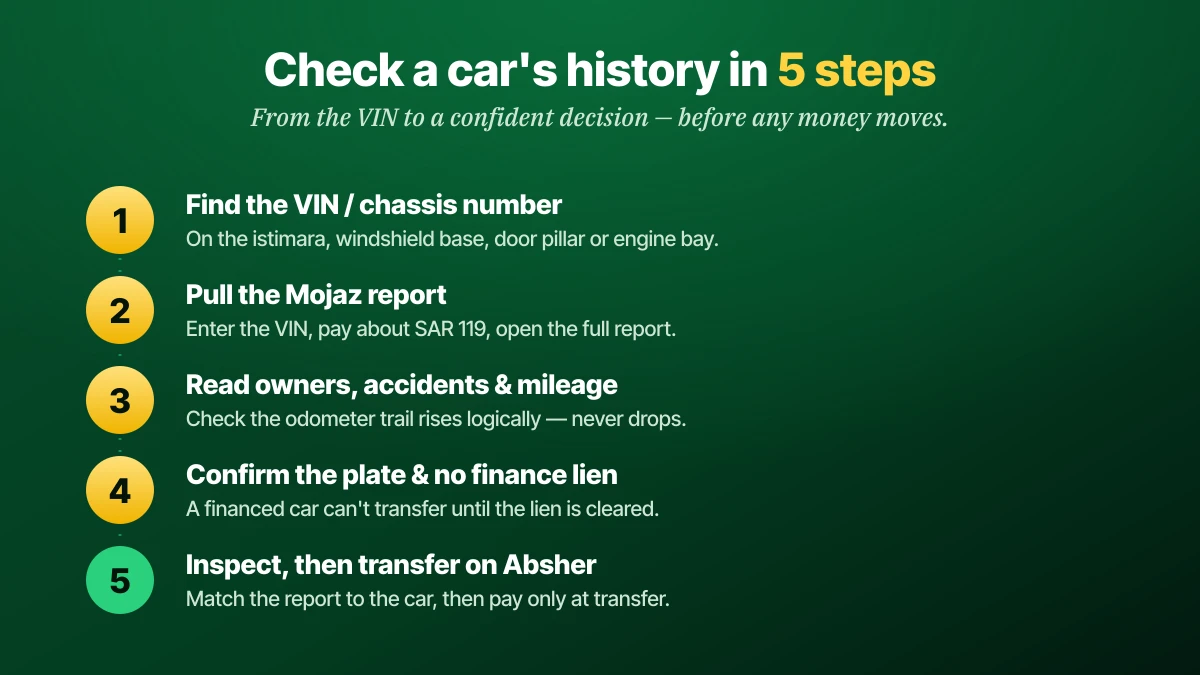
- Find the VIN. Get the 17-character number from the istimara, windshield base, door pillar or engine bay, and confirm the copies match.
- Pull the Mojaz report. Enter the VIN, pay about SAR 119, and open the full report.
- Read owners, accidents and mileage. Check the odometer trail rises logically over time and that the accident record matches the car's condition.
- Confirm the plate and finance. Verify the seller owns the plate and the car has no outstanding finance lien — a financed car cannot transfer until the lien is cleared. Use our plate verification checklist.
- Inspect, then transfer on Absher. Match the report to the physical car, complete a hands-on inspection, and pay only at the Absher ownership transfer.
Pair this with our full used-car buying guide so the report and the physical inspection together cover the whole car.
Verifying the real mileage
Mileage is the number most often tampered with because it directly drives price. The history report is your best defence: it records odometer readings over time, so you can see whether they make sense.
The rule is simple — genuine mileage only ever climbs. Each Fahes inspection and ownership transfer captures a reading, building a trail. If a later reading is lower than an earlier one, or the car shows implausibly few kilometres for its age, the odometer has likely been wound back.
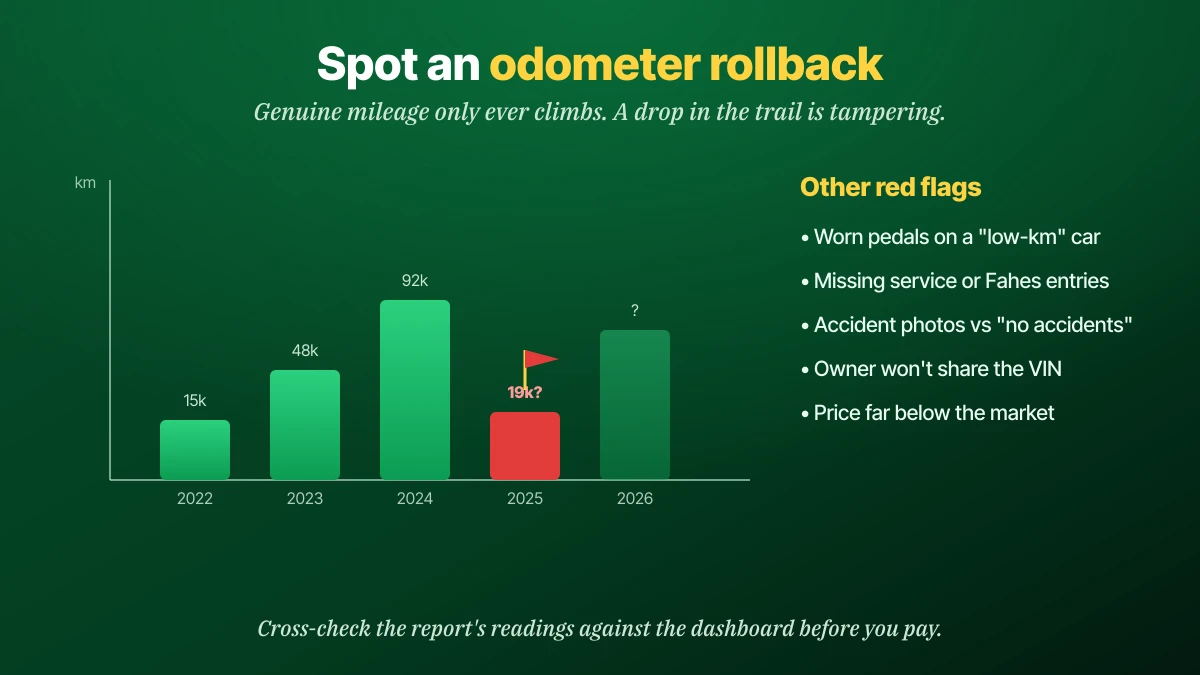
Back the numbers up with your eyes. A car claiming 40,000 km should not have worn pedal rubbers, a shiny-smooth steering wheel, a sagging driver's seat, or stone-chipped headlights. When the dashboard figure and the wear don't agree, trust the wear — and the report's recorded trail — over the seller.
A wound-back odometer is not just overpaying. It hides how much life and how many repairs the car has left, turning a "low-mileage bargain" into a money pit.
Reading the accident record
The accident section tells you whether the car has been in reported collisions and, often, how serious they were. This matters because structural damage can affect safety and value long after the panels are repaired.
Light, well-repaired damage is not always a deal-breaker, but a major structural or airbag-deployment accident is. Cross-reference the report with the car: look for mismatched paint shades, uneven panel gaps, overspray, and bolts that have been turned. Saudi accident claims are also recorded through Najm, which feeds this picture — see our guide to reporting an accident with Najm.
If the report lists accidents but the seller swears the car is "accident-free", that contradiction alone is reason to walk away or renegotiate hard.
Owners, plate & finance lien
Beyond condition, a history check protects the transaction itself. Three administrative points decide whether you can actually take ownership cleanly.
- Number of owners. Many short ownerships in a few years can signal a problem car that people kept offloading.
- Finance lien. A car still under finance cannot be transferred until the lender's lien is cleared. Confirm the car is fully paid off before any money changes hands.
- The plate. Verify the seller genuinely owns the plate and that it transfers correctly, especially for a premium number — our verification guide walks through it.
Never pay a deposit to "hold" a car before these checks. Pay at the Absher transfer, when ownership legally moves to you — not a moment sooner.
What a report won't tell you
A history report is powerful but not omniscient. Knowing its blind spots stops you from trusting it too completely.
It records what reached official channels, so it can miss: private accidents repaired without an insurance or Najm claim; off-the-books repairs done at informal workshops; very recent events not yet logged; and, for an imported car, anything that happened before it entered the Kingdom. It also can't judge present mechanical condition — a clean record doesn't prove the gearbox is healthy today.
| What you want to know | History report | Physical inspection |
|---|---|---|
| Number of owners | Yes | No |
| Reported accidents & mileage trail | Yes | Partly (signs only) |
| Unreported / private repairs | No | Yes |
| Current mechanical health | No | Yes |
| Finance lien & plate ownership | Check via Absher | No |
That is why the report and a physical inspection are partners. The report flags the recorded past; a careful test drive and a trusted mechanic catch what the record can't. Use both, every time.
For sellers: a clean report sells faster
History checks are usually framed for buyers, but sellers gain just as much. Volunteering a clean report removes the buyer's biggest fear and shortens the sale.
When you can show a genuine odometer trail, no hidden accidents, and a tidy inspection record, you remove the haggling leverage a cautious buyer would otherwise use. Cars with verified, transparent histories sell faster and hold their asking price better. When you are ready, list your car on KSAplate and let the report do the convincing — buyers browsing cars for sale reward transparency.
For the full process of pricing and paperwork, see our guide on how to sell a car in Saudi Arabia.
Mistakes that cost buyers
Most history-check mistakes come from doing the check too late, or trusting the wrong source. A few habits keep you safe.
- Checking after paying a deposit. Pull the report before any money moves, not after you're emotionally committed.
- Taking the seller's printout at face value. Run the report yourself from the VIN so it can't be edited or staged.
- Ignoring a VIN mismatch. If the number on the car, the istimara and the report don't all agree, stop.
- Trusting the dashboard over the trail. Believe the recorded odometer history and the physical wear, not the number a seller shows you.
- Skipping the inspection because the report is clean. A clean record is necessary, not sufficient — inspect anyway.
The buyers who get burned almost always skipped one cheap step. The report, the plate check and the physical inspection are a set — do all three.
Frequently asked questions
How do I check a car's history in Saudi Arabia?
What is a Mojaz report?
How much does a car history check cost?
How can I tell if a car's mileage has been rolled back?
Where do I find the VIN?
Can I check a car's accident history?
Will a history report show if the car is still financed?
Does a clean report mean I don't need an inspection?
Can I check the history of an imported car?
Conclusion & next steps
A car history check is the highest-value habit in buying a used car in Saudi Arabia. For about SAR 119 and a few minutes, a Mojaz report tells you who owned the car, whether it crashed, and — most importantly — whether its mileage is real. Find the VIN, pull the report, confirm the odometer trail only rises, check the plate and finance, and still inspect the car in person before paying at the Absher transfer. Do that and you buy with facts, not hope. Ready to find the right one? Browse cars on KSAplate, value it with our car value guide, and buy with confidence.