
Last updated: 4 August 2026
Yes — Saudi Arabia runs official government license-plate auctions. The Ministry of Interior, through the Muroor (General Department of Traffic) and the Absher platform, releases distinctive plates (لوحة مميزة) to the public through an official electronic bidding system, and the highest eligible bidder wins the right to install that number on their vehicle. This is the primary-market channel — plate numbers issued straight from the state, not resold between private owners. It sits alongside, and is distinct from, the private aftermarket where owners buy and sell numbers they already hold. This guide is a deep dive into the official auction channel: what it is, how it compares with the marketplace, how to bid step by step, what it costs, and when the auction is the smarter route versus buying a plate second-hand.
If you want the broader map of where plates trade across the region first, see buying and selling number plates across the GCC, which introduces the auction-versus-marketplace split at a high level — this article goes far deeper on the government side. For why any of these numbers are worth bidding on at all, read the complete Saudi plate guide for the format basics and plate numerology and lucky numbers for why certain combinations sell for millions.

- Yes, they are real and official. The Ministry of Interior / Muroor auctions distinctive plates to the public electronically through Absher — this is the state issuing numbers directly, not a private resale.
- You bid, you don't negotiate. Available numbers are listed with a starting price; eligible bidders compete, and the highest bid at close wins the right to the number.
- Auction vs marketplace is the core choice. The government auction is the primary market (state seller, transparent bidding, official issuance); the private marketplace is the secondary market (owner sellers, negotiated price, instant availability, wider selection).
- Costs stack up. Your winning bid plus government fees, a plate-issuance/making fee, and installation onto your vehicle — all indicative and payable through Absher; confirm current figures there.
- Win, then fit it to your car. After payment the number is issued and installed on an eligible vehicle in your name — the same plate-side mechanics as retaining and fitting a plate.
Quick answer: To buy a plate at a Saudi government auction, sign in to Absher with an eligible account, open the Muroor distinctive-plate auction service, browse the available numbers and their starting prices, place a bid before the auction closes, and — if you are the highest eligible bidder — pay your winning bid plus the government and issuance fees within the deadline. The number is then issued and installed on a matching private-class vehicle registered in your name. Miss the payment deadline and you can forfeit the plate and any deposit. The auction is best when you want an official, transparent primary-market number and can wait for the right lot; the private marketplace is best when you want a specific number now.
Are there official government plate auctions in Saudi Arabia?
Yes. Saudi Arabia has an official, government-run channel for acquiring distinctive license plates directly from the state. The Ministry of Interior, operating through the Muroor (the General Department of Traffic) and the national Absher platform, periodically releases scarce and premium plate numbers to the public through an electronic auction. Eligible members of the public place bids, the highest bid at the close of the auction wins, and the winner gains the right to have that number issued and installed on their vehicle. This is a genuine primary market: the numbers come straight from the Ministry's pool, not from another owner.
This matters because it is fundamentally different from buying a plate second-hand. In the government auction, the seller is the state, the price is set by open competitive bidding rather than negotiation, and the outcome is an official issuance recorded directly in the Ministry's systems. It is the same principle that governs high-value plate sales you may have read about across the Gulf, where scarce numbers change hands for headline sums — many of those originate in official auctions before ever reaching a private owner. The auction is where a brand-new distinctive number enters circulation.
It is also not the only way to get a good number. Once a plate has been won and issued, its owner can later sell it on the private aftermarket, where numbers are listed, negotiated and transferred between individuals. Both channels are legitimate; they simply serve different needs. The rest of this guide unpacks how the auction works and, crucially, how to decide which channel is right for you.
What the government distinctive-plate auction is
The government distinctive-plate auction is the official mechanism by which the Ministry of Interior distributes scarce plate numbers — the ones with commercial and cultural value — to the public in a transparent, competitive way rather than handing them out first-come-first-served.
Why the auction exists
Distinctive plates are a scarce public resource. A single-digit number, a strong repeat, or a culturally lucky combination is genuinely rare — there is only one "1" in any given letter series. If the Ministry issued these on a queue, their real value would be captured by whoever happened to be first in line, not by the public purse. An auction solves that: it lets the market discover the true price of a scarce number, directs that value to the state, and keeps the process open and rule-bound. It is the same logic that governments worldwide use to allocate scarce rights transparently.
What plates go to auction
Not every plate is auctioned. Ordinary working-stock numbers — random four- and five-digit combinations on common letter pairs — are issued as standard registrations and never see an auction; they have no scarcity value. What goes to auction is the distinctive end of the spectrum: low digit counts (one, two and three-digit numbers), strong patterns and repeats, and letter combinations that carry meaning. For a full explanation of which formats are considered premium and why, see the complete plate guide; for the cultural drivers behind the highest prices, the numerology and lucky-numbers guide. In short: the auction is the front door for scarce numbers, and scarcity is exactly what determines whether a plate is auctioned at all.
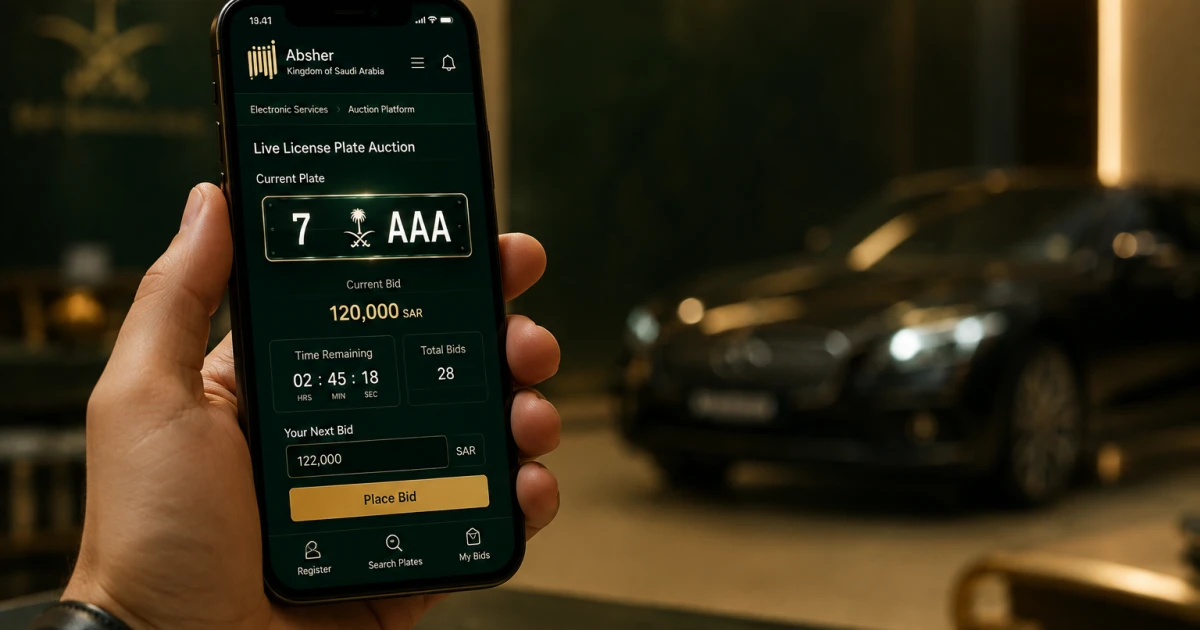
How the bidding format works
Each auctioned number is listed with a starting (reserve) price and a closing time. Eligible bidders place bids electronically; a bid must exceed the current highest bid by at least the minimum increment. When the auction closes, the highest standing bid wins, and the winner is committed to paying that amount plus the associated government and issuance fees. In some rounds a refundable deposit is required to bid, which is applied to the price if you win and returned if you do not — and which you can forfeit if you win but fail to pay. Because it runs on Absher, every step is authenticated against your national ID or Iqama record.
Government auction vs the private marketplace
This is the decision that matters most, and it is the one most guides skate over. The government auction and the private marketplace are both legitimate ways to acquire a distinctive Saudi plate, but they behave very differently on price, selection, speed and trust. Understanding the split lets you pick the right channel instead of defaulting to whichever you stumble on first.
The government auction is the primary market: the seller is the state, the number is newly released, the price is discovered through open bidding, and issuance is official and direct. You get maximum transparency and a clean, first-hand title — but you bid against everyone else, you can only buy what the Ministry chooses to release in a given round, and you may wait for the number you actually want to appear.
The private marketplace is the secondary market: sellers are existing owners, the number is one already in circulation, and the price is negotiated rather than bid. You get a far wider live selection, instant availability of a specific number, and the ability to buy today — but price discovery is less transparent, and trust depends on the platform's verification and a clean transfer. The table below sets the two side by side.
| Factor | Government auction (Absher / Muroor) | Private marketplace |
|---|---|---|
| Who sells | The state (Ministry of Interior) | Existing plate owners |
| Market type | Primary — number newly released | Secondary — number already in circulation |
| Price discovery | Open competitive bidding | Negotiated / listed asking price |
| Selection | Only what is released this round | Wide live inventory across formats |
| Speed | Wait for the lot and the auction close | Buy a specific number now |
| Fees | Winning bid + government + issuance fees | Asking price + transfer fee (flat listing fee to sell) |
| Trust | Maximum — official issuance | Depends on platform verification & clean transfer |
| Best for | Official, transparent, first-hand numbers | Getting the exact number you want, today |
Neither channel is universally "better." If your priority is an official, transparent number and you are willing to wait and compete on price, the auction is ideal. If your priority is a specific number available now — or you are selling rather than buying — the marketplace wins on selection and speed. Many collectors use both: they watch official auctions for fresh releases and the marketplace for numbers already out in the wild. To see what the secondary market looks like in practice, browse KSAplate's distinctive listings, and for the selling side see where to sell a Saudi license plate.
What's your plate worth?
Get an instant, free estimate with our plate value calculator.
Calculate My Plate's ValueHow to participate: step-by-step on Absher
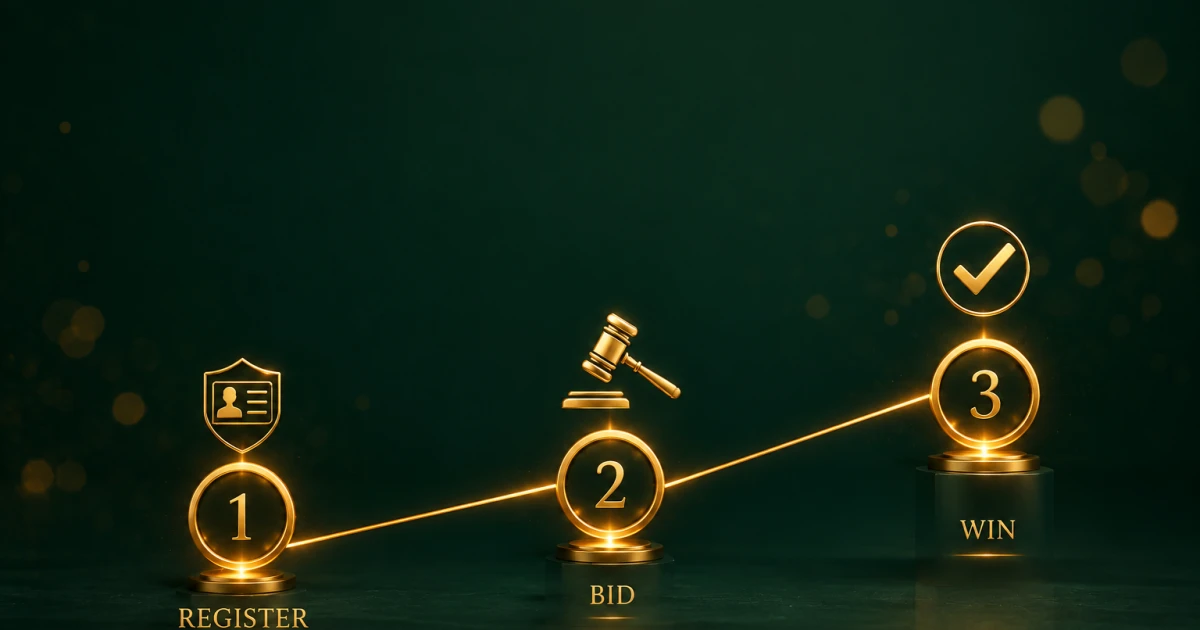
Bidding in an official plate auction is done entirely through Absher — there is no counter to queue at. The sequence below walks from account to installed plate. Treat every specific figure and window as indicative and confirm the live details inside Absher when you start.
- Set up an eligible Absher account. You need an active Absher (Absher Individuals or Business) account tied to a valid national ID or Iqama, and eligibility to register a vehicle in the Kingdom. This is the identity layer that authenticates every bid.
- Open the Muroor distinctive-plate auction service. Within Absher's vehicle / Muroor services, find the plate-auction (مزاد اللوحات المميزة) section. This lists the numbers currently open for bidding.
- Browse the available plates and starting prices. Each lot shows the number, its letter combination, the starting (reserve) price, the current highest bid and the closing time. Shortlist the numbers that fit your budget and taste.
- Place your deposit, if required. Some rounds require a refundable deposit to enable bidding. It is applied to the price if you win and returned if you do not — but can be forfeited if you win and fail to pay.
- Place your bid. Enter a bid above the current highest by at least the minimum increment. You can raise your bid as others compete. Set your ceiling in advance and stick to it.
- Win the auction. If your bid is the highest standing bid when the auction closes, you win the right to the number and are committed to completing payment.
- Pay your winning bid and fees within the deadline. Settle the bid amount plus government and issuance fees through Absher / SADAD before the payment window closes. Missing it can forfeit the plate and your deposit.
- Issuance and installation onto your vehicle. Once paid, the number is issued to you and installed on an eligible private-class vehicle registered in your name; the physical plates are produced and the number is legally on your car.
The two steps people underestimate are the deposit and the payment deadline. The bidding itself is intuitive; the discipline is in setting a ceiling before you start and being ready to pay promptly if you win — because a missed deadline turns a winning bid into a forfeited deposit.
Fees and costs: bid, government fees, issuance
The headline number in an auction is your winning bid, but it is not the only cost. There are several layers, and all are paid through Absher. The figures below are indicative and structural — the Ministry of Interior sets the actual amounts and can revise them, so confirm current fees on Absher before you commit.
| Cost item | When it applies | Indicative SAR | Notes |
|---|---|---|---|
| Winning bid | The price you bid and win at | From a few thousand to millions | Set entirely by competitive bidding; scarce numbers reach seven figures |
| Refundable bid deposit | To enable bidding, in some rounds | ~500–5,000 | Applied to the price if you win; refunded if you don't; forfeited if you win but don't pay |
| Government auction / service fee | On a successful win | ~100–500 | Administrative fee for the auction transaction |
| Plate issuance / making fee | To produce the physical plates | ~100–300 | Cost of manufacturing the new plates for your vehicle |
| Installation / transfer onto vehicle | Fitting the number to your car | ~100–300 | Registers the won number against your eligible vehicle |
Two points are worth stressing. First, the winning bid dwarfs every other line for a genuinely scarce number — the government and issuance fees are rounding error against a five- or six-figure plate, so budget realistically for the bid itself. Second, the deposit is not an extra cost if you follow through; it is applied to your price. It only becomes a real loss if you win and then fail to pay, which is the single most avoidable way to waste money in this process. For how the value of the number itself is set — the digit-count and pattern drivers behind those bids — see the plates-as-investment guide.
Bidding strategy: what drives auction prices
Winning well means understanding what you are actually bidding on. Auction prices for Saudi plates are driven by scarcity and desirability, and those come down to a handful of factors — digit count, letters and patterns — which are covered in depth elsewhere; here the point is how they translate into a bidding plan.
What drives the price
Fewer digits mean higher scarcity: a single-digit number is the rarest and dearest, a two-digit next, and so on down. Repeats and patterns (777, 1212, 9009) add a premium, and certain letter combinations carry cultural or personal meaning that lifts demand. Because these drivers are multiplicative rather than additive, a plate that is both short and patterned can command far more than either trait alone. The full mechanics of why some numbers cost millions are in the numerology guide and the format guide — study those before you set a ceiling.
Turning that into a bidding plan
The disciplined approach is to value the number first, then bid to that value — never the other way round. Decide your maximum before the auction, based on comparable sales and the number's real scarcity, and treat it as a hard ceiling. Auctions punish emotion: the "just one more bid" reflex is how people overpay for a number they had already priced lower. Bid late and decisively rather than early and repeatedly, keep your ceiling private, and be willing to walk away — there will be another release. Above all, separate what a number is worth to the market from what it is worth to you; a personally meaningful plate may justify a premium, but know that you are paying it deliberately, not by getting swept up.
Timing: how often auctions run
Government plate auctions are not continuous — they run in defined rounds, and knowing the rhythm helps you plan rather than miss the number you want.
The Ministry of Interior releases plates in periodic auction rounds rather than as an always-on listing, and each round has a fixed registration and bidding window with a firm closing time. Numbers are grouped into lots for each round, so the specific plates available change from one auction to the next — the number you want may not be in the current round at all, which is a key contrast with the always-available marketplace. Because schedules, windows and deadlines are set by the Ministry and can change, do not rely on a fixed calendar; instead, check Absher regularly for open and upcoming rounds, note the registration window and the closing time for any lot you care about, and be ready to act inside it. Missing a window means waiting for the next round, which could be weeks or months away.
Eligibility: individuals, expats and companies
Who may bid, and on which vehicles a won number can be installed, is governed by Ministry of Interior rules tied to identity and vehicle-registration eligibility.
Saudi individuals
Saudi citizens with an active Absher account and eligibility to register a private vehicle are the core participants. The won number is installed on a matching private-class vehicle registered in the citizen's name.
Expats and Iqama holders
In principle, a resident who can register a vehicle in the Kingdom — with a valid Iqama and an eligible Absher account — can participate in plate services, but the specifics of auction eligibility depend on current Ministry of Interior and Absher rules and on your residency status, which can change. If you are on an Iqama, confirm your eligibility to bid, win and install a number in Absher before placing a deposit. For what happens to a plate if your residency ends, see keeping and fitting a plate to your car for the retention mechanics that also matter to expats.
Companies and establishments
Vehicles and plates held by a company or commercial establishment follow the entity's records via an Absher Business account. A number won by a business is issued to the entity and installed on a vehicle registered to that same entity in an eligible class, with an authorised person operating the account. The identity on the record is the establishment, not an individual — confirm who is authorised before bidding.
Risks and rules: deadlines, forfeiture, class match
The auction is rule-bound, and the rules are unforgiving of carelessness. These are the ones that cost bidders money or the plate.
- Payment deadline and forfeiture. Winning commits you to pay within a fixed window. Miss it and you can forfeit both the plate and your deposit — the number may then go to the next bidder or back to a future round. Be ready to pay the moment you win.
- Refundable deposit at risk. The deposit that lets you bid is returned if you lose, but is at risk if you win and default. Never bid a deposit you are not prepared to convert into full payment.
- Vehicle-class match. A won private-class number can only be installed on an eligible private (passenger) vehicle registered in your name. You cannot fit it to a commercial, transport or motorcycle category — the classes must match, exactly as with plate retention.
- Non-transferable during the reservation. Between winning and installation the number is booked to you and cannot be casually reassigned; it must be issued onto an eligible vehicle you own within the rules.
- Bidding is binding. A placed bid is a commitment, not a query. Do not test the water with a bid you would not honour.
- Everything stays inside Absher. The whole process — bid, deposit, payment, issuance — runs on the official platform. Any side arrangement that steps outside it is a red flag.
After you win: fitting the plate to your car
Winning the auction is not the finish line — the number still has to be issued and physically installed on an eligible vehicle. Once you have paid your winning bid and the associated fees, the Ministry issues the number to your record and you fit it to a private-class car registered in your name, at which point the physical plates are produced and the number is legally on your vehicle.
The plate-side mechanics here are the same as retaining and re-fitting a number when you change cars — the number is booked to your identity and installed on an eligible vehicle through Absher. If you already own the car it will go on, installation is straightforward; if you plan to move the number to a different or future vehicle, the class-match and reservation rules apply exactly as they do for retention. For the full mechanics of holding a number and fitting it to a car — including the reservation window and the vehicle-class match — see how to keep your plate when you change cars. And if the win is part of a broader change of vehicle, the vehicle side is covered in transferring car ownership in Saudi Arabia.
Auction or marketplace: a decision framework
With both channels understood, the practical question is which one to use for a given goal. Here is a simple framework, followed by action steps for each route.
Choose the government auction if you want an official, first-hand number with maximum transparency, you are flexible on exactly which number you get, and you can wait for the right lot and compete on price. The auction rewards patience and discipline and gives you the cleanest possible provenance.
Choose the private marketplace if you want a specific number available right now, you value speed and selection over primary-market provenance, or you are selling rather than buying. The marketplace has a far wider live inventory and lets you transact today rather than waiting for a round.
Action steps — if you go the auction route:
- Value the numbers you like first, using the numerology and format guides, and set a hard ceiling.
- Open Absher, find the Muroor distinctive-plate auction, and note the open lots, starting prices and closing times.
- Place any required deposit, bid to your ceiling, and be ready to pay in full immediately if you win.
- After winning and paying, install the number on an eligible vehicle in your name.
Action steps — if you go the marketplace route:
- Browse live listings to find the exact number you want and compare it against comparable sales.
- Value it with the free plate calculator so you negotiate from evidence, not emotion.
- Agree a price and complete the transfer through the platform's verified process.
- If you are selling instead, list your number — see where to sell a Saudi license plate.
Many buyers ultimately use both channels in parallel — watching official auctions for fresh scarce releases while scanning the marketplace for a number already in circulation. The two are complements, not rivals.
Bidding on a number? Know what it's worth first
Whether you are competing in an official Absher auction or buying on the open market, value the number before you commit. Browse distinctive plates, price yours free, and list one for free when you are ready to sell.
Browse distinctive plates Value a plate free
Frequently asked questions
Are there official plate auctions in Saudi Arabia?
How do I bid on a plate in Absher?
How much does a government plate cost?
Government auction vs marketplace — which is cheaper?
What is the difference between the government auction and the private marketplace?
Can expats bid in Saudi plate auctions?
What happens if I win but don't pay?
Do I need a deposit to bid?
How often do government plate auctions run?
Which plates are sold at government auction?
After I win, how do I get the plate onto my car?
Can I resell a plate I won at auction?
Is the government auction safer than buying on the open market?
Reviewed by Khalid Al-Rashid, Saudi License Plate Market Analyst.
Sources: Ministry of Interior and General Department of Traffic (Muroor) distinctive-plate auction and vehicle-registration conventions, Absher platform plate-auction and vehicle services (bidding, deposit, payment, issuance and eligibility), and KSAplate marketplace data for the secondary-market comparison. All fees, deposits, windows and schedules are indicative and can be revised by the Ministry of Interior — confirm the current auction terms, fees and deadlines inside Absher before placing a deposit or a bid.