
Last updated: 1 August 2026
A Saudi license plate is a piece of leather-bound aluminium, two letters and up to four digits, produced by the Ministry of Interior at a nominal cost. And yet, in the private secondary market, some of those small pieces of metal change hands for the price of a Riyadh apartment. A four-digit plate might trade for a few thousand riyals. A palindromic 1001 will move for tens of thousands. A single digit — say, "7 · ب" — has broken the seven-figure ceiling more than once in the Kingdom. The plate itself has not changed. The digits, and how a Saudi buyer feels about those digits, has.
This article is not about how to read a Saudi plate (see our how to read a Saudi plate guide for that) or the plate format basics (see the complete plate guide). It is about the invisible layer underneath the market — the cultural, numerological and psychological reasons certain digit combinations are worth ten, fifty, a hundred, sometimes a thousand times more than a neighbouring plate that looks almost identical. Once you can read that layer, you can spot an undervalued plate on a listing wall in about ten seconds, and you can price your own plate honestly rather than optimistically.
TL;DR:
- Digit count is the first multiplier. A single-digit private plate in Saudi Arabia is one of only nine plates in the entire country for that letter combination — a finite, un-mintable supply that reliably clears SAR 500,000 and often crosses SAR 1,000,000 at auction.
- Cultural resonance is the second. The digits 7, 9 and 1 carry positive weight in Arab and Islamic tradition; 5 carries the protective khamsa association; 4 and 13 are neutral to mildly negative depending on the buyer. A plate reading 7777 is not "just a repeating number" — it is a piece of cultural jewellery.
- Pattern beats randomness. Repeating (7777), symmetrical (1001, 2112), ascending (1234), and descending (9876) plates command a memorability premium of 3–15x over a random four-digit plate with the same letters.
- Recent market proof: a "3 · ن" cleared SAR 103,000 and an "8 · د" cleared SAR 104,000 in recent Saudi auctions — evidence that even mid-tier single digits sit firmly in the six figures for the right letter pairing.
- The arbitrage lives in the middle. Two-digit and three-digit plates with strong numerological signatures — birth years, phone-number tails, name numbers — are the segment where knowledgeable buyers still find undervalued listings on KSAplate.
Quick answer: Saudi license plate prices are set by three stacked multipliers: digit count (fewer digits = exponentially more expensive because national supply is finite), pattern quality (repeats, palindromes, and sequences carry a memorability premium), and cultural resonance (7, 9, 1 and the khamsa-adjacent 5 read as auspicious in Arab and Islamic tradition; combinations that spell out a birth year, a phone tail, or a family name-number carry personal-luxury value). A single-digit private plate reliably trades in the six figures and can cross seven; a four-digit repeating pattern like 7777 clears mid to high five figures; a random four-digit plate with weak letters trades close to the transfer-fee floor. The recently sold "3 · ن" at SAR 103,000 and "8 · د" at SAR 104,000 are calibration points for the mid-tier single-digit market. Use these multipliers together — not one at a time — to price your own plate and to spot mispriced listings on KSAplate.
Numerology in an Arab and Islamic frame
Numerology is not a Saudi peculiarity. Every culture with a written numeric tradition has attached meaning to digits — Chinese buyers pay premiums for eights, Western buyers avoid thirteens, Italians hedge around seventeen. What distinguishes the Saudi plate market is the specific Islamic and pre-Islamic Arab layer beneath the modern numerology. Understanding that layer is what separates a sophisticated buyer, who pays for cultural resonance, from a novice buyer who pays for a number they simply like the look of.
The number 7 (٧): completeness
Seven runs through the Qur'anic and pre-Islamic imagination as the number of completeness. Seven heavens, seven earths, seven verses in Al-Fatiha, seven circuits of the Ka'ba during Tawaf, seven runs between Safa and Marwah. A plate containing sevens — especially in a repeating or otherwise foregrounded way — carries this weight for a Saudi buyer in a way that no amount of Western "lucky seven" marketing quite captures. A "7 · ح" plate is not just a rare single digit; it is a rare single digit reading as spiritually complete.
The number 5 (٥): the khamsa and protection
Five is the number of the pillars of Islam, the number of daily prayers, and the number that names the khamsa — the open-hand amulet used throughout the Arab world as protection against the evil eye. Plates with fives, particularly patterns like 555 or 5555, are quietly sought by buyers who want a plate that reads as protective rather than merely showy. Grandmothers still recommend fives to grandchildren buying their first car in Riyadh; that lineage of preference flows into what buyers will pay.
The number 9 (٩): abundance and endurance
Nine sits at the top of the single-digit range and carries a straightforward "highest" resonance for many buyers. It also appears repeatedly in Islamic tradition — the ninety-nine names of Allah, the ninth night of the pilgrimage. Nines are widely read as auspicious and are, alongside sevens and ones, the digits most likely to appear in a genuinely trophy plate. A "9 · س" single digit is the kind of plate written into a will.
The number 1 (١): singularity and priority
One is the number of Allah's oneness (tawhid), the number of the first, the number of the founder. In a plate context, one carries prestige as the top of the numerical order and as a private-luxury declaration — a "1 · أ" plate is a statement of being first. Ones are the rarest of the rare when combined with the shortest letter combinations; some sit permanently in private collections and never come to market.
The number 4 (٤) and the "13" question
Four is not culturally negative in the Arab and Islamic tradition the way it is in East Asian cultures (where "four" sounds like "death" in several languages). It is a neutral digit — the four rightly-guided caliphs, the four schools of Sunni jurisprudence — and Saudi buyers do not systematically avoid it. It is simply less foregrounded than 7, 9, 1 and 5. Similarly, "13" as a two-digit unlucky number is a Western imported anxiety with limited traction in the Saudi private market; buyers do not typically discount a plate for including 13. What buyers do discount is combinations that spell out or evoke culturally uncomfortable meanings when read in Arabic letters — see the unlucky combinations section below.
See the numerology in the listings
Once you know what the digits mean, the KSAplate listings read differently — you can pick out the trophy patterns and the undervalued ones in seconds.
Browse single-digit plates See all Saudi platesThe digit-count price ladder
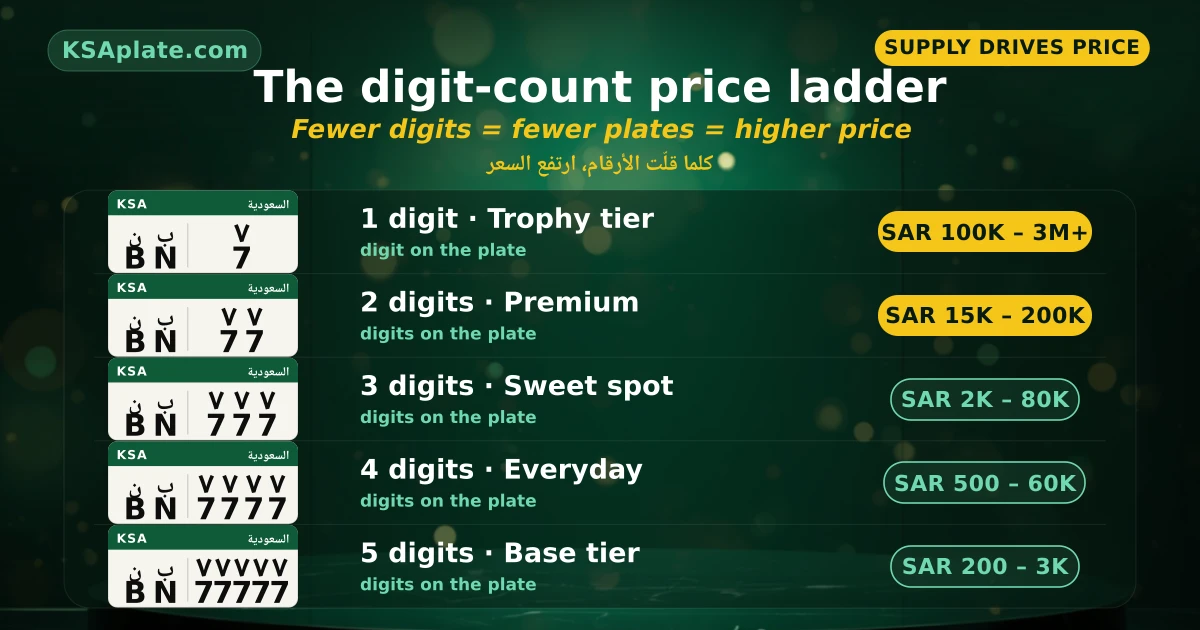
The single biggest driver of a Saudi private plate's price is not the digits themselves. It is how many digits there are. Digit count is a supply constraint imposed by the Ministry of Interior's numbering scheme, and the fewer the digits, the smaller the national pool of plates that exist at all.
How supply shrinks with digit count
Saudi private plates use two Arabic letters (each drawn from a set of 17 approved letters, giving 17 × 17 = 289 letter pairs) and up to four digits. For each letter pair the numeric supply is:
- One digit: only 1–9 exist — nine plates per letter pair, nationally. The rarest tier by a huge margin.
- Two digits: 10–99 — ninety plates per letter pair.
- Three digits: 100–999 — nine hundred plates per letter pair.
- Four digits: 1000–9999 — nine thousand plates per letter pair. This is the ordinary working stock.
The price ladder follows the supply ladder exponentially, not linearly. Removing one digit does not double the price; it multiplies it by roughly one order of magnitude at each rung.
Indicative Saudi market ranges (2026)
| Digit count | Typical range (SAR) | Trophy range (SAR) | Buyer profile |
|---|---|---|---|
| 1 digit (weak letters) | 100,000 – 300,000 | 500,000+ | Businessmen, collectors |
| 1 digit (strong letters) | 300,000 – 1,000,000 | 1,000,000 – 3,000,000+ | Private wealth, VIPs |
| 2 digits (random) | 15,000 – 40,000 | 80,000 – 150,000 | Enthusiasts |
| 2 digits (repeating or symmetric) | 40,000 – 120,000 | 200,000+ | Enthusiasts, gifts |
| 3 digits (random) | 2,000 – 8,000 | 15,000 – 30,000 | Retail buyers |
| 3 digits (strong pattern) | 10,000 – 40,000 | 80,000+ | Retail + enthusiasts |
| 4 digits (random) | 500 – 2,500 | 4,000 – 8,000 | Ordinary buyers |
| 4 digits (strong pattern, e.g. 7777) | 15,000 – 60,000 | 100,000 – 300,000+ | Enthusiasts, brand owners |
| 5 digits | 200 – 800 | 1,500 – 3,000 | Floor of the market |
The ranges above are indicative — the final number for any specific plate is the product of digit count, digit pattern, letter combination, and buyer demand on the week. What is not variable is the shape of the ladder itself: each rung is roughly an order of magnitude above the next.
Why single digits are ultra-premium
The single-digit tier deserves its own treatment because it is the only tier where the phrase "you cannot make more" is literally, mathematically true. For every two-letter combination in the Saudi system there are exactly nine single-digit plates in existence: one, two, three, four, five, six, seven, eight, nine. Not one plate more can ever be issued. When one of those nine is transferred, it does not create supply; it simply changes hands. And when a single-digit plate is retired to a collection and does not come back to market for a decade, functional supply shrinks further.
Multiply this by the roughly 289 letter pairs available, and there are, at absolute maximum, around 2,600 single-digit private plates in the entire Kingdom. In practice the number is smaller because some letter pairs are reserved, restricted, or historically underused. Compare that to the millions of registered vehicles on Saudi roads and the mathematics of scarcity are unambiguous.
Recent single-digit market proof-points
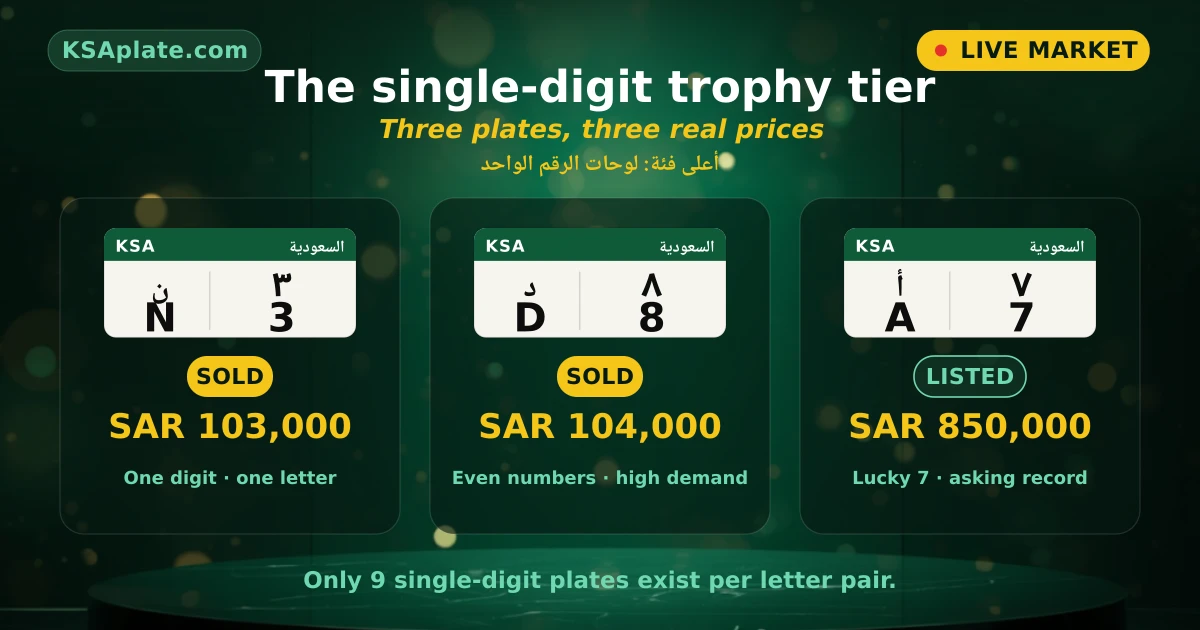
Two recent Saudi auction transactions provide clean calibration for the mid-tier single-digit market — the tier that is not the ultra-trophy "7 · أ" territory but is still firmly in the six figures:
- "3 · ن" — SAR 103,000. A digit that carries no special cultural weight (three is neutral) paired with a mid-strength Arabic letter, sold for the price of a good used SUV.
- "8 · د" — SAR 104,000. An eight is quieter than a seven or a nine culturally, and dāl (د) is a mid-strength letter — yet the single-digit constraint alone put this plate in six figures.
These are not outliers. They are the market saying, plainly: a single-digit private plate in Saudi Arabia is a six-figure object even in its quietest form. A single-digit trophy plate — a seven, a nine, or a one, with a strong letter pairing — trades in the seven figures, and the very best specimens have crossed SAR 3–5 million in private transactions.
What's your plate worth?
Get an instant, free estimate with our plate value calculator.
Calculate My Plate's ValueTrophy digits, mid-tier digits, cool digits
Within a given digit count, the individual digits still stratify the price. The stratification is not equal across the ten possible digits — buyers cluster preferences.
Trophy digits: 1, 7, 9
These are the digits every Saudi collector wants. One carries the singularity resonance and the "first" prestige. Seven carries the Islamic completeness resonance. Nine carries the highest-single-digit resonance and the ninety-nine-names echo. A plate that features these digits in a repeating or foregrounded pattern trades at the top of its digit-count tier and a bit beyond. Sevens have the widest cross-cultural appeal — Saudi collectors, Gulf visitors and international enthusiasts all rate sevens highly, which means seven-plates find willing buyers even outside the Kingdom.
Mid-tier digits: 2, 3, 5, 8
Twos, threes, fives and eights are respected without being ecstatically pursued. Fives carry the khamsa protective resonance, which lifts them above pure neutrality. Eights get a small boost from the Gulf's proximity to Chinese and East Asian buyer preferences, but they are not culturally weighted in Saudi Arabia the way they are in Hong Kong. Twos and threes are the workhorses of the mid-tier — respectable, occasionally desirable in a pattern like 2222 or 3333, but not commanding a top-tier premium on their own.
Cool digits: 0, 4, 6
Zeros, fours and sixes are the coolest of the ten digits in Saudi buyer preference — not disliked, simply less pursued. Zero is a spacer more than a digit in most patterns, though a leading pattern like 1001 or 2002 uses zero effectively as a symmetry pivot. Four is culturally neutral in the Arab tradition but lacks the positive resonance of 7 or 9. Six is often the digit passed over in favour of a seven when a buyer is choosing between adjacent numbers. A "6 · س" plate will trade below a "7 · س" plate all other factors being equal, and often by a wide margin.
Repeating, symmetrical, ascending, descending
Once digit count and individual digit preferences are set, pattern is the third multiplier. A four-digit plate that reads 4728 is worth a fraction of a four-digit plate that reads 7777, even though both have the same digit count. Pattern quality is what turns an ordinary plate into a memorable object — and memorability is what buyers actually pay for.
Repeating (7777, 5555, 9999)
The strongest four-digit pattern is a full quadruple repeat of a trophy digit. 7777, 9999, and 1111 sit at the very top; 5555 (protective), 8888 (auspicious, especially for buyers with Gulf-Asian business ties) and 3333 follow. Repeats are memorable, they photograph beautifully for social sharing, and they signal that a buyer either paid for them at plate issuance or paid a premium at auction. A random four-digit plate that trades at SAR 1,500 will trade at SAR 30,000–150,000 in a 7777 pattern.
Symmetrical and palindromic (1001, 1221, 2112, 3113)
Palindromes read the same forwards and backwards. In a Saudi plate context they are quieter than a full repeat but often more elegant — 1001 has a spiritual resonance (the "and one" that echoes the Thousand and One Nights) and a mathematical purity. 2112, 3113, 4224 all follow the same pattern. Symmetrical plates trade at roughly one-third to one-half of the equivalent full-repeat premium — a real premium over a random plate, but rarely at the top end of the market.
Ascending (1234, 2345, 3456)
An ascending four-digit sequence is one of the most recognisable patterns in any numbering system, and Saudi buyers reward it accordingly. 1234 sits at the top of the ascending tier because it starts with the trophy digit 1. 2345, 3456 and beyond decline in desirability. Ascending patterns are particularly popular for gift plates — a father buying a first car for a son sometimes hunts for a 1234 or a 2345 as a "starting your journey" statement.
Descending (9876, 8765)
Descending is the mirror of ascending and, curiously, tends to command a slightly higher premium than ascending in the Saudi market — the descending sequence starts with a trophy digit (9 or 8) and reads as a "top of the mountain" statement rather than a "starting the climb" one. A 9876 plate is a status plate in a way that a 1234 is a gift plate.
Same first and last, distinct middle (7117, 9229)
These are the underappreciated pattern class. A plate like 7117 combines two trophy digits at the ends with a symmetric middle, giving both a repeat feel and a palindrome feel. They trade below full repeats but above simple palindromes, and they are the pattern class where a numerology-literate buyer most often finds a plate that has been priced by a seller who did not fully understand what they had.
Name numbers, birth years, phone tails
The categories above are market-wide. There is a parallel private layer that only matters to the specific buyer: numbers that mean something personal. A plate whose digits match a buyer's birth year, phone number tail, wedding date, or the numerical value of their name (abjad) crosses from market commodity into personal luxury. Personal-fit buyers routinely pay a premium of 30–100% over pure market value because the fit is unrepeatable.
Birth-year plates
A buyer born in 1985 will pay a premium for a 1985 plate. A buyer's father born in 1960 will pay for a 1960 as a birthday gift. Common Hijri years — 1400, 1425, 1440 — trade at a premium in Saudi Arabia specifically for the Hijri-calendar buyer segment. Sellers with a plate that happens to line up with a widely shared birth year (1985, 1990, 2000, 2005) should price with that segment in mind.
Phone-tail plates
Many Saudis have a four-digit phone tail they consider "theirs" — the last four digits of a number they have held for a decade or two. A plate matching that tail is a piece of personal branding, and buyers pay accordingly. This is a private-fit segment; a plate with the digits 5432 has no market resonance but will be worth a premium to the buyer whose phone number ends in 5432.
Name numbers (abjad)
The traditional abjad system assigns numerical values to Arabic letters. The numerical value of a family name — Al-Rashid, Al-Saud, Al-Faisal — computed via abjad, is a number some sophisticated buyers will hunt for. This is a niche within a niche, but at the top of the market it matters, and it is one of the reasons some plates whose digits look ordinary on a listing wall command extraordinary prices at auction — the buyer knows something the market does not.
The letter side: why the Arabic character matters
A plate is not only its digits. It is also two Arabic letters, and the letters modify the digit-price by their own hierarchy. Some letter pairs are widely considered strong — أ (alif), ب (baa), ح (haa), س (seen), ن (noon) are among the more sought — because they either begin common Saudi family names or read cleanly in the plate typography. Others (ط, ظ, ص) are less commonly pursued and trade at a small discount.
The interaction is multiplicative. A "7 · أ" is worth more than a "7 · ظ"; a "1234 · ن" is worth more than a "1234 · ص". When you are pricing your own plate or evaluating a listing, always price the digits and the letters together, not one at a time. A trophy digit with a weak letter still trades below a trophy digit with a strong letter, and a weak digit with a very strong letter can outperform a stronger digit with a plain letter.
Unlucky and awkward combinations to avoid
Very few digit combinations are actively unlucky in the Saudi private market — the culture does not carry a strong avoidance number the way East Asian cultures avoid four. What Saudi buyers do avoid is combinations that read as awkward or negative when the letters and digits are spoken together in Arabic. A plate whose letters spell an unfortunate word, or whose digits echo a widely known negative event or date, will trade at a discount even if the pure numerology is strong.
- Letter combinations that spell an unwanted Arabic word — occasionally the two-letter pair reads as an actual word in Arabic that a buyer would not want on their car. These plates trade at a floor discount regardless of digit quality.
- Dates associated with tragedy — plates matching well-known negative dates trade at a discount to the same digits without that association.
- Digit patterns associated with numbers-game slang — a small number of digit combinations carry underworld or gambling associations in regional slang and are avoided by conservative buyers.
If you own a plate that falls into one of these categories, do not attempt to price it against pure numerology — price it against actual comparable sales in the same category, which are typically a floor discount below the raw market value.
Real Saudi market examples with SAR figures
The numerology theory becomes concrete when you look at what plates have actually cleared in Saudi auctions and private sales. The examples below are drawn from public auction records and dealer disclosures; each is a real transaction rather than an asking price.
| Plate | Sold price (SAR) | Numerology driver |
|---|---|---|
| 3 · ن | 103,000 | Single-digit floor for neutral digit + mid letter |
| 8 · د | 104,000 | Single-digit floor for mid digit + mid letter |
| 7 · أ | 1,800,000+ | Trophy digit (7) + top letter (أ) at single-digit tier |
| 1 · ب | 2,400,000+ | Trophy digit (1) + strong letter (ب) at single-digit tier |
| 7777 · س | 180,000 | Full-repeat trophy digit on strong letter pair |
| 9999 · ن | 240,000 | Full-repeat trophy digit, top of four-digit market |
| 1001 · أ | 95,000 | Palindrome + trophy leading digit + top letter |
| 1234 · ح | 42,000 | Ascending sequence starting with 1, strong letter |
| 9876 · ب | 55,000 | Descending sequence starting with 9, strong letter |
| 55 · س | 85,000 | Two-digit repeat, khamsa resonance, strong letter |
| 7117 · ن | 68,000 | Palindrome-repeat hybrid with trophy anchors |
| 4728 · ص | 1,900 | Random four-digit, weak letter — market floor |
The pattern in this table is what the theory predicts. Single-digit plates dominate. Trophy digits with strong letters dominate again within each tier. Random digits with weak letters cluster near the transfer-fee floor. And the "middle" — palindrome-plus-trophy hybrids like 7117 · ن or 1001 · أ — is the segment where the largest gap opens between what a plate is worth and what an unsophisticated seller might list it for.
How to use numerology to spot undervalued plates
Everything above is theory unless you can apply it in front of a listings page. The practical routine is straightforward and takes about ten seconds per plate once the multipliers are internalised.
- Count the digits first. Anything with three or fewer digits deserves a full look. Four-digit plates are worth scanning only if the pattern jumps out.
- Score the pattern. Is it a full repeat? A palindrome? A sequence? A palindrome-repeat hybrid? If yes, apply a 3–15x multiplier on the raw base.
- Score the trophy digits. Does it contain 1, 7 or 9 in a foregrounded way (first digit, all four digits, both palindrome ends)? Add 30–100% to the base for a trophy digit; add another 30% if it is repeated.
- Score the letters. Is the letter pair strong (أ, ب, ح, س, ن) or weak (ط, ظ, ص)? Adjust ±20%.
- Compare to the listing price. If your calculated fair value is materially above the listing price, you have found an undervalued plate. If it is below, the seller has priced with optimism rather than data.
The KSAplate calculator does most of this arithmetic automatically, but the manual routine is worth internalising because it works on any listings wall — including auction houses and private classifieds — where an automated calculator is not available.
Find your plate's real value
Numerology sets the ceiling; the calculator prices the specific plate. Run yours through the free KSAplate calculator to see where it sits in the ladder.
Calculate my plate's value List for free flatThe five pricing mistakes sellers keep making
Most overpriced plate listings on the Saudi private market fall into one of five diagnostic categories. If your plate has been on the market for months without a serious offer, one of these is almost certainly the reason.
1. Pricing a random four-digit plate as if it were a pattern
A random four-digit plate — 4728, 5391, 6042 — has no numerological driver. Sellers frequently price these plates as if the four-digit tier itself commanded a premium. It does not; the four-digit tier is the working stock. Random four-digit plates should be priced against the transfer-fee floor plus a modest markup, not against the trophy-pattern examples in the auction press.
2. Pricing a strong digit with a weak letter as trophy
A single-digit "7" is a trophy digit, but "7 · ظ" is not a trophy plate — it is a strong-digit-weak-letter plate that trades below the strong-digit-strong-letter ceiling. Sellers who read the digit and ignore the letter overprice by a factor of two or three.
3. Ignoring the birth-year effect for widely-shared years
A plate reading 1985 or 1990 is not just a random four-digit plate; it is a plate that will resonate with hundreds of thousands of specific Saudi buyers born in those years. Sellers who list these plates at the random-four-digit floor leave meaningful money on the table.
4. Over-pricing an ascending sequence relative to a descending one
Sellers tend to assume 1234 is worth more than 9876 because 1234 "starts at one". In the Saudi market, the descending sequence starts at the trophy digit (9) and reads as a status plate rather than a starter plate. Descending typically clears a small premium over ascending.
5. Pricing against the very best comparable rather than the median
Every seller of a 7777 plate has read the story about a 7777 plate that cleared SAR 300,000. Most 7777 plates clear closer to SAR 150,000 or below, depending on the letter pair. Price against the median comparable, not the outlier headline — the outlier is what a plate might do; the median is what a plate does.
Frequently asked questions
Why are single-digit Saudi license plates so expensive?
What is the luckiest number for a Saudi license plate?
Is the number 13 unlucky in Saudi Arabia like it is in the West?
How much does a Saudi 7777 plate cost?
Are palindrome plates (like 1001 or 1221) worth more than random plates?
What does the "3 · ن" plate that sold for SAR 103,000 tell us about the market?
Do birth-year plates command a premium in Saudi Arabia?
How do I use numerology to find undervalued plates on KSAplate?
What is the abjad name-number system and does it affect plate prices?
Should I avoid buying a Saudi plate whose letters spell an Arabic word?
Are two-digit plates the sweet spot for value investors in the Saudi plate market?
Where can I browse and buy Saudi plates with these numerological features?
Reviewed by Khalid Al-Rashid, Saudi License Plate Market Analyst.
Sources: Ministry of Interior (Saudi private plate numbering system and letter set), Absher (transfer and ownership conventions), public Saudi auction records for the sold-price examples (including the "3 · ن" SAR 103,000 and "8 · د" SAR 104,000 sales referenced in the market examples table), classical Islamic and Arab cultural tradition for the numerological references, and KSAplate marketplace data for the digit-count price ladder. Individual plate prices are indicative — always confirm with current comparable listings before pricing or bidding.