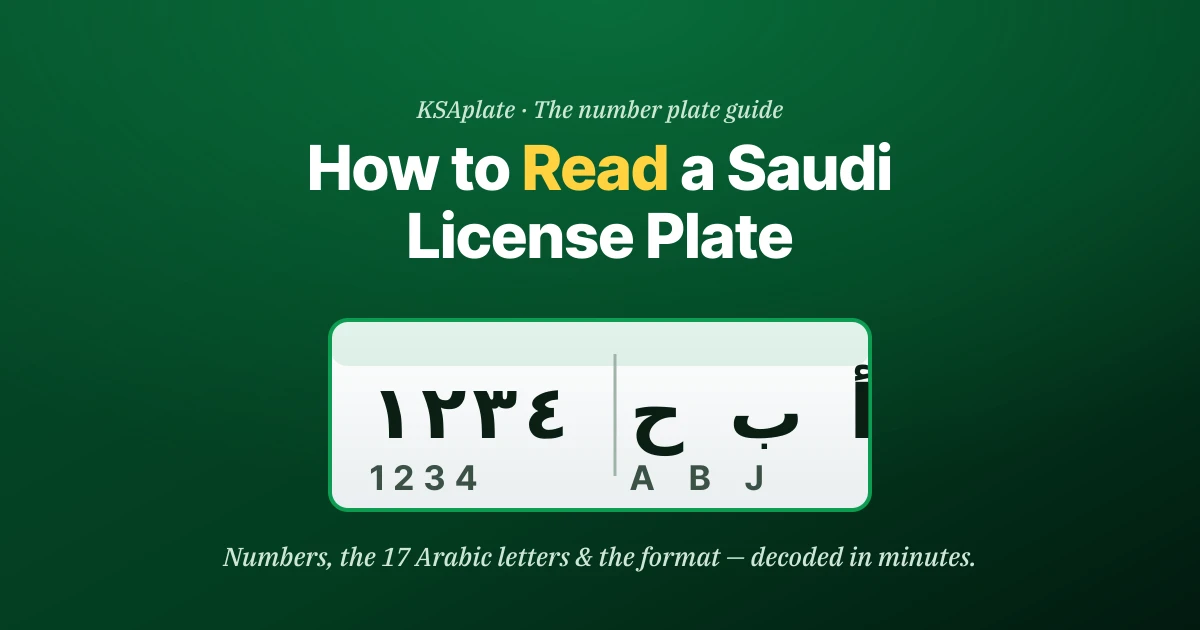
TL;DR:
- A Saudi license plate carries up to 4 numbers and up to 3 letters, each printed twice — once in Arabic script and Arabic-Indic numerals on top, once in Latin letters and Western numerals below.
- To read it, read the two halves separately: the digits on one side, the letters on the other, using the bottom (Latin/Western) line if Arabic is unfamiliar.
- Only 17 Arabic letters are allowed, and seven of them map to surprising Latin codes — ح is J, ص is X, ع is E, ق is G, م is Z, و is U and ى is V.
- A coloured strip beside the number tells you the vehicle type at a glance — the plate itself is white — with white for private, yellow for taxis and public transport, blue for commercial and heavy transport, green for diplomatic and silver for temporary.
- How you read a plate also reveals its value — fewer digits, repeating or mirror numbers, and meaningful letters all push the price up.
Quick answer: To read a Saudi license plate, look at the two rows. The top row is Arabic — Arabic-Indic numerals and Arabic letters. The bottom row is the Latin/Western version of the same plate. Read the numbers (up to four digits) on one side and the letters (up to three) on the other. If you don't read Arabic, just use the bottom line, remembering that seven letters use non-obvious codes such as ح = J and ع = E.
What's actually on a Saudi plate
Before you can read a Saudi license plate, it helps to know what every element on it is. A Saudi plate — also called a number plate — is issued by the General Directorate of Traffic (Moroor). The part you actually read is just two things: a group of numbers and a group of letters. Around them the plate carries the national emblem (a palm tree above crossed swords), the Kingdom's name, the "KSA" country code and a coloured strip marking the vehicle category — but no city name, no slogan and no expiry date.
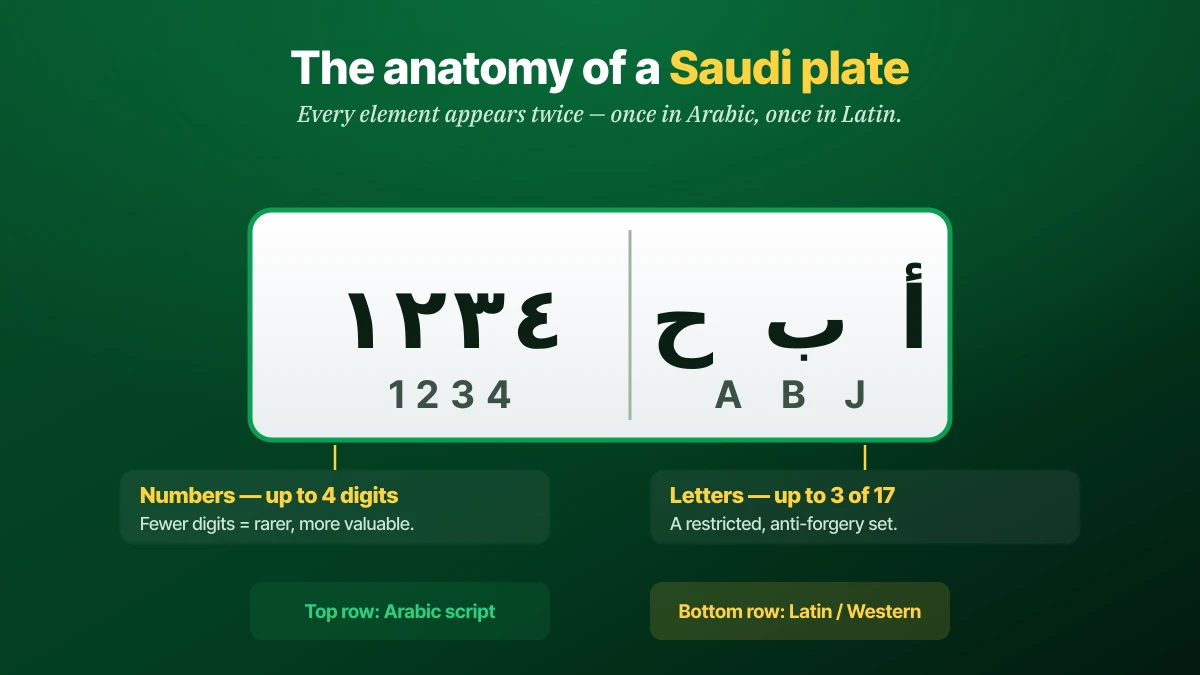
The plate holds up to four digits and up to three letters. Crucially, every element appears twice: the top of the plate shows the Arabic version (Arabic letters and Arabic-Indic numerals), and the bottom shows the Latin version (Western letters and 0–9 numerals). That bilingual design is deliberate, so the plate can be read both by Arabic speakers and by the millions of residents and visitors who don't read Arabic. For the full background on the system, see our pillar guide to Saudi license plates (number plates).
The dual layout: Arabic and Latin
The single most important thing to understand is that a Saudi plate is the same information shown in two scripts at once. You are never reading two different plates — you are reading one plate rendered twice.
- Top line (Arabic): the numbers appear as Arabic-Indic numerals (٠١٢٣٤٥٦٧٨٩) and the letters as Arabic characters.
- Bottom line (Latin): exactly the same numbers as Western digits (0–9) and the same letters as their fixed Latin equivalents.
This is why reading a Saudi plate is easier than it first looks: if the Arabic is unfamiliar, you can simply read the bottom line and you have the entire plate. The two halves of the plate — numbers and letters — are usually separated by a divider, and the layout is consistent on every standard plate, whether it sits on a long European-style plate or a square American-style one. The shape doesn't change what's on it; for the difference between the two formats, see our guide to Saudi plate sizes.
Reading the numbers
The numbers are the easy part — but only if you can match the Arabic-Indic numerals to the Western ones. They look different from the digits used in English, yet they map one-to-one. Here is the full set.
| Western | 0 | 1 | 2 | 3 | 4 | 5 | 6 | 7 | 8 | 9 |
|---|---|---|---|---|---|---|---|---|---|---|
| Arabic-Indic | ٠ | ١ | ٢ | ٣ | ٤ | ٥ | ٦ | ٧ | ٨ | ٩ |
A few of these trip people up. The Arabic ٥ looks like a Western 0, and the Arabic ٦ looks like a Western 7 — but they are 5 and 6. When in doubt, read the bottom (Western) line of the plate, which spells the number out in the digits you already know. A Saudi plate has anywhere from one to four digits, and the digit count alone is a strong clue to its rarity: a single-digit plate is among the scarcest objects on the road, while a random four-digit number is common. We come back to what that means for value below.
What's your plate worth?
Get an instant, free estimate with our plate value calculator.
Calculate My Plate's ValueReading the letters (the 17-letter code)
The letters are where most people get stuck, because Saudi plates use only 17 of the 28 Arabic letters, and each one has a fixed Latin partner that doesn't always match its sound. The restricted set is an anti-forgery measure — it removes letters that look almost identical — and the Latin codes prioritise uniqueness over phonetics, so every letter gets its own single Latin character.
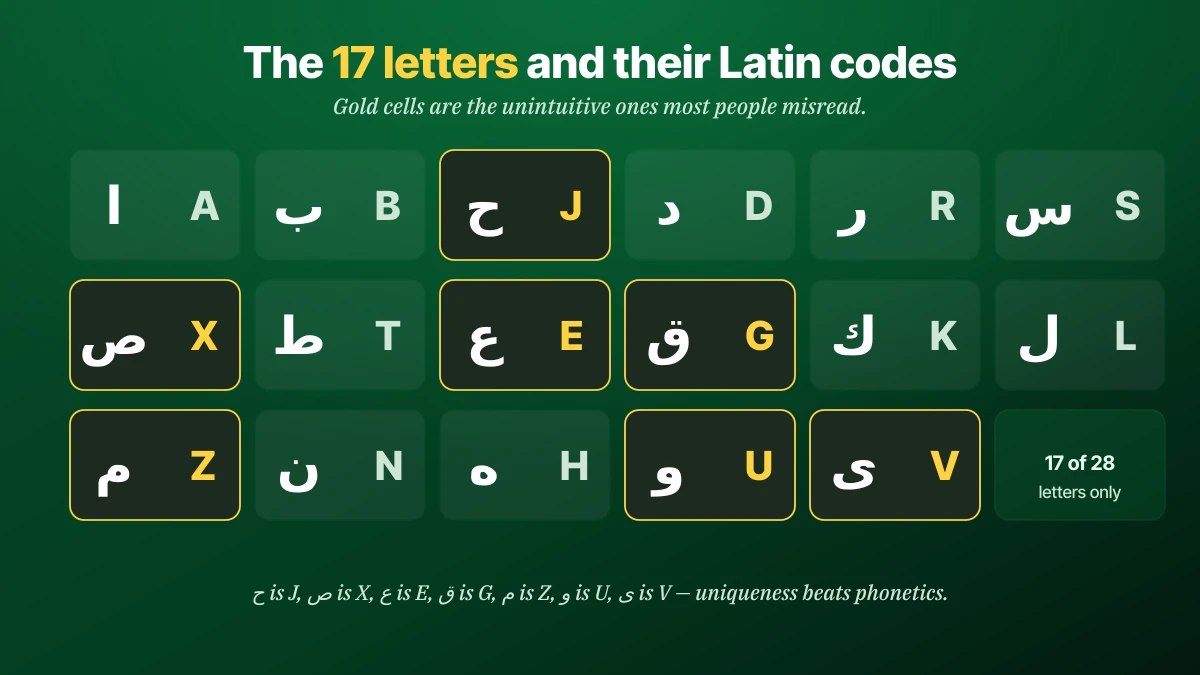
Here is the complete official mapping. The seven highlighted rows are the ones that surprise people — memorise these and you can read almost any plate.
| Arabic | Latin | Arabic | Latin | Arabic | Latin |
|---|---|---|---|---|---|
| ا | A | ط | T | ن | N |
| ب | B | ع | E | ه | H |
| ح | J | ق | G | و | U |
| د | D | ك | K | ى | V |
| ر | R | ل | L | ||
| س | S | م | Z | ||
| ص | X |
The seven to remember are: ح = J, ص = X, ع = E, ق = G, م = Z, و = U, ى = V. The reason ح becomes J (and not H) is that H was already taken by ه, and م becomes Z because the more obvious Latin letters were already assigned — the system needed every Arabic letter to have a unique code. For the deep dive on every letter, the excluded eleven, and which combinations are most valuable, see our complete guide to the Arabic letters on Saudi plates.
Which way do you read it?
Arabic is written right-to-left and Latin left-to-right, which can make a bilingual plate look confusing. In practice the rule is simple: read each line in its own direction, and you'll get the same plate either way.
- On the Arabic (top) line, the characters are laid out for right-to-left reading.
- On the Latin (bottom) line, the same characters read naturally left-to-right.
Because both lines encode the identical number-and-letter combination, you never have to mentally reverse anything. If you read English, drop your eyes to the bottom line and read it normally — that is the plate. The Arabic line is there for Arabic readers and confirms the very same combination.
You are not decoding a cipher. A Saudi plate is one combination shown twice — pick the line you can read and the other line will always agree.
Why a listing can look reversed
Reading a plate in front of you is one thing; finding that same plate in a classified listing is another. Because the Arabic line runs right-to-left and the Latin line left-to-right, sellers type the same three letters in opposite orders — and both spellings end up on the market.
In our own snapshot of live Saudi listings the reversed spelling is often the more common one: نور appears 0 times in reading order and 6 times as ر و ن; حرب 1 against 5; سعد 2 against 4; رند 0 against 4. If a search returns nothing, enter the letters the other way round before concluding the plate is not for sale.
Worked examples: decode a plate step by step
Let's put it together. Reading a plate is a three-step routine: read the digits, read the letters, then note the colour. Here are three worked examples.
| What you see (Arabic) | Numbers | Letters (Arabic → Latin) | Reads as |
|---|---|---|---|
| ١٢٣٤ · أ ب ح | 1234 | ا→A, ب→B, ح→J | 1234 ABJ |
| ٧٧٧ · م ل ك | 777 | م→Z, ل→L, ك→K | 777 ZLK |
| ٥ · ع و ى | 5 | ع→E, و→U, ى→V | 5 EUV |
Walk through the second one. The digits ٧٧٧ are three sevens, so the number is 777 — a repeating-number plate, which is already a premium pattern. The letters م ل ك translate to Z L K, and in Arabic those three letters spell Malik (king) — one of the most valuable letter combinations in the entire market. So just by reading the plate correctly, you can tell this is a high-value combination, not an ordinary one. The third example shows the tricky letters in action: ع و ى looks impossible until you know it is simply E U V.
Telling the vehicle type by colour
The final piece of reading a plate isn't a character at all — it's the colour. And one detail catches people out: on the current design the colour is not the plate's background. The plate is white, and the category colour appears in the vertical strip beside the number, next to the "KSA" code, reinforced by a small symbol below the national emblem — a circle for private, a triangle pointing up for passenger transport, a triangle pointing down for commercial, a white panel for diplomatic and a sideways triangle for temporary. The scheme is consistent nationwide and is documented by Wikipedia and Saudi motoring references such as Al Muraba.
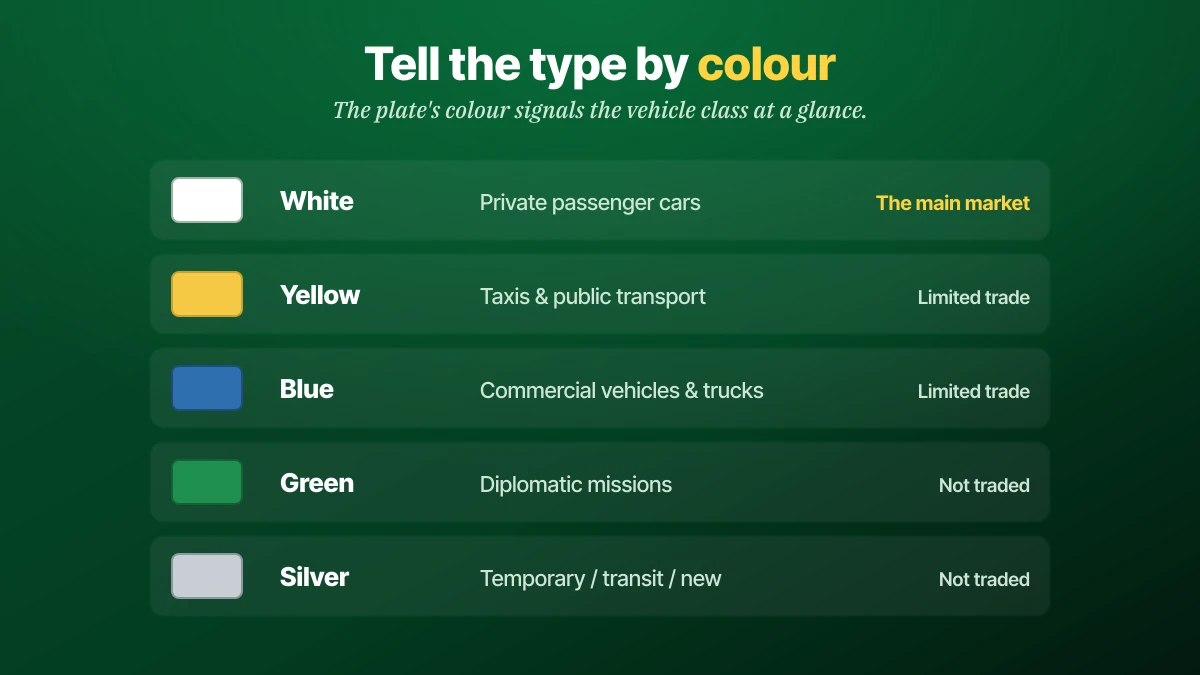
| Colour | Vehicle type | Tradable? |
|---|---|---|
| White | Private passenger cars | Yes — the main market |
| Yellow | Taxis & public transport | Limited |
| Blue | Commercial vehicles & trucks | Limited |
| Green | Diplomatic missions | No |
| Silver | Temporary / transit / new | No |
For everyday reading, the takeaway is simple: a white plate is a private car, and white plates are where almost all plate trading happens, because they carry the short, clean combinations buyers want. For the full breakdown of every colour, category and the national-emblem plates, see our guide to the types and colours of Saudi plates.
Does a Saudi plate show the city?
A common question from drivers used to other countries is whether the plate reveals where the car is from. The Saudi plate combination itself does not encode a city or region — there's no Riyadh code or Jeddah code printed in the number. Unlike some plate systems abroad, you can't look at a Saudi plate and know the registration city from the characters alone.
That said, the city the plate was issued in is recorded in the vehicle's official record. Does it change the price? On our own listings, once you hold digit count and pattern constant, the answer is essentially no: across four-digit non-repeating plates the median asking price is SAR 3,100 in Riyadh, SAR 3,200 in Jeddah and SAR 3,100 in Dammam — a spread of about 3%. City looks like it matters only when you compare cities without controlling for what is actually being listed in each. What city does affect is reach, which we cover in our look at Saudi plate regional markets. For the purpose of simply reading a plate on the road, there is no hidden geography to decode — just numbers, letters and colour.
What reading a plate tells you about its value
Once you can read a Saudi plate fluently, you can also estimate its worth, because value is driven entirely by the combination you've just read — not by the car it's bolted to. Five readable signals decide the price, and they stack on top of each other.
- Digit count: fewer digits are rarer. One, two and three-digit plates command the highest prices; four digits are ordinary.
- Number pattern: repeating numbers (7777), sequences (1234) and mirror/palindrome numbers (12321) all carry a premium. See our guide to Saudi plate number patterns.
- Letters: triple identical letters, or letters that spell a word or name, are the most sought-after — the Malik example above is the classic case.
- Cultural meaning: numbers seen as lucky, such as 786 or 777, attract higher bids. See lucky plate numbers.
- Demand: a combination tied to a name, tribe or brand can spike in value.
This is the practical payoff of learning to read plates: you can glance at a number and immediately sense whether it's a few-thousand-riyal plate or a six-figure one. To turn that instinct into a figure, use the free plate value calculator, which scores any combination using these same factors, or read how to calculate your plate's value. When you're ready to act, you can browse the marketplace or list a plate of your own.
Common misreadings to avoid
Most plate-reading errors come from a short list of predictable slips. Watch for these and you'll read accurately every time.
- Reading ح as H. It's J on a Saudi plate. H belongs to ه. This is the single most common mistake.
- Misreading the numerals. Arabic ٥ (5) looks like a Western 0, and ٦ (6) looks like a 7. If unsure, read the bottom Western line.
- Confusing ع (E) and ق (G). Both have non-obvious codes; check them against the table rather than guessing by sound.
- Assuming the plate shows a city. It doesn't — the combination carries no regional code.
- Trying to reverse the Latin line. The bottom line already reads left-to-right; don't flip it.
- Ignoring the colour. A plate isn't fully "read" until you've noted whether it's white, yellow, blue, green or silver.
If you're reading a plate because you're thinking of buying it, reading it correctly is only step one — you should also confirm the plate's record is clean before paying. Our guide on how to verify a Saudi plate before buying covers exactly that.
Check the istimara, not a converter. The seventeen letter codes are fixed and every published reference gives the same table — but software can still get them wrong. Our own converter mapped م to M and Z to ز until 8 September 2026, and neither is the correct code. Copy the Arabic letters from your vehicle registration document in the order printed there. If you want to know which names those letters can actually spell, see our guide to Saudi plates with your name.
Frequently asked questions
How do you read a Saudi license plate?
Why do the letters on a Saudi plate look wrong in English?
How many letters and numbers are on a Saudi plate?
What are the Arabic-Indic numbers on the plate?
Why do Saudi plates only use 17 Arabic letters?
Which way do you read a bilingual Saudi plate?
Does a Saudi license plate show which city the car is from?
What do the plate colours mean?
Can reading a plate tell me what it's worth?
Conclusion & next steps
Reading a Saudi license plate comes down to three quick moves: read the numbers, translate the up-to-three letters using the 17-letter code, and note the colour to know the vehicle type. The bilingual layout is your safety net — if the Arabic is unfamiliar, the Latin line spells out the whole plate, and the only real traps are the seven letters with surprising codes (ح = J, ص = X, ع = E, ق = G, م = Z, و = U, ى = V) and the two lookalike numerals (٥ and ٦). Master those and you can read any plate on a Saudi road in seconds — and judge its rarity while you're at it. To put that skill to work, score any combination on the free plate value calculator, then browse the marketplace or list your own plate. For the bigger picture, start with our complete guide to Saudi license plates.