


Last updated: 25 September 2026 · By Khalid Al-Rashid
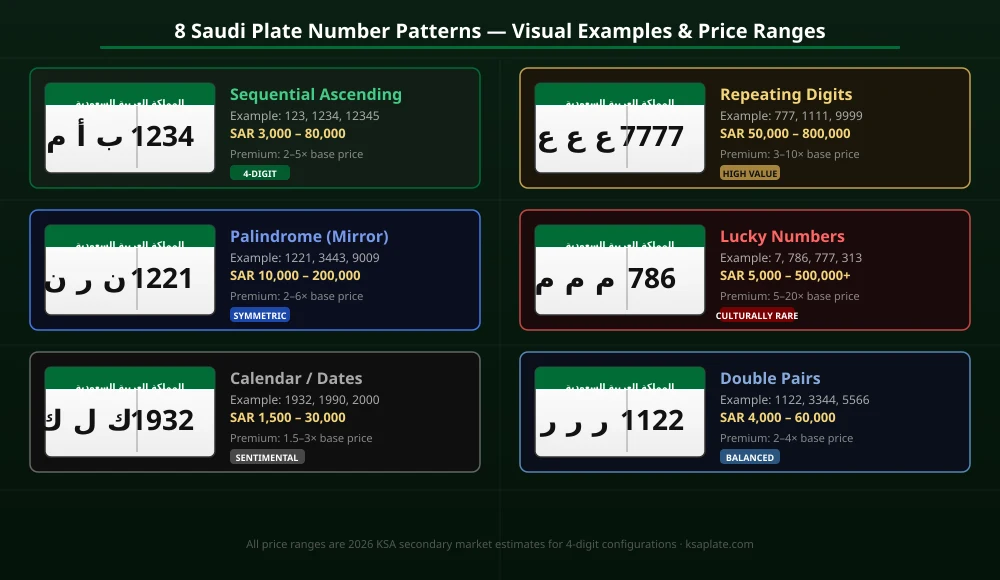
- Saudi license plates carry eight distinct number patterns — sequential, repeating, palindrome, lucky numbers, double pairs, ladder/step, calendar dates, and descending — each commanding a different market premium.
- Repeating digits carry the only large pattern premium we can measure — ×2.98 on four-digit plates. Single-digit plates are expensive because they are short, not because they repeat: their median is SAR 140,000 against SAR 3,300 for four-digit plates.
- Ascending sequences are the most accessible pattern — ×1.21 on four-digit plates, a median of SAR 4,000 against SAR 3,300 — which makes them the cheapest way to own a recognisable number.
- Lucky numbers pay only as standalone three-digit plates: 777 asks ×1.80, 999 ×1.32 and 786 ×1.18. Buried inside a four-digit number, 786 asks ×0.82 — below an ordinary plate.
- Letters matter less than the number. Three identical letters add 33–39% to the asking price; two identical letters add 15–24%. Neither is a multiple of the price.
- Use the KSAplate Value Calculator to estimate your plate's pattern premium instantly.
The most valuable Saudi license plates share one trait: their number tells a visual story at a glance. Sequential digits (1234), repeating digits (7777), and palindromes (1221) are not random — they are deliberate patterns that make a plate instantly recognizable, memorable, and scarce. Measured across 9,839 priced listings, pattern premiums are narrower than the market talks about: from ×0.97 on double pairs to ×2.98 on four-digit repeating digits. This guide maps every pattern type, its exact rarity, its 2026 price range, and which combinations sit at the intersection of pattern and letter value.
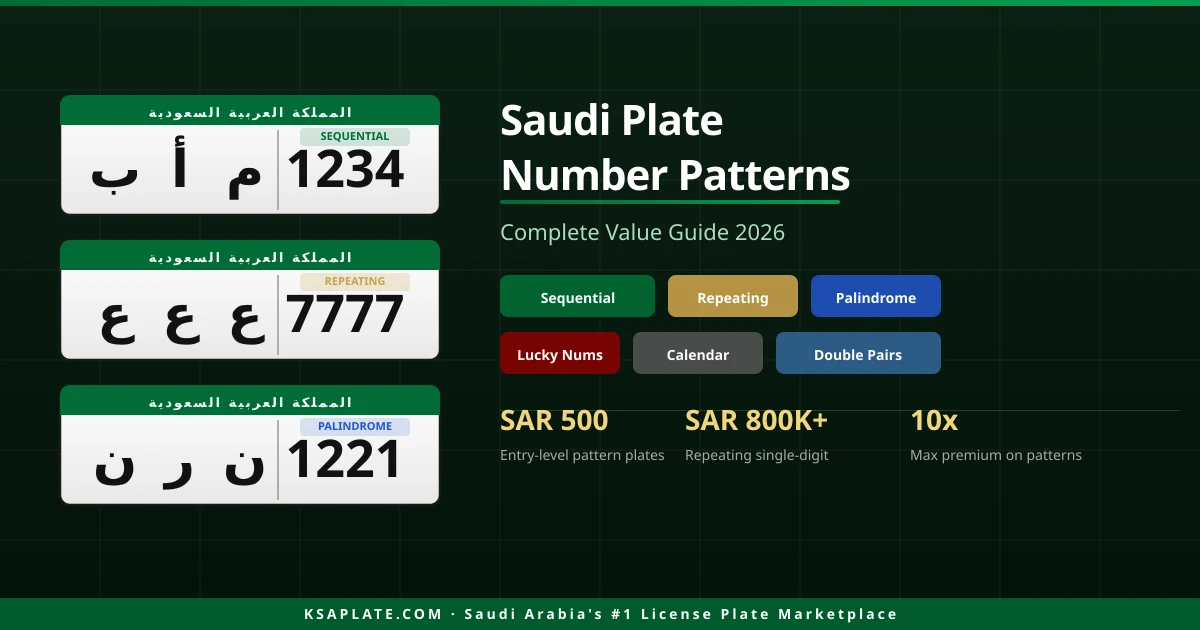
Table of Contents
- What Is a Pattern Plate in Saudi Arabia?
- The 8 Pattern Types — Complete Taxonomy
- Sequential Plates (1234, 12345)
- Repeating Digit Plates (777, 7777)
- Palindrome (Mirror) Plates (1221, 3443)
- Lucky Number Plates (786, 777, 313)
- Double Pair Plates (1122, 3344)
- Ladder and Step Plates (1357, 2468)
- Calendar Date Plates (1932, 1990, 2000)
- Pattern Value Hierarchy — Side-by-Side Comparison
- How We Measured This — and Why Most Numbers You See Are Wrong
- The Arabic Letter Multiplier
- Buyer's Guide by Budget
- How to Spot an Undervalued Pattern Plate
- Frequently Asked Questions
What Is a Pattern Plate in Saudi Arabia?
A pattern plate is any Saudi private vehicle registration whose number follows a recognizable mathematical or cultural sequence. The Saudi plate format — up to three Arabic letters plus up to four digits — gives the number portion a maximum of 9,999 combinations per letter group. Within that range, certain number sequences stand out visually and culturally. The market applies a "pattern premium" to these plates: a percentage above what the same digit count with random numbers would fetch. Pattern premiums in 2026 run from ×0.97 (double pairs) through ×1.05 (Gregorian calendar dates) and ×1.21 (ascending sequences) to ×2.98 (four-digit repeating digits). Digit length moves the price far more than any pattern does.
The term "distinctive plate" (لوحة مميزة) in Saudi usage covers any plate perceived as above-average in desirability — including but not limited to pattern plates. Not all distinctive plates are pattern plates. A plate with only two digits (e.g., 37) is distinctive because of its low digit count, regardless of the numbers themselves. Pattern plates are distinctive because of how the digits relate to each other.
Key principle: Pattern premiums are multiplicative, not additive. A plate with a strong pattern and a strong letter combination does not get a "pattern premium + letter premium" added together — the two premiums multiply against each other. Pattern and letters stack, but modestly: a four-digit repeating plate asks ×2.98 and three identical letters add ×1.39, so the combination lands near ×4 — not the double-digit multiples often quoted.
The 8 Pattern Types — Complete Taxonomy
Saudi plate number patterns fall into eight categories. Each has a distinct rarity profile, buyer demographic, and price ceiling. The table below summarizes all eight.
| Pattern | 3-digit median | vs all 3-digit | 4-digit median | vs all 4-digit |
|---|---|---|---|---|
| Repeating digits (777, 7777) | SAR 36,750 (n=148) | ×1.39 | SAR 9,850 (n=390) | ×2.98 |
| Palindrome / mirror (121, 1221) | SAR 28,500 (n=183) | ×1.08 | SAR 3,700 (n=363) | ×1.12 |
| Ascending sequence (123, 1234) | SAR 27,500 (n=78) | ×1.04 | SAR 4,000 (n=167) | ×1.21 |
| Only two distinct digits | SAR 26,000 (n=215) | ×0.98 | SAR 3,400 (n=480) | ×1.03 |
| Double pairs (1122, 3344) | — | — | SAR 3,200 (n=47) | ×0.97 |
| Mixed digits (no pattern) | SAR 25,000 (n=763) | ×0.94 | SAR 3,100 (n=6,486) | ×0.94 |
| All plates of that length | SAR 26,500 (n=1,399) | 1.00 | SAR 3,300 (n=7,939) | 1.00 |
Shorter plates sit far above both columns and are too few to break down by pattern: the 79 priced one-digit plates have a median of SAR 140,000, and the 422 two-digit plates SAR 36,000 — where repeating digits (11, 22, 99) reach SAR 54,500, a ×1.51 premium.
One pattern carries a large premium. The rest carry a small one, and one carries none at all.
Key takeaway: repeating digits are the only pattern that changes the price band it sits in, and the effect grows as the plate gets longer — ×1.39 at three digits, ×2.98 at four. A four-digit palindrome, by contrast, asks 12% more than an ordinary four-digit plate, not multiples more. Double pairs ask slightly less than a plate with no pattern at all.
What's your plate worth?
Get an instant, free estimate with our plate value calculator.
Calculate My Plate's ValueSequential Plates (1234, 12345)
A sequential ascending plate is a plate whose digits form a consecutive rising integer sequence with a step size of exactly 1. For four-digit plates, the six possible combinations are 1234, 2345, 3456, 4567, 5678, and 6789. Five-digit sequential plates (12345, 23456) exist in the system but are less common in the premium secondary market.
Why Buyers Prize Sequential Plates
Sequential plates stand out because the human eye recognizes the ascending order instantly. On a moving vehicle, a plate reading 1234 communicates pattern, symmetry, and deliberate selection — the three hallmarks of a prestigious plate. Among the six ascending combinations, 1234 commands the highest premium because it starts at the absolute minimum digit (1) and has the longest recognized cultural history in Saudi collecting.
Sequential Plate Pricing in 2026
- 1234 + premium triple letters: SAR 40,000 – 80,000
- 1234 + standard letters: SAR 8,000 – 25,000
- 2345 or 3456 + premium letters: SAR 15,000 – 40,000
- 5678 or 6789 + standard letters: SAR 3,000 – 10,000
- 12345 (5-digit sequential): SAR 2,000 – 8,000
Sequential plates are the most accessible pattern premium in the Saudi market. A buyer with SAR 10,000–30,000 can own a genuine pattern plate with strong resale liquidity. Browse current sequential listings at KSAplate.com → Browse Plates.
Descending Sequential Plates
Descending sequences (9876, 8765) exist but attract lower premiums than ascending sequences — roughly 60–75% of the ascending premium at the same digit positions. The market interprets ascending as "forward progress" and descending as "regression," which weakens buyer sentiment. For investment, ascending is the clear choice.
Repeating Digit Plates (777, 7777)
Repeating digit plates carry the same numeral in every position. They are the single rarest numbered pattern in the Saudi secondary market. For four-digit plates, there are exactly 9 combinations — 1111 through 9999 — per letter group. Because all repeating plates also read the same forwards and backwards, every repeating plate is simultaneously a palindrome, qualifying for both category premiums.
Number Rankings Within Repeating Plates
Not all repeating digits are equal. The Saudi market ranks them by cultural and religious significance:
- 9 (9999, 999, 99): References the 99 Names of Allah (أسماء الله الحسنى). Highest premium within the repeating category across all digit counts.
- 7 (7777, 777, 77): The number of heavens, seven circuits of Tawaf, seven days. Strong universal appeal across Muslim and non-Muslim buyers.
- 1 (1111, 111, 11): Tawhid (the Oneness of God), leadership, top rank. Consistently strong in two-digit form (11).
- 8 (8888, 888, 88): Prosperity association from East Asian buyer influence in the Gulf market, plus inherent symmetry.
- 5, 3, 6, 2, 4: Lower demand, but still command significant premiums over non-pattern plates.
For a detailed breakdown of repeating plate prices and the full rarity math, see the Saudi Repeating Plates guide on KSAplate.com.
Palindrome (Mirror) Plates (1221, 3443)
A palindrome plate reads identically whether you scan left-to-right or right-to-left. For four-digit plates, valid palindromes follow the form ABBA — where the first and fourth digits are the same, and the second and third are the same. The six possible values per position give 90 non-repeating palindrome combinations per letter group (excluding the 9 repeating plates, which are a strict subset).
Top Palindrome Combinations by Demand
- 1221: Most sought-after non-repeating palindrome. Combines 1 (leadership) with 2 (pairs/balance).
- 9009: Uses the culturally resonant 9, framed by zeros for visual impact.
- 7117, 7447, 7007: 7 in the prominent outer position. Consistent strong demand.
- 3443, 4554: Mid-range demand, strong visual symmetry, more accessible price points.
Palindromes are also called "mirror plates" in the Saudi market. Our full Mirror Plates guide covers every palindrome combination with 2026 price data.
Lucky Number Plates (786, 777, 313)
Lucky number plates are driven by cultural and religious meaning rather than purely mathematical pattern. A single determined buyer can pay far above the median for one specific number, which is why this category has the widest spread of any we measured — but the median tells you what the rest of the market is actually asking. Three numbers dominate:
786 — The Bismillah Plate
The number 786 is the Abjad numerical value of the Arabic phrase "Bismillah Al-Rahman Al-Raheem" (بِسْمِ اللَّهِ الرَّحْمَٰنِ الرَّحِيمِ) — "In the name of God, the Most Gracious, the Most Merciful." This is widely used across the Islamic world as a shorthand blessing. A plate reading 786 is not merely a number to its owner — it is a moving declaration of faith. Three-digit 786 plates with triple-same letters sell in the SAR 50,000–300,000 range.
777 — The Triple Seven
The number 7 holds the deepest resonance in Islamic numerology: seven heavens, seven earths, seven Tawaf circuits at Kaaba, seven Sa'i circuits at Safa and Marwa. Three sevens compounds the symbolism. Four sevens (7777) reaches repeating-digit territory. The 777 three-digit plate with premium letters trades in the SAR 80,000–250,000 band.
313 — The Badr Plate
The number 313 references the number of companions (صحابة) who fought at the Battle of Badr — the first major military victory in Islamic history. This plate has intense demand among religious collectors. It also has a natural palindrome quality (3-1-3 reads the same in both directions for a three-digit plate). Three-digit 313 plates with strong letters trade at SAR 30,000–150,000.
For full cultural breakdowns of lucky numbers, see the Lucky Numbers guide.
Double Pair Plates (1122, 3344)
A double pair plate contains two pairs of identical digits in sequence. For four-digit plates: 1122, 1133, 1144 through 8899 — approximately 72 non-repeating double-pair combinations per letter group. These plates appeal to buyers who want visual balance without the extreme scarcity (and price) of fully repeating plates. On paper 1122 is the most sought-after of these, combining the two lowest digits with ascending pair symmetry. The market does not currently reward the shape: across 47 priced double-pair listings the median is SAR 3,200, slightly below the SAR 3,300 median for all four-digit plates.
Double Pairs vs. Palindromes — Which Is Better?
Measured against live listings of the same digit length, four-digit palindromes ask ×1.12 and double pairs ×0.97 — so the palindrome is the stronger of the two today, though both sit close to an ordinary plate. We make no claim about how either has appreciated over time: no public record of realised Saudi plate prices exists, so any multi-year return figure for this market is an estimate. Double pairs are more plentiful (72 combinations vs. 90 palindromes, but palindromes include more "premium" outer-digit 1 and 7 combinations). If forced to choose between 1122 and 1221 at the same price, the palindrome 1221 has the stronger resale case because it satisfies the mirror-plate buyer pool in addition to the pattern-plate buyer pool.
Ladder and Step Plates (1357, 2468)
Ladder plates skip every other integer. The two main subtypes are odd-step (1357, 3579) and even-step (2468, 4680). These patterns are immediately recognizable — the eye follows the cadence of the sequence and perceives it as deliberate. However, ladder plates are less scarce than sequential or palindrome plates: the pattern is obvious but the combination count is low, which paradoxically makes them harder to find on the secondary market at any given moment.
The 2468 plate holds a cultural edge in the Saudi market because "even and balanced" carries positive connotations. The 1357 plate connects to religious symbolism (the odd numbers being especially significant in Islamic tradition — the Prophet Muhammad said "God is odd (witr) and loves the odd number").
Calendar Date Plates (1932, 1990, 2000)
Calendar plates are four-digit numbers that correspond to significant years. Their buyer pool is narrow but price-insensitive: a buyer who wants the year they were born or the year the Kingdom was founded will often pay well above market rate for that specific combination.
Most In-Demand Calendar Date Combinations
- 1932: The year of the Kingdom of Saudi Arabia's founding (September 23, 1932).
- 2030: Saudi Vision 2030 — the national transformation roadmap. Growing demand as 2030 approaches.
- 1990, 1995, 2000: Millennial and Gen-Z birth years. Personal milestone buyers.
- 1979: Historically significant year (Islamic calendar year 1400, plus the Grand Mosque Seizure). Niche but motivated buyers.
- 1446, 1447: Current and upcoming Hijri years. A specific collector demographic.

Pattern Value Hierarchy — Side-by-Side Comparison
Every figure in this section is measured, not estimated. On 25 September 2026 we took every active listing on this marketplace that carries an asking price — 9,839 plates — and computed the median for each pattern within each digit length. Comparing patterns without holding digit length constant is the single most common way plate "premiums" get overstated, and we show exactly how much further down.
The critical insight: pattern premiums compress at the low end and expand at the high end. Gregorian calendar dates (1900–2030) ask ×1.05 — barely above an ordinary four-digit plate. Hijri years (1400–1460) do better at ×1.27. Adding three identical letters lifts it to roughly ×1.4 of the four-digit median — the letters help, but they do not transform the plate.
How We Measured This — and Why Most Numbers You See Are Wrong
A pattern premium is the ratio between the median asking price of plates carrying that pattern and the median of all plates of the same digit length. The second half of that sentence is what most pattern guides leave out, and leaving it out inflates every number in the table.
Here is the effect, using our own figures. Pool all repeating-digit plates together, regardless of length, and the median asking price is SAR 25,500. That looks like a spectacular premium against an overall market median of SAR 3,700. But the pool mixes a handful of one- and two-digit plates — which are expensive because they are short, not because they repeat — with 390 four-digit ones. Hold length constant and the four-digit repeating median is SAR 9,850. The uncontrolled figure is roughly two and a half times the honest one.
The same trap produces the familiar claim that mirror plates are worth several times a normal plate. Uncontrolled, palindromes look strong. Controlled for length, they ask 8–12% more.
What this data is and is not. These are asking prices from live listings, not confirmed sale prices. Saudi plate transfers are private and no public register records what a plate actually fetched, so nobody — us included — can publish verified realised prices or multi-year returns for this market. Anyone who does is estimating. Seeded demonstration rows are excluded from every figure here; the pool is live listings that carry a real asking price.
Key takeaway: when a pattern guide quotes a premium without saying how many digits the comparison plates had, the number is not usable. Ask for the digit length and the sample size.
The Arabic Letter Multiplier
Pattern premiums do not operate in isolation. The Arabic letter combination on a Saudi plate multiplies — not just adds to — the underlying number pattern premium. The letter hierarchy works as follows:
| Letter group | 3-digit median | vs all 3-digit | 4-digit median | vs all 4-digit |
|---|---|---|---|---|
| Three identical letters (ع ع ع) | SAR 35,250 (n=78) | ×1.33 | SAR 4,600 (n=406) | ×1.39 |
| Two identical + one different | SAR 30,500 (n=67) | ×1.15 | SAR 4,100 (n=385) | ×1.24 |
| All three letters different | SAR 26,000 (n=1,253) | ×0.98 | SAR 3,200 (n=7,145) | ×0.97 |
The letter effect is real and it is consistent across both lengths — but it is a third to a half on top of the price, not a multiple of it. Sellers who price a triple-letter plate at several times a comparable plate are asking well above what the rest of the market asks for the same configuration.
Key takeaway: repeated letters add roughly 24–39% to the asking price. Repeated digits at four digits add ×2.98. If you are choosing where to spend, the number matters more than the letters.
See the full Arabic Letters guide for rankings of all 17 used letters and their scarcity tiers.
Buyer's Guide by Budget
Under SAR 10,000 — Entry Level
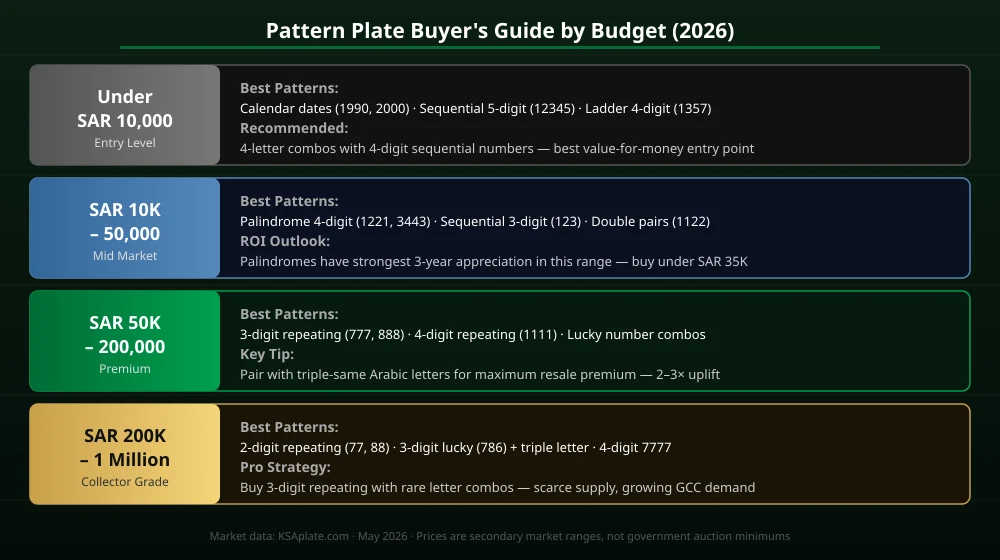
At this price point, the best pattern options are: four-digit sequential plates with standard letters (e.g., 5678 + common letters), five-digit sequential plates, calendar-date plates with personal significance, and ladder plates. These are legitimate pattern plates with real premiums — they simply sit at the lower end of the value hierarchy. For anyone starting a plate portfolio, a SAR 5,000–10,000 sequential plate is a lower-risk entry point than a random non-pattern plate in the same range.
SAR 10,000 – 50,000 — Mid Market
This budget unlocks palindromes (four-digit combinations like 1221, 3443, or 9009 with mid-tier letters), double pairs (1122 with above-average letters), and three-digit sequential plates (123, 234) with standard letters. Palindromes ask a modest premium in this band (×1.12 at four digits) and are far more plentiful than repeating-digit plates, which is what makes them easier to resell. List your plate for free at KSAplate.com → List Your Plate.
SAR 50,000 – 200,000 — Premium
At this level, three-digit repeating plates (777, 888 with mid-tier letters) become accessible. Four-digit lucky number plates (786 with standard letters, 7777 with basic letters) are also in range. The best strategy: look for underappreciated double-premium plates — palindromes that also qualify as lucky numbers (e.g., 7007, which is both a palindrome and a 7-dominant plate).
SAR 200,000 – 1 Million — Collector Grade
This range covers two-digit repeating plates (77, 88 with strong letters), three-digit lucky plates with premium letter combos (786 + triple-same), and four-digit repeating plates with rare letters. Strategy: focus on two-digit plates — they are structurally scarcer (only 9 combinations per letter group) and have the most reliable floor price in a market downturn.
Use the KSAplate Value Calculator to model any combination across all pattern tiers before you commit to a purchase.
How to Spot an Undervalued Pattern Plate
The Saudi plate secondary market has inefficiencies. Pattern plates are sometimes listed without pattern identification, meaning a seller who doesn't know the premium categories will price a 1234 plate as a generic four-digit plate rather than a sequential plate. Here is a five-step process to find undervalued pattern plates:
- Search by number range, not by pattern label. On KSAplate.com's browse page, filter by digit count and scan manually for sequential, palindrome, and double-pair combinations. Many sellers do not use pattern keywords in their listings.
- Check the letter tier independently. A pattern plate priced correctly for its pattern but with undervalued letters (seller focused only on the number, not the letters) is the classic double arbitrage opportunity.
- Compare against the repeating-plate price floor. Any four-digit palindrome should be worth at least 40–60% of the equivalent repeating plate in the same number/letter class. If it's priced below that, it's potentially undervalued.
- Watch for calendar-date plates listed as "random." A plate numbered 1990 or 2000 near a birth-year demographic surge (30-year-olds becoming high earners) has a natural demand catalyst.
- Verify via Absher before buying. Confirm the plate is active, unencumbered, and transferable through the Absher platform before any payment.
Pro tip: The most underpriced plate type in the 2026 Saudi market is the four-digit ascending sequential plate with premium triple-same letters. Sellers frequently price these on digit count alone (4-digit = standard pricing) without applying the sequential premium. These represent a 20–40% discount to fair value on a regular basis.
For the full buying process with Absher verification steps, read the Complete Buyer's Guide. If you want to sell a pattern plate, the Seller's Guide covers pricing strategy and listing optimization.
Frequently Asked Questions
What is the most valuable Saudi license plate number pattern?
Repeating digit plates (7777, 9999, 999) and single-digit plates (1, 7, 9) command the highest premiums. Repeating four-digit plates sell for SAR 20,000–500,000+ depending on letters. Single-digit plates with premium letter combinations have sold for up to SAR 24.15 million at Moroor auctions. Lucky number plates like 786 and 777 can reach similar levels when paired with rare triple-letter combinations.
What is a sequential plate in Saudi Arabia?
A sequential plate is a Saudi license plate whose digits form a consecutive ascending (or descending) sequence with a step of 1. The four-digit ascending sequential combinations are 1234, 2345, 3456, 4567, 5678, and 6789 — only six combinations per letter group. 1234 is the most valuable because it starts at the minimum digit and has the strongest cultural recognition. Four-digit sequential plates sell for SAR 3,000–80,000 depending on the specific combination and letter configuration.
Is 786 considered a pattern plate?
786 is classified as a "lucky number plate" rather than a strict mathematical pattern plate, because its value derives from religious and cultural significance (the Abjad numerical value of Bismillah) rather than from digit sequence structure. As a three-digit plate it does command a measurable premium: 786 asks a median SAR 31,250 against SAR 26,500 for all three-digit plates, or ×1.18. On KSAplate.com, 786 plates are categorized under both "Lucky Numbers" and the three-digit listings.
Do palindrome plates sell faster than other patterns?
Yes, in the SAR 10,000–150,000 range palindromes typically have the shortest average days-on-market of any pattern type. This is because they appeal to two distinct buyer groups simultaneously: collectors specifically seeking mirror plates, and general buyers who recognize the visual symmetry even without knowing the terminology. Average listed time for a well-priced palindrome on KSAplate.com is 14–30 days versus 45–60 days for a comparable non-pattern plate.
Can I mix pattern types? For example, a plate that is both sequential and palindrome?
True combination plates are theoretically possible but extremely rare. A plate that is simultaneously sequential and palindromic would need to read the same forwards and backwards while also having consecutive digits — mathematically impossible for sequences longer than one digit. However, a plate can be "double pattern" in other ways: 7007 is both a palindrome (7-0-0-7) and lucky (7-dominant), qualifying for both premiums. 1221 is a palindrome whose outer digits (1) are the market's most sought-after number.
How do I calculate the exact premium for my pattern plate?
Use the KSAplate Value Calculator — it applies the pattern premium matrix (pattern type × letter tier × digit count) to return an estimated fair market value range. The calculator is updated quarterly with actual transaction data from KSAplate.com listings. For trophy plates above SAR 200,000, a manual appraisal from a specialist is recommended alongside the calculator output.
Are descending sequential plates (9876) worth buying?
Descending sequential plates command approximately 60–75% of the premium of the equivalent ascending sequence. The 9876 plate (the most valuable descending sequence) does benefit from leading with 9 — the highest culturally significant single digit — which partly offsets the "descending" sentiment discount. For investment purposes, ascending plates are strongly preferred. For personal preference, a descending plate is a legitimate pattern plate with real market recognition.
What is a "double pair" plate and is it worth the premium?
A double pair plate has two pairs of identical consecutive digits — such as 1122, 3344, or 5566. The market does not pay for them: across 47 priced double-pair listings the median is SAR 3,200, against SAR 3,300 for all four-digit plates — ×0.97. Because they trade at roughly the ordinary four-digit price, they are worth buying when you simply like the shape — not as a way to capture a premium. Treat any double-pair asking well above the four-digit median as overpriced, whatever the combination.
How rare are sequential plates compared to repeating plates?
For four-digit plates, there are 6 sequential ascending combinations per letter group versus only 9 repeating combinations per letter group. Sequential plates are therefore slightly rarer in absolute count, but repeating plates command higher premiums because they satisfy a stronger cultural driver (all-same digits = maximum simplicity = maximum status). In practice, repeating plates are harder to find on the secondary market because their owners hold them longer — effective secondary market scarcity favors repeating over sequential.