


Last updated: 31 August 2026
TL;DR:
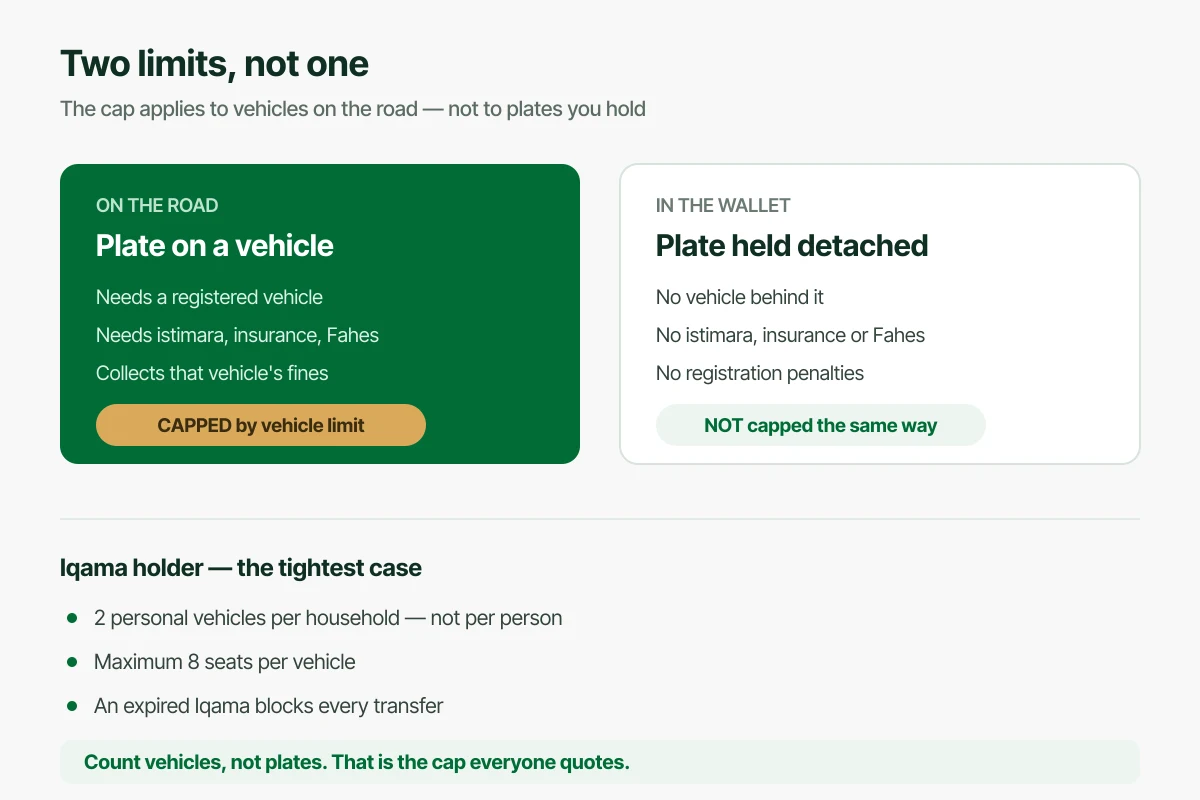
- Two different limits get confused as one. Saudi Arabia caps how many vehicles you can have registered — it does not cap plates the same way, because a plate can be held without a car.
- A plate on the road needs a vehicle. A plate in your Absher wallet does not. Detaching a plate moves it into your digital wallet, where it sits unattached, and unattached plates do not accrue registration penalties.
- Iqama holders are the tightest case: a maximum of two personal vehicles per household, which means two plates on the road at any one time.
- Holding costs money, not much. The Absher plate reservation service holds a number without a vehicle for SAR 100 per year.
- The real limit for most people is not regulatory. It is how many plates you can afford to hold, and whether you can clear a transfer when you want to sell.
Quick answer: There is no single number. Saudi Arabia limits how many vehicles you may have registered — two personal vehicles per household for Iqama holders — and each registered vehicle carries one plate. Plates you are not driving can be detached and held in your Absher digital wallet, and those are not capped the same way, so a collector can hold far more plates than cars.
Why this question has two answers
"How many plates can I own" is two questions wearing one coat: how many plates can be on the road in your name, and how many can you hold in total. The first has a clear cap. The second does not work the same way, and that is where almost every confused answer comes from.
A plate on a car is part of a vehicle registration. It is tied to an istimara, to insurance, to a periodic inspection, and to whatever fines that vehicle collects. Saudi Arabia does not really cap "plates" at that level — it caps how many vehicles a person or household may have registered, and a plate rides along with each one.
A plate that is not on a car is a different object entirely. Once detached, it sits in your Absher digital wallet with no vehicle behind it: no istimara to renew, no insurance to keep current, no inspection due. It is closer to holding a title deed than to owning a car.
Key takeaway: Count vehicles, not plates. The cap you keep reading about is a vehicle registration cap, and it only bites on plates you actually drive.
The limit that actually exists: vehicles
The binding rule in Saudi Arabia is a cap on registered vehicles, not on plate numbers. Each registered private vehicle carries exactly one plate, so the vehicle cap sets how many of your plates can be in use simultaneously.
For residents holding an Iqama, the documented limit is two personal vehicles per household, with a maximum of eight seats per vehicle. Two vehicles means two plates mounted and in use. A third plate you own is not illegal — it simply has nowhere to go until you free up a vehicle or hold it detached.
Saudi nationals are not held to the same two-vehicle household figure, which is why plate collecting is more visible among citizens. The practical constraint moves from a registration ceiling to the ordinary costs of running each vehicle: insurance, the periodic Fahes inspection, and the annual registration renewal.
Whichever category you fall into, the mechanism is identical. If you want a plate on the road, you need a vehicle registered in your name to receive it, and that vehicle has to be clean enough to accept a transfer in the first place — see why a plate transfer gets refused for the preconditions that block it.
Plates you hold but never drive
A detached plate is a plate you own that is attached to no vehicle, held in your Absher digital wallet. This is the mechanism that makes plate collecting possible at all, and it is the part most explanations skip.
Detaching is a deliberate step, not a side effect. Through Absher's vehicle services you initiate a plate detachment, which lifts the number off the car and moves it into your wallet. The car then carries a replacement plate and can be sold or scrapped independently, while the number you actually care about stays with you.
Two consequences matter for anyone holding more than a couple of plates. First, a detached plate is not attached to a vehicle registration, so it does not accumulate istimara-related penalties the way a lapsed car registration does. Second, it stays transferable: you can sell it, or re-register it onto a different vehicle later, without ever putting it back on a car in between.
This is also the clean answer to the most common seller's worry. If you sell the car but want the number, you detach first and transfer the car second — the process is set out in keeping your plate when you change cars.
This became possible in 2024. Saudi Arabia's Public Security launched a digital wallet for licence plates inside Absher, which holds the plate's ownership document and lets the owner keep ownership without the plate being registered on any vehicle. Guides written before that change state that a plate must sit on a registered vehicle at all times — that was correct then, and it is not correct now.
One limit is not settled, and you should treat it as open. Holding a plate detached is not the same as holding it forever: a reservation window applies, and a number whose window lapses without being fitted to an eligible vehicle can return to the Ministry's pool. We have not found that window published, so check it inside your own Absher account before you plan around it. Our guide to keeping your plate when you change cars sets out the retention sequence in full.
Key takeaway: Detachment is what separates "how many plates can I drive" from "how many plates can I own". Without it, the two numbers would be the same.
What's your plate worth?
Get an instant, free estimate with our plate value calculator.
Calculate My Plate's ValueWho can hold what
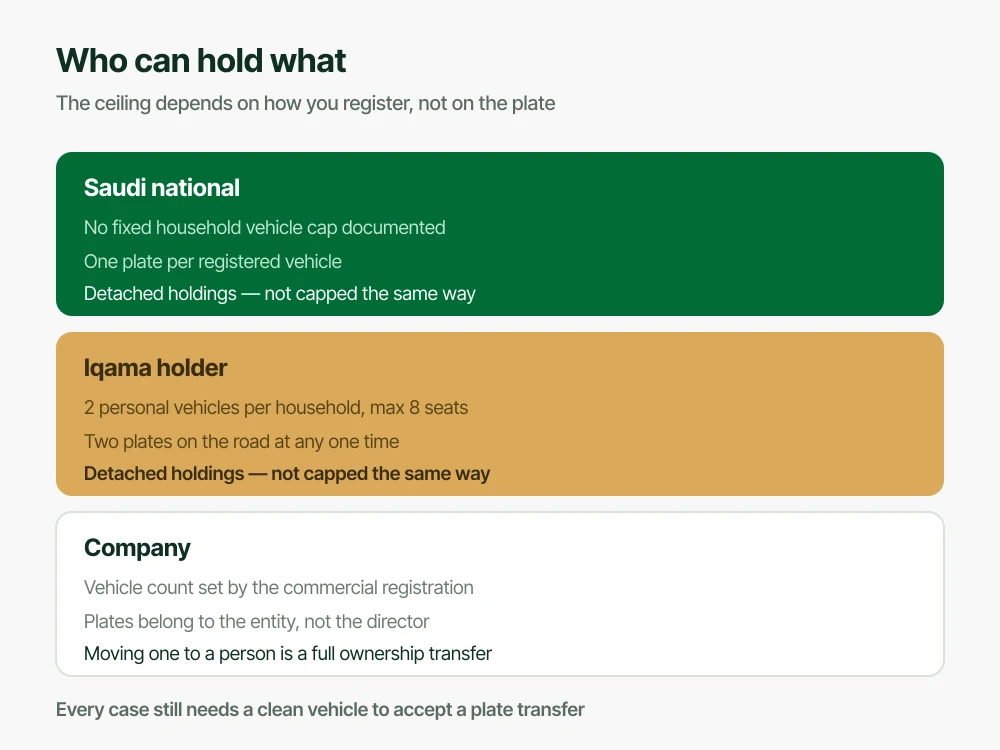
The ceiling you face depends on which category you register under, not on the plates themselves. The table below sets out how the three common cases differ.
| Holder | Vehicles registered | Plates on the road | Plates held detached |
|---|---|---|---|
| Saudi national | No fixed household cap documented | One per registered vehicle | Not capped in the same way |
| Iqama holder (resident) | Two personal vehicles per household | Two at any one time | Not capped in the same way |
| Company / commercial | Set by the commercial registration | One per registered vehicle | Held under the company entity |
Read the third column carefully, because it is the one that answers the actual question. The road-facing limit is strict and easy to state. The holding limit is governed by what you are willing to pay to keep a number reserved, not by a published ceiling on how many numbers one person may own.
Iqama holders: the tightest case
Residents on an Iqama face the clearest cap in the system: two personal vehicles per household. That is the number to plan around if you are an expatriate buying plates in Saudi Arabia.
The cap is per household, not per person, which catches people out. Two working adults in one household do not get two vehicles each. The seat restriction also applies — a maximum of eight seats per vehicle, which rules out registering a bus or a large van as a personal vehicle.
Everything else works identically to a citizen's account. You need an active Absher account linked to your Iqama, the Iqama must not be expired at the time of any transfer, and the transfer flow through Absher is the same one described in the Absher plate transfer guide. For the eligibility detail by residency status, the expat plate buyer guide covers who can bid and buy.
One timing trap deserves a flag. An expired Iqama blocks vehicle services, which means it blocks transfers. If you are approaching the end of a contract and hold plates you intend to sell, sell or detach them while your Iqama is still valid rather than after — the same warning applies when leaving Saudi Arabia with a vehicle in your name.
Company plates work differently
A company plate is registered to a commercial entity rather than to a person, and the vehicle count follows the commercial registration instead of a household rule. That makes companies the usual route for fleets.
The trade-off is control. Plates held under a company belong to the entity, so moving one to a director personally is a transfer between two different owners, with the same Absher steps and fees as any other change of ownership. It is not an internal reshuffle.
For anyone weighing whether to hold plates personally or commercially, the practical differences — registration, liability and what happens on dissolution — are set out in the company plates guide.
Motorcycle plates are a separate pool
Motorcycle plates in Saudi Arabia run on the fixed وص series and do not compete with car plates for the same numbers. Owning a وص number has no bearing on how many car plates you hold.
The series is structurally small. Because every motorcycle plate shares the single وص prefix, the entire pool is bounded by the numeric range rather than multiplied across letter combinations the way car plates are. That is a different scarcity model, and it prices differently.
The same detachment mechanism applies: a motorcycle plate can be lifted off the bike and held in the Absher wallet, then re-registered on another motorcycle later. The motorcycle plates guide covers the series, pricing and transfer specifics.
What holding a plate actually costs
The plate-side cost of holding a detached plate is the one number we will not give you. An earlier version of this page put it at SAR 100 per year through an Absher reservation service. We could not source that figure and have removed it: SAR 100 is the standard plate issuance and annual renewal fee, which is not the same thing as a charge for holding a number with no vehicle behind it. If a holding charge applies to you, Absher will show it.
What does not depend on that number is the comparison, and the comparison is what decides your strategy. Keeping a plate on the road means keeping a vehicle registered behind it, which brings annual registration, insurance and a periodic Fahes inspection. Holding the same number detached strips all three away.
Run that arithmetic before you scale up. Five plates kept on five registered cars cost five insurance policies, five inspections and five registrations. Five plates held detached cost none of them — whatever the plate-side charge turns out to be, it is not five insurance policies, and that gap is the reason serious holders detach.
Key takeaway: Detaching removes the cost of the car, not the cost of the plate. The vehicle-side saving is certain; confirm the plate-side charge in your own Absher account.

The limit that stops most people first
For almost everyone, the binding constraint is liquidity rather than regulation. The rules let you hold more plates than you will comfortably want to.
Work through it in order:
- Can you register it? If you want it on the road, you need a free vehicle slot and a vehicle clean enough to accept the transfer.
- Can you hold it? If not on the road, the reservation fee runs annually for as long as you hold.
- Can you sell it? A held plate is only worth what a buyer will pay when you decide to exit, and scarce combinations have thinner buyer pools than common ones.
- Can you clear the transfer? Selling requires both sides to complete through Absher, which brings the vehicle preconditions back into play on the buyer's side.
That fourth step is the one people underestimate. Owning a plate is easy; converting it back into money on a timetable you choose is the hard part, and it depends on a buyer whose paperwork is in order too.
One more distinction is worth drawing, because it decides how the cap feels in practice. The vehicle ceiling is a ceiling on simultaneous use, not a lifetime quota. Selling a car frees the slot immediately, and the plate that was on it can be detached and kept rather than sold with the vehicle. Holders who plan around this treat their two registered slots as working capital and the wallet as storage, rotating numbers onto the road only when there is a reason to.
The same logic explains why two people with identical allowances end up with very different collections. The constraint is not how many plates the rules permit — it is how disciplined the owner is about detaching before selling, and about not letting a number sit on a car that is about to be sold anyway.
Frequently asked questions
How many licence plates can one person own in Saudi Arabia?
Can I own a plate without owning a car?
How much does it cost to hold a plate that is not on a car?
How many vehicles can an expat register in Saudi Arabia?
Do detached plates collect fines or penalties?
Do motorcycle plates count toward my car plate limit?
Can a company hold more plates than an individual?
What happens to my plates if my Iqama expires?
Is there a limit on how many plates I can buy in a year?
Where can I check what I currently hold?
What to do next
If you are deciding whether to add another plate, settle the two questions in order: whether it goes on the road or into the wallet, and what you would realistically sell it for. The first sets your cost; the second sets your risk.
Value it before you commit. The free plate value calculator gives you an estimate from the digit count, pattern and letters, and you can compare that against what similar numbers are being asked for on the plate marketplace before you decide to hold or pass.