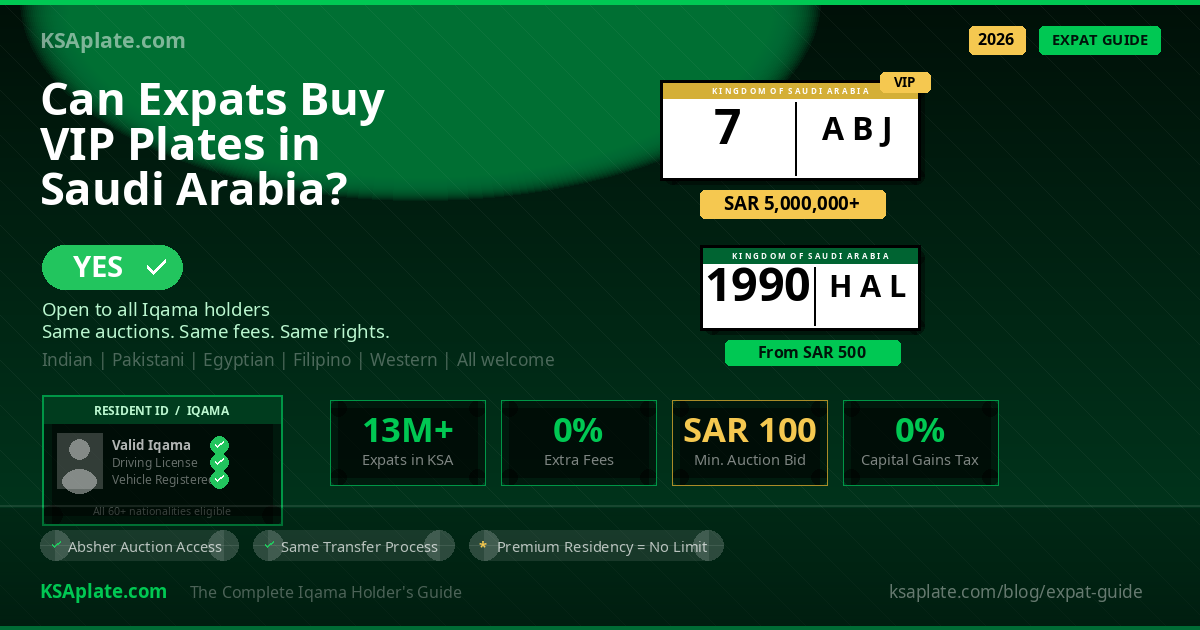
Saudi Arabia is home to over 13 million expatriates from more than 60 countries — that is 41.6% of the entire population. Many of these residents drive luxury vehicles, pursue status symbols, and want to stand out on the road. Yet when it comes to VIP license plates, most expats assume the market is reserved for Saudi nationals only. It is not. If you hold a valid Iqama, you can buy, own, transfer, and even invest in distinctive plates through the exact same channels as Saudi citizens. This guide covers every rule, fee, strategy, and pitfall you need to know — backed by official Absher data, Muroor regulations, and real market insights from KSAplate.com.
Can Expats Actually Buy VIP Plates? (Short Answer: Yes)
Let us settle this immediately: any resident with a valid Iqama and a registered vehicle can own and transfer distinctive plates through Absher. This is not a gray area or a loophole — it is an officially supported process confirmed by the Saudi General Department of Traffic (Muroor).
Expats can acquire VIP plates through all three available channels:
- Government Absher auctions — the primary market where new plates are released
- Online marketplaces like KSAplate.com — the secondary market where owners list plates for sale
- Private transactions — direct deals between individuals, completed via Absher’s plate exchange service
The Traffic Department’s official Absher auction platform is described as providing "an opportunity for citizens and residents to participate remotely." The word "residents" explicitly includes Iqama holders of all nationalities — Indian, Pakistani, Egyptian, Filipino, Bangladeshi, Western, or any other.
Whether you want a triple-seven plate for its cultural significance, a short letter combination that spells a word, or simply a cleaner number than the random one Muroor assigned you — the market is open to you.
Iqama Requirements: What You Need Before Buying
Before you can buy any license plate — standard or VIP — you need to meet the following requirements as an Iqama holder:
| Requirement | Details |
|---|---|
| Valid Iqama | Your residency permit must be current and not expired. Since 2026, new Iqamas are issued as 5-year physical Resident IDs with skill-based classifications. |
| Saudi Driving License | You must hold a valid Saudi driving license. Converting a foreign license typically takes 1-2 weeks via Muroor. |
| Registered Vehicle | You must own at least one registered vehicle. Plates cannot be held in isolation — they must be attached to a vehicle at all times. |
| Valid FAHAS Inspection | Your vehicle must have a current periodic technical inspection certificate from any FAHAS center. |
| Active Vehicle Insurance | Comprehensive or third-party insurance must be active in your name for the vehicle receiving the plate. |
| Absher Account | A verified digital identity on the Absher platform. Most Iqama holders already have one. Registration requires biometric data (fingerprints and facial scan) at a Jawazat center. |
Important: Your Iqama profession must match your actual role. Since Q1 2026, Saudi Arabia actively enforces profession-matching — a mismatch could affect your ability to complete official transactions through Absher.
If you meet all six requirements above, you are fully eligible to purchase any VIP plate available in Saudi Arabia. There is no additional "VIP eligibility" step or special approval required for expats.
The 2-Vehicle Ownership Limit: What It Means for Plate Collectors
This is the single biggest limitation for expat plate enthusiasts. Muroor confirmed on September 25, 2024 that expatriates in Saudi Arabia can own a maximum of 2 personal vehicles per household.
Here are the rules in detail:
- Maximum 2 private vehicles per Iqama holder
- Maximum 8 seats per vehicle (no buses, large vans, or commercial transport)
- Private vehicles only — expats cannot own taxis, public transport vehicles, or commercial fleet vehicles under their personal Iqama
- Trade license exception: If you hold a valid Saudi trade license, you may register up to 5 commercial vehicles under that license — separate from your personal allowance
What does the 2-vehicle limit mean for plates?
It caps how many plates you can have on the road, not how many you can own. As a standard Iqama holder you can run two distinctive plates at a time, one on each registered vehicle. Since 2024 you can also hold further plates undriven: Absher's digital plate wallet keeps a plate's ownership document without the plate being registered on any vehicle.
That distinction matters more than the number itself. The two-vehicle cap is a driving constraint, not a ceiling on a plate portfolio — which is why collectors once registered a car behind every number and no longer have to. Our guide to how many plates you can own works through the difference, and through the reservation window that applies to a plate held with no vehicle behind it. If you want more than two on the road at once, Premium Residency is what lifts the vehicle cap.
What's your plate worth?
Get an instant, free estimate with our plate value calculator.
Calculate My Plate's ValuePremium Residency: The Game-Changer for Serious Collectors
Saudi Arabia’s Premium Residency program — informally called the "Saudi Green Card" — removes the 2-vehicle ownership cap entirely. Launched under Vision 2030 to attract high-net-worth individuals and skilled professionals, over 40,000 applications were submitted between January 2024 and July 2025.
| Feature | Standard Iqama | Premium Residency |
|---|---|---|
| Vehicle ownership limit | 2 personal vehicles | No stated limit (equal to Saudi citizens) |
| Sponsor required | Yes (employer-linked) | No — fully independent |
| Exit/re-entry visa | Requires employer approval or Absher self-service | Free travel, no exit permit needed |
| Property ownership | Restricted | Full rights to own real estate |
| Business ownership | Restricted | 100% ownership allowed |
| Cost | SAR 600-650/year renewal | SAR 800,000 permanent OR SAR 100,000/year renewable |
For plate collectors and investors, the critical advantage is clear: Premium Residency holders can own as many vehicles as they want, meaning they can register and hold an unlimited number of distinctive plates. Combined with the fact that Premium Residency holders do not need a sponsor, they have full autonomy over all vehicle transactions — no employer approval needed for anything.
If you are planning to stay in Saudi Arabia long-term and want to build a plate portfolio, be clear-eyed about what the SAR 800,000 permanent residency fee can and cannot be justified by. It cannot be justified by plate appreciation, because no appreciation rate for this market can be measured — private sales settle through Absher with no public price, so there is nothing to compute one from. Our investment guide sets out what the evidence does and does not support.
3 Ways Expats Can Buy VIP Plates in Saudi Arabia
Expats have access to the same three acquisition channels as Saudi nationals. Here is how each one works, with pros and cons for non-citizens:
Channel 1: Absher Government Auction (Primary Market)
The Saudi Traffic Department releases new distinctive plates through electronic auctions on mazad.absher.sa. This is the only way to acquire a plate that has never been owned before.
- Open to: Citizens AND residents with valid Iqama
- Starting bids: From SAR 100 (Bronze tier) to SAR 50,000+ (Diamond tier)
- Pros: Often the cheapest way to get a plate; no middleman; government-verified
- Cons: Limited inventory; competitive bidding; must pay within 5 days of winning
For a complete walkthrough of the auction tiers, bidding strategy, and post-win process, read our Absher Plate Auction Guide.
Channel 2: KSAplate.com Marketplace (Secondary Market)
The largest selection of VIP plates is on the secondary market, where existing owners list their plates for sale. KSAplate.com is Saudi Arabia’s dedicated plate marketplace with thousands of active listings across all cities and price ranges.
- Open to: Anyone with a valid Iqama and a registered vehicle
- Price range: SAR 500 to SAR 25,000,000+
- Pros: Largest inventory; specific plates searchable; negotiate directly; buy anytime
- Cons: Prices reflect market value (no below-market government pricing)
The advantage of the secondary market for expats is speed and selection. If you want a specific number — your birthday, a lucky number like 786 or 777, or a particular letter combination — the marketplace lets you find and negotiate for it directly, rather than waiting for it to appear in an auction.
Channel 3: Private Purchase (Peer-to-Peer)
You can buy a plate directly from another individual and complete the transfer through Absher’s Vehicle Plates Exchange service.
- Open to: Any two parties with Absher accounts and registered vehicles
- How it works: Both parties initiate a plate exchange request on Absher. The plate moves from the seller’s vehicle to the buyer’s vehicle digitally.
- Pros: Can be the cheapest option if you find a motivated seller
- Cons: Highest scam risk; no platform protection; must verify ownership independently
If you go the private route, read our safety guide on avoiding plate scams first. Always verify the seller owns the plate through Absher before sending any payment.
Absher Plate Auction: Step-by-Step for Non-Saudis
Here is the exact process for expats to participate in an Absher plate auction:
Step 1: Verify Your Absher Account
Log into absher.sa and ensure your account is fully verified. You need an active digital identity with updated biometric data. If you have not visited a Jawazat center recently, your biometrics may need refreshing — especially if you received a new 5-year Resident ID in 2026.
Step 2: Pay the SAR 1,000 Registration Fee
Before placing any bid, you must pay a non-refundable registration fee of SAR 1,000 through Absher. This fee is valid for multiple auctions — you do not pay it again for each auction cycle.
Step 3: Browse Available Plates
Visit mazad.absher.sa to browse current auction lots. Plates are organized into four tiers:
| Tier | Starting Bid | Typical Final Price | Best For |
|---|---|---|---|
| Diamond | SAR 50,000+ | SAR 500,000 – 24,000,000+ | Single-digit, word plates, ultra-premium |
| Gold | SAR 10,000+ | SAR 50,000 – 500,000 | Double-digit, premium repeating numbers |
| Silver | SAR 5,000+ | SAR 10,000 – 50,000 | Triple-digit, attractive patterns |
| Bronze | SAR 100 | SAR 200 – 5,000 | Budget VIP plates, best entry point |
Step 4: Place Your Bid
The auction uses proxy bidding (similar to eBay). Enter your maximum amount and the system bids incrementally on your behalf. Bids are irrevocable — once submitted, you cannot retract them. You can bid on multiple plates simultaneously.
Step 5: Win and Pay
If you win, you must pay the full amount within 5 days through the bank account linked to your Absher profile. Payment is processed via SADAD. 15% VAT is added to the winning bid.
Step 6: Register the Plate
After payment, visit a Muroor (traffic department) office within 30 days to register the plate to one of your vehicles. Bring your Iqama, driving license, vehicle registration (Istimara), and insurance documents.
Pro Tip for Expats: The Bronze tier is the cheapest way in. Starting bids are SAR 100, and plates at that tier typically close between SAR 200 and SAR 2,500. What nobody can tell you is what one would resell for — private Saudi plate sales settle through Absher with no public price attached, so no verified resale figures exist for this tier. Our cheapest VIP plates guide sets out what Bronze plates actually cost, and why the resale numbers you see quoted elsewhere are estimates.
Complete Fee Breakdown for Expat Plate Buyers
Here is every fee you may encounter as an expat buying a VIP plate in Saudi Arabia:
| Fee Type | Amount (SAR) | When You Pay |
|---|---|---|
| Absher auction registration | 1,000 | One-time, before your first bid |
| Auction winning price | Varies (100 – 24,000,000+) | Within 5 days of winning |
| VAT on auction win | 15% of winning price | Added to winning amount |
| Plate transfer fee (private sale) | 400 | When transferring a plate between private vehicles |
| Vehicle ownership transfer (Absher) | 150 + 230 = 380 | If buying a vehicle with the plate |
| Standard plate issuance | 100 | New plate registration |
| Plate replacement | 100 – 300 | If physical plate is lost or damaged |
| Annual registration (Istimara) 0-2000cc | 800/year | Vehicle renewal |
| Annual registration (Istimara) 2001-4000cc | 1,500/year | Vehicle renewal |
| Annual registration (Istimara) 4000+cc | 2,800/year | Vehicle renewal |
Key takeaway for expats: The ongoing costs are identical to what Saudi nationals pay. There is no "foreigner surcharge" on plate ownership, auction participation, or transfers. The only financial difference is the Iqama renewal fee (SAR 600-650/year) and dependent fees (SAR 4,800/year per dependent) that you already pay regardless of plate ownership.
Note on VAT: The 15% VAT applies to government auction purchases only. Private secondary-market transactions between individuals are generally not subject to VAT. This makes marketplace purchases on KSAplate.com potentially more cost-effective for high-value plates.
Can Expats Invest in Saudi Plates? ROI for Non-Citizens
Functionally, yes — but with structural limitations that Saudi nationals do not face.
Tables of "historical appreciation rates" for Saudi plate categories circulate widely, and this article used to carry one — six categories with total and annualised return figures. It has been removed, because those figures were never measured. Saudi plate sales between private parties settle through Absher with no public price attached, so there is no continuous transaction record from which anyone could compute a return. What is documented is a short series of reported auction results, published with their sources on our market data page.
Two structural facts do hold, and they are the honest version of the investment case: the supply of short plates is fixed by the format itself, and Saudi Arabia levies no capital gains tax on a private plate sale. Neither of those is a return figure. They are reasons a value could hold, not evidence that it has.
The UAE is the market people compare against, and there the same caution applies: no annual appreciation figure for plates is published there either. What does circulate widely is the story of a plate bought for AED 12 in the 1980s and later sold for AED 28 million — repeated across the trade for decades, though without a primary source you can check. Treat it as folklore about scarcity, not as a return you can plan around.
Saudi Arabia also offers a massive tax advantage: 0% capital gains tax on plate sales. Whether you buy a plate for SAR 10,000 and sell it for SAR 100,000, you keep the full profit. No income tax, no capital gains tax, no reporting requirements for individuals.
However, expat investors face three constraints:
- 2-plate maximum: Standard Iqama holders can only hold 2 plates at a time (tied to 2 vehicles). Saudi nationals have no such limit. Premium Residency holders are also unrestricted.
- Iqama dependency: Your ability to hold plates depends on your Iqama staying valid. If your Iqama expires or you take final exit, you must sell or transfer all vehicles and plates.
- Forced liquidation risk: Unlike a Saudi national who can hold a plate indefinitely, an expat may be forced to sell at a time that is not optimal — for example, when a job contract ends unexpectedly.
Investment strategy for expats: Focus on plates with high liquidity — plates that sell quickly on the secondary market. Avoid ultra-premium plates (SAR 500,000+) that may take months to find a buyer. The sweet spot for expat buyers is the SAR 5,000-50,000 range: it holds the largest share of active listings, which is what actually lets you sell again quickly. No annualised appreciation figure can be quoted for it — Saudi Arabia publishes no repeat-sale record for plates — so judge the band on liquidity, not on a yield.
The Exit Question: What Happens to Your Plates When You Leave KSA?
This is the most critical section for any expat plate owner. All vehicles in your name must be sold or transferred before you can complete your final exit from Saudi Arabia. An untransferred vehicle can literally block your departure.
Timeline: When to Start
Begin the plate/vehicle sale process at least 45-60 days before your planned departure date. This gives you enough time to:
- List your plate(s) on KSAplate.com or other channels
- Negotiate with buyers and agree on a price
- Complete the Absher transfer process
- Handle any paperwork delays
- Clear outstanding traffic fines (required before final exit)
Option 1: Sell the Plate on the Open Market
List your distinctive plate on KSAplate.com and sell it for market value. Use our plate value calculator guide to price it correctly. The transfer is completed digitally through Absher’s plate exchange service.
Option 2: Transfer to a Friend or Colleague
If you have a trusted friend or colleague (Saudi or Iqama holder) who wants the plate, you can transfer it directly via Absher. The fee is SAR 400 for a private plate transfer. Both parties must have Absher accounts and registered vehicles.
Option 3: Sell the Vehicle with the Plate
Sell your car and plate together as a package. This is often the simplest option if you are leaving and do not want to manage separate transactions. Vehicle ownership transfer costs SAR 150 (government fee) + SAR 230 (Absher fee) = SAR 380 total.
What If You Don’t Transfer Before Leaving?
This is where things get serious:
- Your final exit may be blocked — Absher can prevent exit clearance if vehicles remain registered in your name
- Fines of up to SAR 1,000 for failing to transfer ownership within the specified timeframe
- Vehicle impoundment is possible if the registration expires while you are gone
- You lose the plate’s value — if you cannot return to Saudi Arabia to complete the transfer, the plate effectively becomes stranded
Exit Checklist for Expat Plate Owners: (1) Sell or transfer all plates and vehicles. (2) Cancel vehicle insurance. (3) Clear all traffic fines via Absher. (4) Keep transfer proof documentation. (5) Verify zero vehicles remain under your name on Absher before booking final exit.
Iqama Expiry and Plate Ownership: Don’t Lose Your Investment
An expired Iqama blocks virtually every vehicle-related transaction. Here is exactly what happens:
- Cannot renew your Istimara (vehicle registration) — the system requires a valid Iqama
- Cannot transfer or exchange plates — Absher blocks all plate transactions for expired Iqamas
- Cannot sell your vehicle — ownership transfer requires both parties to have valid documentation
- Cannot participate in auctions — your Absher account functionality is restricted
- Driving becomes illegal — if your Istimara expires because you cannot renew it, driving incurs fines and potential vehicle confiscation
Iqama renewal penalties:
| Offense | Fine (SAR) | Additional Consequence |
|---|---|---|
| First late renewal | 500 | Warning |
| Second late renewal | 1,000 | Increased scrutiny |
| Third late renewal | Escalating fines | Deportation risk |
The bottom line: If you own a VIP plate worth SAR 50,000 or more, treat your Iqama renewal as seriously as you would treat protecting any other investment worth that amount. Set a calendar reminder 90 days before expiry — you can renew via Absher up to 90 days in advance. Do not let administrative neglect destroy your plate’s value.
How the 2025 Kafala Abolition Affects Expat Plate Ownership
In June 2025, Saudi Arabia formally abolished the kafala (sponsorship) system, replacing it with a contract-based employment model. This was a landmark reform affecting over 13 million foreign workers. Here is what it means for plate ownership:
What changed:
- Job mobility: You can now change employers without your current sponsor’s consent after your contract ends. This means you can switch jobs without risking your Iqama status — and by extension, your vehicle and plate ownership.
- Exit visa independence: You can apply for exit and re-entry visas independently through Absher, without employer approval. Previously, a sponsor who refused to process your exit could trap you — and your plates — in legal limbo.
- Digital autonomy: Vehicle registration, plate transfers, and auction participation are all handled through Absher and Qiwa platforms without requiring sponsor involvement.
What did NOT change:
- The 2-vehicle ownership limit for standard Iqama holders remains
- Iqama requirements for plate transactions remain the same
- The plate transfer process itself is unchanged
- Fees are identical to pre-reform levels
The net effect: expats now have greater security and autonomy when it comes to plate ownership. You are less dependent on your employer’s cooperation for transactions, and changing jobs no longer threatens your ability to keep your plates. This is a significant improvement for expats who invest in distinctive plates.
GCC Nationals: Do You Get Different Rules?
If you are a citizen of a GCC country (UAE, Bahrain, Kuwait, Oman, Qatar) residing in Saudi Arabia, you fall under the GCC Common Market framework established in January 2008. In theory, this grants "national treatment" — meaning you should be treated the same as Saudi citizens for commercial activities and services.
In practice, for vehicle and plate ownership:
- If you hold a Saudi Iqama: The standard 2-vehicle limit applies, same as any other expat. No special GCC exemption has been confirmed for vehicle ownership caps.
- If you hold Premium Residency: No vehicle limit, same as any other Premium Residency holder.
- Cross-border vehicle rule (February 2026): Vehicles registered in any GCC country can only remain in Saudi Arabia for 90 days within a 365-day period. This is enforced for both Saudi citizens and GCC nationals equally. Extensions can be requested through the Ministry of Interior before the 90-day period ends.
The 90-day rule means you cannot simply drive your UAE-plated car in Saudi Arabia long-term. If you live in Saudi Arabia, you need Saudi-registered vehicles — which means Saudi plates. This actually increases the value proposition for GCC nationals to buy Saudi plates: if you are going to register a car in Saudi Arabia anyway, you might as well get a distinctive plate.
Best Plate Categories for Expats (by Budget and Stay Duration)
Your optimal plate choice depends on two factors: your budget and how long you plan to stay in Saudi Arabia.
Short Stay (1-2 Years) — Focus on Enjoyment, Not Investment
| Budget | Recommended Plate Type | Example | Why |
|---|---|---|---|
| SAR 500 – 2,000 | Bronze auction win / Cultural Emblem | Random but distinctive 4-digit | Minimal cost, easy to resell or transfer when leaving |
| SAR 2,000 – 10,000 | Birth year / palindrome / sequential | 1990, 1221, 1234 | Personal meaning, good resale in budget segment |
Medium Stay (3-5 Years) — Balance of Enjoyment and Appreciation
| Budget | Recommended Plate Type | Example | Why |
|---|---|---|---|
| SAR 5,000 – 20,000 | Triple repeating / double-letter | 555, A A 1234 | High liquidity — the widest buyer pool of any band |
| SAR 20,000 – 50,000 | Lucky numbers / 3-digit premium | 786, 777, 313 | Cultural demand ensures fast resale; supply of each number is capped |
Long Stay (5+ Years / Premium Residency) — Full Investment Strategy
| Budget | Recommended Plate Type | Example | Why |
|---|---|---|---|
| SAR 50,000 – 200,000 | Double-digit / premium sequential | 33, 55, 123 | Approaching trophy territory; scarcer than four-digit plates |
| SAR 200,000+ | Single-digit / word plates | 7, MLK, NOR | Trophy assets — the scarcest categories; typically held long-term |
Expat Golden Rule: Never invest more in a plate than you can afford to sell at a 20% discount in an emergency. The forced-liquidation risk is real for expats. If a job loss or Iqama issue forces a quick sale, you want to ensure you still come out ahead even at a below-market price.
To browse plates within your budget, use our search filters on KSAplate.com — filter by price range, city, number pattern, and letter combination.
Top 7 Mistakes Expats Make When Buying Plates
Mistake 1: assuming a plate you win must go straight onto a car.
It does not, and it has not since 2024 — a plate won at auction can sit in your Absher plate wallet until you have a vehicle for it. What you should not assume is that it can sit there indefinitely: a reservation window applies, its current length is not something we could find published, so check it in your own Absher account rather than trusting a figure from a guide.
Mistake 2: Ignoring the 2-vehicle limit.
Some expats try to register a third vehicle through a colleague’s or friend’s name. This creates legal complications and can result in loss of the plate if the relationship sours. Stay within your legal limit or invest in Premium Residency.
Mistake 3: Not checking Iqama validity before a transaction.
If your Iqama expires mid-transaction, the transfer will fail and your deposit may be at risk. Always verify your Iqama is valid for at least 6 months before making any plate purchase.
Mistake 4: Paying for a plate before verifying ownership.
Never send money — especially via STC Pay, bank transfer, or cash — before confirming the seller actually owns the plate. Use Absher to verify, or buy through a trusted platform like KSAplate.com. Read our full scam prevention guide for detailed red flags.
Mistake 5: Forgetting to budget for VAT on auction wins.
A SAR 10,000 auction win costs SAR 11,500 with 15% VAT. Many first-time bidders are surprised by this. Factor VAT into your maximum bid from the start.
Mistake 6: Waiting too long to sell before final exit.
Starting the plate sale process 1-2 weeks before departure is not enough. High-value plates can take weeks to find the right buyer. Start at least 45-60 days before your planned exit to avoid fire-sale pricing.
Mistake 7: Buying an illiquid plate as a short-term expat.
A ultra-rare SAR 500,000 plate might appreciate beautifully over 10 years — but if you are on a 2-year contract, you may not find a buyer in time. Match your plate’s liquidity profile to your expected stay duration.
Frequently Asked Questions
Can any expat with an Iqama buy a VIP plate in Saudi Arabia?
How many VIP plates can an expat own at the same time?
Can expats participate in Absher plate auctions?
What happens to my VIP plate if my Iqama expires?
What happens to my plate when I leave Saudi Arabia permanently?
Is there a "foreigner tax" or extra fee for expats buying plates?
Can I hold a plate without owning a vehicle?
Can an expat sell a VIP plate for profit?
Do GCC nationals get special plate privileges in Saudi Arabia?
How did the Kafala abolition in 2025 affect plate ownership?
Can I transfer my Saudi VIP plate to someone in another country?
What is the cheapest VIP plate an expat can buy?
Is Premium Residency worth it just for plate collecting?
Can my spouse (dependent) own a plate separately?
What is the best plate to buy as a first-time expat buyer?
Ready to Find Your Perfect Plate?
Over 13 million expats call Saudi Arabia home. Thousands already own VIP plates. Browse thousands of distinctive plates across every city, budget, and style on KSAplate.com — Saudi Arabia’s dedicated plate marketplace.
Browse VIP Plates Now Check Any Plate’s Value