
Last updated: April 25, 2026 · 14 min read
- No return figure exists for this market. Private Saudi plate sales settle through Absher with no public price attached, so nobody — including us — can compute what plates have returned.
- Two auction results are documented with a named source: SAR 21 million for ع 1 and SAR 13.4 million for م ل ك 1. Both are hammer prices at public auctions, not private resales.
- What we can measure is our own market: across 11,739 priced live listings, the median one-digit ask is SAR 300,000 against SAR 3,400 for a four-digit — a factor of about 88.
- Saudi Arabia levies no personal income tax and no capital gains tax on individuals. We are not tax advisers and this is not tax advice.
- We are not disinterested. KSAplate.com is a plate marketplace. Read anything here that sounds like a recommendation with that in mind.
Saudi license plates are traded as an alternative asset — priced on digit count, letter rarity and cultural resonance rather than on any cash flow. Single-digit plates have changed hands at government auctions for SAR 10 million and above, with SAR 21 million the highest publicly reported result. Saudi Arabia imposes no capital gains tax on individuals, an active secondary market exists on platforms including KSAplate.com, and Vision 2030 is enlarging the pool of wealthy buyers. What does not exist is a price index, a transaction record, or any measurable return — and this guide is written around that gap rather than papering over it.
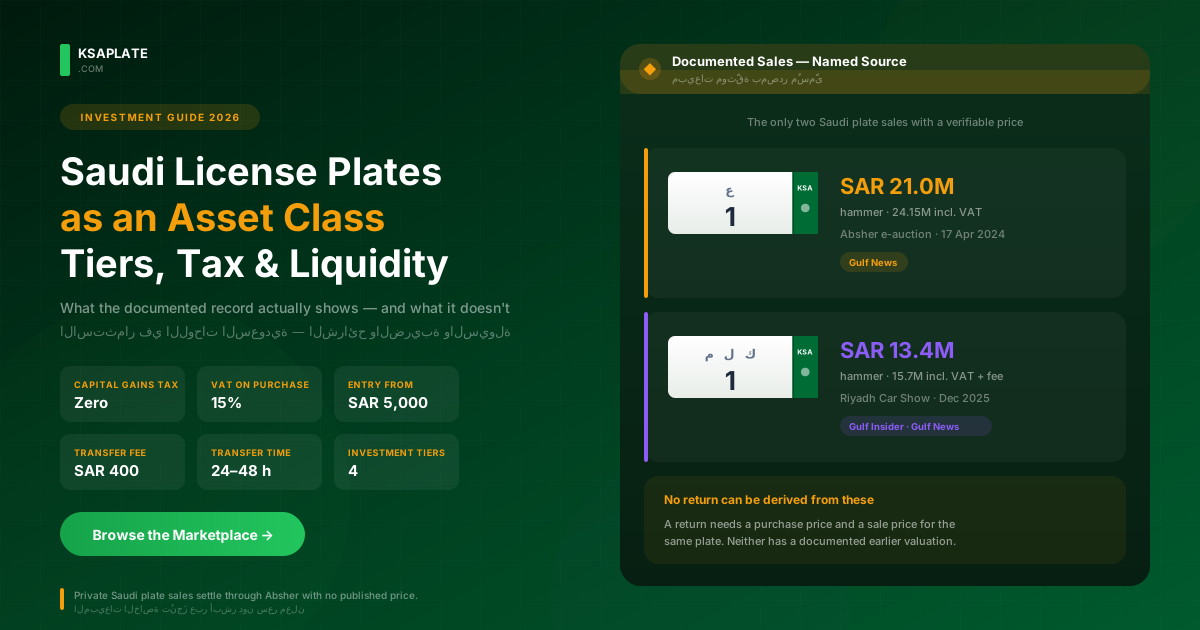
Table of Contents
- Why Saudi License Plates Are a Legitimate Asset Class
- The KSA Plate Market in 2026: Size, Liquidity & Trends
- Which Plates Command the Highest Prices — and Why
- Price Tiers: Where the Listings Actually Sit
- What the Auction Record Actually Shows
- Step-by-Step: How to Buy Your First Investment Plate
- Tax and Legal Framework for Plate Investors in Saudi Arabia
- Risks Every Plate Investor Must Understand
- KSA and UAE Plate Markets Compared
- Concentration, Diversification, and What We Will Not Advise
- Vision 2030 and the Long-Term Demand Story
- FAQ: Saudi License Plate Investment
Why Saudi License Plates Are a Legitimate Asset Class
An asset class is any group of instruments that behaves as a financial investment, holds value over time, and can be bought and sold in a market. Saudi license plates satisfy all three criteria. They are a tangible, finite-supply asset whose scarcity is permanently guaranteed by government issuance rules — once a single-digit plate is issued, no more single-digit plates are ever created. Scarcity combined with rising demand is the basic engine of appreciation.
Beyond scarcity, plates carry social capital in Saudi culture. A single-digit plate such as ع 1 — the one that made SAR 21 million in 2024 — is not merely a vehicle identifier; it is a status signal read instantly by anyone who sees it. That cultural premium is the most plausible reason demand at the top of the market holds up through economic cycles. It is an explanation, not a measurement: we have no data showing how top-tier prices behaved in any past downturn.
Institutional legitimacy matters too. The Saudi General Directorate of Traffic runs official electronic auctions, creating a government-backed primary market with transparent price discovery. This is fundamentally different from speculative collectibles with no official market infrastructure.
A note on a quote we removed. This spot used to carry a polished line comparing plates to fine art and luxury real estate, credited to "KSAplate.com Market Analysis, 2026". There was no such analysis. Nobody said it, and we have taken it out rather than dress up our own marketing as research.
The KSA Plate Market in 2026: Size, Liquidity & Trends
The Saudi private plate market has no published market-cap figure, and we are not going to estimate one. The General Directorate of Traffic runs electronic auctions through Absher — press coverage of the auction rules dates back to at least December 2021, and the SAR 21 million ع 1 sale took place at one in April 2024 — but the totals raised are not published in a form we can cite. Before electronic auctions, premium plates changed hands largely through private broker networks at prices nobody could verify. That much has genuinely improved; the rest is still opaque.
Today, three parallel market layers drive activity:
- Primary market — government auctions: Plates released for the first time, auctioned electronically. These set benchmark "floor" values.
- Secondary market — platforms: Plates resold between private owners on KSAplate.com, dubizzle.sa, and opensooq.com. This is where the bulk of investment-driven trading happens.
- OTC (over-the-counter) broker market: Ultra-high-value plates (SAR 1M+) often trade through private brokers who match discretionary buyers and sellers outside public listings.
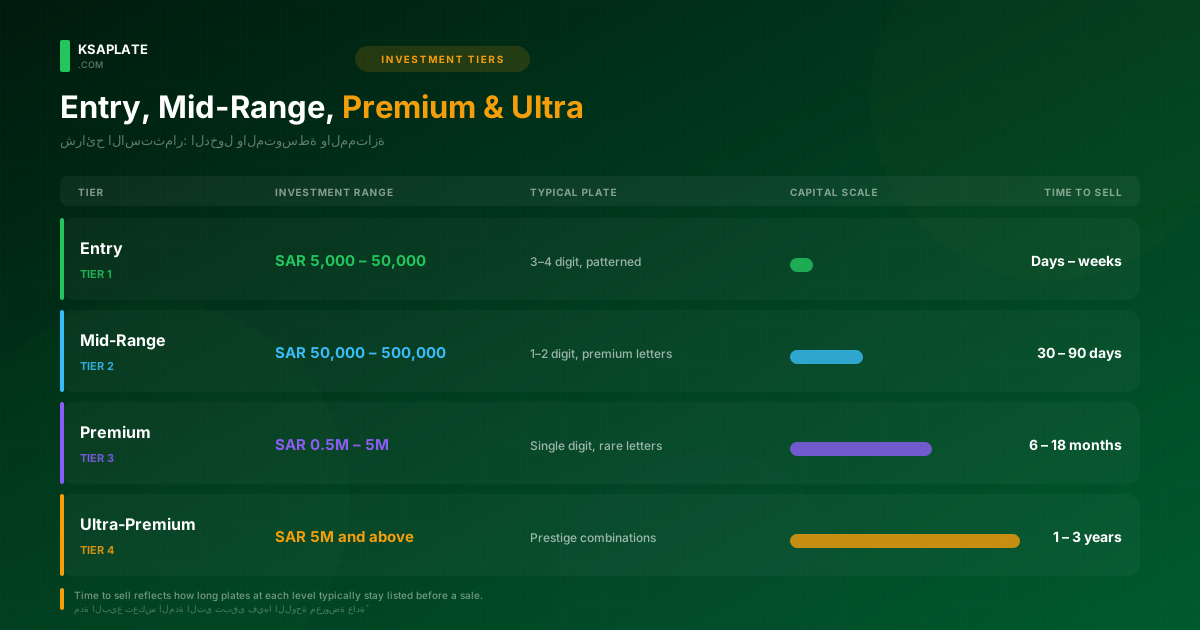
How long a plate takes to sell is the single most over-claimed number in this market. An earlier version of this page gave confident windows — 30 to 90 days for mid-tier, days for entry-level, 6 to 18 months for premium. None of it was measured. We do not track completed sales, no platform publishes them, and Absher attaches no public price to a private transfer. What we can see is how thin the top of the market is: of 11,739 priced live listings, 129 are asking SAR 500,000 or more and exactly one is asking above SAR 5 million. A buyer pool that narrow is slow by construction, whatever the number of days turns out to be.
Key 2026 Market Signals
- The record sale of SAR 21 million for a single plate on 17 April 2024 (documented by Gulf News) reset expectations for what a top-tier plate can fetch, and م ل ك 1 followed at SAR 13.4 million in December 2025.
- Saudi Arabia's population reached 35.3 million at the end of 2024 (GASTAT), of whom 19.6 million are Saudi nationals. The UAE, the closest comparable plate market, is around 11 million in total. The Saudi buyer base is structurally larger.
- We have seen it claimed that GCC buyers are moving into Saudi auctions in growing numbers. We could not source that and have dropped it.
What's your plate worth?
Get an instant, free estimate with our plate value calculator.
Calculate My Plate's ValueWhich Plates Appreciate the Most — and Why
Not all plates are investment-grade. Understanding the value hierarchy is fundamental to generating returns. Five factors determine whether a plate appreciates, holds flat, or depreciates:
- Digit count: fewer digits, higher price — steeply. Measured on our own live listings, the median one-digit ask is SAR 300,000 against SAR 3,400 for a four-digit: a factor of about 88, not the "100x to 1,000x" this page used to claim. Two-digit sits at SAR 42,500 and three-digit at SAR 26,500. These are asking prices, not sales.
- Letter combination: Saudi plates use 17 Arabic letters. Combinations that read as a word (م ل ك = king) or as someone's initials carry a premium — م ل ك 1 is the clearest documented example.
- Pattern: palindromes (1221, 4554), repeating digits (7777, 1111) and sequential runs (1234, 5678) attract collector interest. In our four-digit listings, quad-repeats ask a median of SAR 10,000 against SAR 3,200 for non-repeating — roughly 3×.
- Cultural resonance: numbers rooted in Islamic tradition (786, 313, 7, 777) hold persistent premiums independent of trends. See our guide to lucky numbers on Saudi plates.
- Arabic letter rarity: some letters are more sought after than others. Our guide to Arabic letters on Saudi plates covers this in depth.
Price Tiers: Where the Listings Actually Sit
Rather than describe tiers we have invented, here is how our own live inventory is actually distributed. These are asking prices on 11,739 priced active listings, not sales — but they are counted, not estimated.
| Tier | Asking-price range | Typical plate | Live listings in this range |
|---|---|---|---|
| Below entry | Under SAR 5,000 | 4-digit, ordinary letters | 5,610 (48%) |
| Entry | SAR 5,000–50,000 | 3-4 digit with a pattern | 4,478 (38%) |
| Mid-Range | SAR 50,000–500,000 | 1-2 digit, or strong letters | 1,521 (13%) |
| Premium | SAR 500,000–5M | Single digit, rare letters | 129 (1.1%) |
| Ultra-Premium | Above SAR 5M | Prestige combinations | 1 listing |
The shape of that table is the point. Nearly nine listings in ten ask under SAR 50,000, and the two top tiers together account for 130 plates — about one percent of the market. Whatever you read elsewhere about "the sweet spot", the number of people who can transact above half a million riyals is small, and it does not grow just because you own a plate in that range. We are not going to tell you which tier to buy into. If you want to see what the bottom of the market actually looks like, our list of the cheapest distinctive plates in Saudi Arabia is built from live listings.
What the Auction Record Actually Shows
Two Saudi plate sales are documented with a named source, and they are worth stating precisely because almost nothing else in this market is:
- ع 1 — SAR 21 million at an Absher electronic auction on 17 April 2024, SAR 24.15 million including VAT, after ten bids in 10 minutes and 48 seconds (Gulf News). This remains the highest publicly reported result for a Saudi plate.
- م ل ك 1 (KLZ 1) — SAR 13.4 million hammer at the December 2025 Riyadh Car Show, SAR 15.7 million including VAT and commission (Gulf Insider, Gulf News).
What cannot be derived from those two figures is a return. A return needs a purchase price and a sale price for the same asset, and neither plate has a documented earlier valuation. This section previously carried implied appreciation percentages, a survey of "verified sold comparables" and a quoted multiple — none of which existed. Private Saudi plate sales settle through Absher with no public price attached, so there is no series to compute against. Our market data page lists every reported result with its source.
Step-by-Step: How to Buy Your First Investment Plate
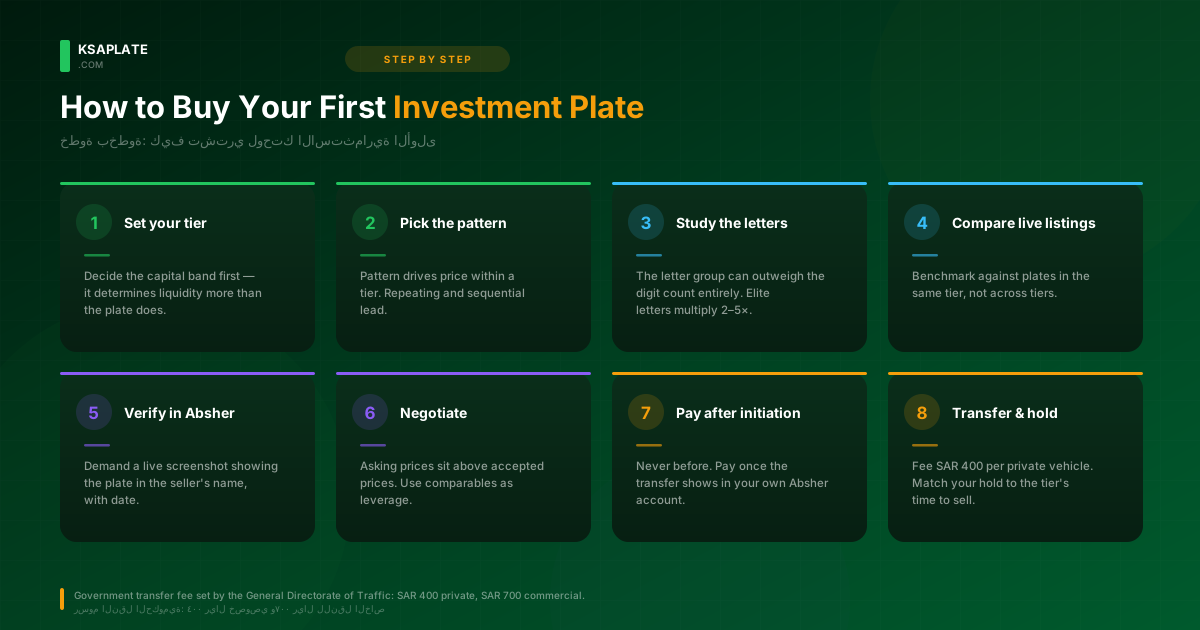
- Research the market first. Browse active listings on KSAplate.com and read them as asking prices, because that is what they are. Public auction results from the General Directorate of Traffic are the only prices with a source attached. There is no database of private sold comparables in this market, and any guide that offers you one is inventing it.
- Set a budget including all costs. Government auctions add 15% VAT to the hammer price — that is exactly how the ع 1 sale went from SAR 21 million to SAR 24.15 million. A private sale between two individuals is not a VAT-able supply, so no VAT applies there. Budget SAR 1,030 for the transfer itself: SAR 400 in government fees for each of the two private vehicles plus a single SAR 230 Absher service fee. Brokers on high-value plates charge a commission — agree it in writing before you engage one.
- Verify ownership via Absher before any payment. Ask the seller to demonstrate ownership through the Absher platform or the Najiz app. Confirm the plate is not encumbered by a traffic fine, loan, or court order. Our guide on how to avoid scams when buying plates covers this verification step in detail.
- Choose your acquisition channel. Private listings on KSAplate.com carry the widest selection at the lower end. Official government auctions are the only channel with published prices. At the very top of the market, plates tend to move through brokers who match discretionary buyers and sellers privately. Our Absher auction bidding guide walks through the official process.
- Negotiate against what you can actually see. You can compare current asking prices for similar combinations, and you can cite auction results. You cannot cite private sold comparables, because they are not published. Say which of the two you are using; a seller who claims a "verified sold comparable" should be asked where it was published. Our market timing guide covers when listing activity is heaviest.
- Complete the official transfer via Absher. Both buyer and seller need a verified Saudi National ID or Iqama, and each needs a vehicle of their own: buying the number is a plate transfer, not a vehicle sale. Never release payment before the transfer is confirmed in the government system. See our complete Absher transfer guide.
- Decide in advance what would make you sell. Writing down your exit condition before you buy is ordinary discipline and costs nothing. We are deliberately not suggesting a target percentage or a hold period, because we have no data that would make either number honest.
Tax and Legal Framework for Plate Investors in Saudi Arabia
The tax position is genuinely favourable, and it is also the part of this article where you should least take our word for it. Saudi Arabia imposes no personal income tax and no capital gains tax on individuals. On the ordinary reading, if you buy a plate for SAR 100,000 as a private individual and later sell it for SAR 200,000, the gain is not taxed. Whether that holds for you depends on your residency and whether the tax authority would treat your activity as a business — we are a marketplace, not a tax adviser, and a ZATCA-registered accountant costs far less than getting this wrong.
What You Do Owe
- 15% VAT at auction. Government auction results are quoted before VAT and settled after it: SAR 21 million became SAR 24.15 million on the ع 1 sale. A private sale between two individuals is not a taxable supply, so VAT does not apply there — but a purchase from a VAT-registered dealer does.
- Zakat if you are a Saudi national holding plates as part of a commercial business. Private collectors holding plates as personal property generally do not, but this is exactly the question to put to a qualified Zakat adviser rather than to a website.
- Transfer fees: SAR 1,030 to move a plate between two private vehicles — SAR 400 per vehicle to the General Directorate of Traffic plus a single SAR 230 Absher service fee including VAT. SAR 1,630 if either vehicle is in the private-transport category.
Legal Title and Ownership
In Saudi Arabia a plate number lives on a vehicle registration. Saudi guides describe a plate won at auction as being held in your record with the Traffic Department until you assign it to a vehicle you own, and Absher is where you manage it. We have deliberately removed the annual "reservation fee" figure this page used to quote, because we could not source it — if a charge applies to you, Absher will show it. Expat Iqama holders face specific restrictions: our expat plate ownership guide explains the current rules.
Bottom line: for a Saudi individual selling a plate privately, there is on the ordinary reading no tax on the gain. That is a real structural advantage over most jurisdictions. It is also a general statement about the law, not advice about your situation, and it says nothing about whether the plate will be worth more when you sell it.
Risks Every Plate Investor Must Understand
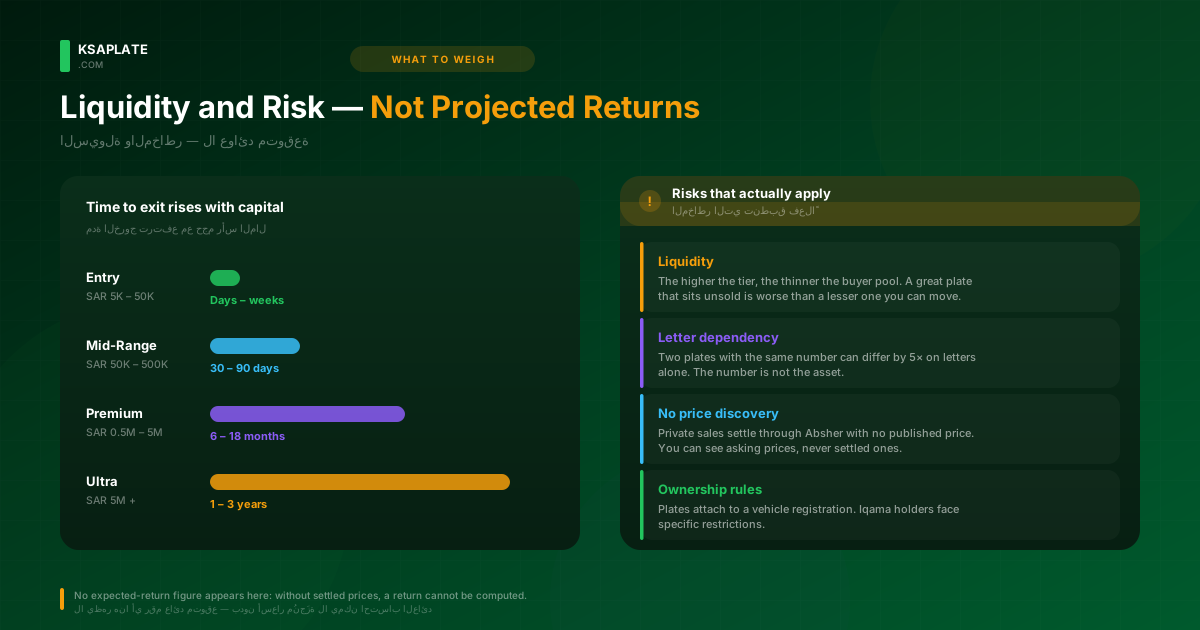
No investment is without risk. Saudi plates carry a specific risk profile that differs from stocks, bonds, and real estate. Understand these before committing capital:
Liquidity Risk
At the premium tier the buyer pool is genuinely thin — 129 of our 11,739 priced listings ask SAR 500,000 or more, and one asks above SAR 5 million. A market that narrow can leave you holding an asset for a long time, and a forced seller has very little negotiating position. An earlier version of this page put numbers on that ("12–24 months", "a discount of 20–40%"); we made them up and have removed them. The principle stands without them: do not put money into a premium plate that you may need back on a schedule.
Market Sentiment Risk
Plate prices are driven by cultural status and wealth sentiment, not earnings or dividends. A macroeconomic shock, a regional conflict, or a shift in social trends could soften demand quickly. There is no floor value anchored in cash flow, the way real estate has rental income or stocks have earnings. Prices can fall sharply if confidence breaks.
Policy and Regulatory Risk
The Saudi government could change rules around plate ownership, transfer, or auction — any of which would affect market dynamics. The General Directorate of Traffic could also release new plate series that increases supply of certain combinations, suppressing prices. This risk is low but non-zero. Monitor official communications from Saudi Arabia’s Ministry of Interior for any policy changes.
Fraud and Scam Risk
Fraudulent sellers attempt to sell plates they do not own, plates with encumbrances, or counterfeit documentation. The Absher/Najiz verification step (Step 3 above) eliminates virtually all of this risk when followed properly. Never pay before completing the official transfer confirmation in the government system.
Concentration Risk
Holding all your plate capital in a single ultra-premium plate is riskier than holding a diversified portfolio across tiers. Portfolio construction is addressed in the section below.
KSA and UAE Plate Markets Compared
Investors familiar with Dubai's plate market often ask how Saudi Arabia compares. Both share structural DNA — no capital gains tax on individuals, a cultural premium for rare combinations, government-run primary auctions — but they differ on size, maturity and access. The table below sticks to facts with sources; it deliberately does not tell you which one is the better investment, because we do not know.
| Factor | Saudi Arabia (KSA) | UAE (Dubai) |
|---|---|---|
| Capital gains tax on individuals | None | None |
| Population | 35.3M total, 19.6M nationals (GASTAT, 2024) | ~11.2M total (2025) |
| Highest reported plate sale | SAR 21M hammer, 17 Apr 2024 (Gulf News) | AED 55M for "P 7", 8 Apr 2023 (Guinness-certified) |
| Secondary market maturity | Younger; electronic auctions documented from 2021 | Older; established auction programme |
| Expat ownership | Allowed, but max two private vehicles per resident | Widely allowed |
| Entry-level asking price | From SAR 500 in our live listings | Not measured by us |
| Published return series | None | None |
The last row is the one that matters. This page used to end the comparison by arguing that Saudi Arabia is at an earlier stage of development and that entering an asset class during its institutional development phase "historically captures the best returns". That is a sales pitch wearing the clothes of analysis: neither market publishes a return series, so nobody can show that the Saudi market is early rather than simply smaller, or that being early would have paid. The differences in the table are real. The conclusion drawn from them was not.
Concentration, Diversification, and What We Will Not Advise
Putting everything into one plate concentrates your risk in a single buyer pool, a single combination and a single moment of demand. That much is arithmetic and needs no data to support it.
Why the "50-30-20 framework" is gone
- This section used to prescribe a portfolio: 50% entry-tier plates, 30% mid-range, 20% "aspirational", with a three-to-five-year hold on the last bucket. Those percentages were invented. There is no return series, no volatility estimate and no correlation data for Saudi plates — the three inputs any allocation model needs.
- An allocation also depends on things we do not know about you: your income, your other assets, your time horizon and how much of a loss you could absorb without it mattering. A marketplace that earns money when you buy is the wrong party to answer that.
- What we will say is bounded and checkable: the top two tiers hold about 1% of live listings, so capital placed there is capital placed in the thinnest part of the market. Whether that suits you is a question for a licensed adviser who has no stake in the transaction.
If you do hold several plates, reviewing them periodically is sensible for the same reason it is sensible with anything else you own — positions drift, and circumstances change. We are not going to attach a rebalancing rule to that, because the numbers such a rule would need do not exist.
Using KSAplate.com as a Portfolio Management Tool
KSAplate.com's wishlist and price alert features let you track comparable listings across the market. Add a plate you own or are targeting to your wishlist and set an alert for new listings that match your criteria, and you will see asking prices move without having to check manually. Be clear about what that shows you: it is a view of what sellers are asking, not of what anyone paid.
Vision 2030 and the Long-Term Demand Story
Saudi Arabia's Vision 2030 programme is the most commonly cited macro driver for the plate market, and it is genuinely reshaping who holds wealth in the Kingdom. Treat what follows as context for demand, not as a forecast — none of it can be connected to a plate price without a transaction record that does not exist.
Key Vision 2030 drivers for plate demand:
- NEOM and the GIGA projects: very large infrastructure programmes are creating new senior earners — executives, contractors, consultants — in a country where a distinctive plate is a recognised status marker.
- Tourism expansion: Saudi Arabia raised its target to 150 million annual tourist visits by 2030. More visitors is not the same as more plate buyers; plates can only be registered to residents, so the link here is indirect at best.
- Economic diversification: as non-oil sectors grow, wealth spreads beyond the traditional merchant families into a younger entrepreneurial class. Non-oil activity reached about 55% of GDP against a 65% target.
- Women driving since June 2018: the legalisation expanded the population of licensed drivers. This page previously said it grew the buyer pool "by roughly 50%" — that figure was invented and is gone. The direction is clear; the magnitude is not published.
Another quote we removed. This spot carried an unattributed line about GIGA-project executives wanting "a plate that announces their arrival", ending with "that is the definition of price appreciation". Nobody said it, and fixed supply meeting growing demand is a hypothesis about prices, not a definition of them.
This page used to close the section by placing the Saudi market "where the UAE plate market was approximately in 2010–2012", and locating investment returns in the gap between current prices and a future ceiling. It is a tidy story and there is nothing behind it: no price series exists for either market at those dates, so the comparison cannot be made, let alone the gap measured. Vision 2030 is a real change in the demand side. What it does to plate prices, nobody can currently show.
FAQ: Saudi License Plate Investment
Are Saudi license plates a good investment in 2026?
What is the minimum amount needed to buy a plate?
Do I pay capital gains tax on Saudi license plate profits?
How long should I hold a plate before selling?
Have record plate prices actually kept rising?
Can I hold a plate without attaching it to a car?
What due diligence protects a plate investment?
How does a plate compare to investing in Saudi stocks (Tadawul)?
📖 Related reading: Curious about the different plate categories? See our complete guide to all Saudi license plate types — colors, meanings, and what makes a plate distinctive.
Next Steps
Saudi plates have a genuinely unusual set of properties: permanently fixed supply at the top, a strong cultural premium, no capital gains tax for individuals, and a growing pool of wealthy buyers. They also have no price index, no published transactions, no income, and a buyer pool at the top measured in dozens. Both halves of that are true at once, and anyone who gives you only the first half is selling something.
The three things to do right now:
- Use the free KSAplate.com value calculator for an estimate of where a combination sits against current asking prices. It is a modelled estimate, not a valuation, and it is built from what plates are listed at rather than what they sold for.
- Browse live listings in the VIP plates section and on the single-digit plates page to see real pricing at each end of the market.
- Set a price alert for the combination you want, and give yourself time. Nothing in this market rewards hurrying.
Looking for a specific plate?
Browse thousands of Saudi plates on KSAplate.com — listing is free, and we take no commission when you sell.
Browse Plates →Last updated: April 25, 2026. This article is information, not financial, tax or legal advice, and KSAplate.com is not a licensed adviser. We operate a plate marketplace and therefore benefit when plates are listed and sold here — treat anything above that reads like a recommendation with that conflict in mind. No return series exists for Saudi license plates, so no past performance can be quoted and none should be inferred. Take independent advice before committing money.