Last updated: 11 September 2026 · 13 min read
Twenty-six plates on the entire Saudi market carry a national number, out of 10,120 live listings. Three of them are 23. One is 923. None at all is 1727. If you are planning to put a National Day number on your car before 23 September, the constraint is not price — it is that the plate you have in mind almost certainly does not exist.
Everyone assumes patriotic plates carry a patriotic premium. We checked our own market and found the opposite: 23 asks less than the average two-digit plate, and the one national number that does look expensive is expensive for a completely different reason.
TL;DR
- National-number plates are vanishingly rare. 26 listings out of 10,120 — about 260 in every 100,000 — carry 22, 23, 92, 923, 1932 or 2202 as their whole number.
- 1727, the founding year, does not exist on the market at all. Not one listing. It is the number most people would guess is valuable and the one you cannot buy.
- 23 does not command a premium. The three live 23 plates average SAR 42,000 against SAR 47,476 for other two-digit plates — below average, on a sample far too small to call either way.
- 22 looks expensive because it is a repeating pair, not because it is Founding Day. Among the nine two-digit repeating pairs it ranks third; 88, which carries no national meaning whatsoever, leads by a wide margin.
- The realistic route is a plate that contains the number. 330 listings contain 23 somewhere, 319 contain 22 — a market hundreds of times larger than the exact matches.
Which numbers are the national ones?
A national plate number is a registration whose digits point at a date or year in the Kingdom's founding. There are six of them in practice, and they divide neatly into two families: the ones that reference 23 September 1932, and the ones that reference 22 February 1727.
The National Day family is 23 (the day), 923 (23 September written as a plate), 1932 (the year of unification) and 92 (1932 in the short form Saudis use in conversation). The Founding Day family is 22 (the day), 2202 (22 February) and 1727 (the founding year).
Everything else people call patriotic is really something else wearing a flag. A single digit 1 is valuable because single digits are scarce, not because the Kingdom is one. A plate whose letters read و ط ن does spell watan, but letters and numbers price differently and our guide to the 17 Arabic letters covers that side separately.
Key takeaway: six numbers carry genuine national meaning. Everything else is a coincidence you are being asked to pay for.
Every national plate on the market today
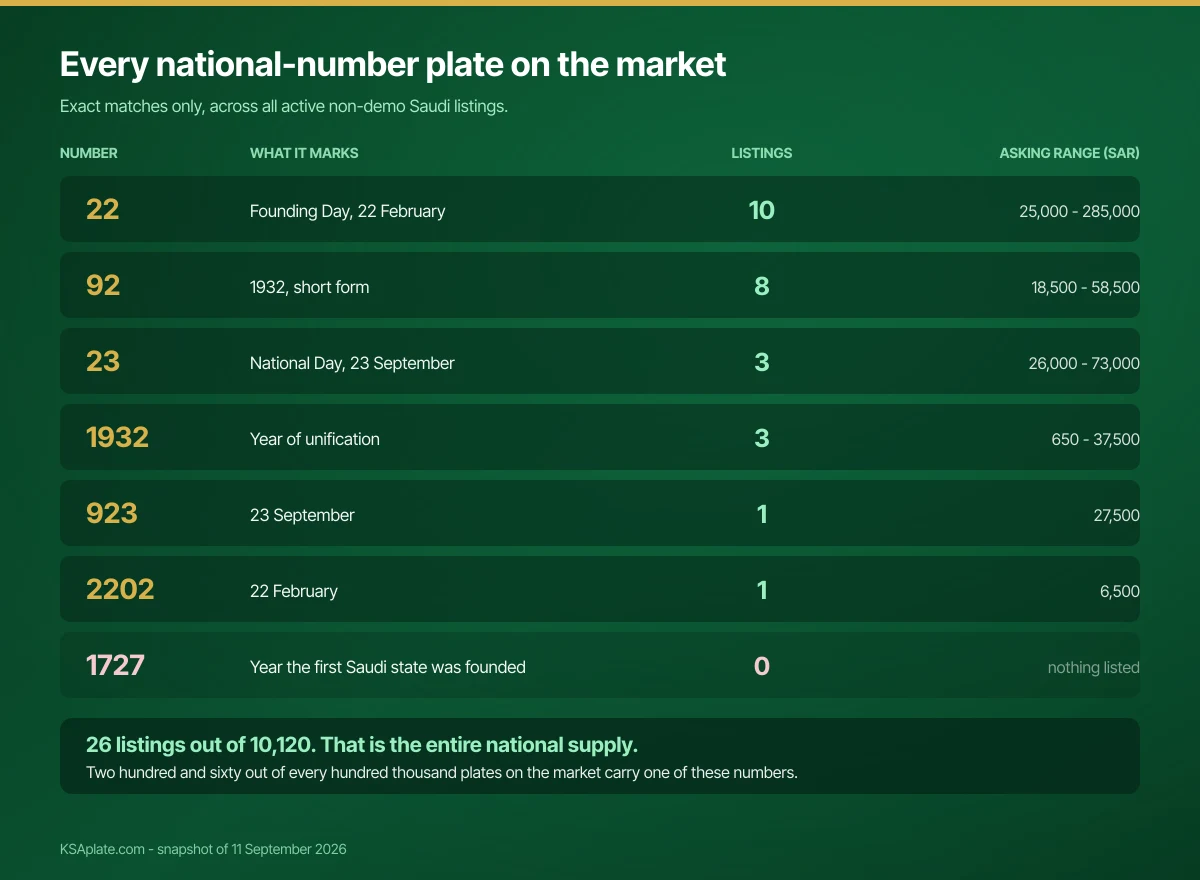
A census is more useful here than a price guide, because the binding constraint is supply. Here is every active non-demo listing on KSAplate whose number is exactly one of the six, counted on 11 September 2026.
| Number | What it marks | Listings | Asking range (SAR) |
|---|---|---|---|
| 22 | Founding Day, 22 February | 10 | 25,000 – 285,000 |
| 92 | 1932, short form | 8 | 18,500 – 58,500 |
| 23 | National Day, 23 September | 3 | 26,000 – 73,000 |
| 1932 | Year of unification | 3 | 650 – 37,500 |
| 923 | 23 September | 1 | 27,500 |
| 2202 | 22 February | 1 | 6,500 |
| 1727 | Year the first Saudi state was founded | 0 | nothing listed |
Twenty-six listings. That is the whole national supply on the largest plate marketplace in the Kingdom, and two of those six numbers are represented by a single plate each. If you want 923 there is exactly one seller in Saudi Arabia to negotiate with, and if they say no, you wait.
Two of the three 1932 plates are cheap — SAR 650 and 2,200 — which tells you something quietly important. A four-digit plate is a four-digit plate. The year of unification does not rescue an otherwise ordinary number from the bottom of the four-digit range, where the median ask is SAR 3,300.
Key takeaway: for national numbers, availability is the whole problem. Price is a detail you only reach if a plate exists.
What's your plate worth?
Get an instant, free estimate with our plate value calculator.
Calculate My Plate's Value23 September and 22 February are different things
National Day and Founding Day are two separate national dates, and confusing them is the most common mistake in this subject. National Day marks 23 September 1932; Founding Day marks 22 February 1727.
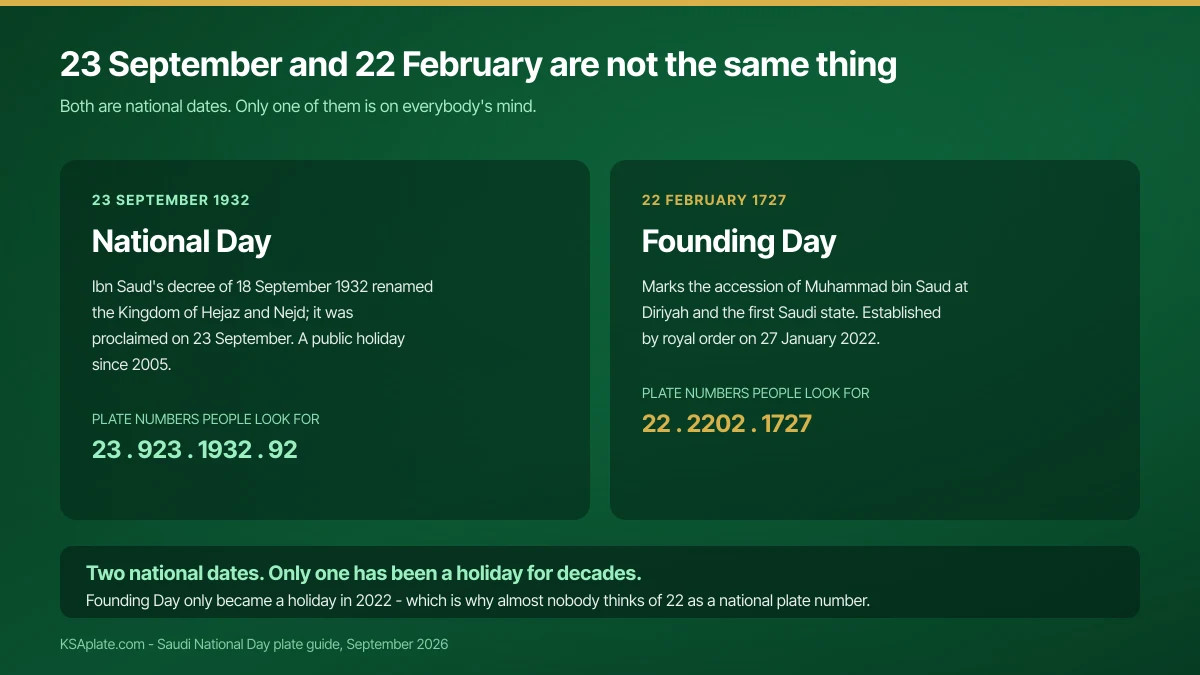
The history is specific. Ibn Saud issued a decree on 18 September 1932 renaming the Kingdom of Hejaz and Nejd and its dependencies to the Kingdom of Saudi Arabia, and it was proclaimed on 23 September by Prince Faisal. The day was observed at government level from 1965 under King Faisal and became a public holiday under King Abdullah in 2005.
Founding Day is much older as history and much newer as an occasion. It marks the accession of Muhammad bin Saud at Diriyah and the beginning of the first Saudi state in 1727. It became an official holiday by royal order on 27 January 2022 and was first observed on 22 February that year.
That four-year gap in recognition is why the plate market treats the two families so differently. Nobody has had time to build a habit around 22 as a national number, which is precisely why nine of the ten live 22 plates are priced as pattern plates rather than commemorative ones.
Key takeaway: 1932 and 1727 are both founding years. Only one of them is on the average buyer's mind, and it is not the older one.
The number that does not exist
1727 has no listing on the Saudi market. Zero, on a marketplace carrying 10,120 live plates — and that absence is more interesting than any price.
The arithmetic explains it. Four-digit plates are the bulk of the market, and any specific four-digit number is one of ten thousand possibilities. With 7,940 four-digit listings live, you would expect fewer than one instance of any given number by chance. Seeing zero 1727s is unremarkable statistically; what makes it worth stating is that the most historically loaded number in the Kingdom cannot be bought today at any price.
The same arithmetic is why 2202 has exactly one listing and 923 has exactly one. These are not rare because they are precious. They are rare because specific four- and three-digit numbers are rare full stop, and the national meaning does not create supply.
Key takeaway: scarcity here is arithmetic, not prestige. Do not read a missing number as a valuable one.
Why 22 looks expensive
22 is the one national number that looks like it carries a premium, and it does not — it carries a pattern premium that has nothing to do with February. Across ten live listings, 22 asks between SAR 25,000 and 285,000 and averages 102,563, against a two-digit market average of 47,476.
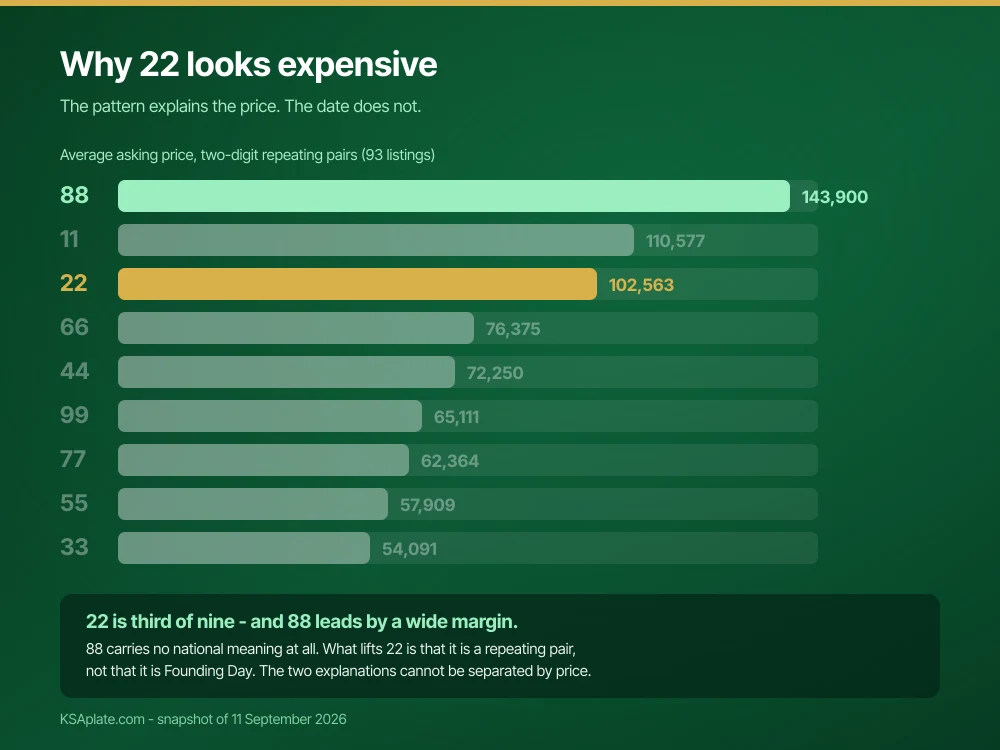
Before crediting Founding Day for that gap, hold the pattern constant. 22 is a repeating pair, and repeating pairs are independently valuable on every plate market in the Gulf. Here is every two-digit repeating pair on our own market.
| Pair | Listings | Average ask (SAR) |
|---|---|---|
| 88 | 10 | 143,900 |
| 11 | 13 | 110,577 |
| 22 | 8 | 102,563 |
| 66 | 8 | 76,375 |
| 44 | 12 | 72,250 |
| 99 | 9 | 65,111 |
| 77 | 11 | 62,364 |
| 55 | 11 | 57,909 |
| 33 | 11 | 54,091 |
The repeating pairs as a group average SAR 82,570 against 47,476 for the other two-digit plates — a large, consistent pattern premium. Within that group, 22 sits third of nine. Above it sits 11, and above that sits 88, which has no national meaning at all and is simply the luckiest digit doubled.
If Founding Day were doing the work, 22 would top this table. It does not. It sits in the upper middle of a group whose common feature is that both digits match — which is the explanation that also covers 88, 11 and 66.
This is the honest reading, and it is the reason we are not going to tell you that 22 is a patriotic investment. Our guide to repeating-number plates covers what that pattern is actually worth.
Key takeaway: the pattern explains the price. The date does not, and the two cannot be separated by looking at the number alone.
Does the market pay for patriotism?
On standing asking prices, no. The three live 23 plates ask SAR 26,000, 27,000 and 73,000 — an average of 42,000 against 47,476 for two-digit plates generally, so slightly below the run of the market rather than above it.
Three listings is not a sample, and we are not going to pretend it is. What we can say is bounded and useful: there is no large, visible premium sitting on national numbers in the current inventory. If one existed at the scale people assume, it would show up even at n=3.
Set that against the four-digit picture, where the year 1932 appears at SAR 650 and SAR 2,200 — both beneath the four-digit median of SAR 3,300 that we measured across 7,940 listings in our guide to pricing a plate for sale. A national year does not lift an ordinary four-digit plate out of the ordinary four-digit range.
One boundary matters. These are asking prices in standing inventory, not transaction prices, and they say nothing about whether a plate sells faster or for more in the weeks around a national date. That is a seasonal question and our data cannot see it.
Key takeaway: buy a national number because you want it, not because you expect the market to reward it.
The route that actually works
If the exact number does not exist, the practical alternative is a plate that contains it. 330 live listings contain 23 somewhere in the number and 319 contain 22 — pools more than a hundred times larger than the exact matches.
This is how most people actually end up with a national plate. A four-digit plate reading 4231 or 2312 carries the date for anyone who looks twice, costs what an ordinary four-digit plate costs, and is available today rather than in principle. The trade you are making is between a number that announces itself and a number that rewards a second glance.
- Decide whether you need the exact number. If yes, accept that your choice is between one and ten sellers and that waiting is part of the plan.
- If not, search on the digits rather than the whole number. Filter four-digit plates and look for 23 or 22 in any position.
- Prefer the leading position. 2310 reads as the date far more readily than 4123 does.
- Check the letters before you commit. A strong letter set costs more than the digits do on ordinary four-digit plates.
- Price it as what it is. A four-digit plate containing 23 is a four-digit plate. Use the four-digit ladder, not a patriotic mark-up.
Key takeaway: the contains-the-number route turns an impossible search into an ordinary one.
Does the date move the market?
Seasonality in the plate market is real but it is not something our standing inventory can prove. What we can see is the stock on any given day; what we cannot see is how quickly plates left the market in previous Septembers, because confirmed sale records do not exist in our data.
Our guide to market timing treats the weeks before 23 September as one of the year's two demand peaks. Read that as a claim about buyer attention, which is observable in enquiry volume, rather than as a promise that a national number will fetch more. The census above is the counterweight: whatever attention the date brings, it has not produced a visible price premium in standing inventory.
If you are selling into the period, the sensible position is the ordinary one. Price against comparable plates of the same digit count, and treat any national reading of your number as a reason a particular buyer might move faster, not as a multiplier you can apply in advance.
Key takeaway: the date may bring buyers. It has not brought higher asking prices.
Buying one before 23 September
Twelve days is enough time if the plate exists and the seller is responsive, because the transfer itself is not the slow part. The slow part is finding a plate at all.
- Search the exact number first. If one of the 26 is what you want, contact the seller today rather than the week of the holiday.
- Set your three numbers before you call. Floor, ask and first concession, decided in advance.
- Verify the seller holds the plate through Absher before any money moves. Our guide to verifying a plate before buying sets out the checks.
- Budget the transfer. Moving a plate between owners costs SAR 400 per vehicle plus a SAR 230 service fee — SAR 1,030 in total for a private vehicle — and needs both parties to consent.
- Do not leave it to the 22nd. A transfer needs the other party to act, and they are on holiday too.
The full process is in our Absher plate transfer guide.
See what is actually listed right now
Browse live Saudi plates and filter by digits and letters — including the numbers in the census above.
Browse live platesValue a plate freeGiving one as a gift
A plate is a gift that has to be registered, which makes it unlike almost anything else you might give on a national holiday. The transfer requires the recipient's own Absher consent and a vehicle in their name, so it cannot be a surprise in the usual sense.
The practical sequence is to agree it with the recipient first, complete the transfer, and let the occasion be the reveal rather than the mechanism. Our guide to gifting a plate covers the paperwork and the timing for Eid, weddings and national occasions.
One caution specific to this article: a national number bought as a gift is worth what its digit count and letters are worth. If the intention is generosity rather than investment, an ordinary four-digit plate containing 23 will read exactly as warmly as an exact match and cost a fraction as much.
Key takeaway: the sentiment is in the number, not in the price paid for it.
Frequently asked questions
How many National Day plates are actually for sale in Saudi Arabia?
Is a 23 plate more expensive than a normal plate?
Why is 22 so much more expensive than 23?
Can I buy a 1727 plate?
What is the difference between National Day and Founding Day?
Does a plate containing 23 count?
Should I buy a national plate as an investment?
Is it better to sell my plate just before National Day?
How long does the transfer take if I buy one now?
What to do next
If you want an exact national number, look now and accept that you are choosing between a handful of sellers — for 923 and 2202, exactly one each. If you want the date on your car without the search, filter four-digit plates for 23 or 22 in the number and price it as the ordinary four-digit plate it is.
Either way, value it before you negotiate. The one thing this census makes clear is that national meaning does not move a price, so the digit count and the letters are what you are actually buying.
Find a plate with the date on it
Filter live Saudi listings by digits and letters, or get a free value range before you make an offer.
Browse live platesList your plate freeLast reviewed on 11 September 2026 by Khalid Al-Rashid, Saudi License Plate Expert. Method: all listing counts and prices are a snapshot of KSAplate's own listing table on 11 September 2026, covering 10,120 active listings excluding demo inventory. "Exact match" means the plate's whole number equals the national number; "contains" means the digits appear anywhere in it. Price figures use listings that carry an asking price and exclude call-for-price entries. These are seller asking prices, not confirmed sale prices, and no claim is made about how quickly any plate sells. The repeating-pair comparison holds digit count constant at two digits. Historical dates are as published by the sources below; fee figures are the Absher schedule for نقل اللوحات (SAR 400 per private vehicle plus a SAR 230 service fee). Confirm current fees in your own Absher account before acting.
Sources: Saudi National Day and Saudi Founding Day for the dates, decrees and years; Absher for the نقل اللوحات service and fees.