Last updated: 10 September 2026 · 15 min read
Ask the median price for your digit class, then adjust up only for a pattern a buyer can name. On live Saudi listings that means roughly SAR 3,300 for a four-digit plate, 26,500 for three digits, 36,000 for two and 140,000 for one. The number matters less than most sellers think. What decides whether anyone sees the listing at all is that the price field is filled in.
A valuation gives you a range. A listing needs one number. Nobody publishes the step in between, which is why sellers stare at "SAR 64,000–390,000" and guess.
TL;DR
- Start at the median for your digit count. Across 9,829 priced Saudi plate listings the medians are SAR 140,000 (one digit), 36,000 (two), 26,500 (three) and 3,300 (four). That is the number to beat, not a number to fear.
- Never leave the price blank. Listings with no price shown get a median of 0.83 page views a day. Listings with a price get 18.75, 11.46 and 5.78 for one-, two- and three-digit plates — 23×, 14× and 7× more attention.
- "Call for price" is not mystery, it is exclusion. On KSAplate a price of zero is dropped by every minimum-price filter and sorted last under both price sorts. The listing is not hidden; it is unreachable by the way people browse.
- Charm pricing does nothing here. We tested odd prices against round ones and found no advantage that survives controlling for plate quality. 93.9% of Saudi sellers price in whole hundreds, and there is no penalty for joining them.
- Fix three numbers before you list — floor, ask, first concession. The seller who decides the floor during a phone call is the seller who sells below it.
What price should you actually ask?
An asking price is the single number a buyer sees in the listing, and it is a filtering decision before it is a money decision. The direct answer: take the median asking price for your plate's digit count, move up toward the upper quartile only if the plate has a pattern you can describe in three words, and round to the nearest SAR 500.
That produces a defensible number in about thirty seconds. A four-digit plate with no pattern asks SAR 3,300. A three-digit plate with an ordinary letter set asks 26,500. A two-digit plate asks 36,000. These are not guesses — they are the middle of what 9,829 Saudi sellers are asking right now.
The reason this works is that plate buyers shop by comparison, not by appraisal. A buyer looking at four-digit plates has thirty tabs open. Your listing is judged against the others on screen, and the median is the position where you are neither dismissed as overpriced nor suspected of hiding a problem.
Key takeaway: the median for your digit class is the default. You need a reason to leave it, and "I paid more than that" is not one.
If you have not valued the plate yet, do that first — our guide to calculating a Saudi plate's value explains the five factors that move the number, and the free plate value calculator applies them to your letters and digits in about ten seconds.
Get the range before you pick the number
Enter your letters and digits and see what comparable Saudi plates are being asked for right now.
Value my plate freeBrowse live listingsWhere your number sits in the live market
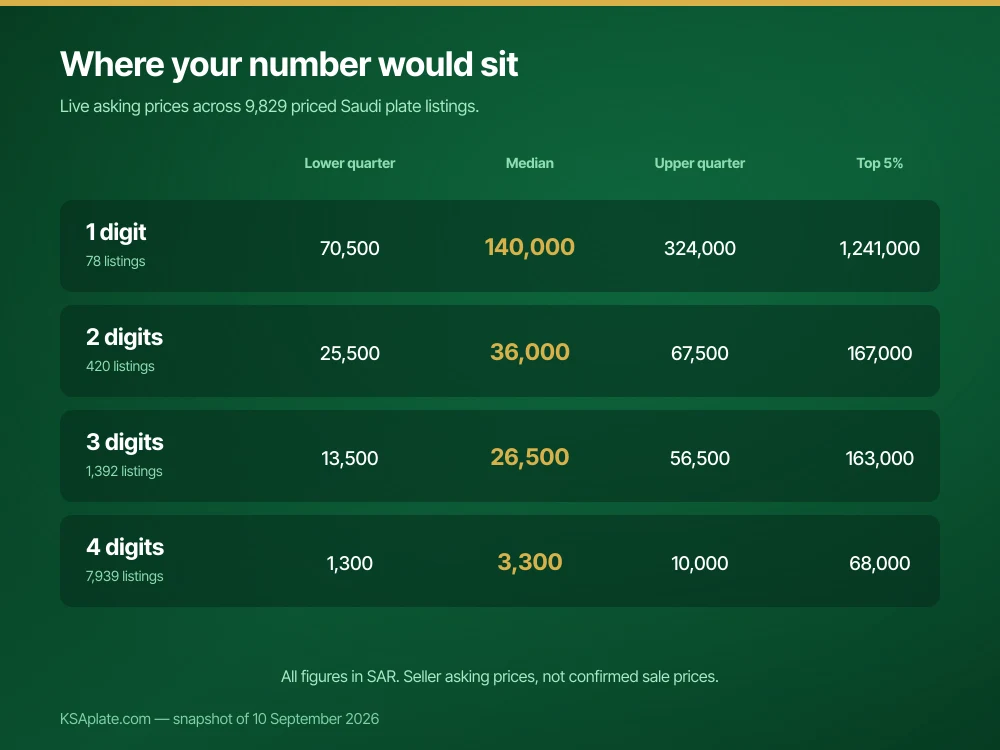
The asking-price ladder is the distribution of what sellers are currently asking, split by digit count. It answers a question a valuation range cannot: not "what is this worth" but "if I ask X, am I cheap, normal or ambitious?"
Here is the ladder, taken from every active non-demo Saudi plate listing that carries a price on 10 September 2026.
| Digit count | Listings | Lower quarter | Median | Upper quarter | Top 5% |
|---|---|---|---|---|---|
| 1 digit | 78 | SAR 70,500 | SAR 140,000 | SAR 324,000 | SAR 1,241,000 |
| 2 digits | 420 | SAR 25,500 | SAR 36,000 | SAR 67,500 | SAR 167,000 |
| 3 digits | 1,392 | SAR 13,500 | SAR 26,500 | SAR 56,500 | SAR 163,000 |
| 4 digits | 7,939 | SAR 1,300 | SAR 3,300 | SAR 10,000 | SAR 68,000 |
Read the columns as positions, not as prices. If you ask SAR 10,000 for a four-digit plate you are in the top quarter of 7,939 listings and you had better be able to say why. If you ask 1,300 you are in the bottom quarter and the plate will be compared against the cheapest inventory on the site.
Notice how compressed the middle is and how far the top stretches. On four-digit plates the gap from the lower quarter to the median is SAR 2,000; the gap from the upper quarter to the top 5% is SAR 58,000. Almost all of the money in this market sits in a small number of exceptional plates, which is exactly why an ordinary plate priced like an exceptional one simply does not move.
Key takeaway: your price is a rank, not a value. Decide which quarter you want to be in and the number follows.
What's your plate worth?
Get an instant, free estimate with our plate value calculator.
Calculate My Plate's ValueThe price field is a search field
A blank price field is not neutral — it is a decision to leave most of the market. This is the single largest effect we can measure in our own listing data, and it is much bigger than the effect of choosing a good number instead of a mediocre one.
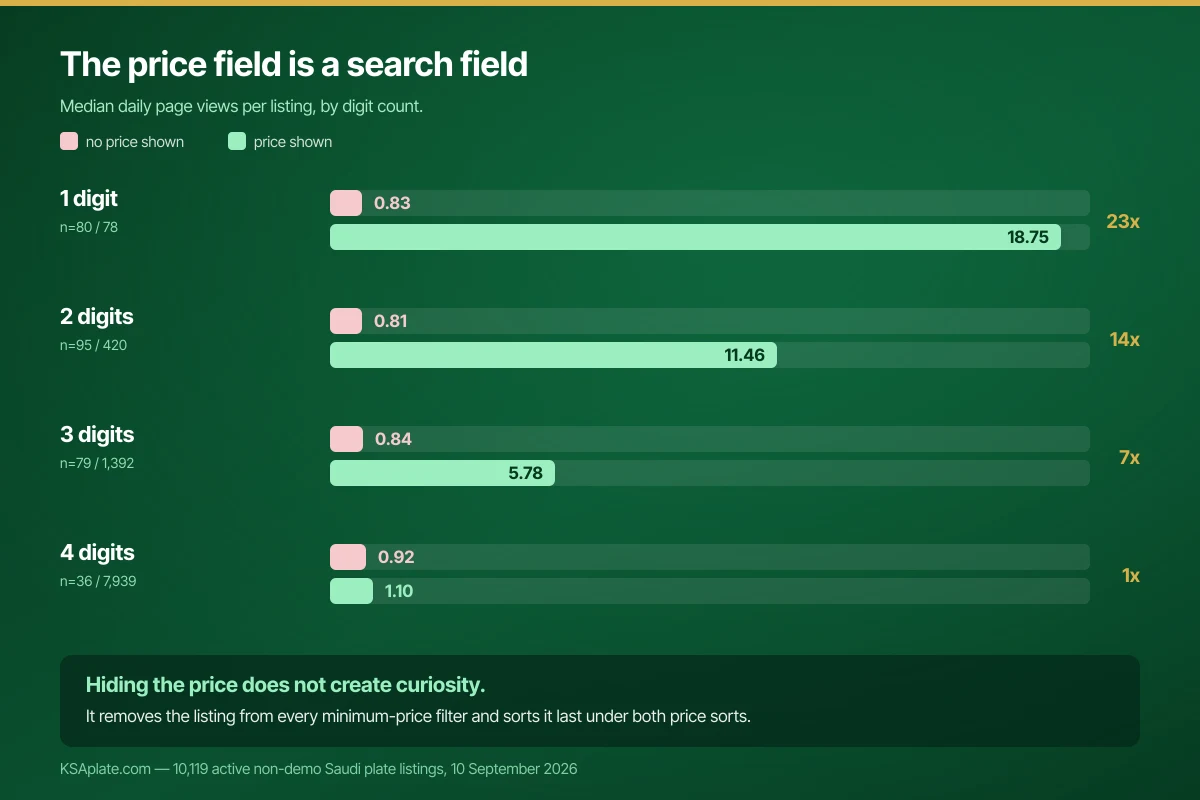
We measured attention as page views divided by days the listing has been live, so an old listing is not rewarded for being old. Then we split by digit count, because a one-digit plate is intrinsically more interesting than a four-digit one and mixing them would fake the result.
| Digit count | No price shown | Price shown | Difference |
|---|---|---|---|
| 1 digit | 0.83 views/day | 18.75 views/day | 23× |
| 2 digits | 0.81 views/day | 11.46 views/day | 14× |
| 3 digits | 0.84 views/day | 5.78 views/day | 7× |
| 4 digits | 0.92 views/day | 1.10 views/day | 1.2× |
Look at the left column. Whatever the plate is worth, a listing with no price settles at roughly 0.83 views a day. A one-digit plate that could sell for six figures gets the same daily attention as an ordinary four-digit plate, because in browsing terms it has stopped being a one-digit plate and become an unsorted row.
The mechanism is not psychology, and we can be specific because it is our own code. A listing with no price is stored with a price of zero. Any buyer who sets a minimum price — "show me plates over SAR 50,000" — filters on price being at or above that figure, and zero never is. Sort by price low-to-high and the no-price listings are pushed to the end; sort high-to-low and they are pushed to the end again. There is no browsing path on which they surface early.
The common belief runs the other way. Wikipedia's entry on price on application notes that "Some online listing systems internally sort POA items as being either very cheap or very expensive meaning they will appear at the start of a price-sorted list" — and that sellers exploit this to stand out. On this marketplace the opposite is coded, and sellers who assume otherwise are paying for a trick that does not exist here.
The four-digit row is the exception that proves the rule: 1.2× is close to no difference at all. Four-digit plates are cheap enough that buyers browse them by pattern and letters rather than by price filter, so the filter penalty barely bites. On everything above that, it is decisive.
Key takeaway: filling in the price field is worth more than filling it in perfectly.
The Three-Number Method
The Three-Number Method is a rule for deciding your position before anyone contacts you. It exists because plate negotiations happen on the phone, at speed, usually with a buyer who does this more often than you do.
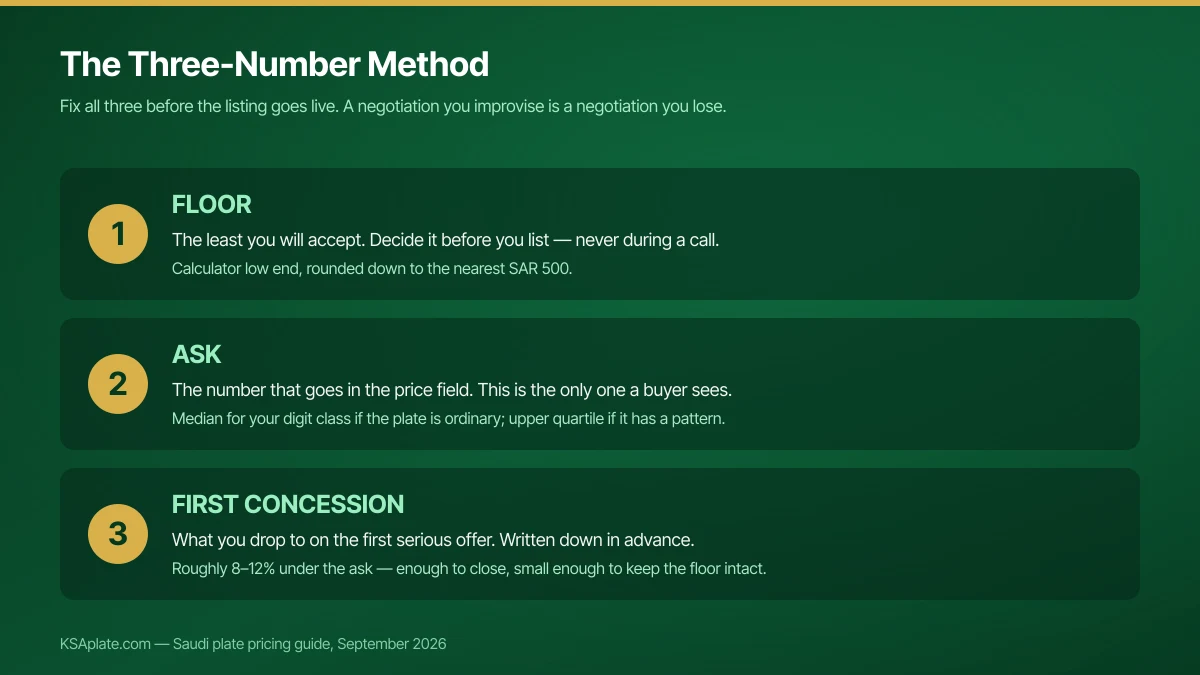
- Set the floor. Take the low end of your valuation range and round down to the nearest SAR 500. This is the number below which you keep the plate. Write it somewhere you will see it during a call. It does not appear in the listing and you never tell a buyer what it is.
- Set the ask. Take the median for your digit class from the ladder above. Move to the upper quarter only if the plate has a named pattern — repeating, mirror, sequential, or letters that spell something. Round to the nearest SAR 500. This is the only number the buyer sees.
- Set the first concession. Decide now what you will drop to when a serious buyer pushes, and make it 8–12% under the ask. Deciding this in advance is the whole point: it converts a negotiation into an execution.
- Check the spread. If your first concession is already below your floor, the ask is too low. Raise the ask, not the floor.
- Leave it alone for 30 days. Re-pricing in week one teaches buyers to wait for the next cut.
An example with real ladder figures. A four-digit plate, no pattern, calculator range SAR 2,400–4,800. Floor: 2,400 rounded down to 2,000. Ask: the median, 3,300, rounded to 3,500. First concession: 10% under, so 3,150 — comfortably above the floor. The spread is healthy and every number was decided before the phone rang.
Key takeaway: the seller who decides the floor during the call is the seller who sells below it.
Turning a valuation range into one number
A valuation range is a statement of uncertainty, not a menu. A calculator that returns SAR 64,000–390,000 is telling you that the plate's value depends heavily on something it cannot observe — usually how much a specific buyer wants those specific letters.
Collapse it in three steps. First, ignore the top of the range unless your plate is the thing that makes the top possible: a genuine one-digit number, a triple-repeat, or letters that spell a name. Second, place the bottom of the range on the ladder and see which quarter it falls in. Third, ask somewhere between the range's bottom and the median for your digit class, whichever is higher.
That last rule matters. A wide range usually means the plate has one unusual feature and several ordinary ones. Ordinary features are what the market prices day to day; unusual ones are what a single buyer might pay for. You list for the market and you negotiate for the individual.
Our VIP plate valuation guide breaks down which features genuinely widen a range and which merely look like they should.
Key takeaway: list at the market's number and keep the exceptional number for the negotiation.
Round numbers, odd numbers and what we tested
Charm pricing is the retail habit of ending a price just below a round figure — 4,999 instead of 5,000 — on the theory that it reads as cheaper. It is close to universal in shops. It is close to absent on Saudi plate listings, and we found no evidence that it helps.
Of 9,829 priced listings, 93.9% are a whole multiple of SAR 100. Just under half are multiples of 500, and 28.4% are multiples of 1,000. Only 6.1% use anything else. The fifteen most-used exact prices — 1,300, 1,400, 1,200, 1,100, 1,000, 1,500, 850, 900, 950, 800, 750, 2,000, 1,600, 650 and 550 — account for one listing in four between them. (They sit low because four-digit plates are 81% of the market.)
We then tested whether the odd-priced 6.1% get more attention. Raw numbers suggested round-thousand prices did better, but round-thousand prices are also attached to more expensive and therefore more desirable plates. Once we held plate quality even, the difference disappeared into the noise. We are reporting a null result rather than dressing it up: on this evidence, round versus odd is not a lever.
The practical reading is liberating. You do not need to be clever. Pick a clean multiple of 500, which is what nearly every Saudi seller does, and spend the saved effort on the listing photographs — where there is a measurable difference, covered in our guide to photographing a plate for sale.
When to price above the median
Pricing above the median is justified when a buyer can name the reason in three words. That is the test, and it is stricter than it sounds — "it's a nice number" fails it, "triple seven" passes.
The features that reliably carry a premium are structural, not aesthetic:
- Repeating digits — 7777, 999, 55. The premium rises sharply with the length of the run.
- Mirror and palindrome numbers — 1221, 4554. Recognisable at a glance, which is what makes them tradeable.
- Sequential runs — 1234, 6789.
- Low absolute numbers — 1 through 9 in any digit class, then 10, 20, 100.
- Letter sets that spell something — initials of a common name, a tribe, or a recognisable three-letter word in either script.
What does not carry a premium, despite sellers believing it does: the city the plate was issued in, the plate being "old", the plate having been on a luxury car, and the price the seller originally paid. Our analysis of what plate buyers actually search for goes through the demand side in detail, and the four-digit plate guide covers pattern premiums for the class most sellers are in.
Key takeaway: if you cannot name the premium in three words, the buyer will not pay for it.
When "call for price" is genuinely the right call
There is a narrow case for withholding a price, and the data shows sellers already know roughly where it lies. Among one-digit plates, 50.6% are listed without a price. Among two-digit plates it is 18.4%, three-digit 5.4%, and four-digit 0.45%.
That gradient is rational. At the very top of the market there are perhaps a dozen credible buyers in the Kingdom, they are not using price filters, and a public number can anchor a negotiation that would otherwise have started higher. If your plate is a single digit with a strong letter set, withholding the price costs you browsing traffic you did not need.
Below that tier the trade is bad. A two-digit plate has hundreds of potential buyers and most of them find listings through filters. Giving up 14× the daily attention to protect an anchor on a SAR 36,000 sale is not a trade worth making.
A middle option most sellers miss: list a price and mark the plate as negotiable in the description. You keep the filter visibility and you signal flexibility, which is what withholding the price was supposed to achieve.
Key takeaway: withhold the price only if your plate is rare enough that buyers would hunt for it by name.
Five pricing mistakes that cost real money
- Pricing from what you paid. The plate market does not know what you paid and does not care. Sunk cost is the most common reason a listing sits for a year.
- Pricing from the record sales you read about. The headline auction results are the top 0.01% of the market. Anchoring an ordinary plate to them guarantees silence.
- Leaving the price blank to "see what people offer". As measured above, this removes the listing from the filters most buyers use. You will get fewer offers, not better ones.
- Cutting the price in the first fortnight. Plate buyers are patient and they watch listings. An early cut is read as a signal that more cuts are coming.
- Forgetting the transfer fee in the net. On a cheap plate the fees are a significant share of the sale. Price with the net in mind, not the headline.
Nobody has called. Now what?
Silence after 30 days is information about position, not about value. Before touching the price, check the two things that suppress a listing more reliably than a high number: a blank price field, and photographs that do not show the plate clearly.
If both are already right, then work through this order:
- Compare against live inventory, not against your valuation. Open the listings for your digit count and sort by price. If ten comparable plates sit below yours, you are not mispriced by a little.
- Cut once, meaningfully. A 5% cut is invisible. Move to the next position on the ladder — from the upper quarter to the median, for instance — and hold there.
- Improve the description before cutting again. Name the pattern explicitly. A buyer searching for a mirror plate needs the word "mirror" to be present.
- Consider timing. Demand is not flat across the year; our market timing guide covers the seasonal pattern and when a pause beats a cut.
Key takeaway: change position once and decisively. Three small cuts train buyers to wait for the fourth.
What the fees leave you
Your net is the asking price minus what the buyer negotiates and minus the transfer costs. The transfer costs are fixed and published, which makes them easy to plan around and easy to forget.
Moving a plate between owners is the Absher service نقل اللوحات, and for a private vehicle it costs SAR 400 per vehicle plus a SAR 230 service fee — SAR 1,030 in total, because two vehicles are involved. Selling the whole car with the plate on it is a different service, مبايعة المركبات, at SAR 150 plus the same SAR 230, so SAR 380. A plate transfer between different owners also requires both parties to consent and is initiated by the party currently holding the plate.
| Digit count | Median ask | Transfer cost | Fees as share of the sale |
|---|---|---|---|
| 1 digit | SAR 140,000 | SAR 1,030 | 0.7% |
| 2 digits | SAR 36,000 | SAR 1,030 | 2.9% |
| 3 digits | SAR 26,500 | SAR 1,030 | 3.9% |
| 4 digits | SAR 3,300 | SAR 1,030 | 31.2% |
That bottom row is the reason a cheap plate needs a firmer floor than its price suggests. On the median four-digit plate, accepting SAR 500 below your ask does not cost you 15% — combined with the transfer fee it can take more than half of what you actually walk away with. The step-by-step process is in our Absher plate transfer guide.
Key takeaway: on plates under SAR 5,000, the fee is the negotiation. Agree who pays it before you agree the price.
Frequently asked questions
Should I price above my valuation to leave room to negotiate?
Is it better to price just under a round number, like 4,900 instead of 5,000?
How long should I wait before changing the price?
Does the city on the plate change what I can ask?
What if my plate has sentimental value to me?
Do the views in this article mean my plate will sell faster if I price it?
Should I show the price in the photographs too?
Is it free to list a plate, and does paying for placement change the price I should ask?
Who pays the SAR 1,030 transfer fee?
What to do next
Value the plate, find your row on the ladder, and write down three numbers before you open the listing form. That sequence takes about five minutes and it removes every decision you would otherwise be making while a buyer waits on the phone.
Then list it with the price filled in. That last part is the one this article exists for: on one-, two- and three-digit plates it is worth 7 to 23 times the daily attention of the alternative, and it costs nothing.
List your plate free — with a number in the price field
No listing fee and no commission on the sale. Takes about two minutes.
List my plate freeRead the full selling guideLast reviewed on 10 September 2026 by Khalid Al-Rashid, Saudi License Plate Expert. Method: price and attention figures are a snapshot of KSAplate's own listing table on 10 September 2026, covering 10,119 active listings excluding demo inventory, of which 9,829 carry an asking price. Attention is page views divided by days live, compared only within a digit count. View counts are not deduplicated per visitor and include crawler traffic, so absolute values are inflated; the inflation is uniform, which is why only comparisons between segments are stated and no claim is made about time to sell. These are seller asking prices, not confirmed sale prices. Fee figures are the published Absher schedule for نقل اللوحات (SAR 400 per private vehicle plus a SAR 230 service fee) and مبايعة المركبات (SAR 150 plus SAR 230). Confirm current fees in your own Absher account before acting.
Sources: Absher (نقل اللوحات and مبايعة المركبات service cards); Ministry of Interior / General Directorate of Traffic fee schedule; Price on application (Wikipedia) for the POA sorting convention referenced above.