Last updated: 31 July 2026
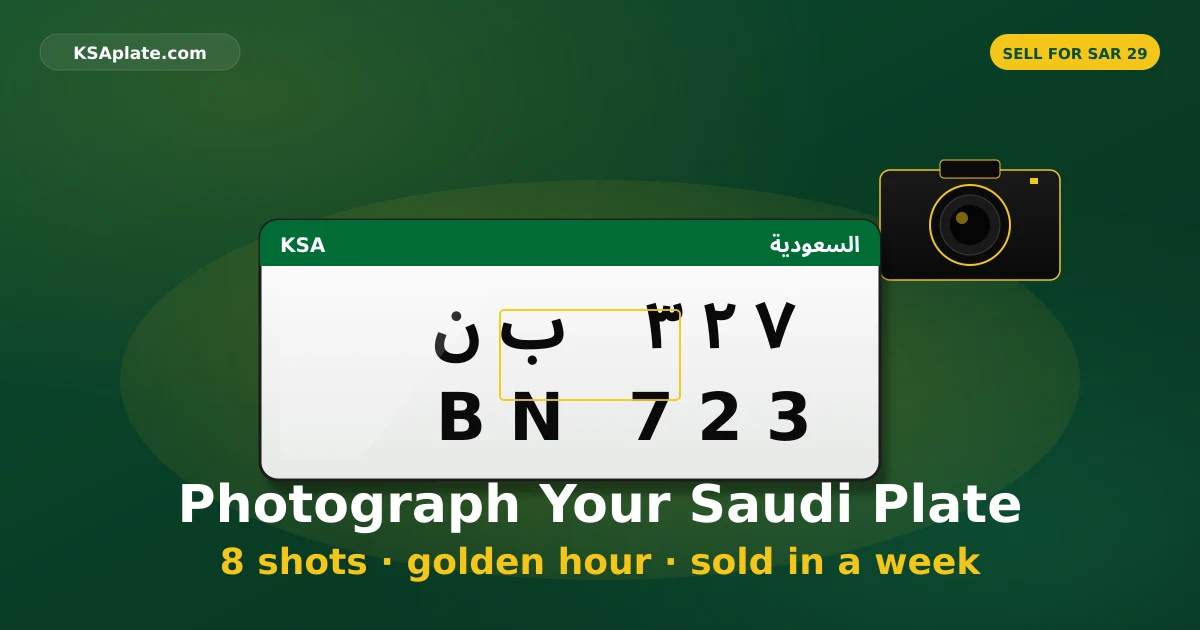
A Saudi license plate is not sold by its description. It is sold by its first photograph. Buyers scroll a wall of thumbnails, and somewhere in a fraction of a second per image a thumb decides: stop, or keep moving. Everything you want from the sale — the calls, the serious offers, the price you have in mind — passes through that instant. Thirty minutes with a clean cloth, the right window of afternoon light, and eight deliberate shots is often the difference between a plate that sells in a week and a plate that lives in the listings for a year.
TL;DR:
- The plate is your product. Treat it like one. Not a passport photo of your car with the plate in it — a clean, sharp, well-lit portrait of the plate itself. That is what buyers zoom into and screenshot to their WhatsApp groups.
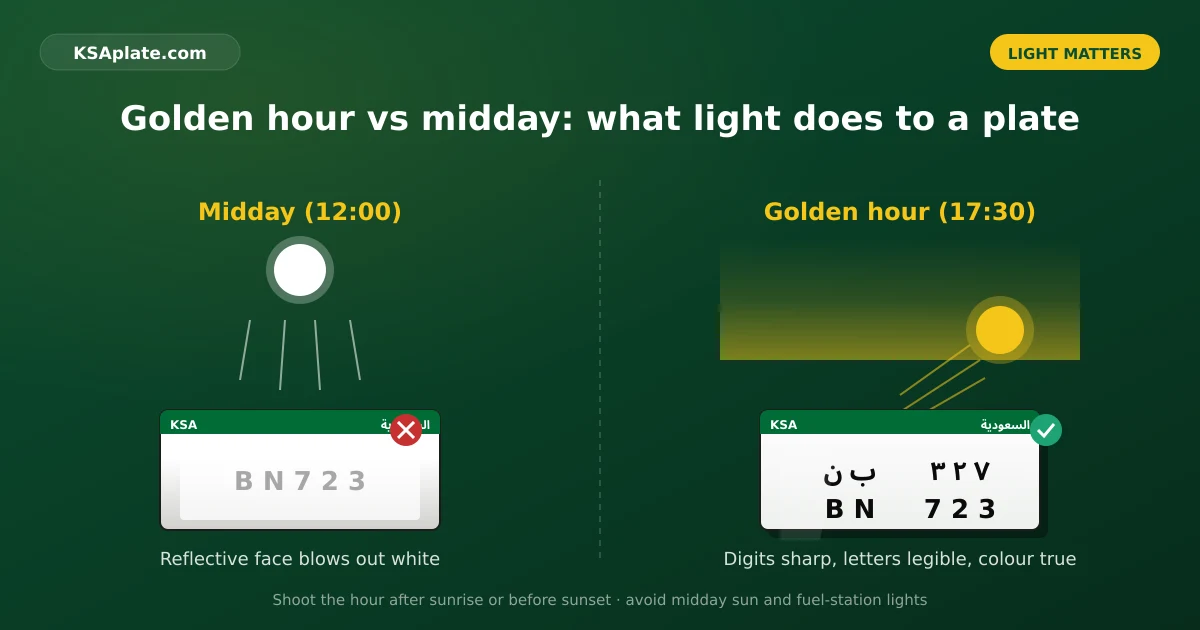
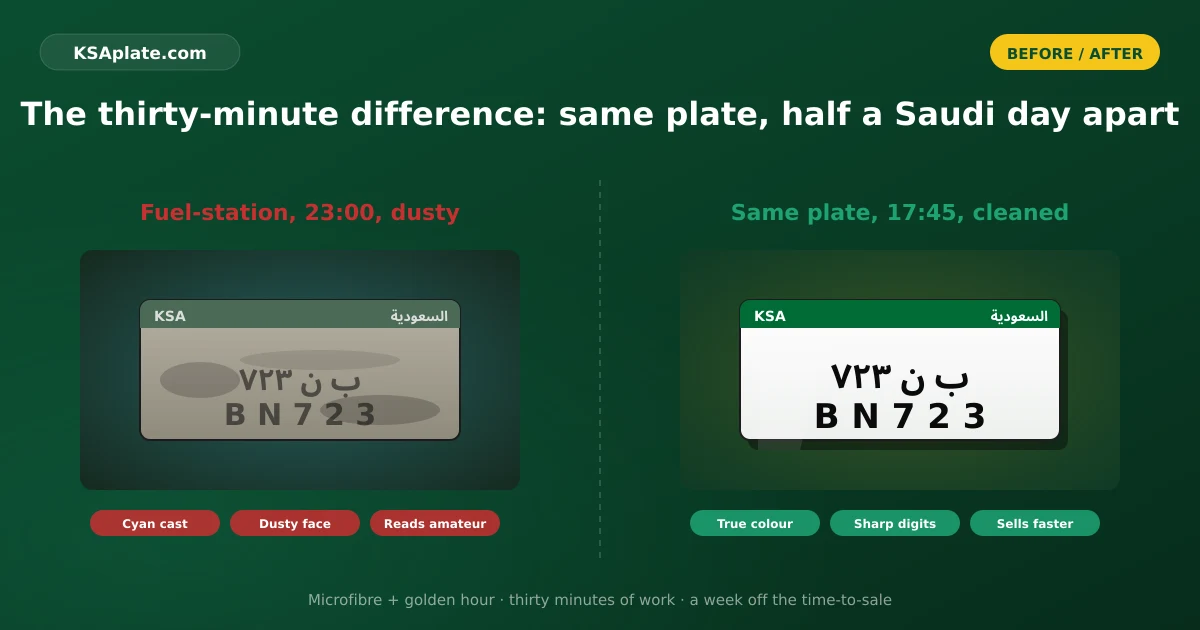
- Light beats gear. Shoot in the diffuse hour after sunrise or before sunset in the Kingdom. Midday sun blows out the reflective face; night and fuel-station fluorescents cast every plate green-cyan and read "amateur" to a serious buyer.
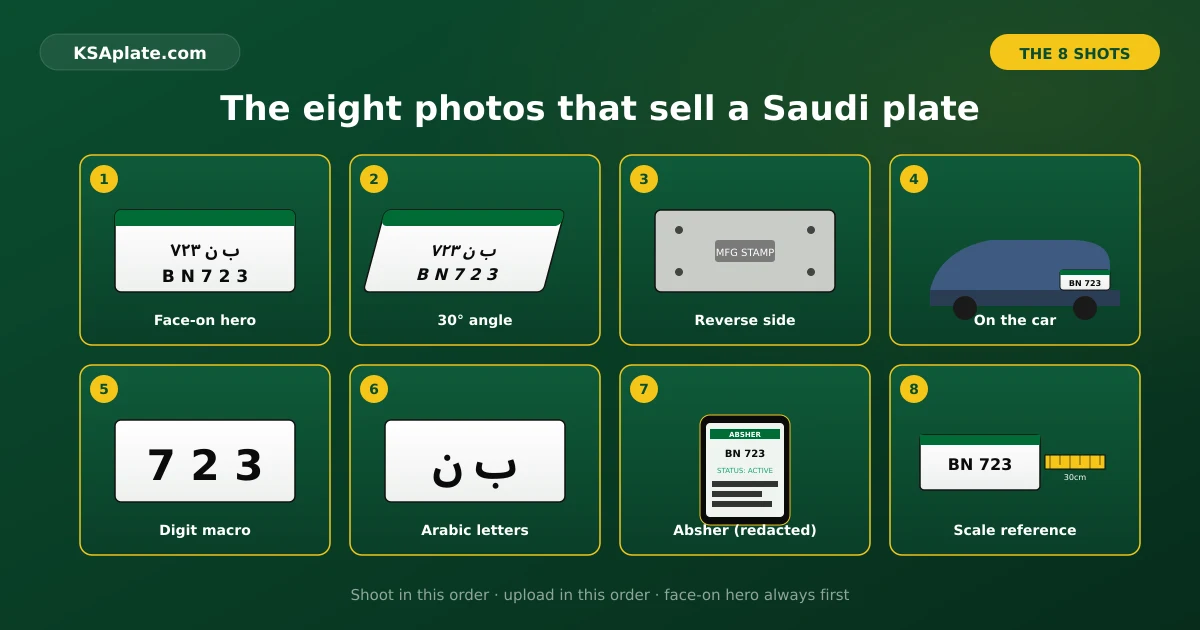
- Eight photos sell a Saudi plate: the straight face-on hero, the 30° angle proving it is real metal, the reverse side, the pair on the car in situ, a macro of the digits, a macro of the Arabic letters, the Absher/istimara ownership screen with sensitive data covered, and a scale reference showing the size (long or square).
- Cover what should not be public, keep what proves the plate is legitimate. Buyers want to see the plate face and the ownership status — not your national ID, your address, or your phone number in the frame.
- The value you calculated is the anchor. Lead the listing with the plate's calculated value, not the price you hope for. On the KSAplate calculator the number appears before the free listing fee, and the fee reads as a rounding error against a real four- or five-figure market value.
Quick answer: To photograph a Saudi license plate for sale, remove it from the vehicle if you can, wipe it clean with a soft cloth (never abrasive), and shoot in the diffuse light of the hour after sunrise or before sunset — never at midday, never at night, never under fuel-station lights. Take eight photos: a straight face-on shot as the hero, a 30° angle, the reverse with the security markings visible, both plates mounted on the car for context, a macro of the digits, a macro of the Arabic letters, the ownership screen from Absher or the physical istimara with sensitive fields covered, and one scale reference. Shoot with your phone at chest height, tap-lock focus and exposure on the plate, keep the horizon straight, and upload the face-on hero as photo one. Then anchor the price to the KSAplate calculator value, list on KSAplate for free, and let the photographs do the work.
Why plate photos are different from car photos
When you sell a car, the buyer is buying the whole object — the way it holds a line down the road, the state of the boot carpet, the honesty of the seller. Photos of the car are photos of a lifestyle, and the plate is a footnote. When you sell a Saudi license plate, the transaction inverts entirely. The buyer is not buying a car. They are buying this specific arrangement of two letters and one, two, three or four digits, and everything else in the frame — including the car it happens to be attached to — is noise.
That inversion changes every rule of the shot. The plate needs to be sharp, straight-on, evenly lit, and the frame around it needs to be quiet. The buyer's eye needs to land on the digits and read them cleanly, without craning at an angle, without squinting through a windscreen reflection, without having to zoom in twice to check whether that is a ن (Noon) or a ب (Baa). If the buyer has to work to see the plate, they scroll on. You have half a second — spend it on the plate itself.
The rule: photograph the plate, not the car. If a buyer covered the plate in your first photo with a thumb, would the image have any reason to exist? If not, you have shot a car with a plate in it. Reshoot the plate.
Light: the Saudi plate photographer's real problem
Every Saudi license plate has one thing in common: it is designed to reflect. The white background of a private plate is reflective, the letters are reflective, the emblem panel is glossy. In direct midday Saudi sun that reflectivity turns the plate into a small mirror. The digits blow out white, the Arabic letters lose their edges, and any buyer who zooms in sees a haze of overexposed pixels where a plate should be. Night is worse. Fuel-station fluorescents and mall car-park sodium lamps cast a green-cyan tint that changes the perceived colour of the plate face and instantly signals "shot in a hurry, at midnight, in a hurry to sell."
The window you want is the same window Saudi car photographers use, for the same reason: the hour after sunrise, or the hour before sunset. The sun is low, the light is diffuse and warm, the shadows are long and soft, and the plate face reads exactly the colour it will read to the buyer in daylight. In summer, this means shooting at 05:30 or after 18:30. In winter, closer to 06:30 or 16:30. Check the forecast the night before — a cloudy day is a photographer's gift, because the whole sky becomes one enormous softbox and the plate has no glare at all.
If you must shoot midday, find open shade. The side of a building. Under a carport with the sun on the far side. The plate should be in shade while the background is in shade too — a plate in shade against a sunlit wall creates a dynamic range your phone cannot handle, and the plate turns muddy grey.
Know the number before you photograph it
Buyers negotiate with a value in mind. So should you. Run your plate through the KSAplate calculator first — the number you get back is the anchor for every conversation, and the frame every photo has to live up to.
Calculate my plate's value List for free flatThe thirty-minute clean and stage
Before the light is right, prepare the plate. A Saudi plate that lives on a car in Riyadh, Jeddah or Dammam collects a specific film — desert dust bound with humidity in the coastal cities, salt spray if the car parks near the Red Sea corniche, exhaust film if the car sits behind a fuel station in traffic. A dirty plate reads as a used plate. A clean plate reads as an asset.
The cleaning kit
- A microfibre cloth. Never a paper towel — it scratches the reflective coating and dulls the digits.
- Distilled water, or a mild car-glass cleaner. Not household glass cleaner (ammonia clouds the reflective layer over time), not petrol, not solvents.
- A soft-bristle brush for the recesses of the digits and the Arabic letters, where dust settles into the raised edges.
- A second dry microfibre for the final wipe.
Spray or dampen the first cloth, wipe in a single direction from top to bottom of the plate, work the brush gently around the raised digits, then dry with the second cloth in the same top-to-bottom motion. Two minutes per plate face. Do not use a cloth that has been on the car body — brake dust in a paint-cleaning cloth will scratch the plate the moment you drag it across.
The background that quiet-frames the plate
A quiet background is not a blank wall — a completely white wall makes the plate look like a product on a store shelf and buyers subconsciously distrust it. What you want is a background that has texture but no story: a plain painted garage wall in a neutral colour, the smooth concrete of a driveway shot from above with the plate flat on the ground, or a matte grey car body (yours or another parked car, ideally clean and dark). Avoid the mall parking floor line-markings, avoid the fuel-station canopy above, avoid other plates in the frame — a competitor's plate accidentally in your photo is the fastest way to look unprofessional.
What's your plate worth?
Get an instant, free estimate with our plate value calculator.
Calculate My Plate's ValueThe eight shots that sell a Saudi plate
Not twelve. Not five. Eight. Fewer and the buyer has questions and messages you; more and the buyer stops scrolling before reaching the price. Shoot these in this order and upload in this order — the first is your hero.
1. The face-on hero
Remove the plate from the car if the car is not being sold with it. If you cannot remove it, park somewhere clean, drop to one knee so the phone is at plate height, and step back until the plate fills roughly 70% of the frame with quiet space around it. Shoot square-on. The digits should be perfectly horizontal — the top edge of the plate parallel to the top edge of the frame. This is the photograph that will appear in the search results. This is the photograph the buyer will screenshot and forward. If nothing else in this article lands, land this shot.
2. The 30° angle — proof of physical plate
Rotate to a shallow angle, roughly 30° off the face. This shot has one job: it proves the plate is a real physical piece of aluminium and not a photoshopped mock-up of the digits. It shows the depth of the raised characters, the way the light catches the reflective coating, and the slight thickness of the metal itself. Skipping this shot flags "listing scam" to experienced buyers.
3. The reverse — mounting holes and security markings
Turn the plate over and shoot the back flat. Saudi plates have specific holes, a manufacturing stamp, and often faded adhesive residue where the previous holder mounted them. All of this is proof of provenance. A brand-new plate has none of it and is suspicious for a used-plate sale; a plate with years of honest wear on the back is confirming its own history.
4. Both plates on the car — in situ
Mount both plates on the car (front and rear) and take a single mid-distance three-quarter shot of the whole car with both plates visible and readable. This is the shot that confirms the plate is real, matches, and is currently active on a vehicle — not a stripped-off scrap. This is not a car photo. Do not stage the car itself; a clean but unstaged car with the plates on is what you want.
5. Macro of the digits
Move in until the digits fill the frame. Tap to focus on the digits themselves. This shot lets a serious buyer verify the exact spacing, the font, the condition of each digit at close range. It is also the shot that a buyer in Jeddah shares with a friend in Riyadh to say "look at this three-digit before I go and see it."
6. Macro of the Arabic letters
Same technique, this time filling the frame with the Arabic letter pair. Saudi plate value is driven partly by letter combinations (see our Arabic letters guide), and buyers who know the market will inspect the letters as carefully as the digits. Show them clearly.
7. Absher / istimara — with sensitive data covered
Open your Absher app to the vehicle screen showing the plate, take a screenshot, and use any photo editor to cover your national ID number, your address, your phone number, and the VIN. Leave visible: the plate number itself, the ownership status ("Active" / "سارية"), and the vehicle it is registered to. This one image singlehandedly separates you from every scam listing on Haraj — it proves the plate is yours to sell. If you are not comfortable sharing the Absher screen, photograph the physical istimara with the same fields covered by a strip of tape or a matte-black rectangle in your editor.
8. Scale reference
Place the plate flat on a table next to a common object with a known size: a standard SAR banknote (155 mm long), an iPhone with the model visible, or a 30 cm ruler. This tells the buyer at a glance whether they are looking at a European long plate (330×165 mm) or an American square (300×155 mm), which matters if they plan to mount it on a specific car — see our plate sizes guide for why this affects buyer intent.
Phone technique: five rules that raise every frame
You do not need a camera. Every phone from the last four years takes photographs good enough to sell a plate — provided you use it correctly. Five rules do most of the work.
- Clean the lens first. The one thing a phone camera has that a real camera does not is a lens covered in fingerprints because it lives in a pocket with keys. Wipe it with the same microfibre before every shoot. This single habit raises the sharpness of every photograph you have ever taken.
- Shoot at 1× — never zoom. Every zoom past 1× on a phone is a digital crop that discards resolution. If you need the digits larger, walk closer with your feet. The face-on hero should still be shot at 1× and cropped later — a full-resolution native image gives a buyer room to zoom into the digits themselves.
- Tap-lock focus and exposure on the plate. On iPhone and modern Android, tap the plate on the screen and hold until you see "AE/AF Lock" or the equivalent. This forces the camera to expose for the plate itself, not the average of the scene. Without this step, a bright wall behind the plate makes the plate come out too dark.
- Turn HDR on, flash off. HDR handles the mix of a bright reflective plate and a darker background. The built-in flash creates a harsh central hotspot exactly where the buyer's eye will go.
- Hold the horizon. If the top edge of the plate is not parallel to the top edge of the frame, your listing looks amateur. Turn on the phone's grid overlay (Settings → Camera on iPhone; the "gridlines" toggle on Android) and align the top of the plate to a horizontal grid line.
What to cover, blur, and leave out entirely
A plate listing is a public document — indexed by Google, forwarded on WhatsApp, screenshotted by strangers. What appears in the frame stays in the frame. Saudi Arabia's Personal Data Protection Law (PDPL), in force since 2023, treats a national ID and residential address as personal data that must not be published without consent — and yours certainly does not need to be published to sell a plate. The rule is simple: photograph proof of ownership, not proof of identity.
| Show freely | Cover before publishing | Leave out of frame entirely |
|---|---|---|
| Plate face (both sides) | National ID / Iqama number | Your reflection in the plate |
| Absher status "سارية / Active" | Residential address on istimara | House number visible in background |
| Plate on the car mid-shot | Full VIN (last 6 digits are enough) | Your phone number written on the plate |
| Manufacturing stamp on the back | Phone number on Absher screen | Children, family, other people |
| Reasonable wear and honest history | Registration plate of other cars | Any weapon, or anything ambiguous |
Do not: write your WhatsApp number on the plate in tape or marker for the photo. It looks unprofessional, it damages the reflective coating, and it fills the frame with information the listing platform already collects. The plate speaks; you handle the contact.
The listing text: verified facts, not adjectives
The photographs get the click. The listing text keeps the buyer reading. The mistake almost every seller makes is loading the description with adjectives — "premium", "rare", "unique opportunity" — that any buyer has learned to ignore. What holds a buyer is verifiable facts.
Write in checkable statements. "Three-digit private plate, letters ب ن, Absher status active as of 31 July 2026, held by one owner for the past four years, no fines, calculated market value SAR 42,000 (see KSAplate calculator), open to reasonable offers via bank transfer only, Absher transfer within 24 hours of payment." Every clause of that sentence is falsifiable. That is what makes it credible. Compare that with "Rare premium plate for sale, serious buyers only, WhatsApp for price" — the second version has no information, and a buyer with cash is going to skip it every time.
The three anchors your description needs
- The calculator value. Reference the KSAplate value explicitly. It signals you have done the work, and it turns your price from an opinion into a number the buyer can independently reproduce.
- The Absher status. "Status: سارية" removes the biggest buyer fear in one word.
- The transfer method and timeline. "Absher transfer within 24 hours, bank transfer only, meet at Absher office in [city]" tells the buyer you know the process. It also filters out the time-wasters who message every listing asking "how does this work?"
Pricing and the free listing fee
Every serious Saudi plate marketplace charges something to list. KSAplate charges a single flat free upfront listing fee, and zero commission on the sale — the platform takes nothing out of the transaction between you and the buyer. That is significant: on a five-figure plate sale, a commission-based marketplace (5–10% is standard in adjacent markets) would take between SAR 500 and SAR 3,000 out of your pocket. free is a rounding error on a plate worth even SAR 2,000, and it makes zero difference on a plate worth SAR 40,000. What it buys you is a verified, moderated listing on a specialist plate platform — not a general classifieds board where your plate competes with 2010 Sonatas and used sofas.
Price the plate at the calculator value first. Overpricing a plate is the single most expensive mistake — a plate listed 40% above market sits, and every week it sits is a week of accumulated "seen it, ignored it" fatigue among the small population of buyers actively looking for that letter and digit combination. Better to list at value, receive real offers, and negotiate up on the ones from serious buyers, than to list at fantasy and wait forever.
For a full breakdown of how plate values are set, see our 2026 plate prices guide and the calculator methodology. For negotiation tactics after the photos have earned the offer, see the market timing and negotiation guide.
Publishing on KSAplate: the step-by-step
The listing wizard on /list-plate is deliberately short — the goal is to get from decision to live listing in under four minutes. The order matters: use the calculator first, then land on the listing form with your value pre-filled and your fee visible in context.
- Run the calculator. Enter your plate letters and digits at /calculator. Read the value estimate. If it surprises you, click through to the linked category page (e.g. three-digit plates, mirror plates) to see comparable recent listings.
- Click through to list. The calculator carries your letters, digits, and value into the listing wizard.
- Upload the eight photos in order. Face-on hero first. That is what buyers see in the grid.
- Paste your fact-based description using the three anchors above. Include the calculator value in text.
- Pay the free listing via Ziina or card. The listing is live within minutes once payment clears and the moderation queue accepts it (usually inside two hours during business hours).
- Share the listing URL yourself. Post the direct link on your WhatsApp status, in relevant Telegram groups, and to friends who know plate enthusiasts. Marketplace visibility plus your own network outperforms marketplace visibility alone by a factor of two or three.
After it goes live: screening, offers, Absher handover
Photos get the click; the response process closes the deal. Most sellers lose the sale not because the price was wrong but because the first message from a serious buyer was answered eight hours later, or with a one-word reply. The market is competitive and buyer attention decays fast — a plate enthusiast who messages three listings on Wednesday morning will buy from whichever seller has answered by Wednesday lunchtime.
Filter the messages, quickly
- Ignore "last price?" as the first message. Your last price is the listed price. Buyers who negotiate before asking anything else are the buyers who never close.
- Respond to specific questions in specific hours. A message asking "what is the current Absher status, and how quickly can you transfer?" is a serious buyer. Answer within an hour when you can.
- Set the transfer expectation up front: "Meet at [city] Absher office, bank transfer once we are seated, plate transfers in the same visit." Buyers who back away at this stage were never going to buy.
The Absher transfer itself
The mechanics of the actual plate handover — booking the Absher appointment, the buyer's iqama or ID check, the ownership transfer flow — are covered in full in our Absher plate transfer step-by-step. Read it before the buyer walks into the meeting; the seller who runs the meeting confidently closes deals that a hesitant seller loses.
The ten mistakes that cost you the sale
- Shooting at night under fuel-station lights. The cyan cast reads amateur. Wait for morning.
- Uploading the car photo as the hero instead of the plate. The plate is the product. Lead with it.
- Leaving your national ID, address or phone number visible in the Absher screenshot. A PDPL problem for you, a distraction for the buyer.
- Writing your WhatsApp number on the plate in tape. It fills the frame with information the platform already has and damages the reflective coating.
- Shooting from below or above rather than at plate height. Perspective distortion makes the digits look uneven.
- Using flash. It creates a central hotspot exactly where the eye lands.
- Pricing on hope rather than the calculator value. Overpriced plates sit until the seller gives up.
- Answering the first serious message eight hours later. Buyer attention decays fast.
- Refusing to meet at Absher and insisting on private paperwork. Serious buyers walk. Only the scammers stay.
- Not including the Absher status shot. Buyers assume the worst without it.
Frequently asked questions
Do I need a professional camera to photograph my Saudi license plate for sale?
Should I remove the plate from my car to photograph it?
How many photos should I upload with my Saudi plate listing?
Is it safe to show my Absher screen in the listing?
What time of day is best to photograph a license plate in Saudi Arabia?
What background should I use for my plate photo?
Can I use a photo of my plate that I already have on my phone?
Do I need to include a photo of the car with the plate on it?
How much does it cost to list a Saudi license plate on KSAplate?
What should I write in the plate listing description?
Should I list my phone number in the description?
How quickly should I respond to a serious inquiry?
Can I sell a Saudi plate that is currently on my car and still driving?
Does the eight-photo rule apply to VIP and single-digit plates?
Reviewed by Khalid Al-Rashid, Saudi License Plate Market Analyst.
Sources: absher.sa (vehicle ownership screen conventions), moi.gov.sa (plate specifications and ownership transfer rules), Saudi Personal Data Protection Law (Royal Decree M/19, 2021, in force 2023), saudipedia (plate history and cultural context). Regulatory specifics are indicative — always confirm the current process in Absher before a transaction.