TL;DR:
- SAR 50,000 is the smartest money in the Saudi used market — below it live cars whose steep depreciation someone else already paid, and our market curves (built from thousands of real local listings) put precise numbers on exactly what the budget buys.
- Three honest paths through the budget: nearly-new small (a 2-year Nissan Sunny at ~SAR 29,600), mid-life mid-size (a 5-year Corolla around 40,000), or old-but-big — the full-size loophole where a 7–9 year Expedition or Tahoe seats seven for the price of a new city car.
- Under 30,000 the champions are boring on purpose: Accent, Rio, Sunny, Yaris, Cerato — cheap parts everywhere, curves so flat the car barely loses value while you own it.
- The traps are predictable: the cheap German luxury car whose maintenance costs what the car did, the flood car priced to skip your checks, and the seller pricing hope instead of market. Condition beats age at this end of the market — every time.
- Budget cars have the kingdom's flattest curves, which means your exit is protected: buy at the honest number, keep the paper trail, and most of your money comes back at resale.
Quick answer: The best used cars under SAR 50,000 in Saudi Arabia are the boring, parts-everywhere workhorses: under 30,000, a 4–5 year Hyundai Accent (~SAR 25,000–30,000), Kia Rio, Nissan Sunny or Toyota Yaris; between 30,000 and 50,000, a 4–6 year Toyota Corolla or Camry, Hyundai Elantra or Sonata, or a nearly-new Accent or Yaris. Families can use the full-size loophole — 7–9 year Ford Expeditions and Chevrolet Tahoes trade around SAR 42,000–52,000 — if they budget honestly for fuel and tires. At this price level condition matters more than age: verify history, inspect in daylight, and anchor every negotiation to a real market value, not the asking price.
Why 50,000 is the smart money
Every car on the road is falling toward a price where it becomes transport for whoever needs transport. The expensive question is who pays for the fall. Under SAR 50,000, the answer is: somebody else already did. A mid-size sedan that left the showroom above SAR 110,000 arrives in this band five or six years later having shed more than half its value — while keeping most of its useful life. Saudi cars in this range routinely have 150,000+ km of service left in them, in a country where fuel is cheap, parts networks for the volume brands are everywhere, and the climate destroys neglected cars but rewards maintained ones.
What makes this guide different from the usual listicle: the prices below are not guesses. We maintain valuation curves for the Saudi market built from thousands of real local listings — the same data behind our free car value calculator — and every number quoted here comes from them. That matters twice: it tells you what a fair price actually is before you negotiate, and it shows which cars hold value so well that owning them costs almost nothing per year. In this band, both questions decide whether the cheap car is actually cheap.
What the budget actually buys: three paths
SAR 50,000 opens three genuinely different doors, and choosing between them is the real decision:
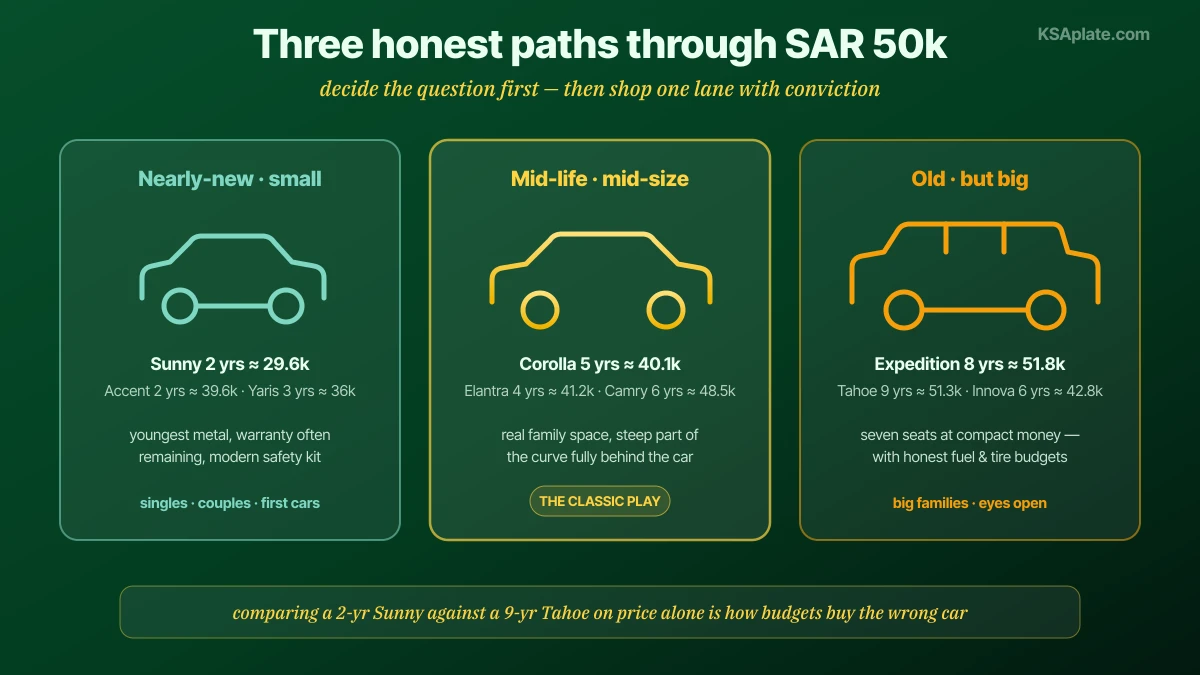
- Nearly-new and small. A 2-year Nissan Sunny trades around SAR 29,600 on our curves; a 2-year Accent around 39,600, a 2–3 year Yaris in the mid-30s. Youngest metal, often remaining warranty, modern safety kit — in exchange for size. The right answer for singles, couples, first cars and daily commuters.
- Mid-life and mid-size. The classic value play: a 5-year Corolla around SAR 40,000, a 4–5 year Elantra at 37,500–41,200, a 4–5 year Sonata around 45,500, a 6-year Camry at 48,500. Real family space, highway comfort, and the steep part of the curve fully behind the car.
- Old but big. The full-size loophole below: 7–9 year American three-rows at compact-car money. Seven seats and towing muscle — bought with open eyes about fuel and consumables.
The mistake is drifting between paths mid-search — comparing a 2-year Sunny against a 9-year Tahoe on price alone, when they are different answers to different questions. Decide the question first (how many people, what distances, how long you will keep it), then shop one path with conviction. The live listings across Saudi Arabia filter cleanly by budget and year once you know which lane you are in.
Under SAR 30,000: the champions
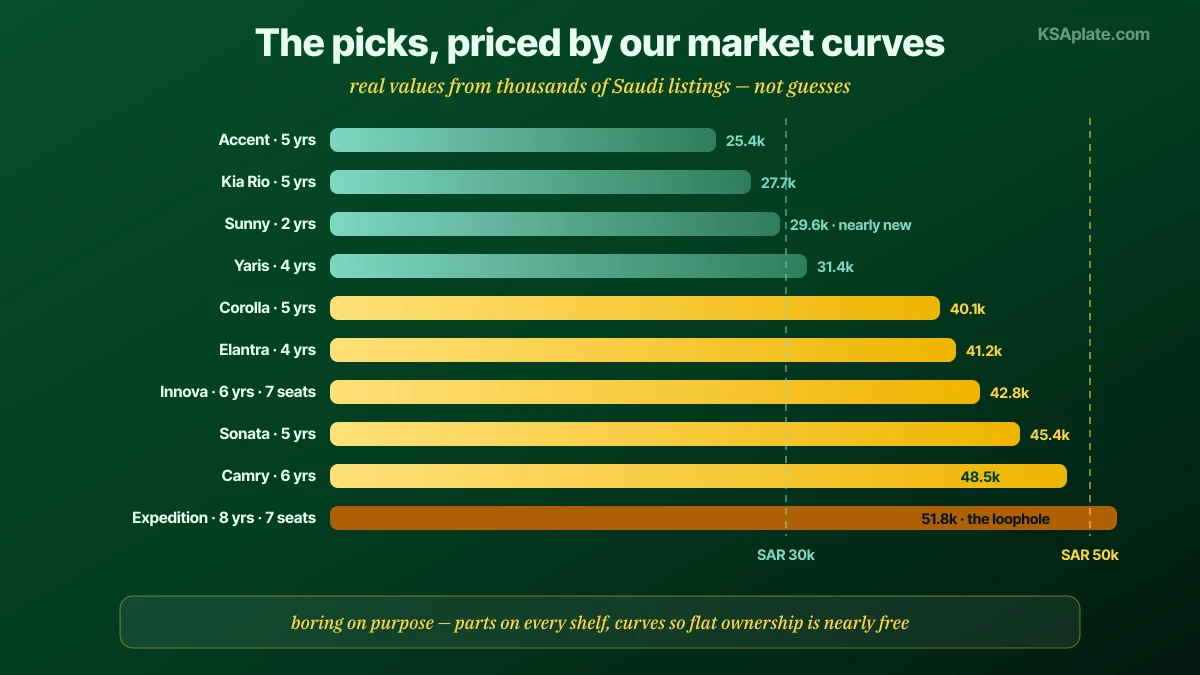
The band where cars become almost free to own — the curves are so flat here that a well-bought example gives most of its price back at resale. The picks, with our curve numbers:
| Car | Age band | Our curve value | Why it works |
|---|---|---|---|
| Hyundai Accent | 4–5 years | ≈ SAR 25,400–30,200 | The band's benchmark — biggest sample in our data (n=45 at 4 yrs), parts in every district, ~SAR 5,000 total depreciation over two further years |
| Kia Rio | 5 years | ≈ SAR 27,700 | Accent economics, Kia badge — often slightly cheaper to buy |
| Nissan Sunny | 2–3 years | ≈ SAR 28,100–29,600 | The youngest car money buys here — nearly new under 30k, fleet-proven drivetrain |
| Toyota Yaris | 4–5 years | ≈ SAR 28,500–31,400 | Toyota resale gravity in miniature — strongest exit value of the small cars |
| Kia Cerato | 5 years | ≈ SAR 28,800 | A size up from Rio for the same money — the quiet bargain of the band |
Notice what is not on the list: nothing exotic, nothing European, nothing with an interesting badge. That is the point. Under 30,000, the winning move is the car whose spare parts sit on a shelf in every neighborhood workshop and whose mechanics have seen a thousand of them. Excitement at this price is spelled "reliability."
What's your car worth?
Get a free instant estimate based on real Saudi market data — then sell it on KSAplate with direct WhatsApp contact.
Value My Car — FreeSAR 30,000–50,000: the family zone
Between 30 and 50 thousand, the budget graduates from transport to family car — real back seats, real boots, highway composure:
| Car | Age band | Our curve value | Why it works |
|---|---|---|---|
| Toyota Corolla | 4–6 years | ≈ SAR 37,000–45,500 | The kingdom's default sensible car — slowest-depreciating sedan in the band |
| Hyundai Elantra | 3–5 years | ≈ SAR 37,500–49,300 | More car per riyal than Corolla; strong sample depth in our data |
| Toyota Camry | 6–7 years | ≈ SAR 36,100–48,500 | Full mid-size comfort at compact money — the taxi fleets are the durability proof |
| Hyundai Sonata | 4–5 years | ≈ SAR 45,400–45,900 | Camry space, younger metal — the value alternative |
| Kia Optima | 6 years | ≈ SAR 40,100 | Sonata's twin, usually a notch cheaper |
| Nissan Altima | 4 years | ≈ SAR 44,900 | Youngest mid-size the band reaches — check CVT service history specifically |
| Toyota Innova | 6 years | ≈ SAR 42,800 | The stealth pick: honest 7 seats, van practicality, Toyota running costs |
| Hyundai Accent / Toyota Yaris | 2–3 years | ≈ SAR 33,600–39,600 | The nearly-new play: youngest possible car, warranty often remaining |
Two navigational notes. The 3-year Corolla sits just over the fence at ≈50,800 — worth stretching for if the budget flexes, because its later curve is the flattest in the class. And the Innova is the quiet answer for big families who cannot reach the SUV budget: seven genuine seats, sliding-friendly practicality, and Toyota consumables, for the price of a mid-size sedan.
The full-size loophole
Here is the corner of the Saudi market that surprises newcomers: the mighty American three-rows fall, after seven or eight years, into compact-car money. Our curves put a 7–8 year Ford Expedition at ≈ SAR 51,800, a 9-year at ≈41,800; a 9–10 year Chevrolet Tahoe at ≈45,200–51,300; a 10-year GMC Yukon at ≈46,000. Seven seats, V8 muscle, desert capability — for Accent money.
The loophole is real, and so is the fine print:
- Fuel is the second payment. A V8 full-size can double a compact's monthly fuel line. At Saudi prices that is manageable — but it is a permanent line item, and on a school-run-plus-highway profile it adds up to real money per year.
- Consumables are sized like the car. Tires in the 18–20 inch range cost multiples of an Accent's, brakes and suspension parts likewise. Budget a maintenance reserve of several thousand riyals per year and the loophole stays a bargain; skip it and the cheap giant becomes the expensive one.
- Buy on service history or not at all. A 9-year truck that lived on schedule is a decade of family service waiting to happen; one that skipped its transmission services is a gamble. The full inspection discipline — underbody, diffs, cooling — is the same desert-use audit from our family SUV guide, applied with more suspicion.
- The age cutoff matters for financing and some insurers — older vehicles narrow your finance and comprehensive-cover options; more below.
The four budget traps
The under-50k market has four recurring ways to lose, all avoidable:
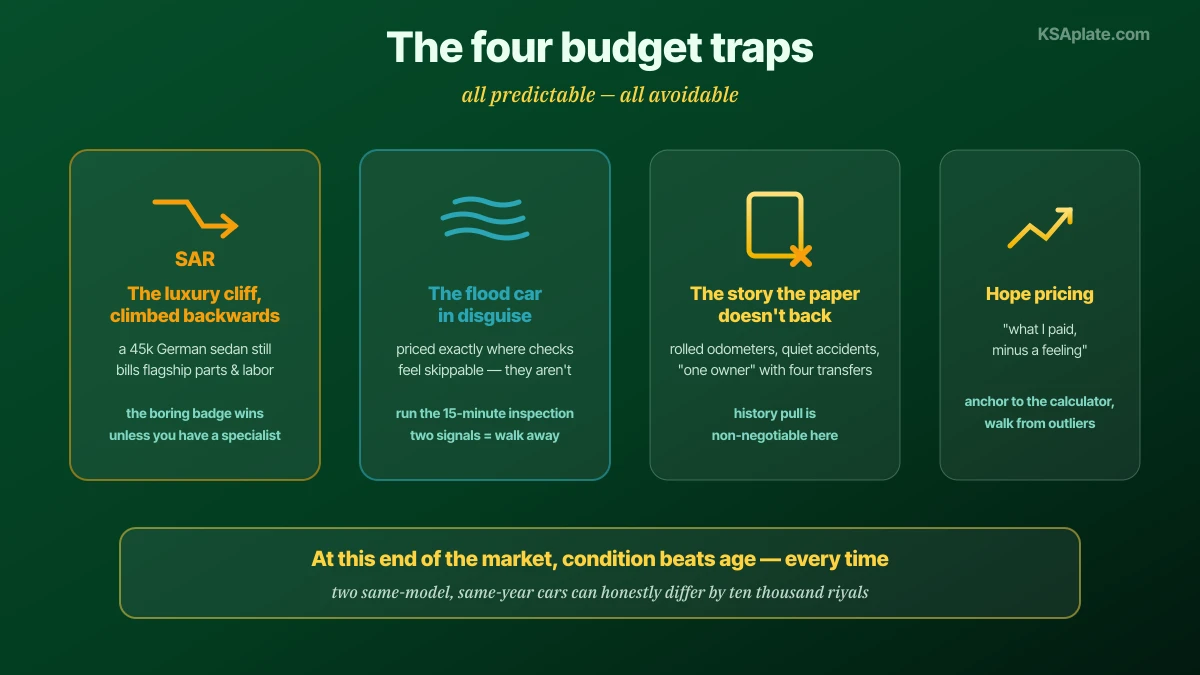
- The luxury cliff, climbed backwards. The same cliff that makes a 2-year German flagship cheap keeps falling — and at year 8–10 it lands in this band. A SAR 45,000 luxury sedan is not a SAR 45,000 car to own: parts, electronics and specialist labor still bill at flagship rates. Unless you have a trusted independent specialist and a real reserve, the boring badge wins.
- The flood car in disguise. Budget buyers are the target market for dried-out flood cars, because the price is set exactly where checks feel skippable. They are not: the 15-minute inspection in our flood-car guide exists precisely for this shelf of the market.
- The story that does not match the paper. Rolled-back odometers, quiet accident history, "one owner" cars with four transfers — the full catalog is in the used-car scams guide, and a history pull (how-to here) is non-negotiable at this end, where margins for repair surprises are thin.
- Hope pricing. Sellers in this band frequently price at what they paid minus a feeling. Our curves say what the car is worth; the negotiation section turns that into riyals.
Condition beats age: how to check
Above 100,000 riyals you buy specifications; below 50,000 you buy this particular car's life so far. Two same-model, same-year cars can honestly differ by ten thousand riyals in value here. The condition audit:
- Service records outrank the odometer. A 140,000 km car with a folder of stamps beats an 80,000 km car with none. In this climate, evidence of cooling-system and oil discipline is the single best predictor of the next three years.
- The heat-critical systems first: AC blowing genuinely cold (compressor work is negotiation-grade money), radiator and hoses, battery age, tire date codes — the desert kills these first, and each is a checkable line item.
- Daylight, cold start, full loop. Inspect in daylight, insist on a cold start (pre-warmed engines hide starting faults), and drive a loop long enough to heat-soak everything. The full sequence — including seller verification and transfer-then-pay — is the discipline in our used car buying guide.
- Spend the inspection fee. A workshop inspection costs a small fraction of the smallest surprise it prevents. At this price point it is the best money in the entire transaction.
Running costs at this end of the market
The band's quiet superpower is what happens after purchase:
- Insurance gets cheap. Comprehensive premiums scale with value, so cover on a 30,000-riyal car costs a fraction of a new car's. On the oldest cars, weigh comprehensive against third-party honestly — the framework is in the insurance guide — but remember that third-party leaves your own car unprotected against everything, including the floods above.
- Parts economics decide the total. This is why the tables above are all Toyota, Hyundai, Kia, Nissan: their parts sit in every market at commodity prices and every mechanic knows them. The exotic alternative can double the running-cost line without improving the driving week at all.
- Depreciation nearly stops. An Accent that costs ≈30,200 at four years is worth ≈25,400 at five — the car costs ~SAR 400 a month in value loss. The full ledger method — fuel, insurance, maintenance, registration — is worked through in the cost of ownership guide; budget cars are where its totals get pleasantly small.
- Fahes and registration stay routine if the car is sound — the periodic inspection (guide here) is one more reason to buy the maintained example: it passes, the neglected one negotiates with the test center every year.
Negotiating with a number, not a feeling
Budget negotiations are won before the meeting:
- Pull the honest number first. Run the exact model, year and mileage through the free car value calculator — it prices from the same Saudi market curves quoted throughout this article and returns the fair private-sale range.
- Bring the comparison set. Three to five current listings of the same model-year band, screenshotted. "The market says" is a different conversation than "I feel."
- Price the defects, don't debate them. Weak AC, due tires, a pending service — each is a riyal number, not an argument. The inspection list converts directly into the discount list.
- Let the flattest curves embolden you. On an Accent or Corolla, paying SAR 2,000 over market is recoverable at resale; on the hope-priced outlier it is simply lost. Walk away from mispriced cars — in this band there is always another one, and the timing guide's summer supply wave makes the walking easiest of all.
Your exit: the curve protects you
The final virtue of the band: leaving it is cheap. The flat curves that made the car inexpensive to own also mean that when life upgrades you — new job, new baby, the family SUV conversation — most of your money is still in the car waiting to come back out. Protect that exit while you own it: keep every receipt, photograph the service file, fix small things before they photograph badly.
When the moment comes, the same discipline that bought well sells well: price at the calculator's honest range, list with daylight photos and the history stated plainly, and list it for free — in this band the next buyer is exactly who you were, running exactly your search, and the well-documented example is the one that sells first. Time the listing against the market's demand waves (selling guide for the craft), and the budget car completes its quiet magic: years of service, most of the money back.
Frequently asked questions
What is the best used car under SAR 50,000 in Saudi Arabia?
For most buyers: a 4–6 year Toyota Corolla (≈SAR 37,000–45,500 on our market curves) or Hyundai Elantra (≈37,500–49,300) — family-capable, parts everywhere, and the slowest depreciation in the band. For maximum budget stretch, a 6–7 year Camry delivers full mid-size comfort from ≈36,000.
What is the best used car under SAR 30,000?
The Hyundai Accent at 4–5 years (≈SAR 25,400–30,200) is the band's benchmark — the largest sample in our market data, commodity parts, and a nearly flat value curve. The Kia Rio and Cerato, a 2–3 year Nissan Sunny (nearly new under 30k) and a 4–5 year Toyota Yaris are the equally sane alternatives.
Can I really get a 7-seater for under SAR 50,000?
Yes, two ways: a 6-year Toyota Innova (≈SAR 42,800) with van-honest seven seats and Toyota running costs, or the full-size loophole — 7–9 year Ford Expeditions and Chevrolet Tahoes trading at ≈42,000–52,000. The big Americans demand honest budgeting for fuel and large-size consumables; the Innova does not.
Are cheap used luxury cars in Saudi Arabia a good deal?
Rarely at this budget. An 8–10 year German luxury sedan reaches SAR 40,000–50,000 precisely because its parts, electronics and specialist labor still cost flagship money. Unless you have a trusted independent specialist and a genuine repair reserve, the boring volume brands deliver more transport per riyal with a fraction of the risk.
Is high mileage a deal-breaker on a budget car?
No — condition and records outrank the odometer. A 140,000 km car with documented service beats an 80,000 km mystery. Saudi highway kilometers are gentle on drivetrains; neglect is not. Verify the history matches the story, inspect the heat-critical systems, and judge the individual car, not the number.
Should I buy comprehensive insurance on a car under 50k?
Weigh it honestly: premiums scale with value, so comprehensive on this band is cheap in absolute terms, and it is the only cover that protects your own car — including against flood damage. On the oldest, cheapest cars some owners accept third-party plus a self-insurance mindset; understand what that trade means before choosing it.
How do I avoid buying a flood-damaged car at this price?
Assume you are the target market — dried flood cars are priced exactly to make budget buyers skip checks. Run the 15-minute inspection: smell the cabin, find water lines in door pockets and the spare wheel well, check seat rails and belt anchors for rust, and pull the vehicle history. Two signals together: walk away.
Is it better to buy a newer small car or an older big car?
Decide the question before the car: how many ride, and how far. A 2-year Sunny (~SAR 29,600) gives the youngest metal and warranty; a 5-year Corolla (~40,000) balances space and age; a 8-year Expedition (~52,000) seats seven with real fuel costs. All three are rational — mixing the paths mid-search is how buyers end up with the wrong car at the right price.
What should I check first on a cheap used car in Saudi Arabia?
The heat-critical systems: AC performance (compressor work is expensive), cooling system condition, battery age and tire date codes — the desert attacks these first. Then service records against the odometer, a history pull for accidents and status, and a workshop inspection. At this price, the inspection fee is the best money in the deal.
Do budget cars hold their value in Saudi Arabia?
Better than anything else on the road, proportionally. Our curves show an Accent losing only ~SAR 5,000 between years four and five (~SAR 400/month), and Corolla-class cars depreciating slower than any other sedans. Buy at the honest number and keep records, and most of the purchase price returns at resale.
How do I know a fair price before negotiating?
Run the exact model, year and mileage through the free car value calculator — it prices from real Saudi listing curves and returns the honest private-sale range — then screenshot three to five comparable current listings. Negotiate from that pair of anchors and price defects as riyal amounts, not arguments.
Conclusion
The under-50,000 market rewards exactly one temperament: the buyer who chooses the boring champion, verifies the individual car harder than the badge, and anchors every riyal to data. Pick your path — nearly-new small, mid-life mid-size, or the full-size loophole with its eyes-open fuel math — and the band pays you three ways: low purchase price, running costs that shrink to pocket change, and a value curve so flat that ownership is nearly free.
Start where every good budget purchase starts: with the honest number from the free value calculator in one hand and the live listings across Saudi Arabia in the other. And when the budget car has done its years of quiet service and life calls for the upgrade, list it for free with the service file photographed — the next careful buyer is already searching for exactly the car you are about to finish proving.