


TL;DR:
- The same car, from the same dealer, can cost 10–15% less depending on when you sign. Saudi car prices move on a predictable annual rhythm — Ramadan campaigns, year-end clearances, model-year changeovers, and the summer used-car glut — and buyers who time those windows keep thousands of riyals.
- Ramadan is the kingdom's biggest discount season. Dealers stack their best offers — cash discounts, free insurance and registration, zero down payment — into one crowded month. The catch: the best variants sell out early, so shop the first two weeks.
- December and January are the second window: dealers clear outgoing model years to hit annual targets, and last year's "new" car drops sharply the moment its successor lands in the showroom.
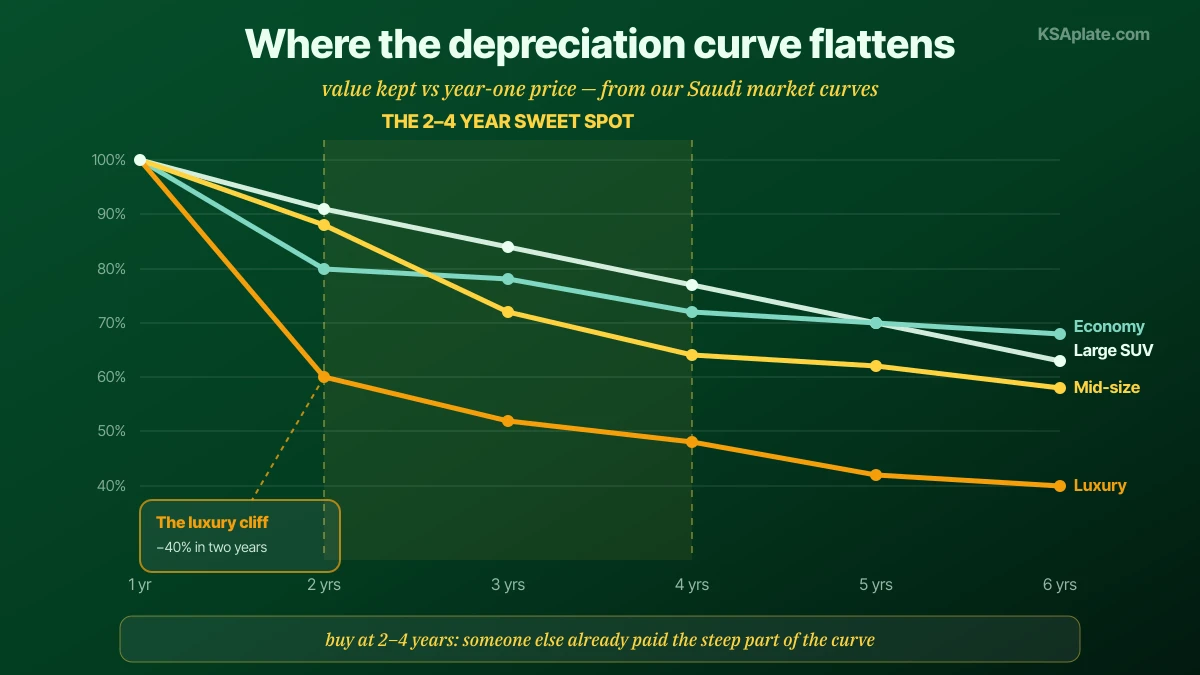
- For used cars, age beats season. Our market curves show luxury cars shed roughly 40% of their value by year two while economy cars keep about 80% — the 2–4 year window is where someone else has already paid the steep part of the curve.
- Sellers run the same calendar in reverse: list before the demand waves — pre-Ramadan, early summer before the travel exodus, and early autumn — and every year you wait costs a predictable slice of value.
Quick answer: The best time to buy a car in Saudi Arabia is during Ramadan, when dealers concentrate their strongest offers of the year — followed by December and January, when outgoing model years are cleared at year-end discounts. For used cars, the summer months add a supply surge as departing expats sell quickly, and the smartest value sits in cars aged two to four years, after the steepest depreciation has already happened to someone else. Month-end and quarter-end visits add negotiating room at any time of year, because dealer sales targets reset on those dates.
Why timing is worth thousands in Saudi Arabia
Most buyers research the car for weeks and the timing for zero minutes. That ordering is backwards, because in Saudi Arabia the calendar moves prices more reliably than negotiation skill does. A mid-size sedan that carries a sticker of SAR 115,000 in October routinely wears a Ramadan-campaign price with free registration, insurance, and a cash discount that together are worth SAR 8,000–15,000 — the same car, the same showroom, a different month.
Three forces create this rhythm, and all three are stronger in the kingdom than in most markets:
- Campaign culture. Saudi dealers concentrate marketing budgets into a few national moments — Ramadan above all — rather than spreading discounts evenly across the year. When the season arrives, every brand competes in the same weeks, and offers stack: cash discount plus free first-year insurance plus registration plus zero-percent down.
- Model-year psychology. The market prices "current model year" as a feature. The day the new year's stock reaches the showroom — mostly late autumn — the identical outgoing car becomes "last year's model" and dealers move it with real money, because it ages on their books, not yours.
- A used market with tides. Expat departure waves each summer, bonus seasons, and school-calendar moves push private listings up and down in volume. More supply in the market means more choice and softer prices for whoever is buying that month — you can watch the tide yourself in the current listings across Saudi Arabia.
None of this requires insider access. It requires knowing the calendar — so here it is.
The Saudi car-buying calendar
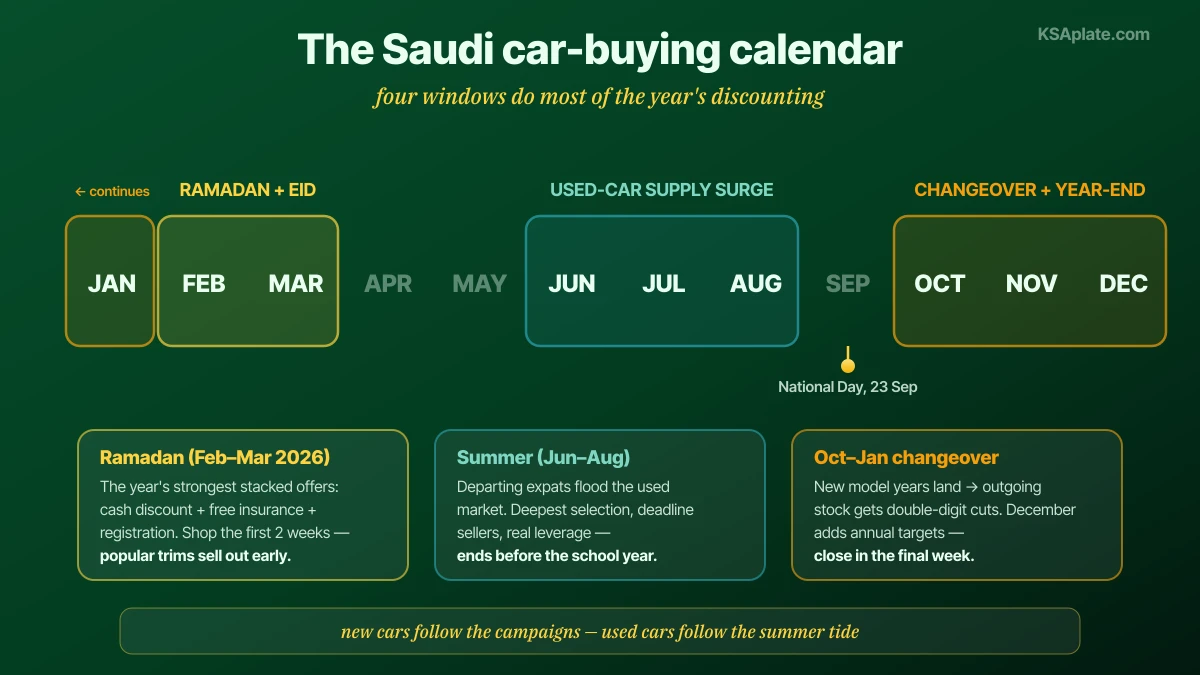
The year, window by window. Individual campaigns vary by brand and year, but the structure repeats reliably:
| Window | When (2026) | What actually happens | Buyer's edge |
|---|---|---|---|
| Ramadan campaigns | Late Feb – late Mar | Every brand's biggest stacked offers: cash discounts, free insurance/registration, deferred payments | Strongest new-car pricing of the year |
| Eid al-Fitr follow-through | Late Mar – Apr | Remaining Ramadan stock moves with extended offers; popular variants already thin | Good deals, shrinking choice |
| Summer supply surge | Jun – Aug | Departing expats and relocating families flood the used market; private sellers price to close fast | Best used-car selection and leverage |
| National Day promos | Around 23 Sep | Short, sharp campaign week across dealers and banks | Quick win if your model is included |
| Model-year changeover | Oct – Nov | New model-year stock lands; outgoing year becomes negotiable immediately | Double-digit percentage cuts on "last year's" new cars |
| Year-end clearance | Dec – Jan | Dealers chase annual targets; banks push year-end finance campaigns | Second-strongest window, best for negotiation |
Two windows dominate: Ramadan for stacked offers, and the December–January stretch for clearance-plus-target-chasing. Everything else is opportunistic. If your purchase can float a few months, anchor it to one of those two.
Ramadan and Eid: the biggest discount window
Ramadan — which in 2026 runs from late February through most of March — is when the Saudi car market does the majority of its discounting for the entire year. The logic is simple: it is the season when families gather, salaries stretch toward Eid spending, and every brand knows its competitors are running campaigns in the same four weeks. No dealer can afford to sit it out.
What the offers actually look like, and how to read them:
- Cash discounts are the cleanest — a real reduction you can compare across brands.
- Bundled extras — free first-year comprehensive insurance, free registration, free service packages — are worth real money (insurance alone can be several thousand riyals) but only if you would have bought them anyway. Price the bundle, not the headline.
- Finance offers — zero down payment, deferred first installments, subsidized rates — move the monthly number without necessarily moving the price. Always ask for the cash-equivalent price first, then evaluate financing against it; the mechanics are covered in our car finance guide.
The tactical details matter. Shop the first half of Ramadan: campaigns launch with full stock, and the popular trims and colors are gone by week three, leaving offers that technically exist on cars nobody wanted. Evenings after iftar are when showrooms are busiest and salespeople have the least patience for negotiation — a late-morning visit gets you a quieter floor and more attention. And if you miss the month entirely, the first days of Eid al-Fitr often carry the same offers on whatever remains.
What's your car worth?
Get a free instant estimate based on real Saudi market data — then sell it on KSAplate with direct WhatsApp contact.
Value My Car — FreeYear-end and the model-year changeover
The second great window is really two overlapping events. In October and November, next year's model stock starts arriving in showrooms. From that moment the identical car parked next to it — new, zero kilometers, one model-year older — is a depreciating asset on the dealer's floor plan, and everyone in the building knows it. In December, the second force arrives: annual sales targets. Dealerships and their salespeople close their year on numbers, and a deal that was impossible on 15 November becomes signable on 28 December.
Practical playbook for this window:
- Target the outgoing model year explicitly. Ask what current-registration, previous-model-year stock is still on the floor. A brand-new car that is "last year's model" typically gives up a double-digit percentage against the incoming year's sticker — and it is still a new car with a full warranty.
- Understand what you give back. When you eventually resell, your car will be valued by its model year, not its purchase date. You are harvesting the discount now and repaying a slice of it at resale — usually a favorable trade, but check the specific model's depreciation on our free car value calculator before assuming.
- Let December work for you. Get your test drive and your quote in early December, then close in the final week when targets bite. Have financing pre-approved so the only open variable is price.
Summer: the used-car supply surge
The new-car windows are dealer theater; the used-car market runs on migration. Every June through August, the kingdom's used listings swell with a predictable wave: expat families leaving at contract end or school-year end, relocations timed to the summer break, and owners upgrading before the autumn. Many of those sellers are on a deadline — a flight out — and a seller with a departure date is the most flexible negotiator in any market. The dynamics of that situation, from both sides, are covered in our expat car ownership guide.
For buyers this means three concrete advantages:
- Selection. The deepest pool of the year — browse the live listings in July and you will see model-and-trim combinations that simply are not available in February.
- Leverage. "I can transfer this week" is worth real money to someone flying out on the 30th. Fast, clean buyers get discounts that patient sellers would never concede.
- Documentation habits. Departing owners typically need clean paperwork to close quickly — but never let urgency compress your checks. The full inspection-and-transfer discipline is in the used car buying guide, and every check in it applies double when someone is in a hurry.
The mirror image: late August, the supply wave recedes and prices firm up as demand returns with the school year. The buyer's summer ends earlier than the calendar's.
New vs used: two different clocks
Whether you should buy new or used at all is its own decision — we walk through the total-cost math in new vs used in Saudi Arabia — but once you have chosen, note that the two run on different clocks:
- New cars are seasonal. Their price moves with campaigns and model-year changeovers, so Ramadan and December–January dominate. Between windows, new-car prices barely move; waiting from April to July buys you almost nothing.
- Used cars are structural. Their price moves with supply (summer surge), with the individual seller's urgency, and above all with the car's age — which is a clock you can position yourself on deliberately. That is the next section.
One hybrid case deserves a mention: dealer demo cars and current-year registrations with delivery kilometers. These surface at changeover time carrying new-car warranties and used-car logic, and in the right week they price like neither — below the outgoing new sticker, above trade-in. If flexibility on "factory-new" is available to you, ask for them by name in October and November.
The age sweet spot — what our market data shows
For used cars, the single biggest price lever is not the month you buy — it is the age of the car you target. We maintain valuation curves for the Saudi market built from thousands of real local listings (the same curves that power our car value calculator), and they show the pattern with unusual clarity:
| Segment | Value kept at year 2 | Value kept at year 5 | What it means for buyers |
|---|---|---|---|
| Economy (Accent, Yaris class) | ≈ 80% | ≈ 70% | Gentle curve — buying nearly-new costs little extra; buy on condition, not age |
| Mid-size (Camry, Sonata class) | ≈ 85–90% | ≈ 60% | Classic sweet spot at 2–4 years: steep part paid, long life left |
| Large SUV (Land Cruiser, Patrol class) | ≈ 90% | ≈ 70% | Flat, linear curve — age matters less; buy in a seasonal window instead |
| Luxury (German sedans and SUVs) | ≈ 60% | ≈ 40% | The cliff: year-two luxury cars sell for barely more than half of new — the bargain segment for cash buyers who budget for maintenance |
Concrete numbers from our curves make the sweet spot tangible. A Toyota Camry trades around SAR 82,000 at two years old and SAR 61,000 at four — so the two middle years of ownership cost roughly SAR 21,000, after the first owner absorbed the far steeper drive-off-the-lot drop. A Hyundai Accent falls from about SAR 40,000 at two years to SAR 30,000 at four. A Land Cruiser, by contrast, glides almost linearly from SAR 206,000 at two years to SAR 174,000 at four — the desert-proof large SUVs hold value so well that when you buy matters more than how old.
The luxury cliff is the market's biggest arbitrage: a two-year-old German flagship at 60% of sticker is the same machine that humiliated its first owner's bank account. It rewards buyers who have read our cost of ownership guide and budget honestly for parts and service — the purchase discount funds years of maintenance if the rest of the math is done soberly.
Month-end, quarter-end, and the salary cycle
Underneath the annual calendar runs a smaller, monthly one — and it is the only timing lever that works in any month of the year:
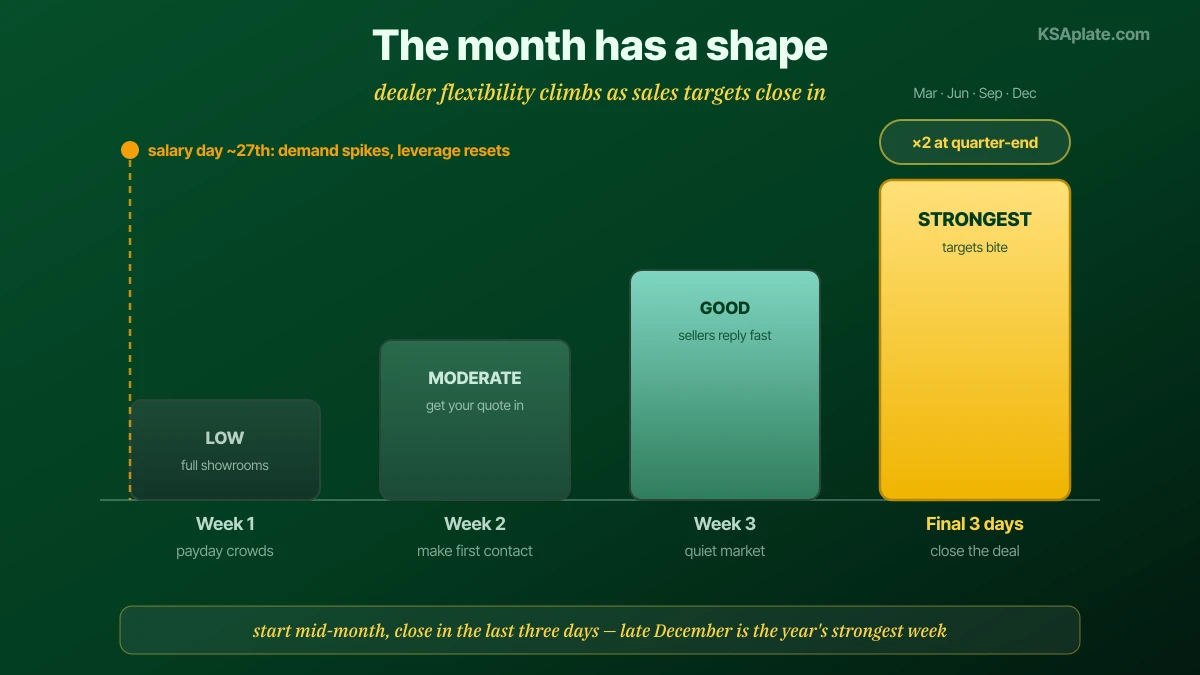
- Month-end beats month-start. Dealership sales targets are monthly. A salesperson two cars short of quota on the 28th is a different negotiating partner than the same person on the 3rd. If your schedule allows, make first contact mid-month and close in the last three days.
- Quarter-end stacks the effect. March, June, September, and December close corporate quarters; manufacturer bonuses to dealers often key on quarterly volume. December quarter-end plus year-end is the strongest single week of the calendar — which is why the year-end section told you to close, not start, in late December.
- Mind the salary rhythm. Salaries in the kingdom cluster around the 27th of the month. The following week, showrooms and the used market both see their demand spike — more competition for the same cars, less patience from sellers. The quiet third week of the month, when everyone's money is spent, is when private sellers answer messages fastest and negotiate most.
- Weekday mornings win. Fridays and Saturdays fill showrooms with families; a Tuesday morning buyer gets the manager's attention and same-day paperwork. Small edge, costs nothing, always available.
The worst times to buy
Symmetry demands the other list — the moments when the calendar works against you:
- The week after salary day. Peak demand, full showrooms, sellers fielding multiple offers. Your leverage is at its monthly minimum.
- Just before Ramadan with a new car target. Dealers know the campaign is weeks away and hold margin so the "Ramadan offer" looks generous against it. Either buy well before or wait for the season itself.
- September–October for used family cars. The school year restarts demand exactly as the summer supply wave recedes — the worst supply-to-demand ratio of the used year.
- The month a new generation launches, for the outgoing used one. When an all-new version of a model arrives, used prices of the old shape sag for a few months as the market digests it — bad time to buy the old shape at a fixed asking price, good time three months later once sellers have accepted reality.
- Any time you are in a hurry. The market smells deadlines. Every window in this guide exists because someone else was time-pressured; make sure the pressured party is never you. If your current car is already listed and moving slowly, fix the listing rather than accepting a panic price for the next car — our selling guide covers the usual causes.
The seller's calendar: when to list
Every buyer's window is a seller's warning, and the reverse. If you are selling — or trading up, which makes you both at once — the calendar reads like this:
- List before the demand waves, not during the supply waves. The two golden listing moments are late winter (buyers flush before Ramadan spending, supply still thin) and early June — catching the first departing-buyer demand before the full summer glut of competing listings arrives. A listing that goes live in mid-July swims against hundreds of motivated leavers.
- Avoid listing into the changeover. October–November, when new model years land and dealers discount outgoing new stock, is when your used car's price anchor is weakest.
- Every year you wait has a price. Our curves put numbers on procrastination: a mid-size sedan gives up roughly 8–10% of its value per year through the middle of its life, and the Camry example above — SAR 82,000 at two years, SAR 61,000 at four — is a SAR 10,000+ annual cost of "I'll sell it next year." Check your specific car on the valuation calculator, then decide with the number in front of you.
- Price to the window. In a demand window, price at market and hold; in a supply glut, the first week decides whether your listing is fresh or stale. Either way, list it for free with honest photos and the history stated plainly — a well-documented car at a fair price outsells a mispriced one in any season. If you are weighing the dealer trade-in shortcut instead, run the numbers in our trade-in vs private sale comparison first; the convenience discount is largest exactly when private demand is strongest.
Plates run on their own market clock, incidentally — if a distinctive plate is part of what you are selling, the plate market timing guide covers that side separately.
Frequently asked questions
What is the best month to buy a new car in Saudi Arabia?
How much can Ramadan car offers actually save?
When do new model years arrive in Saudi showrooms?
Is buying last year's model year a mistake?
Why are used cars cheaper in summer in Saudi Arabia?
What age of used car is the best value?
Does month-end really make dealers more flexible?
When is the best time to sell a car in Saudi Arabia?
How much value does a used car lose per year in Saudi Arabia?
Are National Day or White Friday car offers worth waiting for?
Should I check market value before negotiating in any window?
Conclusion
The Saudi car market rewards the same person twice: once for knowing the annual windows — Ramadan's stacked campaigns, the October changeover, December's target-chasing, summer's used-car tide — and once for knowing the small clocks underneath, month-ends and salary weeks and Tuesday mornings. None of it is secret. It is simply written in a calendar most buyers never read, which is precisely why the savings survive year after year.
Anchor the big decision to a big window, position yourself on the age curve where someone else paid the steep part, and walk in with the honest number from the free value calculator already in hand. And when the calendar says it is your turn to be the seller — before Ramadan, or in that early-June gap before the summer glut — list your car for free and let the same windows that saved you money as a buyer earn it back as a seller. The calendar pays both directions; most people only ever collect once.