


TL;DR:
- Child restraints are required by Saudi traffic regulations, and children under ten belong in the back seat. Enforcement has tightened alongside camera-based systems, but the law is the floor, not the goal — a correctly used seat is the single most effective safety device your car will ever carry.
- The seat must match the child, not the child's age alone. Weight and height decide the group — from rear-facing infant shells to high-back boosters — and every early "graduation" to the next stage trades away protection.
- Rear-facing is the safest direction and worth keeping for years, not months. A small child's head is heavy and the neck immature; riding rear-facing spreads crash forces across the whole back instead of the neck.
- Most seats fail at installation, not purchase. A loose base, a twisted harness, a winter-thick jacket, a booster used years too early — the common errors are boring, invisible in daily driving, and decisive in a crash.
- Saudi heat is its own chapter: a parked cabin can climb past 60°C, buckles and dark shells get hot enough to burn small skin, and a child must never wait in a parked car — not for five minutes, not with the windows cracked.
Quick answer: Yes — Saudi traffic regulations require young children to travel in an appropriate child restraint, and children under ten should ride in the back seat, with fines applied for violations. Choose the seat by weight and height, not age alone: rear-facing infant and toddler seats first (kept rear-facing as long as the seat allows), then a forward-facing harness seat, then a belt-positioning booster until the adult belt genuinely fits, at roughly 135–150 cm. Never place a rear-facing seat in front of an active airbag, install with ISOFIX where available, and in Saudi summers never leave a child in a parked car for any length of time.
Why this matters more here
Saudi Arabia is a driving country in a way few places are: long highway distances, high speed limits, families that travel by car for everything from the school run to a 900-kilometer Eid visit. Children spend a large share of their childhood in the back seat — which makes the equipment holding them there the highest-leverage safety purchase a Saudi family makes.
The physics do not negotiate. At 100 km/h, an unrestrained passenger keeps moving at 100 km/h when the car stops — and a ten-kilogram infant effectively becomes several hundred kilograms of force. Adult arms cannot hold that; an adult belt across a small body redirects it into soft tissue instead of bone. A correctly fitted child seat solves exactly this problem, and nothing else in the car does.
Three local realities sharpen the picture:
- Speed. Much family driving happens at 120–140 km/h on intercity routes — crash energies where restraint quality is the difference in kind, not degree. Speed enforcement itself is covered in our Saher and speed limits guide.
- Heat. The kingdom's summer turns parked cars into ovens and seat hardware into a burn hazard — a whole section below deals with it.
- Habit. A generation grew up riding on laps, and a child on a lap in the front seat remains a common sight. The law has moved; this article is about moving the practice.
What Saudi law actually requires
The direct answer first: Saudi traffic regulations require child restraints for young children and bar children under ten from the front seats. Violations carry fines in the lower band of the traffic-penalty schedule (the same range as seat-belt offenses), and enforcement runs through both patrols and the camera network. Practical points that follow from the rules:
- A restraint appropriate to the child is required — an infant carrier, child seat, or booster matched to the child's size, correctly secured to the vehicle. A lap is not a restraint; an adult belt alone, on a small child, is not an appropriate one either.
- The back seat is the child's place. Children under ten ride in the rear. This is not bureaucratic caution: front airbags deploy with a force calibrated for adults, and the back seat is statistically the safest real estate in the car.
- The driver carries the responsibility. As with seat belts, the fine attaches to the driver — worth remembering when the children in the car are not your own.
- The law is the minimum. Regulations set a floor; the manufacturer's weight and height limits, and the best-practice guidance below, are the actual standard of care. Passing a checkpoint is not the same as protecting a child at 120 km/h.
If you are new to the kingdom's driving rules more broadly — licensing, points, the fine schedule — the driving license guide and our traffic fines guide cover that ground; this article stays with the child.
Seat groups: matching the seat to the child
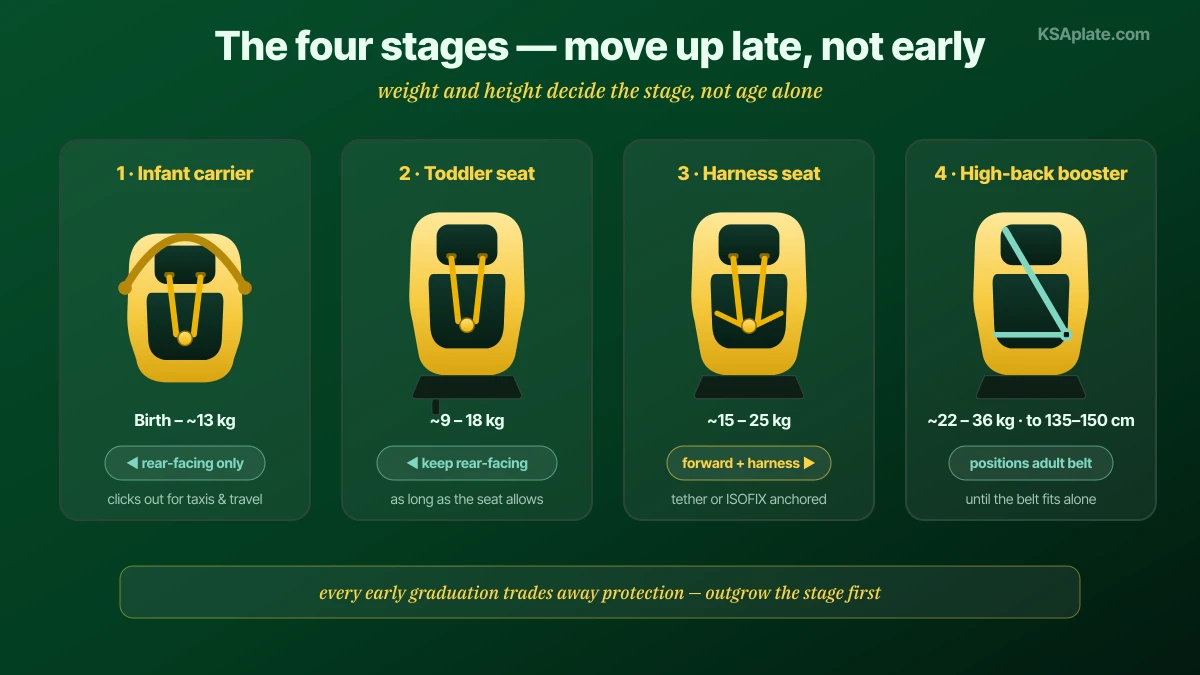
Child seats are sold against two overlapping standards — the older weight-based groups (R44) and the newer height-based i-Size system (R129). Both appear in Saudi shops, and both work; what matters is matching the seat's band to your child's current weight and height, and staying in each stage as long as the seat allows:
| Stage | Typical band | Seat type | Direction & key rule |
|---|---|---|---|
| Infant | Birth to ~13 kg (to ~15 months+) | Infant carrier shell, often on an ISOFIX base | Rear-facing only — never in front of an active airbag |
| Toddler | ~9–18 kg (to ~4 years) | Convertible / toddler seat | Keep rear-facing as long as the seat allows, then forward with full harness |
| Child | ~15–25 kg (to ~6–7 years) | Forward-facing harness seat | Five-point harness snug at the shoulders; top tether or ISOFIX anchored |
| Booster | ~22–36 kg (until ~135–150 cm) | High-back booster | Positions the adult belt across hips and mid-shoulder — until it fits without help |
Two rules cover most real-world confusion. First, move up late, not early: each graduation — shell to toddler seat, harness to booster, booster to bare belt — is a small loss of protection, justified only when the child has genuinely outgrown the current stage (ears above the shell, shoulders above the top harness slots, weight over the limit). Second, the exit test is fit, not age: a child is ready to ride on the adult belt alone when the lap section sits on the hips (not the belly), the shoulder section crosses mid-shoulder (not the neck), and the back rests against the seat with knees bending at its edge — for most children somewhere around 135–150 cm, usually age 10–12.
What's your car worth?
Get a free instant estimate based on real Saudi market data — then sell it on KSAplate with direct WhatsApp contact.
Value My Car — FreeRear-facing: the direction that does the work
The single most protective choice in this whole article costs nothing: keeping small children rear-facing longer. The reason is anatomy. An infant's head is roughly a quarter of its body weight, riding on neck vertebrae that are still partly cartilage. In a frontal crash — the most common serious type — a forward-facing child's head whips forward and the neck takes the load. Rear-facing, the same forces press the child into the shell, spreading the load across the entire back and head like a hand catching a ball.
Practical consequences:
- Minimum, not maximum: around 15 months (the i-Size minimum) is the earliest defensible turning point — not a target. Seats rated rear-facing to 18 kg or ~4 years exist precisely because longer is safer.
- Bent legs are fine. The most common objection — "his legs are squashed" — has no injury data behind it. Children sit cross-legged happily; necks do not have that option.
- Buy the turning point, don't improvise it. A convertible seat rated for extended rear-facing costs little more than one that flips at 9 kg, and removes the temptation to turn early.
Installation: where good seats go wrong
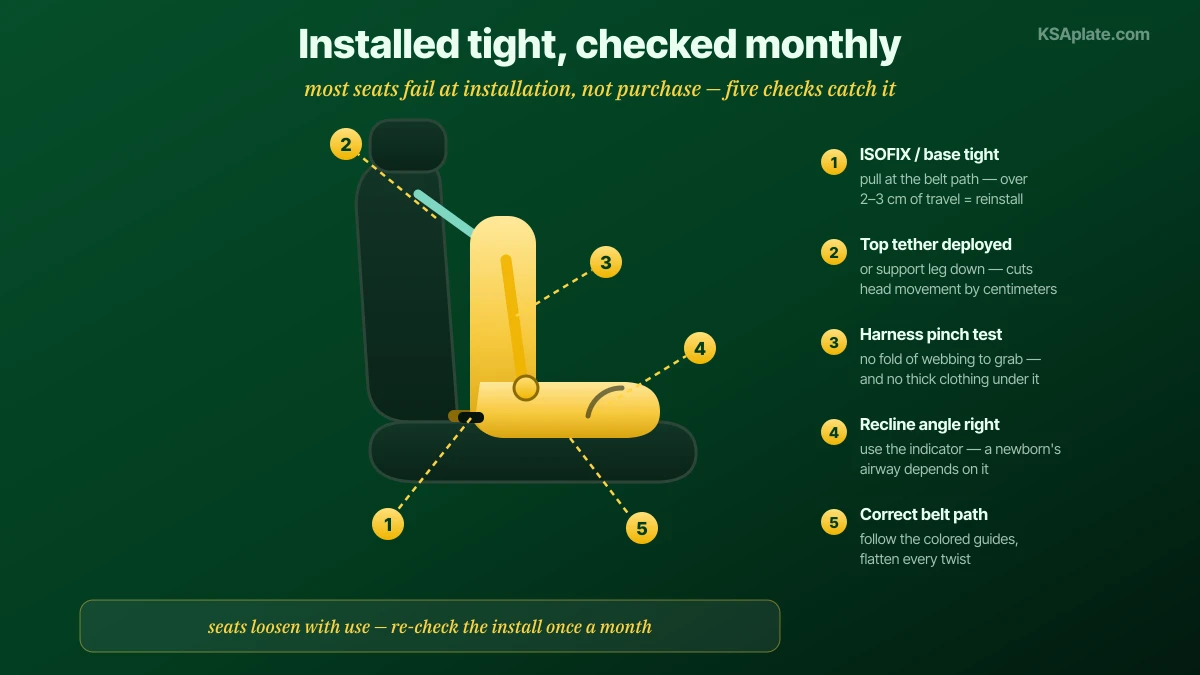
Seat quality is largely a solved problem; installation is not. Checks of child seats in use around the world consistently find that a majority are installed or used with at least one significant error — and the errors repeat:
| Common error | Why it matters in a crash | The fix / test |
|---|---|---|
| Loose installation | The seat itself becomes a projectile stage before the harness even loads | Grab the seat at the belt path and pull — more than ~2–3 cm of travel means reinstall |
| Slack harness | The child moves before the straps catch — higher forces, possible ejection | Pinch test: if you can pinch a fold of webbing at the shoulder, tighten |
| Thick clothing under straps | Padding compresses in a crash, turning a snug harness into a loose one | Thin layers only; blanket over the harness if warmth is needed |
| Wrong belt path / twisted belt | Loads feed into the shell at points not designed to take them | Follow the colored guides (blue rear-facing, red forward) and flatten every twist |
| Too upright for a newborn | A sleeping infant's heavy head can drop and close the airway | Use the seat's recline indicator; check the angle every install |
| Early booster | An adult belt on a too-small body cuts into abdomen and neck | Stay in the harness until weight/height limits are genuinely reached |
| Tether / support leg unused | Head excursion increases by many centimeters — the margin that reaches the front seat | Deploy the top tether or floor leg on every forward-facing ISOFIX install |
ISOFIX earns its reputation — rigid anchors between seat frame and car body remove most of the belt-routing errors above, and nearly every car sold in the kingdom in the last decade has the anchors in the rear outboard positions (feel between the seat cushions for the metal bars, and look for the top-tether point behind the backrest). Belt installation is still perfectly safe when done exactly by the manual; it simply offers more ways to be almost right. Whichever route you use: install once, properly, and then re-check monthly — seats loosen with use, and children grow past settings quietly.
The front seat, airbags, and where kids sit
The rules of placement, in order of importance:
- Never a rear-facing seat in front of an active front airbag. An airbag fires at up to ~300 km/h into exactly the space where the rear-facing shell sits. This combination is the one genuinely lethal configuration ordinary care can produce — if a front install is truly unavoidable (a two-seater), the airbag must be switched off first.
- Under ten rides in the back, by law and by data. The center rear position, when it has a full three-point belt or ISOFIX, is the furthest point from every crumple zone; the outboard positions are next and usually easier to install well. A properly installed seat in an outboard position beats a badly installed one in the center.
- The child who "graduated" still sits in the back. Booster-age and belt-age children remain rear-seat passengers until the age threshold passes — the airbag calibration point applies to them too.
One configuration question arrives with every second family: three seats across one bench. Measure before you buy — both the car and the seats. Some combinations of three restraints genuinely do not fit a mid-size sedan's bench, and the practical answers are choosing narrower boosters, mixing positions, or accepting that this is the real reason the family is shopping for a wider car (more on that below).
Children and the Saudi heat
Heat is the kingdom-specific chapter of child car safety, and it has two faces — the parked car and the touched surface:
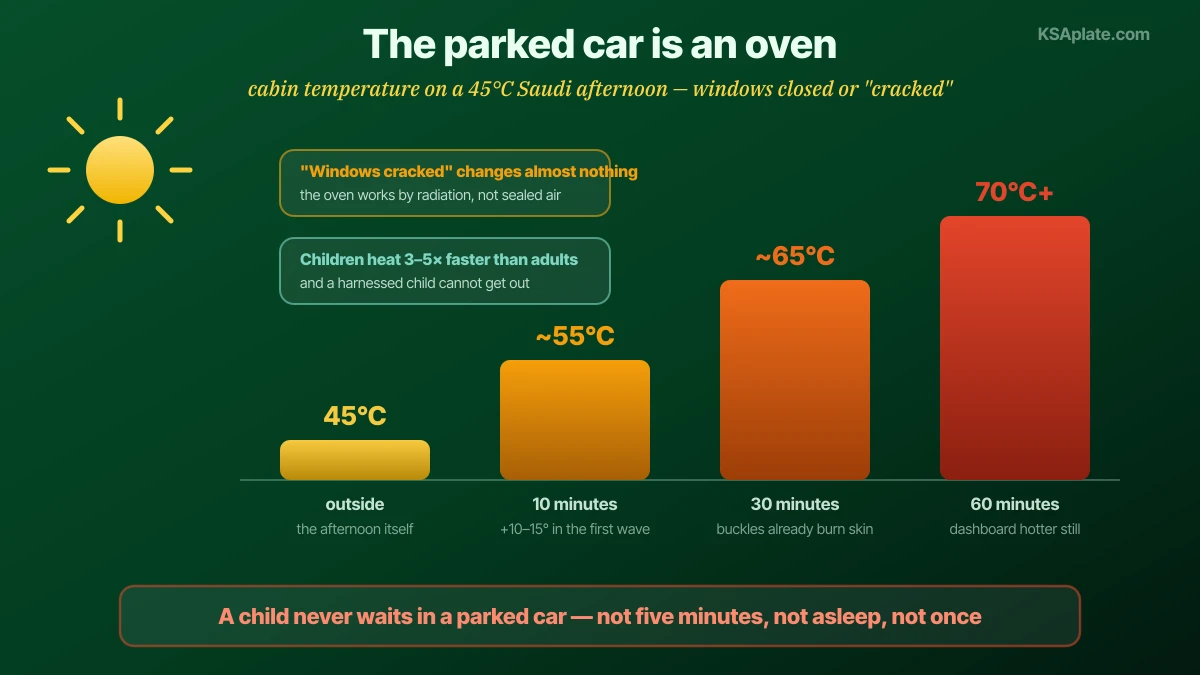
- The parked car is the emergency. Studies of closed parked cars show cabin air climbing 10–15°C within the first quarter hour and continuing past 60–70°C on a Saudi summer afternoon, with dashboards and buckles hotter still. Children heat up several times faster than adults and cannot escape a harness. The rule has no exceptions worth writing: a child never waits in a parked car — not during a five-minute errand, not asleep, not with windows cracked (which measurably changes almost nothing). Build a physical habit against forgetting: bag or phone on the floor by the child's seat, so opening the back door ends every trip.
- The seat itself becomes hardware-hot. Black shells, metal buckles and chest clips in direct sun reach skin-burning temperatures. Park with the seat side in shade where you can, throw a light cover or towel over the seat when parked, and press a hand to buckle and straps before the child touches them. A windscreen sunshade and — within the legal limits described in our tinting rules guide — quality rear-window film both cut cabin and hardware temperatures meaningfully.
- Cooling has a sequence. Doors open for thirty seconds first, then AC on high through the front vents, child in last. On long summer trips, rear-vent airflow and a check that the seat's fabric is not trapping sweat matter more than any accessory — and if the car strands you on the road with children aboard, the shade-and-water discipline in the breakdown guide is written for exactly that afternoon.
Taxis, ride-hailing, rentals and school runs
The seat you own is only part of the year; children also ride in cars you do not control:
- Ride-hailing and taxis. Drivers are not required to carry child seats, and a lap is no safer at the airport than anywhere else. For planned rides, bring your own: infant shells click out of their base in seconds, and folding boosters weigh under a kilogram and live happily in a backpack. For a family that rides daily, a second cheap booster kept by the door costs less than one fine.
- Rental cars. Book the child seat at reservation time, not at the counter — fleets carry few, and what remains at pickup is whatever nobody else took. Inspect it like a used purchase (below): check the shell, the label, the harness. Details of the rental process itself are in the car rental guide.
- School transport. Buses run under their own rules, but the private school run is ordinary family driving at rush hour — the booster stays in use even for the daily kilometer, which is statistically where much of the risk actually lives.
- Grandparents' and drivers' cars. The second car a child regularly rides in deserves a permanently installed second seat more than the primary car deserves an upgrade. Consistency beats equipment: the child who always rides restrained never argues about it.
Buying the seat: new, used, and what to check
The buying rules compress well:
- Buy by the label. Look for the orange approval label (ECE R44/04 or R129 i-Size) — it carries the standard, the weight or height band, and the approval number. No label, no purchase, whatever the price.
- Fit it to your actual car before paying. Good shops let you test-install; ISOFIX spacing, belt lengths and seat-cushion angles vary enough that "approved" does not guarantee "fits your bench."
- Treat used seats as high-risk purchases. A seat that has been through a crash can be invisibly compromised — foam crushed, shell micro-cracked — and plastic ages in Gulf heat faster than anywhere. The used-seat checklist is strict: known history (family, not stranger), under ~6 years old (check the shell's molded date), all labels and manual present, no cracks, straps untwisted and unfrayed, no recall against the model. The general discipline for buying anything used — verify, inspect, walk away on doubt — is the same one our used-car scams guide teaches at larger scale; a child seat is simply the purchase where "probably fine" is not a price worth paying.
- Register the seat and log the date. Manufacturers fix and recall like carmakers do; registration is the channel through which you find out.
The family-car side of the equation
Every parent eventually discovers that the seats choose the car as much as the reverse. Three child seats across, stroller in the boot, ISOFIX in the right positions, rear AC vents that actually reach row three — these are specifications, and they explain a large share of the family upgrades moving through the current listings across Saudi Arabia every summer.
When the upgrade moment comes, run it with numbers instead of showroom instinct. Check what the current car is honestly worth on the free car value calculator — and note, from the depreciation curves behind it, that the family-workhorse segments (large SUVs above all) hold value unusually well here, which makes a well-kept three-row truckish thing one of the saner purchases in the market. Check ISOFIX positions and measure the bench of any candidate before falling in love with it; the checks-and-transfer discipline lives in the used car buying guide. And when the outgrown two-row goes, list it for free — mention the ISOFIX anchors and the non-smoking family history in the description; the next buyer is a parent running exactly your search. If the timing is flexible, the best-time-to-buy guide covers which months favor the swap; either way listing before the summer glut beats swimming in it.
Frequently asked questions
Is a child car seat mandatory in Saudi Arabia?
Can a child sit in the front seat in Saudi Arabia?
What is the fine for not using a child seat in Saudi Arabia?
How long should my child stay rear-facing?
When can a child use just the adult seat belt?
Is ISOFIX better than installing with the seat belt?
How hot does a parked car really get in Saudi Arabia?
Do taxis and ride-hailing cars in Saudi Arabia have child seats?
Can I use a second-hand child seat?
Which position in the back seat is safest for the child seat?
What should I look for in a family car for three child seats?
Conclusion
Child car safety compresses into a short list that is easy to state and easy to drift from: a labeled seat matched to the child's current weight and height, installed tight, harness snug on thin clothing; rear-facing kept for years; the back seat until ten and beyond; no child in a parked car in this climate, ever. None of it costs much, and all of it works — the seat is the one component in the car whose entire job is your child's outcome in the worst second of family life.
The rest is logistics, and logistics respond to planning: a second booster for the cars you don't drive, the rental seat reserved at booking, the monthly two-minute re-tighten. And when the family outgrows the car itself, do the swap with numbers — value the old one on the free calculator, shop the listings with a measuring tape, and list the outgrown car for free with its ISOFIX anchors in the first line of the description. The next parent is searching for exactly that sentence.