


TL;DR:
- Flood cars are a real, recurring feature of the Saudi used market. Every heavy winter rain in Jeddah, Riyadh or the Eastern Province puts vehicles underwater — and months later, a share of them reappears looking clean, smelling of shampoo, and priced just attractively enough.
- Water kills slowly, not instantly. The paint survives; the electronics, connectors, airbag modules and hidden metal corrode over months. That delay is exactly why flood cars get resold — they drive fine on the test drive.
- Fifteen minutes of the right checks catch most of them: water lines, mud in seams, rust where sun-country cars never rust, fogged lights, and carpets or seat rails that don't match the car's age.
- If your own car floods: the engine stays off. Starting a hydrolocked engine converts a repairable insurance claim into a destroyed block. Disconnect, document, tow, call the insurer — in that order.
- Comprehensive insurance typically covers flood damage in the Kingdom; third-party never does. The premium difference suddenly looks small the first time a parking garage fills with water.
Quick answer: To spot a flood-damaged car in Saudi Arabia, trust evidence over appearance: a musty or heavily perfumed cabin, water lines inside doors or under the hood, dried mud in wiring seams and under carpets, rust on seat rails and seatbelt anchors, fogged headlights, and electronics that hesitate. Pull the full history before paying, and price-check the exact model — flood cars are usually listed suspiciously below market. If your own car floods, never start the engine: disconnect the battery, document everything, tow it out and call your insurer — comprehensive policies typically cover flood, third-party does not.
Why flood cars are a Saudi problem
A desert country seems like the last place to worry about water damage — which is precisely why the risk works. Saudi rain is rare but violent: a season's worth can fall in an afternoon, wadis reclaim the roads built through them, underpasses become pools, and basement parking floods faster than owners can react. Jeddah's flood years are burned into national memory, and every winter produces smaller repeats across the Kingdom.
What happens to those cars matters to every used-car buyer. Some are properly written off and sold transparently as salvage through auction channels. Others follow a quieter route: dried, deep-cleaned, perfumed, and returned to the market weeks later with no mention of their swim. The car looks immaculate — flood damage photographs invisibly — and the seller is often several owners removed from the water by the time you meet the car.
The defense is not paranoia; it is knowing that the market contains these cars, and that fifteen disciplined minutes reliably expose most of them.
What water actually destroys
Understanding the damage explains every check that follows — and why "it drives fine" means nothing.
- Electronics, on a delay. Modern cars carry dozens of control modules and hundreds of connectors, many low in the body — under seats, in footwells, behind kick panels. Water wicks into pins and boards; corrosion grows for months before the first gremlin appears. This delay is the flood car's business model.
- Safety systems. Airbag modules and pretensioner wiring often live under the carpet and seats — exactly where water sits longest. A flood car can pass every visual check and still fail the one moment it exists for.
- Hidden metal. Seat rails, floor pans, harness brackets, inner seams: places sun-country cars never rust. Corrosion there is a signature, not a coincidence.
- Interior biology. Foam and carpet underlay hold moisture for weeks; mold follows. The masking perfume is itself a warning sign.
- Salt multiplies everything. Coastal flooding — Jeddah, Dammam — is saltwater flooding, and salt turns slow corrosion into fast corrosion. A seawater car is damaged in a different category than a rainwater car.
One mechanical note for owners: water that enters a running or started engine through the intake does not compress — hydrolock bends connecting rods in a single crank. That is why the golden rule of the owner section is absolute.
The 15-minute flood check
All of this happens in daylight, before any test drive, and none of it needs tools:
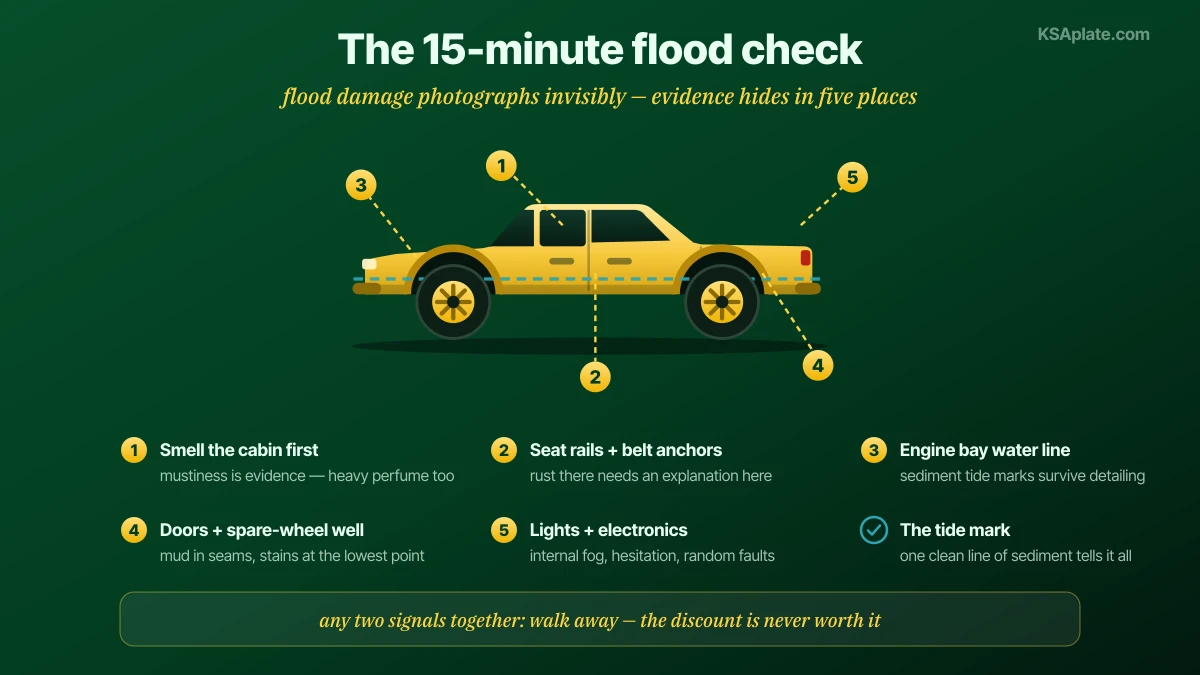
- Smell before you look. Sit inside with the doors closed for thirty seconds. Mustiness is evidence; overwhelming air freshener is also evidence. A normal used car smells like nothing much.
- Find the water line. Open the doors and look low: inside door pockets, on the plastic of the B-pillar, around the spare-wheel well, along the engine-bay walls. Water leaves a tide mark of fine sediment that survives most cleaning.
- Hunt mud in the seams. Wiring harness channels, connector recesses, the gap between center console and carpet, under the fuse-box lid. Detailers clean surfaces; sediment in crevices outlives them.
- Read the metal. Slide the front seats fully forward and back: rails should show grease and wear, not orange bloom. Check seatbelt anchor bolts and the springs under the seats — rust there, in this climate, demands an explanation.
- Check the lights and glass. Internal fogging, droplet stains inside headlights, or suspiciously new lamps on an older car. Then pull each seatbelt out to its end — water stains and stiffness live in the last third that nobody cleans.
Any two of these together move the car from "maybe" to "walk away" — the discount is never worth an airbag controller that corroded quietly for a year.
What's your car worth?
Get a free instant estimate based on real Saudi market data — then sell it on KSAplate with direct WhatsApp contact.
Value My Car — FreeGoing deeper: the hidden evidence
If the car passes the quick pass and you are serious, another twenty minutes goes below the surface:
| Where to look | What flood evidence looks like | Why it survives cleaning |
|---|---|---|
| Under the carpet edge | Damp underlay, water-stained foam, new carpet in an old car | Underlay is never replaced in a cheap dry-out |
| Fuse box + relays | Green-white crust on terminals, mud film under the lid | Hundreds of pins — impossible to clean each one |
| OBD scan | Clusters of stored faults across unrelated systems | Corroding connectors fault randomly, not logically |
| Spare-wheel well | Sediment ring, standing-water stains, surface rust | The lowest point of the body collects the proof |
| Engine oil + transmission dipstick | Milky or foamy fluid — water emulsified inside | A flush helps, but residue tells the story first |
| Screws + brackets under dash | Uniform dull corrosion on fasteners nobody ever touches | No detailer works upside-down under a dashboard |
A mobile mechanic with a lift and an OBD scanner performs this entire layer for a small fee — on any car that shows even one soft signal from the quick check, that fee is the best money in the transaction. The general discipline of buying used — verify the seller, inspect in daylight, pay only after transfer — is covered in the used-car buying guide.
The paper trail
Flood history hides better in metal than in records. Before money moves:
- Pull the vehicle history — our step-by-step guide shows how to check accident and status records in minutes. An insurance total-loss event followed by a reappearance on the market is the classic flood-car biography.
- Ask where the car has lived. A car from a flood-affected district, sold shortly after a flood season, deserves double scrutiny — and an honest seller will answer location questions easily.
- Check the selling pattern. Multiple quick ownership transfers in the months after a flood event are how salvage cars get "washed" through the market — each transfer distances the paper from the water. The broader catalogue of tricks lives in the used-car scams guide.
The price trap
Flood cars are priced to make you skip the checks: far enough below market to feel like a win, close enough not to scream. The antidote is knowing what the car should cost before you feel the pull.
Run the exact model, year and mileage through the free car value calculator — it prices from real Saudi market data and shows the honest private-sale range. A listing sitting 20–30% under that range without a stated reason is the stated reason. Then compare against current listings across Saudi Arabia: if every comparable car asks more, the "bargain" is carrying a story, and your job is to find it before the transfer — not after the first winter of electrical gremlins.
Your car is in the water: first moves
The other half of this guide is for the day the water comes to you. The first minutes decide whether you have an insurance claim or a dead car:
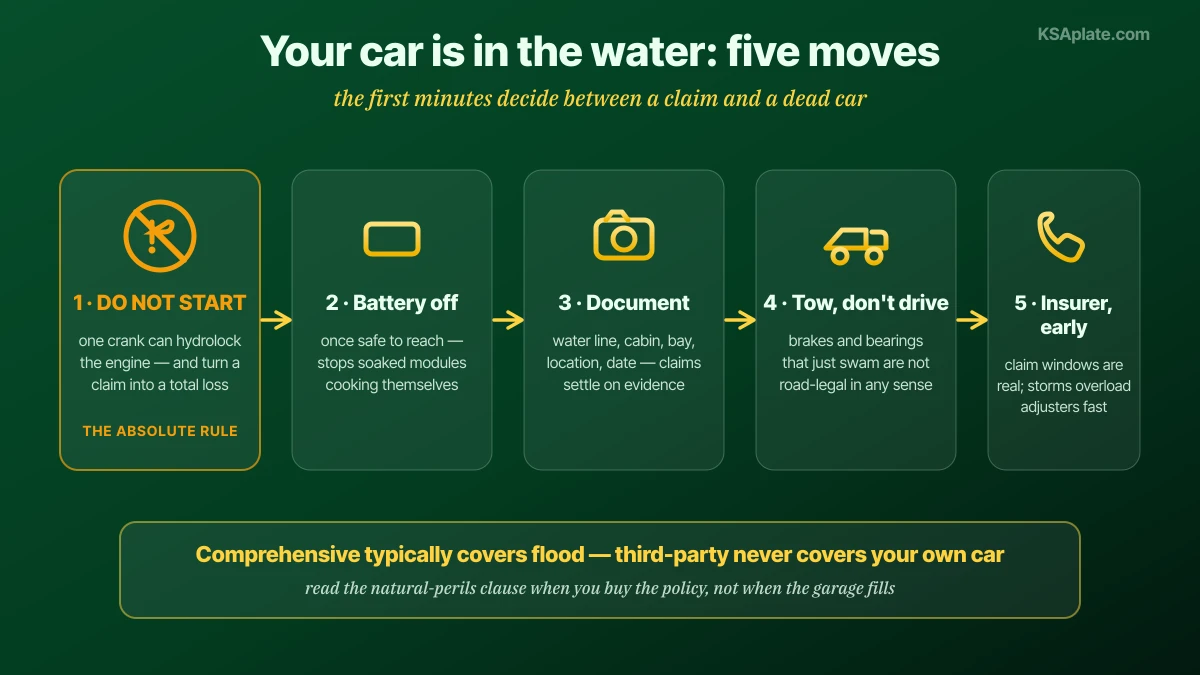
- The engine stays off. Not to test it, not to move it three meters. If water reached intake height, one crank can hydrolock the engine and bend rods — converting a covered claim into a mechanical total loss with your fingerprints on it.
- Kill the electrics when safe. Once the water recedes and it is safe to open the hood, disconnect the battery. It stops modules cooking themselves while soaked.
- Document like an adjuster. Photos and video: the water line on the body, the interior, the engine bay, the location, the date. Claims settle on evidence, and evidence evaporates with the puddles.
- Tow, never drive. Even if it would start. Brakes, bearings and electronics that just swam are not road-legal in any meaningful sense — the towing options and etiquette are in the breakdown guide.
- Call the insurer early. Claim windows are real, adjusters get overloaded after big storms, and early claims get earlier inspections — which matters when mold starts its own clock.
Insurance: who pays for the flood
The Saudi market's two-tier insurance structure decides everything here:
- Third-party (the legal minimum) covers damage you cause to others. Your own flooded car is entirely your problem — the policy owes you nothing.
- Comprehensive typically covers natural events including flood and rain damage — but policies differ in wording, excesses and exclusions (some historically excluded "acts of nature" unless specifically added). The time to read that clause is when you buy the policy, not when the garage fills.
Two practical notes: first, insurers may reject claims where the driver drove into standing water versus being caught by it — another reason the "engine stays off" rule protects your claim as well as your engine. Second, after major flood events, claim volume spikes and settlements slow; documentation quality is what moves your file up the pile. The full market mechanics — what moves premiums, how claims work — are in the Saudi car insurance guide.
After the water: repair or write off?
The honest decision framework, by how high the water reached:
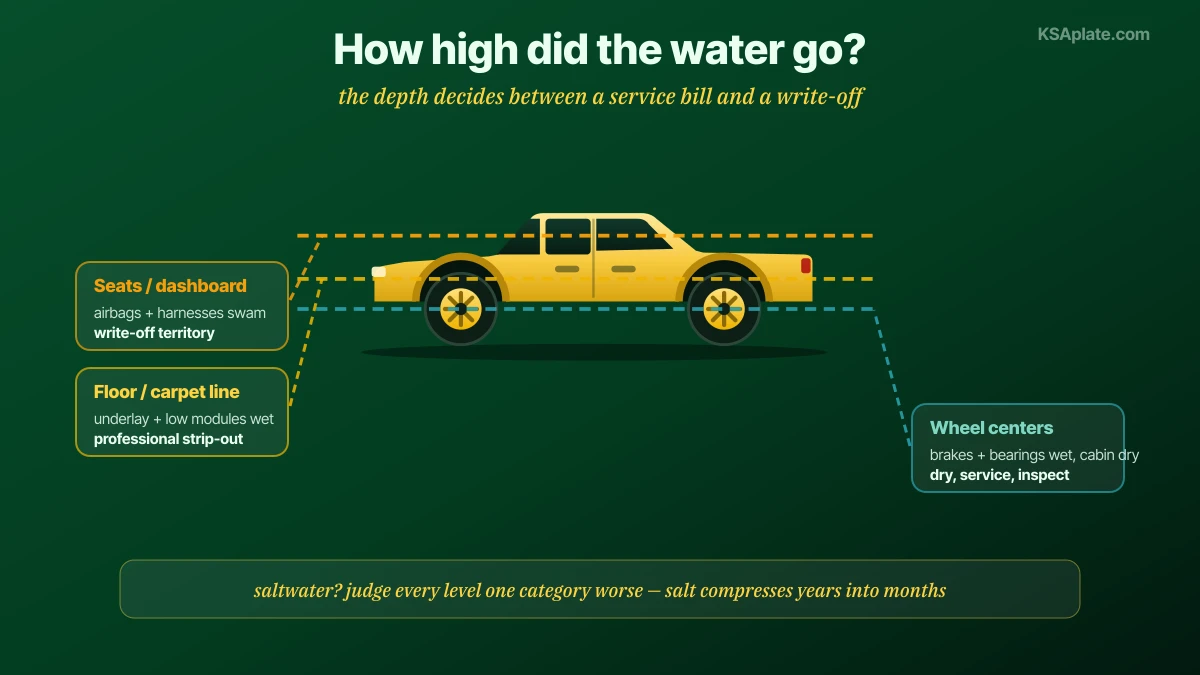
| Water level | Typical reality | Sensible path |
|---|---|---|
| Wheel centers, splashing only | Brakes and bearings wet; cabin dry | Dry, service brakes, inspect — usually fine |
| Floor / carpet line | Underlay soaked, low connectors wet, modules under seats at risk | Professional strip-out and dry; electronics inspection; negotiate with insurer |
| Seat cushions / dashboard | Airbag wiring, main harnesses, modules submerged | Economic write-off territory — fight for total-loss settlement, not repair |
| Any level, saltwater | Corrosion timeline compressed from years to months | Treat one category worse than the fresh-water equivalent |
The uncomfortable truth: a deeply flooded modern car is rarely truly fixed — it is postponed. If the insurer offers total-loss settlement on a dashboard-deep car, taking the money is almost always the right call, even when the car "still works." You are selling the problem at its maximum honest price.
Selling a flooded car honestly
If you keep a flooded car, dry it properly and it behaves — you still own its history. When selling time comes, the temptation is silence; the correct play is the opposite, for reasons both ethical and practical: buyers' mechanics find flood evidence more often than sellers hope, discovered concealment kills deals at the final hour, and a misrepresented sale can follow you legally after transfer.
The honest route works better than sellers expect: disclose the event and the professional repairs, show the invoices, price the car with a genuine flood discount off its calculator value, and let the transparency itself become the sales argument — the buyer knows every other cheap car in the market might be hiding what yours is admitting. Get the baseline number from the valuation tool, apply an honest reduction, and list it for free with the story in the description; disclosed-and-documented consistently beats discovered-and-dead. For write-offs beyond sensible repair, the salvage auction channel exists precisely so damaged cars change hands with eyes open.
FAQ
How can I tell if a used car in Saudi Arabia was flood-damaged?
Do flood-damaged cars really get resold in the Kingdom?
Why do flood cars seem to drive perfectly on the test drive?
What is a fair price for a car with admitted flood history?
My car was caught in a flood — should I try to start it?
Does insurance cover flood damage in Saudi Arabia?
Can a flooded car be properly repaired?
Is saltwater flooding worse than rainwater?
What does mold in a flooded car mean for health?
How do I avoid buying a flood car at auction?
Should I check the market value before buying a suspiciously cheap car?
Conclusion
Flood cars work because of two delays: the months between the water and the symptoms, and the minutes buyers skip between seeing a bargain and paying for it. Close the second delay and the first cannot hurt you — smell the cabin, find the water line, read the hidden metal, pull the history, and let the market price tell you when a deal is actually a story.
And if the water ever comes for your own car: engine off, battery off, camera out, tow truck, insurer — in that order, and your worst day becomes a paperwork exercise instead of a write-off. Know what any car is honestly worth on the free calculator before you buy or sell, and when it is time to move yours on, list it for free — with its history told straight, because in this corner of the market, transparency is the rarest feature of all.