TL;DR:
- A used car scam in Saudi Arabia is any deal designed to take your money without delivering the car — most often a fake listing on open classifieds that demands a deposit before you ever see the vehicle.
- The biggest red flag is a deposit request via STC Pay or bank transfer to "hold" a car you have not inspected in person. Never pay it.
- Other red flags: a price far below market, a seller who won't meet, pressure to decide fast, a seller claiming to be abroad, and the name on the Istimara not matching the seller.
- Buy safely in 5 steps: see the car, match the seller to the Istimara, verify fines and Najm history, agree the price in writing, and transfer ownership on Absher — paying only after the transfer starts.
- Open classifieds carry the most risk because anyone can post and nobody is verified. A specialist marketplace shifts the odds back to you.
Quick answer: To avoid used car scams in Saudi Arabia, never pay a deposit before seeing the car in person, confirm the seller's ID matches the Istimara, and check the car's fines and Najm accident history. Complete the sale only through the official Absher ownership transfer, and release payment after the transfer is initiated — never before.
What used car scams are
A used car scam is a fraudulent transaction built to take a buyer's or seller's money without a genuine, legal car sale behind it. In Saudi Arabia the most common version lives on open classifieds platforms, where anyone can post a listing and no one verifies the seller.
The fraud usually works by separating you from your money before the safeguards kick in. A real Saudi car sale ends with an ownership transfer on Absher, the Ministry of Interior's platform — that step is traceable and legal. Scammers exist to get paid before that step, then vanish.
Understanding that single fact protects you: the danger is always in paying early. Every safe-buying rule below exists to keep your money behind the Absher transfer, where the law can protect it.
The 6 red flags
A red flag is a warning sign that a used car deal may be fraudulent. One alone is enough reason to stop and verify; two or more means walk away.
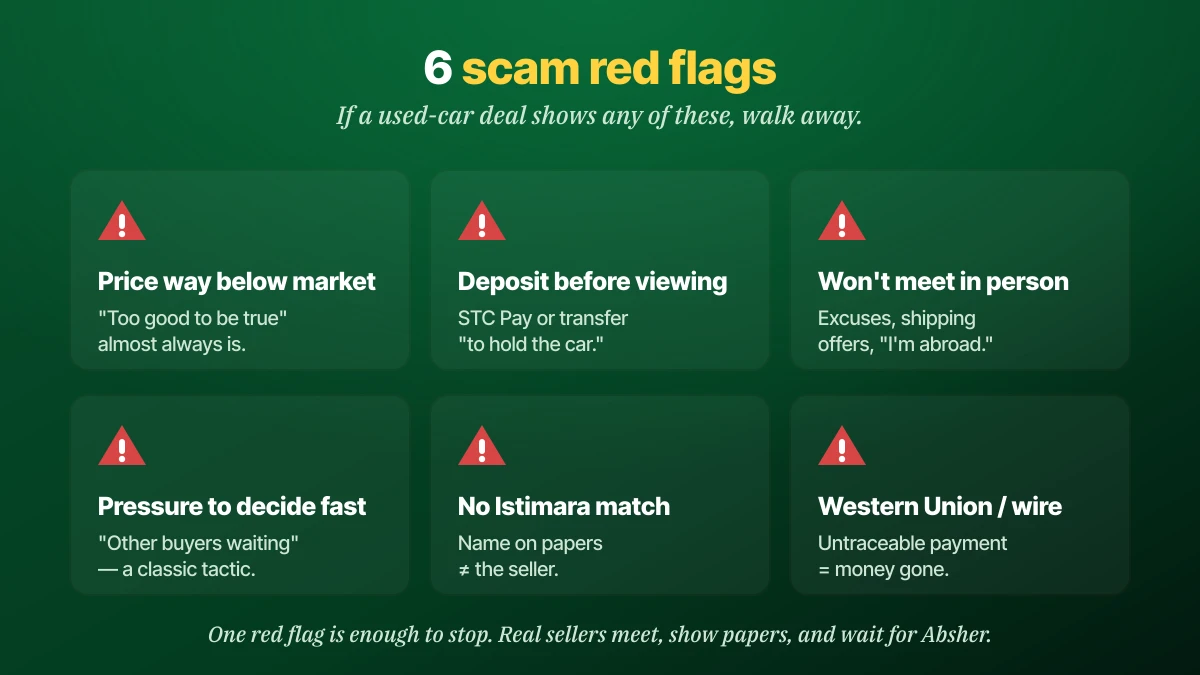
- Price far below market. If a car is priced well under similar listings, treat it as bait. Check the real range first — see how much a used car is worth.
- Deposit before viewing. Any request to pay via STC Pay or transfer to "reserve" a car you haven't seen is the classic scam.
- The seller won't meet in person. Excuses, shipping offers, or "I'm travelling" all point to a seller who does not have the car.
- Pressure to decide fast. "Other buyers are waiting" is a manufactured urgency tactic, not a real deadline.
- Istimara name mismatch. If the name on the registration is not the person selling, stop until ownership and authorisation are proven.
- Untraceable payment. Western Union, MoneyGram or crypto requests mean the money cannot be recovered once sent.
One red flag is enough to stop. A genuine seller will meet you, show the Istimara, let you inspect the car, and wait for the Absher transfer. A scammer needs you to skip all four.
How the deposit scam works
The deposit scam is the most common used car fraud in Saudi Arabia, and it follows a fixed script. Recognising the pattern makes it harmless.
It starts with an attractive listing — a clean car at a price slightly below market, with good photos lifted from elsewhere. When you message, the "seller" is friendly but cannot meet today: the car is in another city, with a shipping company, or being held at customs. To "guarantee" it for you, they ask for a deposit via STC Pay or bank transfer. The moment you pay, they disappear, and the photos reappear on a new listing the next week.
No legitimate private seller in Saudi Arabia needs a deposit to "hold" a car. The car is held by you turning up, inspecting it, and completing the Absher transfer. If a deposit is the condition, it is a scam.
What's your car worth?
Get a free instant estimate based on real Saudi market data — then sell it on KSAplate with direct WhatsApp contact.
Value My Car — FreeHow to buy a used car safely in 5 steps
Buying safely is a fixed sequence that keeps your money protected until ownership is legally yours. Follow these five steps and the common scams cannot reach you.
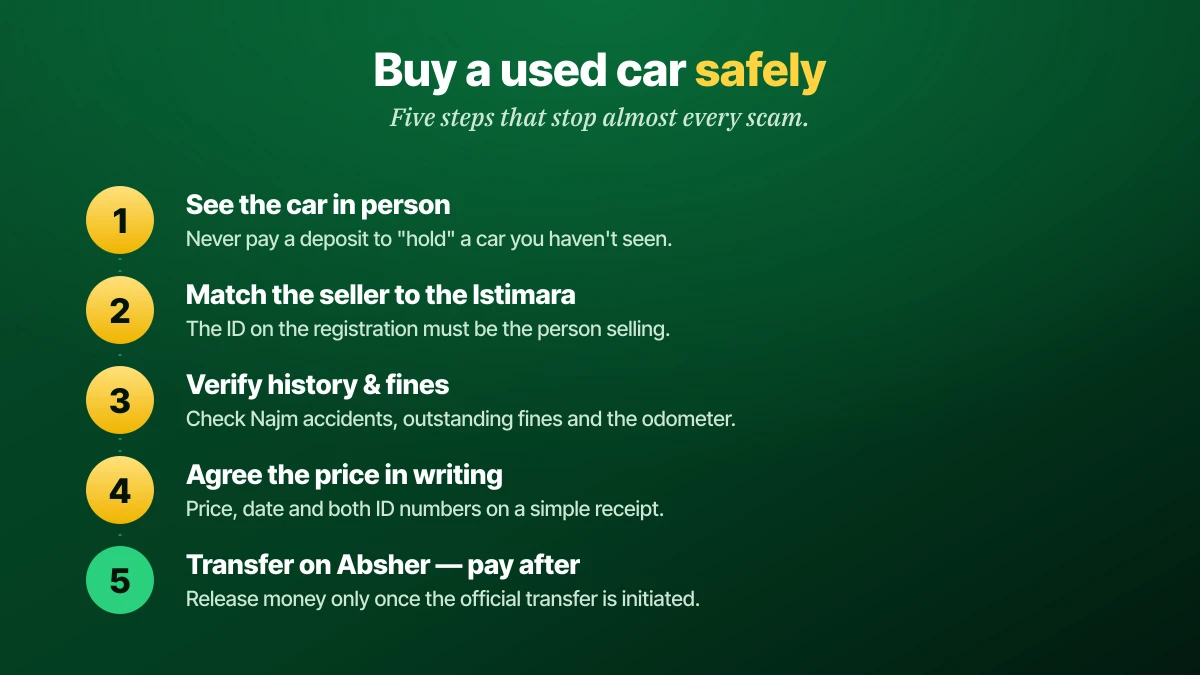
- See the car in person. Inspect the actual vehicle in daylight before any money changes hands. No viewing, no deal.
- Match the seller to the Istimara. The ID on the vehicle registration must be the person in front of you, or a properly authorised agent.
- Verify history and fines. Check the Najm accident record, outstanding traffic fines, and that the odometer matches the service history.
- Agree the price in writing. Record the price, date and both ID numbers on a simple receipt before paying anything.
- Transfer on Absher, then pay. Initiate the official ownership transfer first; release the money only once the transfer is underway. Our car ownership transfer guide covers the exact steps.
For the full mechanical inspection and paperwork side of a purchase, pair this with our used-car buying guide. The two together cover both the fraud risk and the condition risk.
Verify the car before you pay
Verification is the process of confirming a car is legally clean and as described before money moves. In Saudi Arabia three checks catch most problems, and all are quick.
- Outstanding fines. Saudi traffic police (Muroor) confirm unpaid fines do not block the ownership transfer while the Istimara and periodic inspection are valid. Ask the seller to settle them anyway and check the list so there are no surprises — see checking and paying traffic fines.
- Accident history. A logged major accident on the Najm record affects safety and value; a clean record protects both.
- Odometer and identity. Compare the mileage to the service and inspection records, and confirm the chassis and plate match the Istimara exactly.
Verification is not optional politeness — it is the difference between buying a car and buying someone else's debt. A car with a mortgage, an expired Istimara or a lapsed periodic inspection cannot even be transferred to you.
Safe payment & the Absher transfer
Safe payment in a Saudi car sale means money moves only when the legal transfer does. The ownership change is recorded on Absher, and that record — not a promise or a screenshot — is what makes the car yours.
Use a traceable method: a bank transfer you can prove, or cash exchanged at the moment of transfer. Avoid Western Union, MoneyGram and crypto entirely, because they are designed to be irreversible. Most importantly, sequence it correctly: the Absher transfer is initiated, then payment is released. A seller who demands full payment before any transfer step is either inexperienced or dishonest — in both cases, you wait.
In practice a safe handover looks like this: you meet at a quiet, public place in daylight; you inspect the car and check the documents; the seller starts the ownership transfer on Absher and you confirm it on your own phone; only then do you transfer the agreed amount and take the keys. Each step is visible to both sides, and no money leaves your account until the legal change of ownership is genuinely under way. If anyone wants to compress or reorder those steps, that is the moment to pause.
Open classifieds vs a specialist marketplace
An open classifieds platform is a site where anyone can post any listing with no verification, while a specialist marketplace keeps listings focused and supports a safe completion. The difference decides how much risk you personally carry.
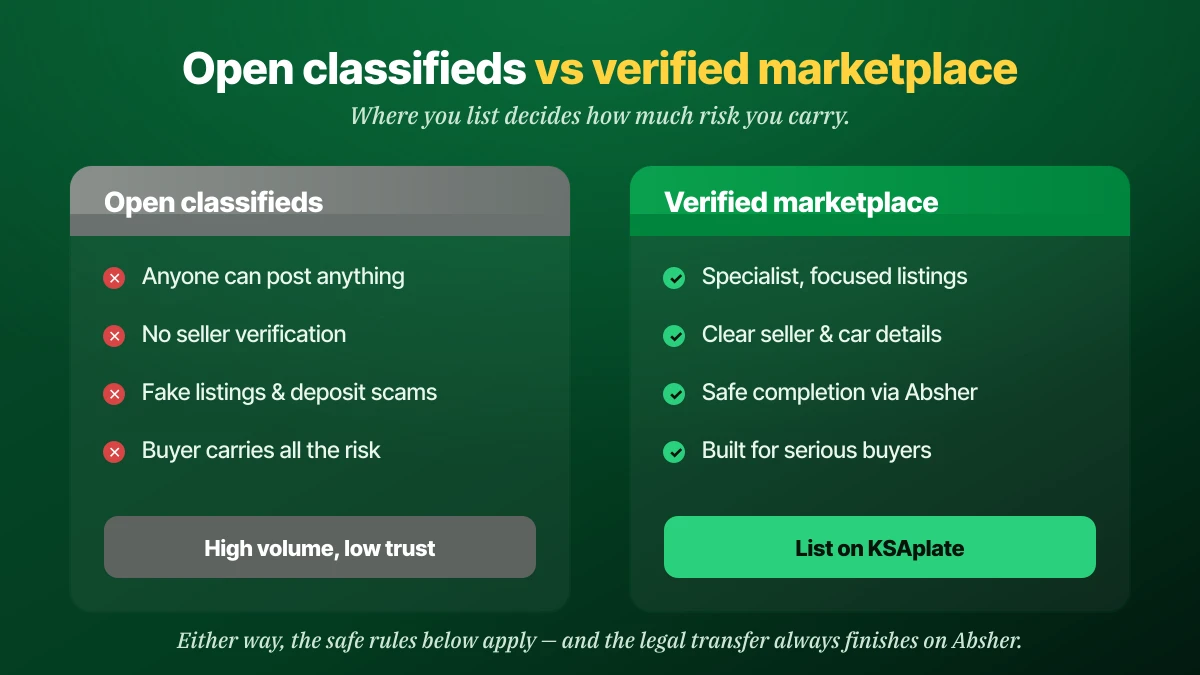
| Factor | Open classifieds | Specialist marketplace |
|---|---|---|
| Who can post | Anyone, anything | Focused, specialist listings |
| Seller information | Little or none | Clear seller & car details |
| Scam exposure | High — fake listings, deposit scams | Lower — built for genuine deals |
| Who carries the risk | The buyer, alone | Shared with platform safeguards |
| Completion | Up to you to get it right | Guided toward the Absher transfer |
Open classifieds win on raw volume, but volume without verification is exactly what scammers exploit — the bigger the open marketplace, the more fake listings hide inside it. A focused, specialist marketplace trades some of that volume for trust, which is the one thing a buyer parting with tens of thousands of riyals actually needs. You can browse cars for sale on KSAplate where listings are specialist and the path leads to a proper Absher transfer — and if you are selling, list your car in front of serious buyers instead of time-wasters.
Other scams to watch for
The deposit scam is the most common, but a careful buyer should know the rest of the playbook. These frauds target the car itself rather than just the payment.
- Odometer rollback. The mileage is wound back to lift the price. Catch it by comparing the dashboard to service-history and inspection dates.
- Disguised dealers. A trader posts as a private seller to dodge accountability. Multiple recent listings from one number is the tell.
- Salvage or flood cars relabelled. A written-off or water-damaged car is cosmetically repaired and sold as clean. The Najm and insurance history exposes it.
- Fake escrow or "delivery" services. A scammer invents a third-party holding service and sends you a spoofed payment link. Real Saudi transfers happen on Absher, not a private "escrow."
- Outstanding finance. A car still under a loan is mortgaged and cannot legally transfer until the lender releases it — verify it is unencumbered before paying.
Most of these collapse under one habit: insist on the Istimara, the Najm history and the Absher transfer. A car that cannot pass those three checks is not a bargain — it is a trap.
What to do if you were scammed
If you have already paid a scammer, act within minutes, not hours — speed decides whether the money can be frozen. Take these steps in order:
- Call your bank immediately and report the transfer as fraud to attempt a freeze or recall.
- Report to the authorities. Use the Saudi anti-fraud channels — the "Kollona Amn" (We Are All Security) app or 911 — to file a cybercrime/fraud report.
- Gather evidence. Save the listing, chat logs, phone numbers, the account you paid, and any names — this is what an investigation needs.
- Check the seller's business record on official channels such as Maroof if a business was involved, and report a fraudulent store there.
- Warn others by reporting the listing so the platform can remove it.
The first phone call matters most. A bank transfer reported as fraud within minutes can sometimes be stopped; the same call an hour later usually cannot.
Selling safely too
Sellers face the mirror-image risk: fake buyers, bounced transfers and payment screenshots that are not real money. The rule is symmetrical — do not hand over the car or the keys until the payment has genuinely cleared into your account and the Absher transfer is underway.
Be wary of "overpayment" tricks and buyers who want the transfer done before paying. If you are selling a plate rather than a car, the same caution applies; our guide on buying and selling plates safely covers that side. Listing on a specialist marketplace filters out most time-wasters before they reach you.
Frequently asked questions
Is it safe to buy a used car from online classifieds in Saudi Arabia?
What is the most common used car scam in Saudi Arabia?
How do I verify a used car before buying?
Should I ever pay a deposit to reserve a car?
What is the safest way to pay for a used car?
How do I report a car scam in Saudi Arabia?
Can I get my money back after a car scam?
Why is a specialist marketplace safer than open classifieds?
Does buying privately mean no buyer protection?
Conclusion & next steps
Used car scams in Saudi Arabia all rely on one thing: getting your money before the Absher transfer protects it. Spot the red flags, refuse every deposit request, verify the car's fines and Najm history, and release payment only once the legal transfer is underway. Choosing where you buy matters too — open classifieds offer volume but no verification, while a focused, specialist marketplace puts trust back on your side. Start safe: browse cars on KSAplate, and when you sell, list your car where genuine buyers are looking.