Last updated: 3 August 2026
Yes — in Saudi Arabia you can keep your license plate when you change cars, as long as you reserve (retain) the plate number before the old vehicle's ownership is transferred and then fit it to another vehicle you own. The plate and the car are two separate assets in the Ministry of Interior's records, and the Muroor (traffic) system lets you detach a distinctive plate (لوحة مميزة) from one vehicle, hold the number under your name, and re-install it on the next. What trips people up is the default: unless you actively request to retain it, the plate usually travels with the car to its new owner. This guide is about the plate side of the move — reserving it, holding it, and refitting it — not the whole-car ownership transfer, which is covered separately.
If your goal is simply moving the car to a new owner, read transferring car ownership in Saudi Arabia for the vehicle-side Absher steps. Here the focus is narrower: how to make sure a valuable number stays with you across cars. For why a good number is worth keeping at all, see the complete Saudi plate guide and plate numerology and lucky numbers; for the bigger picture of a plate as a portable asset, see Saudi plates as an investment.

- Yes. A distinctive plate number can be detached from your current car and re-installed on another vehicle registered in your name, through Absher / the Muroor traffic system.
- The default is the trap. If you do nothing, the plate transfers with the car to the buyer. You must request to retain the number before the ownership transfer is finalised.
- You can hold the number without a car on it for a limited reservation window. If the window lapses without you fitting it to a vehicle, the reservation can expire and the number returns to the pool.
- Fees are modest versus the plate's value — an indicative reservation/retention fee and a plate transfer/installation fee, both payable through Absher. Confirm current figures on Absher before you act.
- Only distinctive/premium plates are worth this effort. An ordinary working-stock number is not worth reserving; a scarce number is a portable asset you keep for life. Value yours first with the numerology guide.
Quick answer: To keep your plate when you change cars in Saudi Arabia, request to retain (reserve) the distinctive number before transferring or scrapping the old vehicle, hold it under your name during the reservation window, pay the indicative reservation and transfer fees on Absher, and install it on the new vehicle — which must be a matching private class. If you sell the car and do nothing, the number goes with it by default, so the single most important action is to detach the plate first. Only distinctive plates justify the process; ordinary numbers should simply travel with the car. Browse what a keep-worthy number looks like on KSAplate's single-digit listings.
Can you keep your plate when you change cars?
Yes. In Saudi Arabia the plate number and the vehicle are recorded separately, so a distinctive plate can outlive the car it is currently fitted to. When you change cars — whether you sell the old one, scrap it, or simply buy a second vehicle — you can ask the traffic authority to detach the number, keep it reserved under your name, and later fit it to another vehicle you own. The number becomes yours to carry from car to car for years.
The critical nuance is timing and intent. The system's default behaviour is that the plate belongs to the vehicle: when ownership of the car moves to a new owner through Absher, the plate on it moves too, unless you have already flagged that you want to keep the number. That is why the retention request has to happen before the ownership transfer or deregistration is completed — once the car and its plate are in the buyer's name, the number is no longer yours to reserve. Think of it as removing a valuable painting from a house before you sell the house; do it first, or it goes with the sale.
This is a different process from the whole-car ownership transfer itself. If you only care about moving the car to a new owner and the number is ordinary, you do not need any of this — just follow the standard car ownership transfer steps and let the plate go with it. Retention is specifically for people who own a number worth keeping.
How plate reservation & retention works via Absher
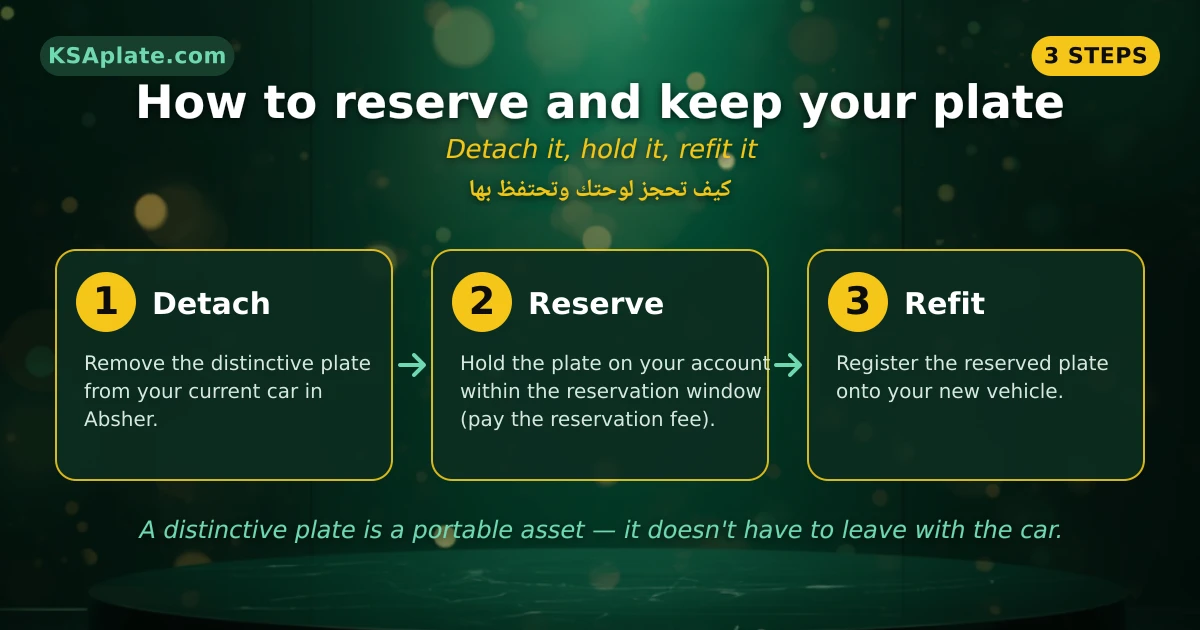
Retention is handled through the Ministry of Interior's digital channels — the Absher platform and the Muroor (General Department of Traffic) services — rather than at a plate-maker's counter. The mechanism has three moving parts: detaching the number, holding it, and re-installing it.
Detaching the distinctive plate
The first action is to separate the number from the vehicle it currently sits on. In Absher's vehicle services you request to retain or reserve the plate number, which flags to the system that the number should not travel with the car when the vehicle is later transferred, scrapped or exported. In practice this is done while the car is still registered in your name — you are, in effect, telling the system "the car may change hands, but this number stays with me." A distinctive plate (لوحة مميزة) is the category that qualifies; the number is booked to your national ID or Iqama record.
Holding the number under your name
Once detached, the number is reserved to you without a vehicle attached to it. During this window you own the right to the number but it is not fitted to any car. This is the stage that makes plate-keeping possible: you can sell or scrap the old car, take delivery of the new one, and only then bring the two together. The reservation is what protects the number in the gap between cars.
Re-installing it on the new vehicle
When the replacement vehicle is registered in your name, you use Absher to install the reserved number onto it, replacing whatever temporary or standard plate the new car arrived with. The new vehicle must be an eligible match — the same private-plate class — and once the transfer of the number is confirmed and the fee paid, the physical plates are produced and the number is legally on the new car. Because this all runs through the same government platform as the car ownership transfer, the two processes are often done back to back, but they are separate transactions with separate fees.
The reservation window: how long you can hold a plate
You cannot hold a detached number under your name indefinitely with no vehicle on it — there is a reservation window, and understanding it is the difference between keeping a valuable number and losing it back to the pool.
The reservation is time-limited. After you detach the number, the system gives you a defined period to install it on a replacement vehicle. Hold it within that window and the number stays yours; let the window lapse without fitting it to an eligible car, and the reservation can expire — at which point the distinctive number can return to the Ministry's pool and, in the worst case, be lost to you entirely or offered to others. The exact length of the window and the rules around extending or renewing it are set by the Ministry of Interior and can change, so treat any specific figure you read as indicative and confirm the current window inside Absher when you start the process.
The practical rule is simple: do not detach a plate until you have a clear plan and timeline for the replacement car. If there will be a long gap between selling the old vehicle and registering the new one, check the current reservation window first and, if needed, whether it can be renewed, so a scarce number worth six or seven figures is never left to expire on a technicality. A number this valuable is exactly the kind of portable asset you protect with a diary reminder, not a guess.
What's your plate worth?
Get an instant, free estimate with our plate value calculator.
Calculate My Plate's ValueWhat it costs: reservation & transfer fees
Keeping a plate is cheap relative to what a distinctive number is worth, but it is not free — there are two cost points, and both are paid through Absher. The figures below are indicative, rounded to show the structure of the cost rather than to quote an exact tariff; the Ministry of Interior sets the actual amounts and can revise them, so confirm the current fees on Absher before you commit.
| Cost item | When it applies | Indicative SAR | Notes |
|---|---|---|---|
| Plate reservation / retention | When you detach the number to hold it under your name | ~100–400 | Books the distinctive number to your ID during the gap between cars |
| Plate transfer / installation | When you fit the reserved number to the new vehicle | ~100–300 | Produces the physical plates and registers the number on the new car |
| New plate issuance (physical) | Bundled with installation | ~50–150 | Cost of printing the plates for the replacement vehicle |
| Car ownership transfer (separate) | Only if you are also selling/transferring the old car | Varies | A different transaction — see the ownership transfer guide |
Two things are worth stressing. First, the retention and installation fees are trivial against the value of a plate worth keeping — a number that trades in five or six figures is protected for a couple of hundred riyals, which is the whole reason retention makes sense only for distinctive plates. Second, do not confuse these plate-side fees with the car ownership-transfer fee; they are separate line items for separate actions, and budgeting for one but not the other is a common source of surprise at the counter.
Step-by-step: reserve, hold, fit to the new car
Here is the plate-side sequence from start to finish. When a sale is involved, the buyer and seller each have a role, and the order matters enormously — retain first, transfer the car second.
- Confirm the number is worth keeping. Only distinctive plates justify the process. Value yours against the numerology multipliers and recent comparables first.
- Check the current reservation window and fees in Absher. Note how long you can hold the number without a car and what retention and transfer will cost today.
- Detach / reserve the number — before anything else. In Absher vehicle services, request to retain the distinctive plate so it will not travel with the car. This is the single most important step and it must come before any sale, scrap or export.
- Complete the car side. Now sell the old vehicle (the buyer receives it with a standard replacement plate, not your reserved number), scrap it, or otherwise deregister it — following the standard ownership transfer process for a sale.
- Register the replacement vehicle in your name. Buy and register the new car; it will arrive on a standard plate.
- Install the reserved number on the new car. In Absher, transfer the held number onto the new vehicle, confirm it is an eligible private-plate match, and pay the transfer/installation fee.
- Collect and fit the physical plates. The new plates are produced and the number is now legally on your new car. Keep the confirmation for your records.
When a car is sold rather than scrapped, the buyer's only involvement is receiving the car after your number has been detached — so their ownership transfer completes against a fresh standard plate, leaving your distinctive number safely reserved to you. If you flip that order and transfer the car first, the number is gone.
Selling your car: keep the plate or let it go?
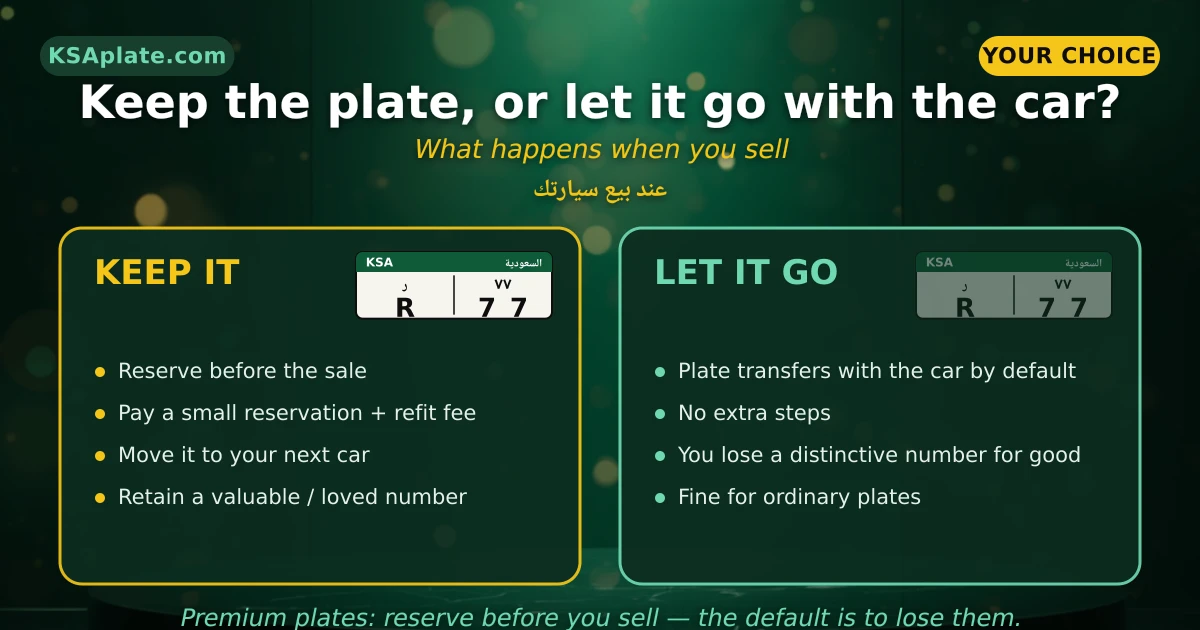
Selling a car forces a decision most owners never think about until it is too late: does the number go with the car, or do you keep it? Because the default is that the plate travels with the vehicle, doing nothing is itself a choice — and for a valuable number it is usually the wrong one.
The decision framework
The question turns on one thing: is the number distinctive enough to be worth more to you than the small convenience of letting it go? A scarce single-digit, a strong repeat, or a lucky combination is a portable asset — keep it, and carry it to your next car or sell it separately on its own timeline. An ordinary four- or five-digit working number is not worth the retention fee or the paperwork; let it travel with the car. The table below frames the two paths.
| Consideration | Keep the plate (retain) | Let it go with the car |
|---|---|---|
| Best for | Distinctive / premium numbers | Ordinary working-stock numbers |
| What you do | Reserve the number before the sale | Nothing — it transfers by default |
| Cost | Retention + transfer fees | None on the plate |
| Upside | Carry it to the next car, or sell it separately for its full value | May slightly help the car sell |
| Risk | Missing the reservation window | Giving away a valuable asset for free |
| Outcome | Number stays a lifelong, sellable asset | Number is gone with the car |
If you decide to keep the number but do not want to fit it to another car, remember there is a third path: retain it and sell it on its own. A distinctive number sold separately can be worth far more than the bump it would add to a car's asking price — see where to sell a Saudi license plate for the routes and their costs. The one option that almost never makes sense for a valuable number is the default: handing it to the buyer for nothing.
Eligibility: private plates, expats and companies
Who can reserve a plate, and which plates qualify, is set by the Ministry of Interior — and the rules hinge on plate class and the reserver's status.
Private plates and matching vehicle class
Retention applies to private (passenger) distinctive plates, and the number can only be re-installed on a vehicle of the same eligible class. You cannot move a private-car number onto a commercial, transport or motorcycle plate category — the classes must match. This is why "mismatched vehicle class" is one of the common mistakes below: reserving a number and then buying a replacement vehicle in a different plate class can leave you holding a number you cannot legally fit.
Expats and Iqama holders
Plate ownership and transfer are tied to a valid identity record — a national ID for citizens or a valid Iqama for residents — and to eligibility to register a vehicle in the Kingdom. In principle a resident who can register a car in their name can also hold a reserved number, but the specifics depend on current Absher and Ministry of Interior rules and on your own residency status, which can change. If you are on an Iqama, confirm your eligibility to retain and re-install a number in Absher before you detach a valuable plate. For what happens to a plate if you are leaving the country rather than just changing cars, see your license plate when you leave Saudi Arabia.
Companies and establishments
Vehicles and plates registered to a company or commercial establishment follow the entity's records rather than an individual's. A distinctive number held by a business is reserved to the entity, and re-installation must be onto a vehicle registered to that same entity in an eligible class. The principle is the same — detach before transfer, match the class — but the identity on the record is the establishment, so confirm the authorised person handling the Absher account before starting.
Premium plates vs ordinary plates
Retention only makes sense for a plate worth keeping, so the premium-versus-ordinary distinction is really the distinction between plates you should reserve and plates you should let go.
A distinctive or premium plate — a single digit, a strong two-digit repeat, a pattern-rich three-digit number, or a culturally lucky combination — is scarce by design and holds or grows its value over time. These are the numbers that justify the reservation fee, the paperwork, and the discipline of retaining before you sell. Carried from car to car, a premium number is one of the few assets you use every day and can still sell later for its full standalone value. For why certain digit combinations command so much, see the numerology and lucky numbers guide, and for the format basics that make a plate premium in the first place, the complete plate guide.
An ordinary plate — a random four- or five-digit number on a weak letter pair — sits in deep supply and carries little standalone value. Reserving it costs more in fees and effort than the number is worth, and it will not appreciate. For these, the sensible move is to let the plate travel with the car when you sell, exactly as the default already does. The retention machinery exists for the scarce end of the market, not the working stock — the same divide that separates a plate as an investment from a plate as a mere registration.
Common mistakes that lose a valuable plate
Most lost plates are lost to avoidable errors, not bad luck. These are the ones that cost owners a valuable number.
- Letting the plate transfer with the car by default. The number one error. Owners sell the car, sign the transfer, and only afterwards realise the number went with it. Retention must be requested before the ownership transfer — after it, the number belongs to the buyer.
- Missing the reservation window. Detaching the number and then leaving too long a gap before fitting it to a new car, so the reservation lapses and the number returns to the pool. Check the window and diarise the deadline.
- Mismatched vehicle class. Reserving a private-car number and then buying a replacement in a different plate class, leaving a number that cannot be legally installed. Confirm the class match before you commit to the new vehicle.
- Assuming an ordinary number is worth keeping. Paying retention fees on a plate that has no standalone value. Value the number first; only reserve distinctive plates.
- Handing over a valuable number for free. Including a scarce plate in a car sale as a throw-in. A distinctive number is often worth more sold separately than the entire lift it gives the car's price.
- Trusting an informal handshake. Any arrangement that avoids the formal Absher reservation and transfer is a red flag. Keep every step inside the government platform.
And if the sale has already gone through with the plate still attached, retention is no longer the question — recovery is. Our guide on what to do when you sold the car with the plate still on it sets out the one route back and what it costs.
Action-steps checklist
Use this quick checklist whenever you are changing cars and want to keep a distinctive number.
- Value the number. Confirm it is distinctive enough to be worth retaining, using the numerology and comparables method.
- Check Absher. Note the current reservation window, retention fee, and transfer fee before you start.
- Reserve first. Detach and retain the number in Absher before selling, scrapping or exporting the old car.
- Move the car. Complete the ownership transfer or deregistration with a standard plate on the vehicle.
- Match the class. Ensure the replacement vehicle is the same eligible private-plate class.
- Install the number. Transfer the reserved plate onto the new car in Absher and pay the fee.
- Beat the deadline. Fit the number to the new car within the reservation window; renew if the rules allow and you need more time.
- Keep records. Save every Absher confirmation in case of any later dispute.
Your number is a portable asset — treat it like one
A distinctive plate stays with you across every car you own, and it can be sold on its own timeline for its full value. See what keep-worthy numbers look like, value yours free, and list it for free when you are ready to sell.
Browse distinctive plates Value a plate free
Frequently asked questions
Can I keep my plate when I change cars in Saudi Arabia?
Can I keep my plate when I sell my car?
Does a premium plate transfer automatically with the car?
How much does it cost to reserve a plate?
How long can I hold a plate without a car on it?
What happens if I miss the reservation window?
How do I move my plate to the new car?
Can expats reserve a plate?
Can a company keep a plate when it changes vehicles?
Can I move my plate onto any vehicle I buy?
Is keeping the plate the same as transferring car ownership?
Should I keep my plate or let it go with the car?
What happens to my plate if I scrap the car instead of selling it?
Where can I sell a plate I decide not to keep on my next car?
Reviewed by Khalid Al-Rashid, Saudi License Plate Market Analyst.
Sources: Ministry of Interior and General Department of Traffic (Muroor) plate-retention and vehicle-registration conventions, Absher platform vehicle services (reservation, transfer and eligibility), and KSAplate marketplace data for the value context that makes retention worthwhile. All fees and windows are indicative and can be revised by the Ministry of Interior — confirm the current reservation window, retention fee and transfer fee inside Absher before detaching or re-installing a plate.