Last updated: 2 August 2026
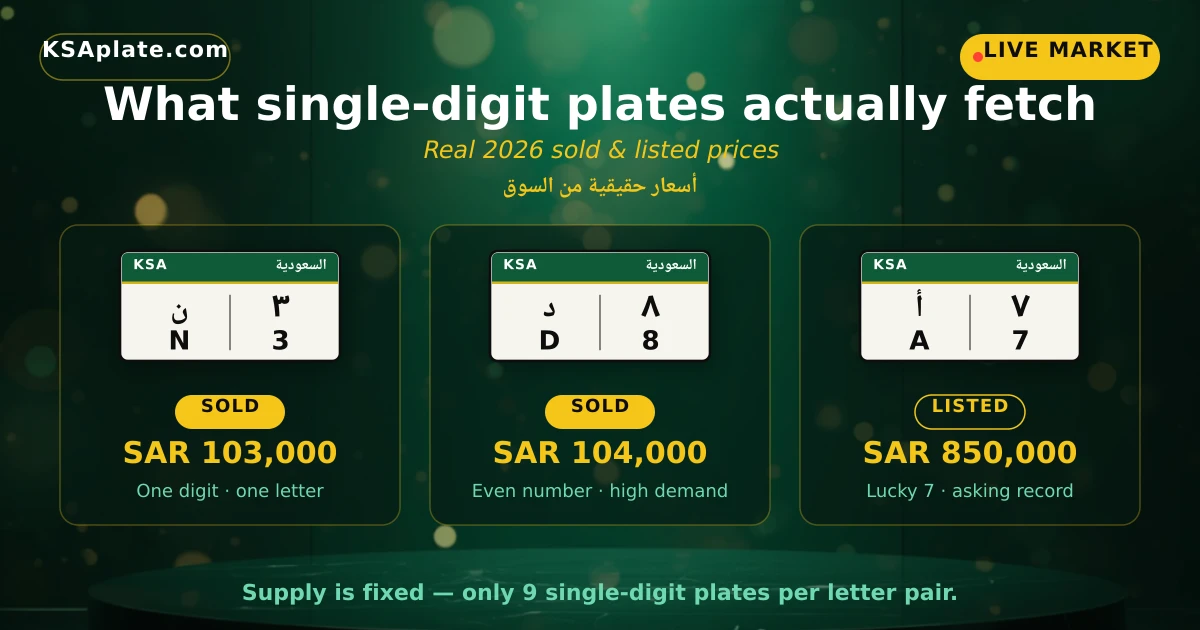
Yes — Saudi license plates have behaved like a genuine appreciating asset class over the past decade, but only in the tiers where supply is mathematically capped and demand is culturally durable. A single-digit private plate that changed hands for a five-figure sum a decade ago now clears six or seven figures at auction. The recent Saudi sales of "3 · ن" at SAR 103,000 and "8 · د" at SAR 104,000 are not vanity headlines — they are pricing data for a market where the entire national supply of single-digit plates for any letter pair is exactly nine units that can never be reprinted. For an investor, that combination of fixed supply, rising demand and cultural prestige is the whole thesis. The catch is everything below that top tier, where the returns thin out fast.
This article treats Saudi plates as an asset class — not as a primer on the format. If you want to understand what makes a plate valuable in the first place, read the complete Saudi plate guide; for the cultural reasons certain digits command millions, see plate numerology and lucky numbers. Here the questions are narrower and colder: do plates actually appreciate, what is the real ROI after the buy–sell spread and fees, how liquid is the market, what are the risks, and how should a plate sit inside a wider portfolio alongside gold, Tadawul stocks and Riyadh real estate.

TL;DR — Are Saudi plates a good investment?
- Yes, at the top tier; not really at the bottom. Single-digit and strong two-digit plates have appreciated reliably because supply is fixed at nine (single) or ninety (two-digit) plates per letter pair nationally. Random four- and five-digit plates trade near the transfer-fee floor and do not appreciate — treat them as consumption, not investment.
- The mechanism is real scarcity plus cultural demand. The Ministry of Interior cannot mint more single-digit plates; a growing base of Saudi wealth chases a shrinking float as trophy plates are locked into collections. That is a textbook appreciation setup.
- Returns are lumpy and illiquid. A good single-digit plate might compound at a healthy annual rate over a multi-year hold, but you pay for that with a wide bid–ask spread, months-long time-to-sell, and marketplace fees — there is no yield or dividend while you wait.
- Market proof: "3 · ن" cleared SAR 103,000 and "8 · د" cleared SAR 104,000 recently — a six-figure floor even for neutral single digits, while trophy single digits (7, 9, 1 on strong letters) have crossed SAR 1–3 million.
- The investor's edge is discipline: buy scarce tiers with strong letters and patterns, ignore the working stock, size the position as a small slice of a collection budget, and hold for years — not weeks.
Quick answer: Saudi plates are a good investment in the narrow band where scarcity is real — single-digit plates, strong two-digit repeats, and pattern-rich three-digit plates on sought letters — and a poor one everywhere else. The appreciation mechanism is fixed supply per tier (nine single-digit plates per letter pair, ninety two-digit, and so on) meeting rising Saudi wealth and durable cultural prestige, so the float shrinks as collectors lock trophies away. The trade-off is illiquidity: wide buy–sell spreads, holding periods measured in months to years, marketplace fees on exit, and zero income while you hold. Compared with gold (liquid, low-yield), Tadawul equities (liquid, dividend-paying, volatile) and real estate (illiquid, income-producing), a plate is a collectible — high prestige, potentially high appreciation, but the least liquid and most taste-driven of the four. Size it small, buy quality, and hold long. Browse the tiers that actually appreciate on KSAplate's single-digit listings.
Do Saudi plates actually appreciate?
The honest answer is: some of them, structurally, and the rest barely at all. To invest rather than gamble, you have to know which is which — and why.
The appreciation is concentrated in the scarce tiers
A Saudi private plate carries two Arabic letters and one to four digits. The number of plates that can exist for any given letter pair is fixed by digit count: nine single-digit plates, ninety two-digit, nine hundred three-digit, nine thousand four-digit. The Ministry of Interior cannot issue a tenth single-digit plate for a letter pair — the supply is not merely limited, it is closed. That closed supply is the precondition for appreciation. Where supply cannot grow and demand rises, price rises. Where supply is deep (the four- and five-digit working stock), new demand is absorbed by abundant inventory and price stays flat. This is why the investment case lives almost entirely in the one-, two- and pattern-rich three-digit tiers, and why the five-digit tier is the cheapest, most abundant, and least investable segment of the market.
Three mechanisms drive the trend
- Fixed supply per tier. Nine single-digit plates per letter pair, forever. Every plate absorbed into a permanent collection reduces the tradable float, tightening the market further.
- Rising demand. Saudi Arabia's Vision 2030 wealth creation, a growing collector culture, and social-media status display have expanded the pool of buyers competing for the same fixed set of trophy plates.
- Cultural prestige. A single-digit or 7777-style plate is culturally legible luxury — instantly understood by every Saudi driver in a way a watch or a handbag is not. That legibility sustains demand across generations rather than fashion cycles.
The evidence
Auction and private-sale records tell a consistent story. Trophy single digits on strong letters have moved from five figures a decade ago into seven figures today; specimens like "7 · أ" and "1 · ب" have reportedly cleared SAR 1.8–2.4 million and above. Even the quiet end of the single-digit tier holds a six-figure floor — the recent "3 · ن" at SAR 103,000 and "8 · د" at SAR 104,000 are the cleanest calibration points we have: neutral digits, mid-strength letters, and still six figures. That floor has risen over time, which is the signature of an appreciating asset rather than a flat collectible.
The ROI math: worked examples
Appreciation only matters after costs. A plate's return to an investor is the exit price minus the entry price, minus the buy–sell spread and marketplace fees, spread over the holding period. The table below works through representative cases. Figures are illustrative and rounded to show the mechanics, not price guarantees.
| Plate (tier) | Entry (SAR) | Hold | Exit (SAR) | Gross gain | Approx. annualised |
|---|---|---|---|---|---|
| Single digit, strong letter (7 · ب) | 650,000 | 5 yrs | 1,150,000 | +77% | ~12%/yr |
| Single digit, neutral (3 · ن) | 72,000 | 4 yrs | 103,000 | +43% | ~9%/yr |
| Two-digit repeat (55 · س) | 48,000 | 4 yrs | 85,000 | +77% | ~15%/yr |
| Four-digit 7777, strong letter | 95,000 | 3 yrs | 180,000 | +89% | ~24%/yr |
| Random four-digit (4728 · ص) | 1,800 | 3 yrs | 1,900 | +6% | ~2%/yr |
| Five-digit random | 500 | 3 yrs | 500 | 0% | ~0%/yr |
Two lessons jump out. First, the scarce and pattern-rich tiers produced double-digit annualised returns in these representative cases, while the working stock produced roughly nothing. Second, the headline gain is not what lands in your pocket. Apply the real-world frictions:
- Buy–sell spread. You buy near the asking price and sell near the bid. On thin tiers that gap can be 10–25% of value, and it comes straight off your return.
- Marketplace and transfer costs. Listing a plate on KSAplate is free, which is negligible against a six-figure plate — a real structural advantage over percentage-based auction commissions that can take 5–15% of the sale. Budget separately for the Absher ownership-transfer fee on completion.
- Holding cost. Zero income while you wait, and your capital is locked. A 12%/yr plate and a 12%/yr dividend stock are not equivalent — the stock paid you along the way.
Net of a 15% spread and fees, the "7 · ب" example above still returns a respectable multi-year gain — but an investor who paid a percentage auction commission on both entry and exit would hand back a meaningful slice of it. The flat free listing model is one of the few structural edges available to the plate investor, which is why disciplined sellers list directly rather than only through commission houses. For selling routes and their costs, see where to sell a Saudi license plate.
Liquidity reality: spreads and time-to-sell
The single most under-appreciated fact about plates as an asset is that liquidity is inversely correlated with the very scarcity that drives appreciation. The rarer the plate, the fewer the buyers who can afford it, and the longer it can sit before the right buyer appears.
How fast each tier sells
| Tier | Buyer pool | Typical time-to-sell | Bid–ask spread | Liquidity |
|---|---|---|---|---|
| Trophy single digit (7 · أ) | A handful of VIPs nationally | Months to years | Wide (15–30%) | Low |
| Neutral single digit (3 · ن) | Collectors, businessmen | Weeks to months | 10–20% | Moderate–low |
| Strong two-digit / pattern | Enthusiasts, gift buyers | Weeks | 10–15% | Moderate |
| Four-digit strong pattern (7777) | Enthusiasts, brand owners | Days to weeks | 8–12% | Moderate–high |
| Random four/five-digit | Ordinary buyers | Fast at floor price | Narrow but tiny value | High (but no upside) |
The paradox for the investor is stark: the plates most likely to appreciate are the hardest to exit quickly, and the plates easiest to sell barely appreciate at all. A trophy single-digit plate is like a trophy painting — worth a fortune, but you sell it on the market's timetable, not yours. If you might need the cash on short notice, the plate is the wrong instrument. Plan every plate purchase as capital you can leave untouched for years. This is also why the wider GCC plate market matters: a deeper pan-Gulf buyer pool improves liquidity for the very top tier, where a single motivated Emirati or Qatari collector can be the difference between a sale this month and next year.
What's your plate worth?
Get an instant, free estimate with our plate value calculator.
Calculate My Plate's ValueThe risk factors you must price in
A plate is not a bank deposit. The appreciation case is real, but so are the risks, and an investor who ignores them is speculating.
Illiquidity risk
Covered above and worth repeating because it is the dominant risk. You cannot assume you can sell at a chosen price on a chosen date. Forced sales into a thin market clear at the bid, not the ask.
Taste-driven, subjective pricing
Unlike gold (a global spot price) or a listed stock (a live quote), a plate has no objective mark. Its value is what one particular buyer will pay on one particular week, and taste shifts. A pattern that feels premium today may cool; a letter pair prized this decade may fall out of fashion. Value your holdings against recent comparable sales, and check current comparables before pricing — the plate value check guide walks through the method.
No yield
A plate pays nothing while you hold it. Every year of holding is a year your capital earns no income and cannot be redeployed. The entire return must come from price appreciation, which raises the bar the plate must clear to beat a dividend-paying alternative.
Transfer friction and legal risk
Ownership transfers run through Absher and carry fees, paperwork, and eligibility conditions. Friction lengthens the sale and can deter marginal buyers. Confirm current transfer rules in Absher before every transaction.
Market thinness and single-buyer dependence
At the top, price can hinge on one or two active collectors. If they step back, the bid for a whole tier can soften quickly. Thin markets gap down faster than deep ones.
Fakes, disputes and title problems
As with any high-value collectible, verify authenticity and clean title before paying. Insist on a proper Absher transfer, never an informal handshake, and treat any listing that avoids formal transfer as a red flag.
Which plates are the best investments
The investment quality of a plate is decided before you ever negotiate price. Three attributes stack: scarcity (digit count), pattern, and letter strength.
The best: scarce, patterned, strong-lettered
- Single-digit plates on strong letters (أ, ب, ح, س, ن) with trophy digits (1, 7, 9) — the bluest of blue chips. Highest absolute prices, strongest appreciation, worst liquidity. The core holding of any serious collection.
- Strong two-digit repeats and palindromes (55, 77, 99) on good letters — the value investor's sweet spot: real scarcity, better liquidity than single digits, and often still mispriced by casual sellers.
- Pattern-rich three-digit plates and sequential runs — repeats, palindromes and clean sequences carry a durable memorability premium. See the sequential plates guide for how sequence quality is priced.
The worst: long, random, weak-lettered
- Random four- and five-digit plates with no pattern and weak letters. These are consumption goods, not investments — you buy them to drive, and they return to the floor when you sell.
- Trophy digits crippled by weak letters. A "7 · ظ" is a strong digit on a weak letter and trades well below its strong-letter equivalent. Never price the digit alone; price the digit and letter together.
Holding strategy: entry, exit, cycles
Plates reward patience and punish impatience. A coherent strategy has an entry discipline, a holding thesis, and a pre-planned exit.
Entry
Buy quality below fair value. The edge is not in owning any single-digit plate; it is in buying the mispriced one — the strong-letter plate a casual seller listed against a weak-letter comparable, or the palindrome-plus-trophy hybrid a seller did not recognise. Do the numerology arithmetic before you offer (the numerology guide gives the multipliers), and let overpriced listings pass. There is always another plate.
Holding
Think in years, not weeks. The appreciation thesis is a slow tightening of float against rising demand — that plays out over multi-year horizons, not quarters. Trying to flip a plate in ninety days puts the wide bid–ask spread squarely against you. Hold long enough for appreciation to swamp the spread.
Exit and cycles
Sell into strength, not weakness. Demand for trophy plates tracks broad Saudi liquidity — strong oil years, buoyant markets and confident consumer sentiment lift bids; downturns thin the buyer pool at the top first. If you do not need the money, do not sell into a soft market; the whole point of an illiquid asset with no carrying cost is that you can wait for the cycle. When you do sell, list early and widely, price against the median comparable rather than the outlier headline, and use the flat-fee route to protect your net.
Plates vs gold, stocks and real estate
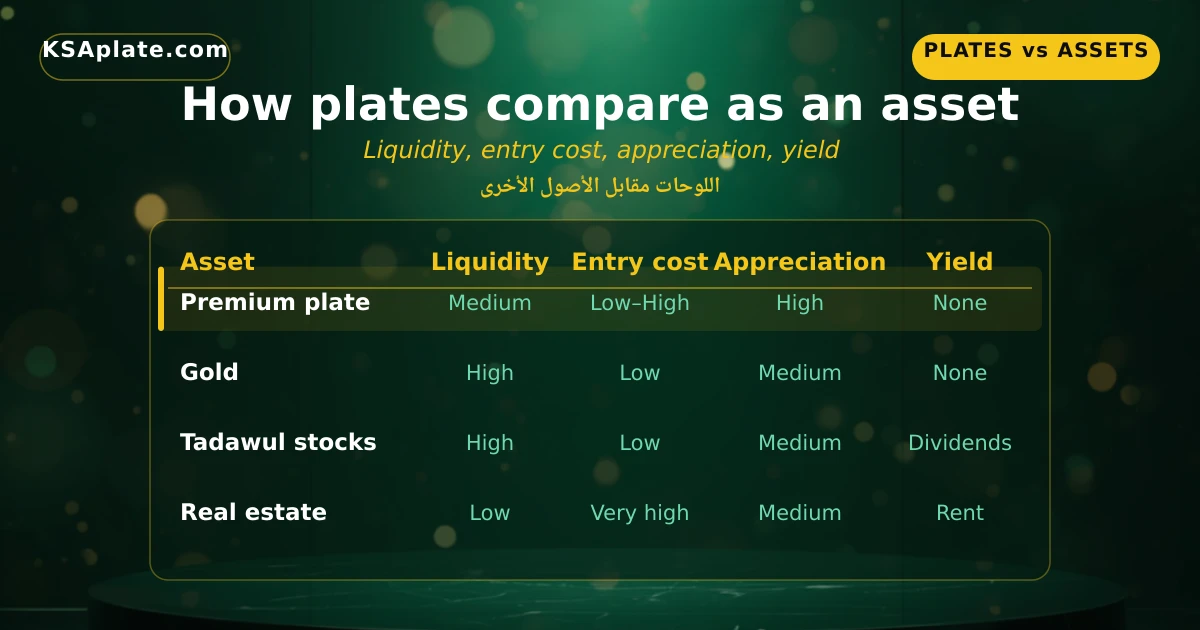
An investor's real question is not "do plates go up?" but "how does a plate compare with what else I could buy?" The table sets the four side by side on the attributes that matter.
| Attribute | Saudi plates | Gold | Tadawul stocks | Real estate |
|---|---|---|---|---|
| Liquidity | Low (tier-dependent) | Very high | High | Low |
| Entry cost | Low to very high | Very low | Very low | Very high |
| Appreciation potential | High (scarce tiers) | Moderate | Moderate–high | Moderate |
| Yield / income | None | None | Dividends | Rental income |
| Volatility | Low print, wide spread | Moderate | High | Low–moderate |
| Effort to manage | Low (once held) | Very low | Low | High |
| Prestige / use value | Very high | Low | None | High |
The honest read: a plate is a collectible, and it should be judged as one. It can outrun gold on appreciation in the scarce tiers and it carries a prestige and daily-use dividend no financial asset offers, but it is the least liquid of the four, pays no income, and prices on taste rather than a public quote. It is not a substitute for a diversified core of equities and property — it is a satellite holding that adds scarcity-driven upside and status to a portfolio whose foundation sits elsewhere.
Portfolio thinking and allocation
Treated sensibly, plates are an alternative-asset sleeve — the same bucket a disciplined investor uses for art, watches or classic cars. A few principles keep the allocation rational.
- Size it as a satellite, not the core. A common frame is to keep collectibles as a modest slice of investable wealth — enough to matter if it appreciates, small enough that illiquidity never forces a bad sale. Never put money you may need soon into a plate.
- Diversify across tiers, not just within one. A collection budget spread across one blue-chip single digit, two or three strong two-digit repeats, and a few pattern-rich three-digit plates balances upside against liquidity better than one all-or-nothing trophy purchase.
- Quality over quantity. One correctly-bought scarce plate will out-appreciate a garage full of random four-digit plates. Concentrate the budget in the tiers that actually move.
- Keep dry powder. The best entries appear when a motivated seller lists a strong plate below comparable — you can only act if capital is ready.
The investor buyer vs the user buyer
The same listing wall serves two very different buyers, and confusing them is the most common way plate money is lost.
A user buyer wants a plate they personally love — their birth year, their initials, a number that feels lucky. Fit matters more than resale, and they will happily pay a personal-fit premium for the exact plate that speaks to them. That is a perfectly good reason to buy; it just is not investing.
An investor buyer is indifferent to personal meaning and ruthless about scarcity, pattern, letter strength, and the gap between price and fair value. They buy the plate the market will re-rate, not the plate they would enjoy — often the strong-letter single digit or the mispriced palindrome, rarely the sentimental birth-year plate. They plan the exit at the moment of entry, size the position deliberately, and let dozens of listings pass to buy one correctly. If you want plates to build wealth rather than express taste, buy like the investor, not the user.
How to start investing on KSAplate
A disciplined first campaign looks like this:
- Set a budget you can lock away for years. Decide the total allocation up front and treat it as illiquid capital, not savings.
- Learn the ladder cold. Internalise the digit-count price ladder and the numerology multipliers so you can value any plate in seconds — start with the complete guide and numerology guide.
- Filter for scarcity. On KSAplate's single-digit listings and the two- and three-digit tiers, ignore the four- and five-digit working stock entirely.
- Value before you offer. Run each candidate through the KSAplate value calculator and against recent comparables using the plate check method. Only pursue plates listed below fair value.
- Verify title and transfer. Insist on a formal Absher ownership transfer; walk away from any deal that avoids it.
- Buy quality, then wait. Acquire one or two strong plates rather than many weak ones, and hold through the cycle until appreciation clears the spread.
- Plan the exit. Know your target price and your minimum, list early and widely when the cycle is strong, and use the flat free listing to protect your net return.
Start with the tiers that actually appreciate
The investment case lives in the scarce end of the market. Browse the single-digit trophy tier and the strong two- and three-digit plates on KSAplate, value them with the free calculator, and list your own for free when it is time to exit.
Browse single-digit plates Value a plate free
Frequently asked questions
Do Saudi license plates actually appreciate in value?
Are Saudi plates a better investment than gold?
Which Saudi plate is the best investment?
Can expats invest in Saudi license plates?
How liquid are premium Saudi plates?
What return can I expect from a Saudi plate investment?
What does the "3 · ن" sale at SAR 103,000 tell an investor?
What are the biggest risks of investing in plates?
How much of my portfolio should be in plates?
Are plates better than Tadawul stocks?
How long should I hold a Saudi plate to profit?
What is the cheapest way to buy and sell plates as an investor?
Where do I find undervalued plates to invest in?
Reviewed by Khalid Al-Rashid, Saudi License Plate Market Analyst.
Sources: Ministry of Interior (Saudi private plate numbering system and letter set), Absher (ownership-transfer conventions and eligibility), public Saudi auction records for the sold-price examples (including the "3 · ن" SAR 103,000 and "8 · د" SAR 104,000 sales), and KSAplate marketplace data for tier ranges and the flat free listing model. All prices are indicative and illustrative, not guarantees — plates are illiquid, taste-driven assets; confirm current comparable sales and Absher transfer rules before buying or selling.