
TL;DR:
- A Saudi license plate check means looking up everything the plate and its vehicle can officially tell you — market value, traffic fines, registration (Istimara) status, inspection and insurance, and vehicle history.
- Use the right tool for each check: Absher and the Tam app for fines, registration and transfers; Mojaz for vehicle history; Najm for accident records; and a plate value calculator for what the plate is worth.
- You cannot look up who owns a car from its plate number. Owner identity and personal details are private — only authorities can access them.
- Before buying a distinctive plate, check its value, confirm it's free of fines and clear to transfer, and verify the seller — never pay before the record is clean.
- The fastest first check is value: score any number-and-letter combination instantly, then decide whether to buy, sell, or keep looking.
Quick answer: To check a Saudi license plate, decide what you actually need to know. For a plate's market value, use a plate value calculator. For traffic fines, registration status and transfers, use Absher or the Tam app. For vehicle history (mileage, accidents, finance lien), use a Mojaz report, with Najm for accident records. You cannot find an owner's identity from a plate number — that information is private and restricted to the authorities.
What a "license plate check" actually means
"Checking a Saudi license plate" isn't a single action — it's a handful of different lookups that people lump under one phrase. Depending on why you're asking, a plate check can mean valuing the plate, seeing its fines, confirming the car's registration is valid, pulling the vehicle's history, or making sure a plate is clean before money changes hands.
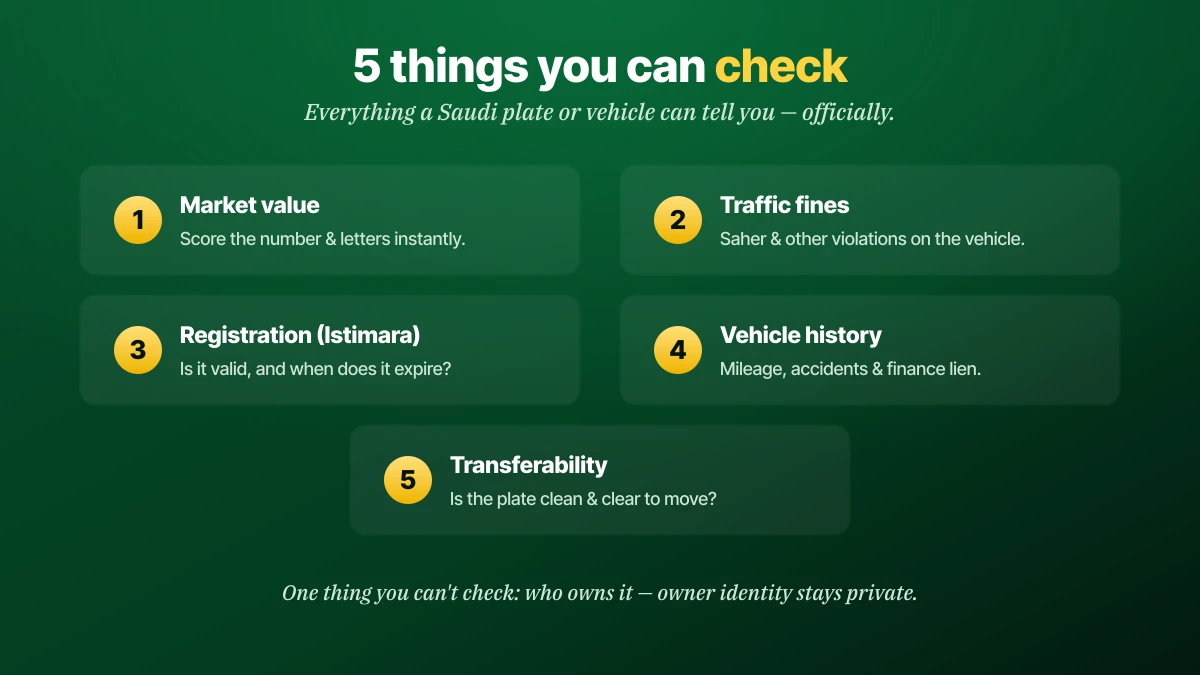
There are five checks that cover almost every real need:
- Value — what the plate's number-and-letter combination is worth on the market.
- Fines — outstanding Saher and other traffic violations on the vehicle.
- Registration — whether the Istimara (vehicle registration) is valid and when it expires.
- History — the vehicle's mileage, accident record and any finance lien.
- Transferability — whether the plate is clean and clear to move to a new owner.
The one thing you can't do is look up a person from a plate. We'll come back to that, because it's the most common misconception. First, the check most people actually want.
Check a plate's value
If you're dealing with a distinctive plate — a short number, a repeating pattern, or a meaningful letter set — the first and most useful check is what it's worth. In Saudi Arabia a plate is a tradable asset, and its value is set entirely by its combination, not by the car it sits on.
The fastest way to check value is a calculator built for it. Enter the numbers and letters (in Arabic or Latin) and you get an instant estimate based on the factors the market actually uses: digit count, number pattern, the letters, cultural meaning and demand. Try it on the free plate value calculator, or read how to calculate your plate's value to understand the method behind the score.
Value is the check to run first. It tells you whether a plate is a few-thousand-riyal number or a six-figure one — before you spend another minute on it.
Once you know a figure, you can act: browse the marketplace to compare similar plates, or list a plate you already own at a price grounded in real data.
Check traffic fines
The most common official check is for traffic fines. Unpaid Saher (speed-camera) and other violations sit against the vehicle, and they matter because outstanding fines can block a registration renewal or an ownership transfer.
You check fines through Absher or the Tam app, where violations are linked to your vehicle and ID. The lookup shows each fine, its amount, and its status, and you can usually pay in the same flow — often with an early-payment discount. If you're buying a used car, checking its fines first is essential, because once it's in your name, the liability follows the vehicle. Our full guide on how to check and pay traffic fines covers the discount, appeals and the whole process.
What's your plate worth?
Get an instant, free estimate with our plate value calculator.
Calculate My Plate's ValueCheck registration (Istimara) status
A registration check tells you whether the vehicle's Istimara is valid and when it expires. This is the document that proves the car is legally registered, and an expired one means the vehicle can't be driven legally — and any plate authorization or transfer is affected.
Through Absher or Tam you can see the registration status tied to a vehicle, including its expiry date and whether anything (like unpaid fines or a failed inspection) is blocking renewal. A valid Istimara also depends on a current periodic inspection (Fahes) and valid insurance, so a registration check is really a quick health check on the whole car. If the registration is close to expiry, our guide to renewing your Istimara walks through it, and the Fahes inspection guide and car insurance guide cover the two things it depends on.
Check vehicle history
If the plate is attached to a car you're thinking of buying, the deepest check is the vehicle history. This is where you confirm the car is what the seller says it is — and it's separate from the plate's value entirely.
A Mojaz report is the standard vehicle-history check in Saudi Arabia. It pulls together the car's recorded mileage, accident history and finance status, so you can spot a clocked odometer, an undisclosed crash, or a car still under a finance lien. For accidents specifically, Najm holds the insurance-claim and accident records. The full process — finding the VIN, reading the mileage and accident record, and what a report won't tell you — is in our guide to a car history check in Saudi Arabia.
A plate check and a car check are two different things. The plate tells you value; the Mojaz report tells you whether the car behind it is sound.
Check that a plate is clear to transfer
Before you buy a plate, you need to know it can actually move to your name. A plate is "clear to transfer" when the vehicle it's on has no blocking issues — no unpaid fines, a valid registration, and no finance lien or legal hold preventing the transfer.
This check combines the others: confirm fines are zero, the Istimara is valid, and there's no lien on the vehicle. Ownership then moves online through Absher, where the seller initiates the transfer and the buyer accepts. Because the transfer is electronic and the record updates instantly, the golden rule is simple — payment clears first, transfer second. Our step-by-step guide to transferring a license plate via Absher covers the mechanics, and how to verify a plate before buying covers the pre-purchase due diligence in detail.
Can you check who owns a plate?
This is the question people most often expect a "plate check" to answer — and the honest answer is no. You cannot look up the owner of a car from its plate number. Owner identity, phone number, address and ID details are private personal data, and access is restricted to the relevant authorities for law-enforcement and official purposes.
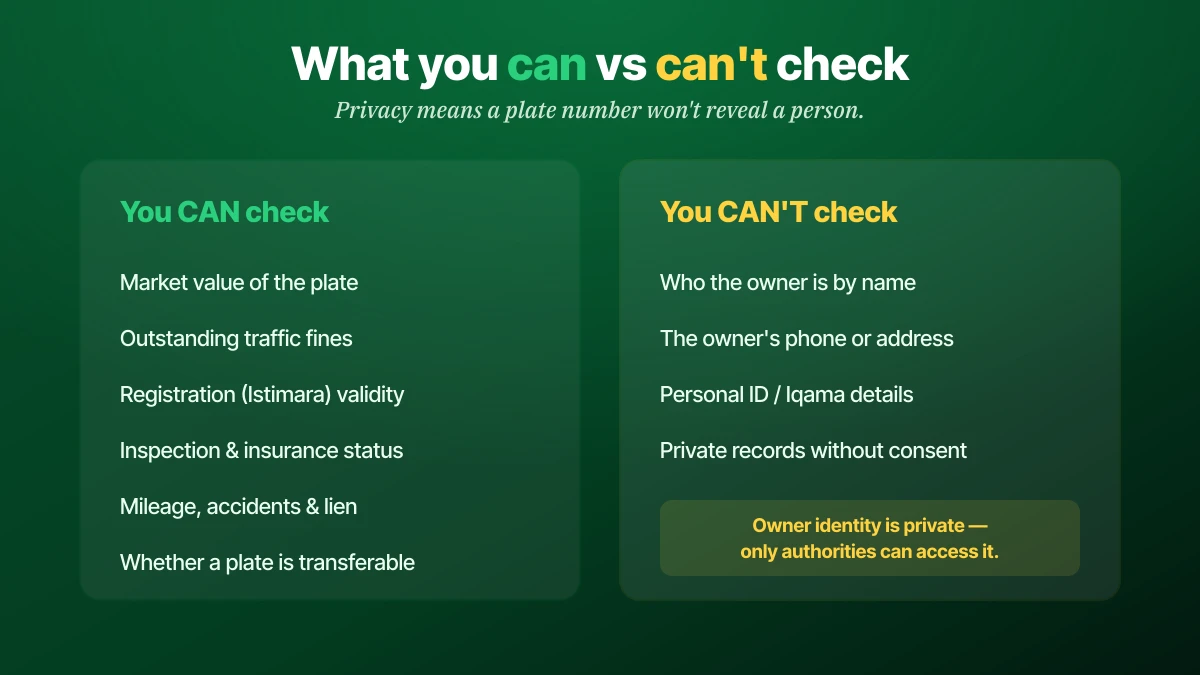
This protects everyone, including you. It means a stranger can't pull your personal details from your plate, and it's why legitimate plate trading happens through accounts and verified channels rather than a public owner database. Since October 2025 Absher has offered a way to reach an owner without learning their identity — see our guide to contacting a car owner by plate number for the four request types and which situation each one fits. If you have a genuine reason that involves another person's vehicle — an accident, for example — the correct route is through the authorities (such as filing with Najm after a collision), not an informal lookup. So when you see a service promising to "find the owner by plate number," treat it as a red flag: it can't legally deliver that in Saudi Arabia.
Which tool checks what
Because each check lives in a different place, knowing the right channel saves time. Here's the official tool for each kind of plate check.
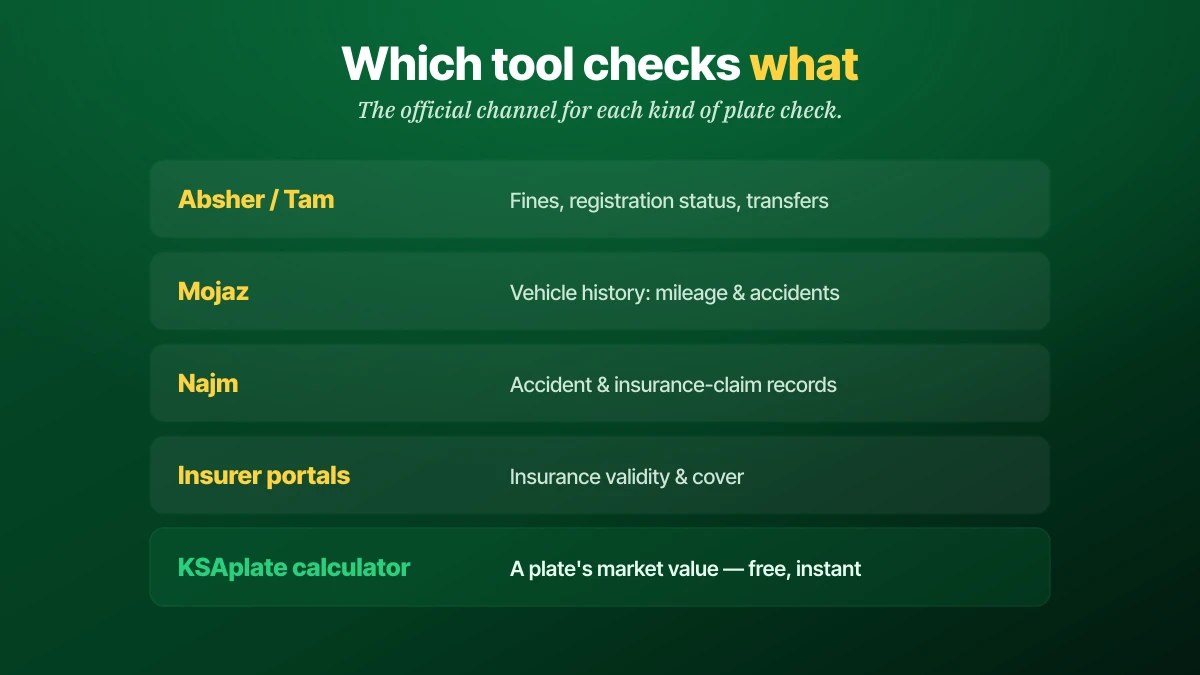
| You want to check… | Use | What it shows |
|---|---|---|
| Market value of a plate | Plate value calculator | Estimated worth of the combination |
| Traffic fines | Absher / Tam | Violations, amounts, payment |
| Registration (Istimara) | Absher / Tam | Status, expiry, blocks |
| Vehicle history | Mojaz | Mileage, accidents, finance lien |
| Accident records | Najm | Insurance-claim & accident data |
| Insurance validity | Insurer portals | Active cover and dates |
| Owner identity | — | Not available (private) |
For most buyers and owners, the practical sequence is: value the plate first (calculator), then run the official checks on Absher/Tam and Mojaz if a real vehicle is involved. You rarely need all of them — match the check to the question.
Checks to run before you buy
If your plate check is part of buying a distinctive plate, run this short checklist in order. Each step protects the money you're about to spend.
- Value it. Score the combination on the calculator so you know fair market price before you negotiate.
- Check the fines. Confirm the vehicle has no unpaid violations that could block the transfer.
- Confirm the registration. The Istimara should be valid, with inspection and insurance current.
- Confirm it's transferable. No finance lien or legal hold on the vehicle.
- Verify the seller. Confirm ownership on the istimara, agree terms in writing, and pay only through a traceable method.
- Transfer on Absher — after payment clears. Never move the plate on a promise.
This is exactly the discipline our guides on buying a Saudi plate and buying and selling safely are built around. Do the checks first, and the purchase itself is the easy part.
Mistakes & scams to avoid
Most check-related problems come from skipping a step or trusting the wrong source. Avoid these and you'll stay protected.
- Believing an "owner lookup by plate" service. It can't legally provide owner identity in Saudi Arabia — it's either useless or a scam fishing for your data.
- Skipping the fines check before buying a car. Outstanding violations follow the vehicle to you once it's in your name.
- Checking value but not transferability. A great price means nothing if the plate can't legally move yet.
- Paying before the transfer. The single most expensive mistake — always let payment clear first.
- Trusting a screenshot. Verify status live in Absher/Tam yourself rather than accepting a seller's image.
- Confusing the plate with the car. Value the plate, but run a Mojaz history check on the vehicle separately.
Frequently asked questions
How do I check a Saudi license plate?
Can I find out who owns a car by its plate number in Saudi Arabia?
Does a plate check reveal outstanding fines?
How do I check if a car's registration (Istimara) is valid?
How do I check a plate's value?
How do I check a vehicle's history before buying?
Is checking a plate or vehicle free?
What does it mean for a plate to be "clear to transfer"?
Can I check a plate before I own the car?
Conclusion & next steps
A Saudi license plate check is really five checks in one phrase: value, fines, registration, history and transferability — each with its own official tool. Use a calculator for value, Absher or Tam for fines and registration, and Mojaz with Najm for the vehicle's history. Remember the one thing no check can give you: the owner's identity is private, and any service promising it is one to avoid. Whether you're buying, selling, or just curious what a number is worth, start with the fastest and most useful check of all — score any combination on the free plate value calculator, then browse the marketplace or list your plate. For the complete picture of how the market works, see our guide to Saudi license plates.