
Last updated: 11 August 2026
The vehicle sequence number in Saudi Arabia is a 10-digit code that links your car to its registration file at the General Directorate of Traffic (Moroor). You find it on your Istimara (vehicle registration card) or inside Absher, and you need it for insurance, registration renewal, and any ownership or plate transfer. It is not your plate number and not your chassis/VIN — it is the number the traffic system uses to identify your specific registration.
Most people only go looking for the sequence number at the worst moment: mid-way through buying insurance or transferring a car, when a form suddenly demands it. Two minutes now saves that scramble later.
TL;DR
- What it is: a 10-digit number (الرقم التسلسلي) that ties your vehicle to its Saudi registration file at Moroor — the ID traffic services use, not the number on the plate.
- Where to find it: printed on the Istimara card, and inside Absher under Vehicles → Renew Vehicle Registration → your car → more details.
- What it is for: buying or renewing car insurance, renewing the Istimara, transferring ownership, and moving a distinctive plate between vehicles.
- The 10-digit rule: if your Istimara shows 8 or 9 digits, add leading zeros to make exactly 10 before entering it.
- Not the same as VIN or plate: the VIN identifies the car from the factory, the plate identifies it on the road, and the sequence number identifies its Saudi registration.
Quick answer
The vehicle sequence number is the 10-digit identifier the Saudi traffic system uses to locate your car's registration file. It lives on your Istimara and in Absher, and it appears on almost every official form tied to your car — insurance, renewal, fines, and transfers. If a service asks for your "sequence number," "الرقم التسلسلي," or "VSN," they all mean the same 10-digit code. Find it once, save it in your phone, and every future transaction gets faster.
Transferring or selling around this? Start here
If you are looking up the sequence number to move a plate or sell a car, price the plate first — our free calculator scores it in seconds, and listing takes minutes.
Value my plate free Read the transfer guide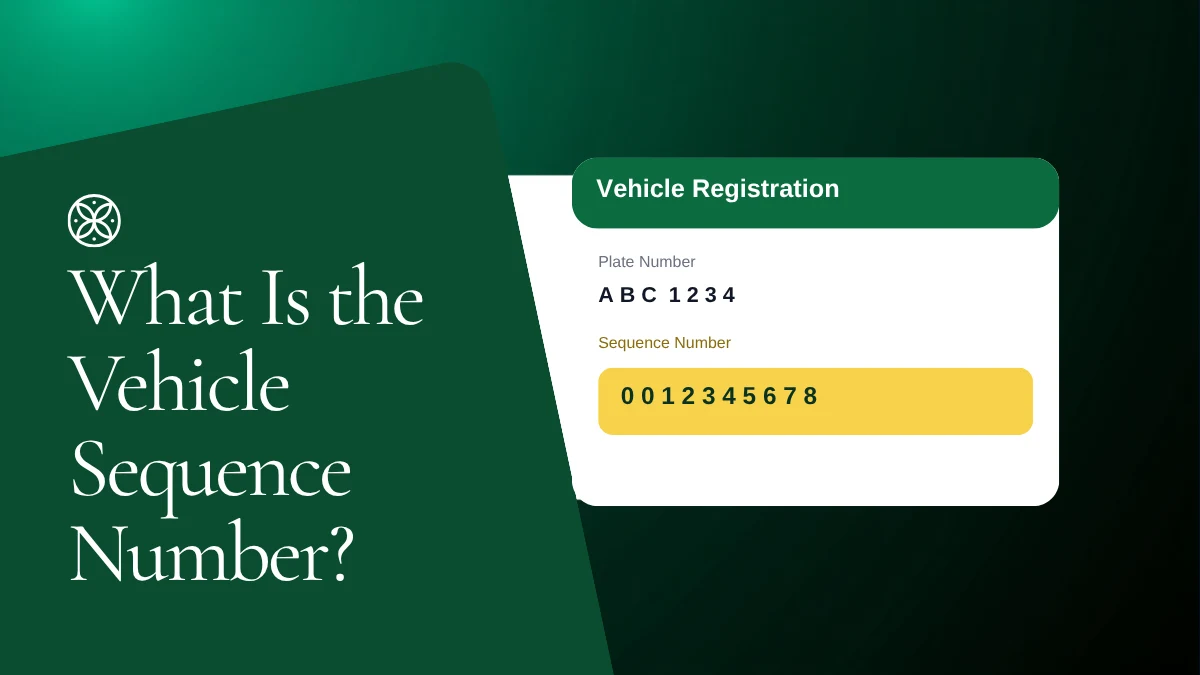
What the vehicle sequence number is
A vehicle sequence number is a unique 10-digit code that connects a car to its registration record at the General Directorate of Traffic. It exists so that the traffic system, Absher, insurers, and Moroor offices can pull up one exact vehicle without relying on the plate, which can change, or the VIN, which is a manufacturer code.
Think of it as the account number for your car's paperwork. Your plate is what the public sees; your VIN is stamped by the factory; your sequence number is how the Kingdom's systems file and find your registration. Because ownership, insurance, and plate transfers all touch that registration file, the sequence number is the key that opens it.
The plate is the face of the car. The VIN is its birth certificate. The sequence number is its file reference inside the Saudi system.
For example, when you sell a car and the buyer transfers ownership through Absher, the system does not search by plate design — it works from the sequence number that identifies the registration being handed over. Our guide to reading a Saudi license plate covers the plate side of this; the sequence number is the registration side.
Key takeaway: the sequence number identifies your registration file, not your plate or your car's body — which is exactly why official forms keep asking for it.
What's your car worth?
Get a free instant estimate based on real Saudi market data — then sell it on KSAplate with direct WhatsApp contact.
Value My Car — FreeFind it on your Istimara
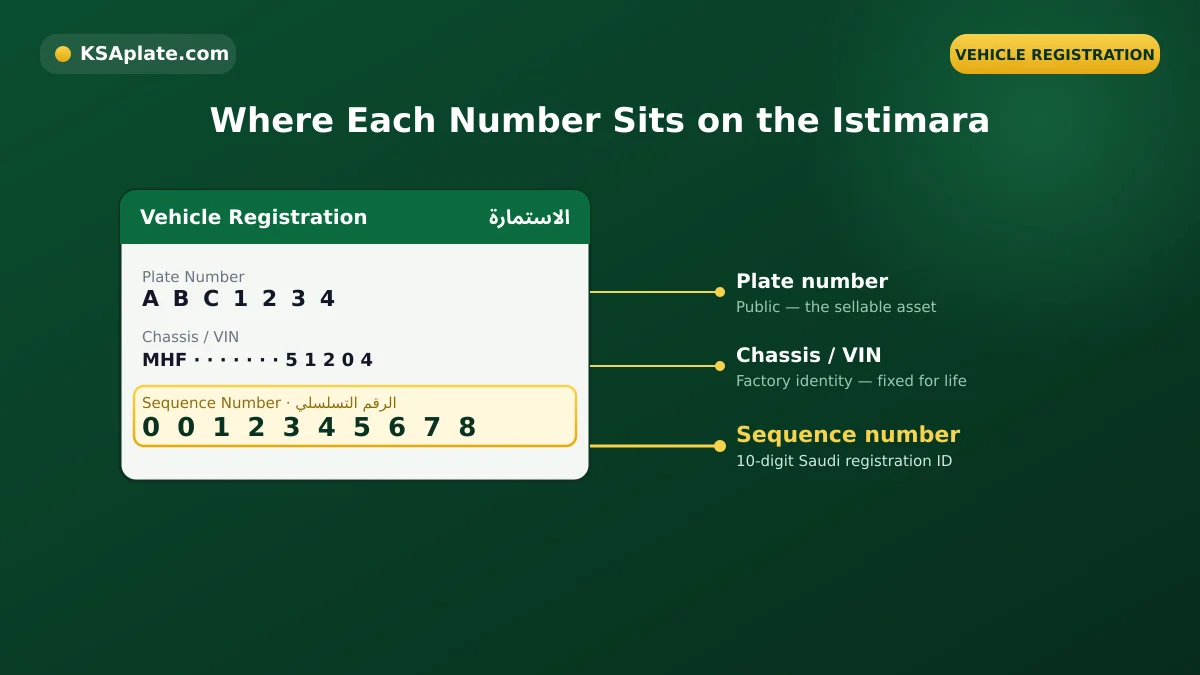
The Istimara is the Saudi vehicle registration card, and it is the fastest place to read your sequence number. On the card, the number is labelled "Sequence Number" in English and "الرقم التسلسلي" in Arabic, usually grouped with the other registration details rather than with the plate.
Hold the card and look past the obvious fields. The plate letters and numbers sit together; the chassis/VIN is a long 17-character string; the sequence number is a clean run of digits (up to 10) tied to the registration. If your card is bilingual, match the Arabic "الرقم التسلسلي" to be certain you are reading the right field and not the plate or the ID number.
For example, drivers often photograph the front of the Istimara and zoom in later when a form asks for the number — a habit worth building, because the physical card is the one source that never needs a login. If your registration is due, our guide to renewing the Istimara walks through the full process.
Key takeaway: on the Istimara, match the Arabic label "الرقم التسلسلي" to read the correct 10-digit field with confidence.
Find it in Absher
Absher is the Saudi government's digital services platform, and it holds your sequence number even when the card is not in hand. The number sits inside your vehicle's details, a few taps from the home screen, and it is the reliable backup when the Istimara is locked in the glovebox or lost.
Here is the path most owners use:
- Log in to your Absher Individuals account.
- Open Services, then the Vehicles section.
- Choose Renew Vehicle Registration (you do not have to complete a renewal to view details).
- Select the car you want, then tap more details.
- Read the sequence number under the vehicle details.
For example, expats who bought a used car often verify the sequence number in Absher right after transfer to confirm the registration moved to their name. The official platform is absher.sa, operated under the Ministry of Interior.
Key takeaway: Absher → Vehicles → Renew Vehicle Registration → your car → more details shows the sequence number without the physical card.
Sequence number vs VIN vs plate number
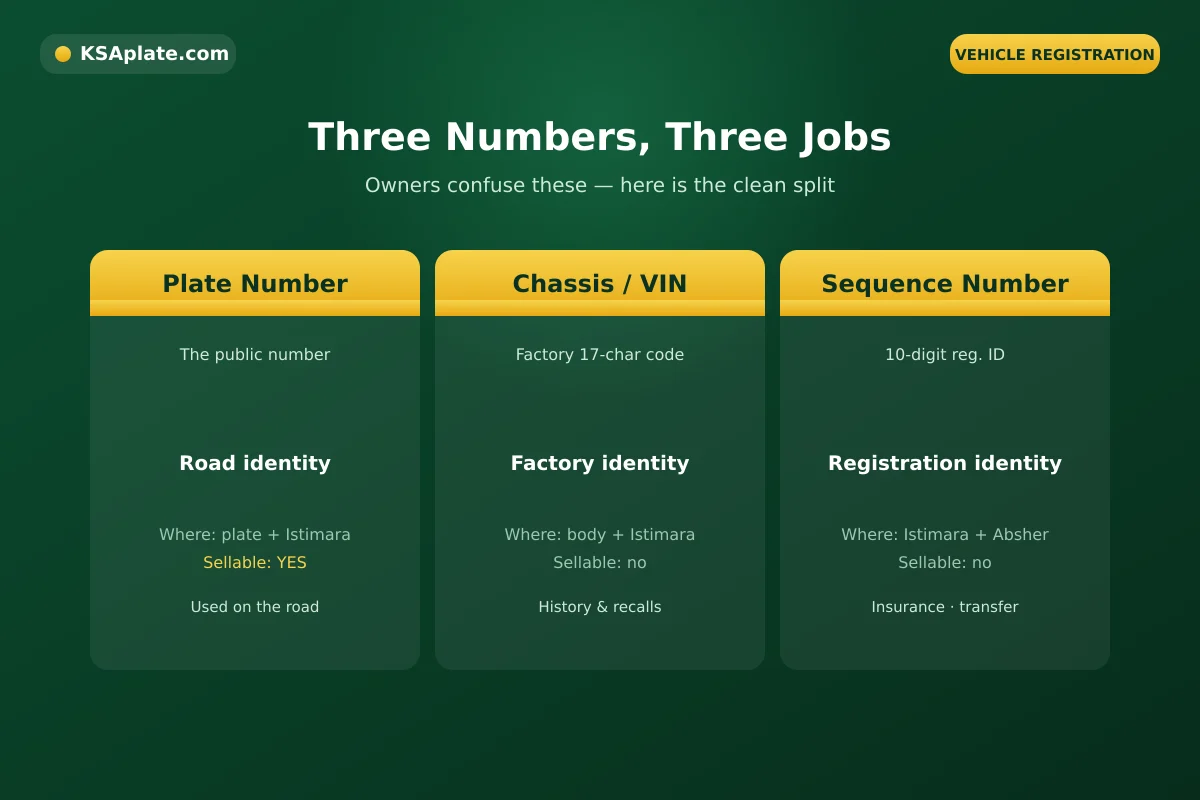
The sequence number, the VIN, and the plate number are three different identifiers that owners routinely confuse. Each answers a different question about the car, and using the wrong one is the most common reason an insurance or transfer form rejects your entry.
Here is the clean separation: the plate number identifies the car visually on the road, the chassis number (VIN) identifies the vehicle as built by the manufacturer, and the sequence number links the vehicle to its Saudi registration and traffic services. Only the plate is a transferable, sellable asset — the other two are fixed to the car and its file.
| Identifier | What it is | Where to find it | Used for | Transferable? |
|---|---|---|---|---|
| Plate number | The public number on the car (e.g. ABC 1234) | The plate; the Istimara | Identifying the car on the road; a distinctive plate is a saleable asset | Yes — can be sold or moved |
| Chassis / VIN | 17-character factory code | Windshield, door jamb, Istimara | Manufacturer identity, recalls, history checks | No — fixed to the car |
| Sequence number | 10-digit Saudi registration ID | Istimara; Absher vehicle details | Insurance, renewal, ownership and plate transfer | No — tied to the registration file |
For example, if you are running a pre-purchase check, the VIN drives the car history check while the sequence number drives the ownership and insurance steps. Confusing the two sends you to the wrong service. Our plate verification guide keeps the plate side separate from both.
Key takeaway: plate = road identity, VIN = factory identity, sequence number = Saudi registration identity — and only the plate can be sold.
Where you will actually need it
The sequence number is a background number until a transaction forces it into the foreground. Knowing exactly which moments require it means you can have it ready instead of pausing a form to dig through Absher.
It becomes essential during practical steps: buying or renewing car insurance, renewing the Istimara, transferring ownership of a used car, and moving a distinctive plate between vehicles. Some fine-payment and verification screens also accept it. The table below maps the common transactions.
| Transaction | Sequence number needed? | Also needed |
|---|---|---|
| Buy or renew car insurance | Yes | Iqama/ID, sometimes VIN |
| Renew Istimara (registration) | Yes | Valid insurance, passed Fahes |
| Transfer car ownership | Yes | Both parties' Absher, insurance |
| Transfer a plate between cars | Yes | Sequence numbers of both vehicles |
| Check or pay traffic fines | Sometimes | Plate number or ID often enough |
For example, buying insurance is where most people first hit the wall, because the quote form will not proceed without the number. If you are at the ownership-transfer stage, our guide to transferring car ownership and the car insurance guide show where the number slots in.
Key takeaway: insurance, Istimara renewal, ownership transfer, and plate transfer all require the sequence number — save it before you start any of them.
Selling the plate, not just the car?
A distinctive plate is a separate asset you can keep or sell. Check what yours is worth, then list it to active Saudi buyers for free — no commission.
Check my plate value List my plateThe 10-digit rule and common errors
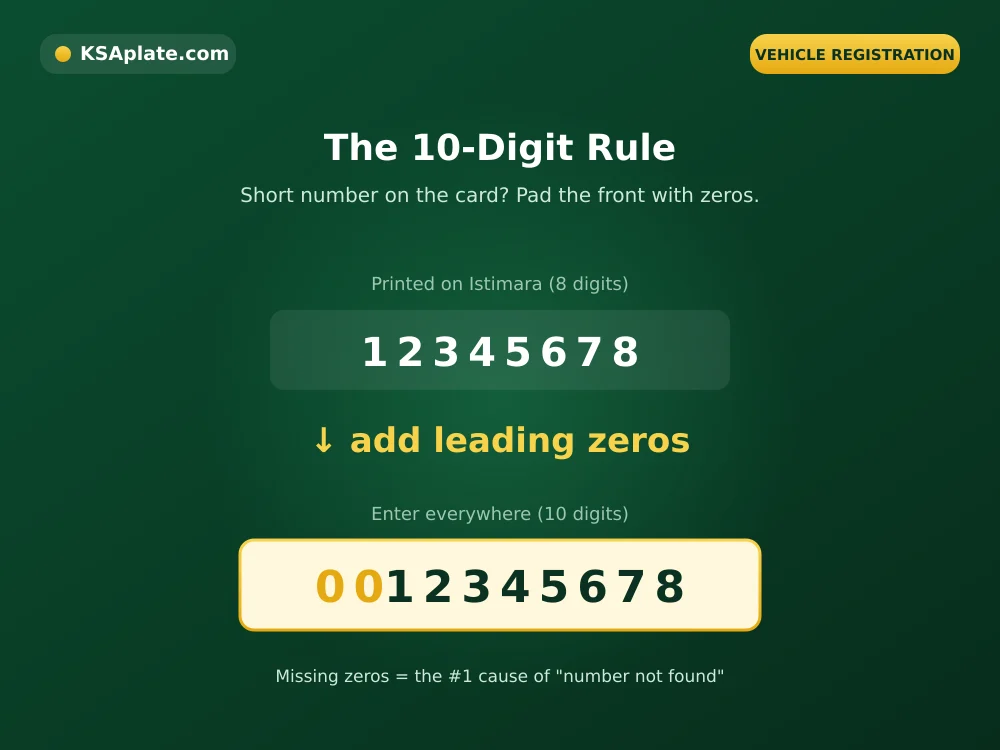
The sequence number is always 10 digits, even when the printed version looks shorter. If your Istimara shows an 8 or 9-digit number, the rule is simple: add leading zeros until it is exactly 10 digits before you enter it anywhere.
This trips up thousands of drivers. A card printed with "12345678" is entered as "0012345678" on an insurance or Absher form. Leaving off the zeros is the single most common reason a valid number gets rejected as "not found." The digits are correct — the length is not.
If a form rejects your sequence number, count the digits before you doubt the number. Nine times out of ten, you are one or two leading zeros short of ten.
For example, an owner whose card reads "987654321" (nine digits) should enter "0987654321." Same number, correct length, instant acceptance. When in doubt, the Absher vehicle-details screen shows the full padded value.
Key takeaway: pad any short sequence number with leading zeros to a full 10 digits — the most frequent fix for a rejected entry.
New and unregistered cars
A brand-new car that has not been registered yet does not have a sequence number. The number is assigned when the vehicle is registered with Moroor, so during the gap between purchase and registration there is nothing on file to enter.
In that window, buyers of new, unregistered cars use the customs card number in place of the sequence number for early steps such as arranging initial insurance. Once the car is registered and the Istimara is issued, the 10-digit sequence number appears and replaces the customs card reference for all future transactions.
For example, someone collecting a new car from the showroom may buy a short initial insurance policy using the customs card, then update to the sequence number after registration. If you are buying used instead, the number already exists — see our used-car buying guide for the full handover checklist.
Key takeaway: no registration means no sequence number yet — new-car buyers use the customs card number until the Istimara is issued.
How it connects to selling a plate or car
The sequence number is the registration handle that makes a clean plate or car transfer possible. Because a distinctive plate can be sold and moved separately from the car, both the source and destination vehicles are identified by their sequence numbers during the transfer.
This is where the three identifiers meet. You sell the plate — the asset — while the sequence numbers of the two cars tell Absher which registration loses the plate and which one receives it. Keeping these straight is what turns a plate sale into a smooth, same-week transfer rather than a stalled one.
For example, a seller listing a premium plate on KSAplate will complete the handover through Absher, where the buyer's vehicle sequence number receives the plate. Our plate transfer guide and plate check guide cover both ends of that move.
Key takeaway: in a plate transfer, the plate is the asset and the sequence numbers are the addresses — you need both to move it cleanly.
Frequently asked questions
What is the vehicle sequence number in Saudi Arabia?
Where do I find my vehicle sequence number?
Is the sequence number the same as the plate number?
Why does my sequence number have only 8 or 9 digits?
Do I need the sequence number to buy car insurance?
Is the sequence number the same as the chassis number or VIN?
Can I find the sequence number without logging into Absher?
Does transferring a license plate use the sequence number?
The bottom line
The vehicle sequence number is your car's registration ID in the Saudi system — a 10-digit code on your Istimara and in Absher that insurance, renewal, and transfer forms all rely on. Keep it distinct from your plate number and your VIN, pad it to a full ten digits, and save it once so it is ready every time. If the reason you looked it up is a plate you plan to move or sell, the next step is knowing what that plate is worth.
Turn a plate you own into an offer
Value it free in seconds, then list it to active Saudi buyers for free — no commission when it sells.
Value my plate List for freeLast updated: 11 August 2026. Written and reviewed by Khalid Al-Rashid, Saudi License Plate Market Analyst, drawing on the Absher vehicle services flow and current Istimara card layout.
Sources: General Directorate of Traffic / Absher (absher.sa), Ministry of Interior (moi.gov.sa). Steps and field labels reflect the current Absher and Istimara layout; confirm the exact screen in your own Absher account, as government interfaces update over time.