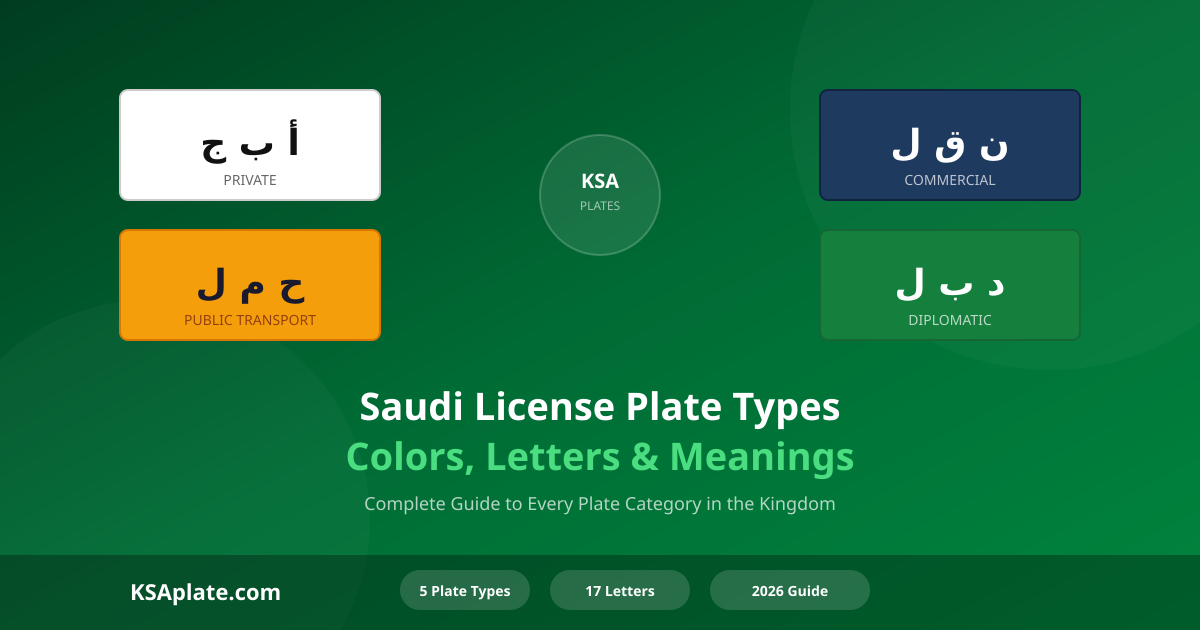
Every vehicle on Saudi roads carries a license plate — but not all plates are created equal. The Kingdom of Saudi Arabia uses a color-coded, dual-script plate system that instantly identifies a vehicle’s purpose, owner type, and registration category. Whether you are an expat seeing Saudi plates for the first time, a new car buyer, or a collector hunting for VIP plates, understanding how the system works is essential.
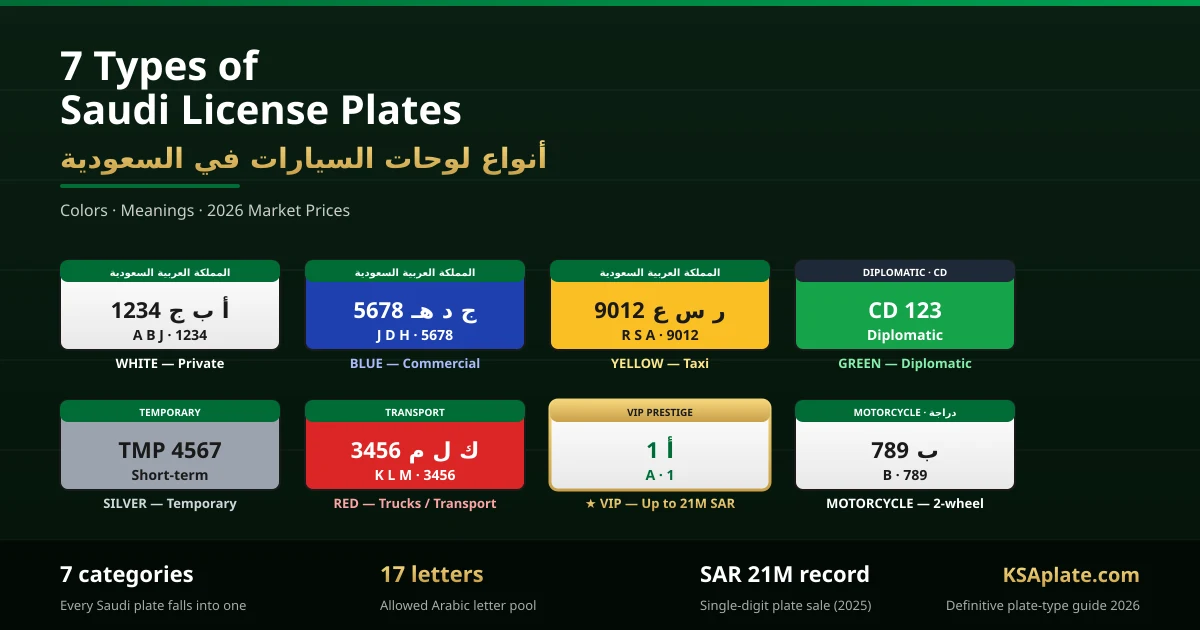
In this comprehensive guide, we break down every Saudi plate type by color, explain the 17 permitted Arabic letters and their Latin equivalents, cover recent changes including the 2025 sports car plates, and show you what makes a plate "distinctive" — and potentially worth millions of Riyals.
دليل شامل لجميع أنواع لوحات السيارات في المملكة العربية السعودية — الألوان، الحروف، الأنواع، وما الذي يجعل لوحتك مميزة أو عادية. تعرف على النظام الكامل للوحات السعودية.
How Saudi License Plates Work: The Dual-Script System
Saudi Arabia adopted its current plate format in 2007, replacing the older single-script system. Every standard Saudi plate now features two rows of text in a structured layout:
- Top row: Arabic numerals (Eastern Arabic digits ١٢٣٤) and Arabic letters
- Bottom row: Western Arabic numerals (1234) and Latin letter equivalents
- Center: The Saudi national emblem (palm tree and crossed swords) with "KSA" and "السعودية"
This dual-script design ensures plates are readable by both Arabic-speaking residents and international visitors. The format consists of up to 3 Arabic letters + up to 4 digits, creating millions of possible combinations — though certain combinations are far more valuable than others. Curious about your own plate’s value? Try the free plate value calculator.
Standard Saudi license plate layout — dual-script with Arabic and Latin characters
The 17 Permitted Arabic Letters
Not all 28 Arabic alphabet letters appear on Saudi plates. The General Directorate of Traffic permits only 17 letters that have clear, unambiguous Latin equivalents. This prevents forgery and ensures international readability at border crossings and toll gates.
The excluded letters are those that could be confused with other characters when read quickly at speed or across borders, or those without a clean single-letter Latin transliteration. For example, the letter ث (Tha) has no single-character Latin equivalent, and ش (Shin) could be confused with multiple Latin representations.
This restriction also creates scarcity. With only 17 letters and 4 digit positions, certain letter combinations that spell out names or words in Arabic become extremely valuable. Letters like م ل ك (spelling "King" — MLK) have sold for over SR 15 million.
Saudi Plate Types by Color: Complete Breakdown
The background color of a Saudi license plate tells you everything about the vehicle’s registration category. There are five main types currently in use across the Kingdom, each regulated by the General Directorate of Traffic under the Ministry of Interior.
White Plate — Private Vehicles
The white plate is by far the most common type on Saudi roads. It is issued to privately owned passenger vehicles — cars, SUVs, and light trucks registered to individual Saudi citizens or residents (Iqama holders). This is the plate type you see on everything from a daily-driven Toyota Camry to a Rolls-Royce Phantom.
White plates are also the type traded on the private market. When people buy and sell distinctive plates on KSAplate.com, they are almost always referring to white private plates. The value of a white plate depends entirely on its letter-number combination — a plate like أ 1 (A 1) is worth millions, while a random four-digit plate might be worth a few thousand Riyals. Use the plate value calculator to estimate yours.
- Background: White
- Text color: Black
- Issued to: Private passenger vehicles
- Tradeable: Yes — the most traded plate type in the Kingdom
Blue Plate — Commercial & Transport Vehicles
Blue plates are assigned to commercial vehicles used for transporting goods. This includes delivery trucks, cargo vehicles, and commercial vans registered to businesses or transport companies. If you see a blue plate on Saudi highways, it typically belongs to a logistics or freight operation.
Blue plates are not commonly traded on the private market since they are tied to commercial registrations. However, some low-digit commercial plates do carry premium value among fleet operators in major cities like Riyadh and Jeddah.
- Background: Dark blue
- Text color: White
- Issued to: Commercial cargo and transport vehicles
- Tradeable: Limited — mostly B2B transactions
Yellow Plate — Taxis & Public Transport
Yellow plates identify vehicles used for public transportation and taxi services. This includes traditional taxi cabs, airport shuttle services, and other licensed public transport vehicles. In Saudi Arabia, the taxi industry has evolved significantly with the rise of ride-hailing apps, but yellow plates remain the standard for traditionally licensed operators.
Note that ride-hailing vehicles (Uber, Careem) in Saudi Arabia typically operate under their regular white private plates with a separate commercial permit, rather than yellow plates. The yellow plate is specifically for dedicated taxi and public transport registrations.
- Background: Yellow / amber
- Text color: Black
- Issued to: Licensed taxis and public transport vehicles
- Tradeable: No — tied to taxi operating licenses
Green Plate — Diplomatic Vehicles
Green plates are reserved for diplomatic missions and consular staff accredited in Saudi Arabia. These plates typically carry a country code number rather than the standard letter-number format, and they grant certain privileges including diplomatic immunity from traffic enforcement in some cases.
You will most commonly see green plates in the Diplomatic Quarter (DQ) of Riyadh and near consulate buildings in Jeddah. These plates cannot be privately purchased or transferred under any circumstances.
- Background: Green
- Text color: White
- Issued to: Embassy and consular vehicles
- Tradeable: No — government-issued diplomatic registration only
Silver / Temporary Plate — Short-Term Registration
Silver or gray plates are issued as temporary registrations. These are used for newly purchased vehicles awaiting permanent registration, vehicles being transferred between owners, or cars that need to be driven to an inspection center (FAHS) for the first time. Temporary plates have an expiration date printed on them and must be replaced with a permanent plate of the appropriate color within the specified period.
- Background: Silver / light gray
- Text color: Dark gray or black
- Issued to: Vehicles in transit or awaiting permanent registration
- Tradeable: No — temporary by definition
What's your plate worth?
Get an instant, free estimate with our plate value calculator.
Calculate My Plate's ValueWhat Makes a Plate "Distinctive" in Saudi Arabia?
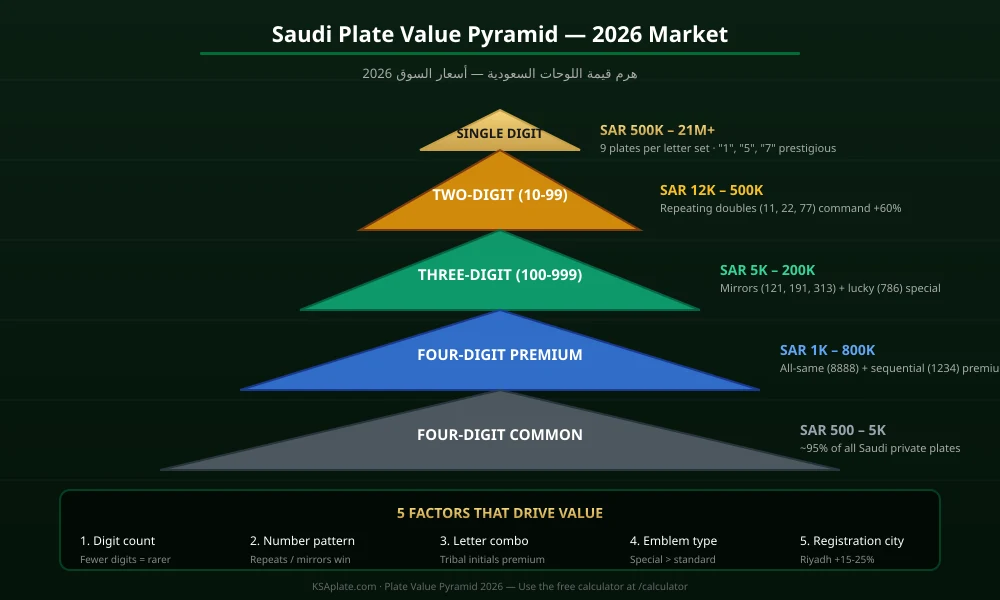
In Saudi culture, a distinctive plate (لوحة مميزة) is far more than a registration number — it is a statement of status, identity, and sometimes an investment asset. But what exactly separates a 5,000 SAR plate from a 5,000,000 SAR plate? Several key factors determine a plate’s desirability and market value.
The 5 Factors That Determine Plate Value
1. Digit Count — Single-digit plates (1-9) are the rarest and most expensive. Each additional digit reduces the value significantly. A one-digit plate can be worth 1000x more than a four-digit plate with the same letters.
2. Number Pattern — Repeating numbers (1111, 7777), palindromes (1221), and sequential numbers (1234) carry premiums. Lucky numbers like 7 have cultural significance in Saudi Arabia.
3. Letter Combination — Single-letter plates are ultra-rare. Triple same letters (ب ب ب) and combinations that spell Arabic words or names (like م ل ك meaning "King") command the highest prices.
4. Emblem Type — Standard plates carry the palm tree emblem, but rare "desert" and heritage emblem variants from older registrations can add significant value to a plate.
Want to know where your plate falls? The KSAplate Value Calculator analyzes all five factors instantly and gives you a free estimate based on current market data.
How to Buy a Distinctive Saudi Plate
There are two main channels for acquiring a distinctive license plate in Saudi Arabia:
1. Government ABSHER Auctions
The Saudi Traffic Department conducts regular electronic auctions through the ABSHER platform. These auctions release batches of distinctive plates to the public, with bidding open to any Saudi citizen or resident with a verified ABSHER account. Starting bids typically begin at SR 10,000 for the most basic distinctive plates, with premium single-digit plates starting much higher. Auctions run for a fixed period and the highest bidder wins.
2. Private Marketplace
The secondary market for Saudi plates is where most transactions happen. Owners who acquired plates — whether through auctions, inheritance, or initial vehicle registration — can sell them privately. Platforms like KSAplate.com connect buyers and sellers directly via WhatsApp, with transparent pricing and direct seller contact. Browse all available plates or filter by city, price range, and digit count.
Frequently Asked Questions
How many letters are on a Saudi plate?
A Saudi license plate can have 1, 2, or 3 Arabic letters. Each letter has a corresponding Latin equivalent displayed on the bottom row. Plates with fewer letters (especially single-letter plates) are significantly rarer and more valuable.
Can expats own distinctive plates in Saudi Arabia?
Yes. Any resident with a valid Iqama and a registered vehicle can own and transfer distinctive plates through ABSHER. Expats can also participate in government plate auctions. The plate is tied to the vehicle registration (Istimara), and ownership transfers when the plate is officially reassigned.
What is the difference between standard and distinctive plates?
Physically, there is no difference — both use the same white plate with black text format. The distinction is in the number-letter combination. "Distinctive" is an unofficial market term for plates with desirable patterns: low digits, meaningful letters, or rare combinations. The plate calculator can tell you if your plate qualifies as distinctive.
Why are some Arabic letters not used on Saudi plates?
The General Directorate of Traffic selected 17 letters that each have a single, clear Latin equivalent. This prevents confusion at border crossings, ensures compatibility with international license plate recognition systems, and reduces the risk of forgery through letter similarity.
How do I check what my Saudi plate is worth?
The fastest way is to use the KSAplate Value Calculator. Enter your plate letters and number, and the algorithm analyzes digit count, letter rarity, number patterns, and market demand to produce an instant free estimate. For a deeper understanding of the valuation methodology, read our complete guide to plate value calculation.
Understanding Saudi plate types is the first step to navigating the Kingdom’s vibrant plate market. Whether you are looking to buy your first distinctive plate, sell one you already own, or simply decode the plates you see on the road every day — you now have the complete picture.
Ready to explore? Browse all plates for sale, calculate your plate’s value, or list your own plate for free on KSAplate.com — Saudi Arabia’s first and only dedicated plate marketplace.