
Last updated: 28 August 2026
TL;DR:
- Istimara (استمارة) is the Saudi vehicle registration card — the official document from the General Directorate of Traffic that ties one specific vehicle and one specific plate to one specific owner.
- The word itself simply means "form" in Arabic. In English it is called the vehicle registration, vehicle registration card, or car registration — all four refer to the same document.
- It is the only document that proves who owns a licence plate. If you are buying a distinctive plate, the seller's istimara is the check that matters most, because the plate number and the owner's name appear on the same card.
- It is not insurance and it is not the Fahes certificate — but it depends on both. An istimara cannot be renewed while insurance or the periodic inspection has lapsed.
- There is a digital version inside Absher and Tawakkalna, which is what most people now show at a checkpoint instead of the plastic card.
Quick answer: Istimara (استمارة) is the Saudi vehicle registration card issued by the General Directorate of Traffic. It records the owner's name and ID number, the licence plate, the chassis number and the vehicle's details, and it proves the car is legally registered for the road. The Arabic word means "form". In English it is the vehicle registration card.
What istimara means
Istimara is the Saudi vehicle registration card — the government document that proves a named person is the registered owner of a named vehicle and its licence plate. It is issued by the General Directorate of Traffic (المرور, "Muroor") under the Ministry of Interior, and every vehicle on a Saudi road must have a valid one.
The word itself is plainer than people expect. استمارة (transliterated istimara, sometimes written istemara or estemara) is ordinary Arabic for form — as in a printed form you fill in. Over decades of daily use the word narrowed until, in a driving context, it means one form specifically: the vehicle registration. Saudis will say "renew the istimara" the way a British driver says "renew the log book".
In English the same document goes by several names, and all of them are correct: vehicle registration, vehicle registration card, car registration, or simply registration. Older drivers still call the physical card the rukhsat sayyara. On official English-language pages the Ministry of Interior uses "vehicle registration".
Key takeaway: "Istimara" is not a technical term or an acronym. It is the Arabic word for form, used to mean the vehicle registration card.
What is printed on the card, field by field
The istimara is a wallet-sized card that carries eleven pieces of information, and each one exists for a reason. Most guides stop at defining the word. The card is more useful than the definition, because almost every question a buyer, a police officer or an insurer will ask is answered by one of these fields.
Here is what you are actually looking at, and what each line is good for:
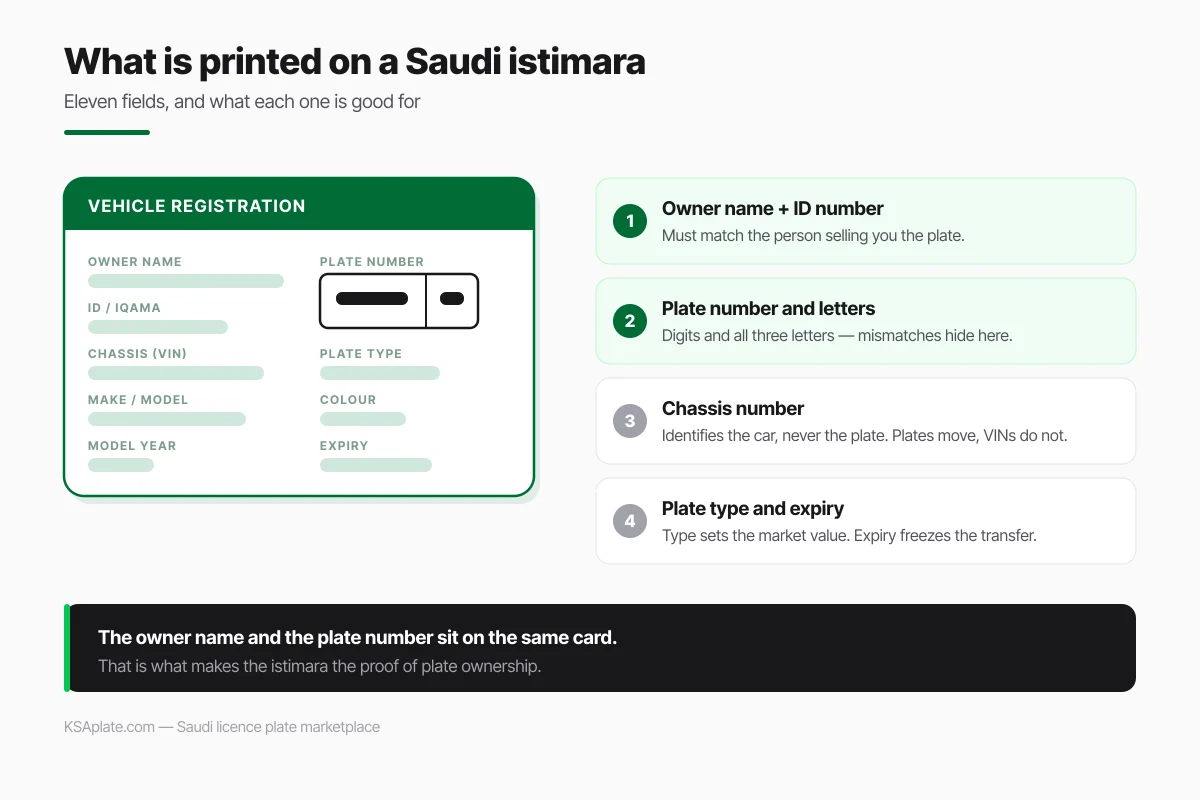
| Field on the card | Arabic | What it tells you |
|---|---|---|
| Owner name | اسم المالك | The registered owner. For a plate sale, this must match the person you are paying. |
| ID / Iqama number | رقم الهوية | National ID for citizens, Iqama number for residents. The identity behind the ownership. |
| Plate number and letters | رقم اللوحة | Digits plus three Arabic letters and their Latin equivalents. This is the plate itself. |
| Plate type | نوع اللوحة | Private, private transport, taxi, diplomatic and so on. Determines who may drive it and what it is worth. |
| Chassis number (VIN) | رقم الهيكل | The vehicle's permanent 17-character identity. Unlike the plate, it never changes. |
| Make and model | الصانع / الطراز | Manufacturer and model line. |
| Model year | سنة الصنع | Drives the inspection schedule — newer vehicles are exempt from Fahes for their first years. |
| Colour | اللون | Checked at roadside stops against the vehicle in front of the officer. |
| Vehicle type / body | نوع المركبة | Saloon, SUV, pickup, motorcycle. |
| Load capacity or seats | الحمولة | Relevant for transport and commercial plates. |
| Registration expiry | تاريخ الانتهاء | The date the card stops being valid. Everything else on the card depends on this being in the future. |
Two fields deserve more attention than they usually get. The chassis number is the vehicle's real identity — plates can be transferred between cars, chassis numbers cannot. And the plate type quietly sets the market value of the plate: a private plate and a transport plate carrying the identical number trade at very different prices, because the pool of buyers is different.
Key takeaway: The owner name, the ID number and the plate number sit on the same card. That single fact is what makes the istimara the proof of plate ownership.
What the istimara is not: Fahes, insurance and the plate
The istimara is the registration document; Fahes is the roadworthiness test, insurance is the liability cover, and the plate is a physical object with its own market value. Four separate things, frequently confused, and the confusion is expensive when someone tries to sell a plate without understanding which document does what.
Google's own "People also ask" box for this topic carries the question "What is fahas and istimara?", which tells you how common the mix-up is. The distinction is simple once laid out:
| Istimara | Fahes | Insurance | The plate | |
|---|---|---|---|---|
| What it is | Registration card | Periodic technical inspection | Liability cover | The number itself |
| Issued by | General Directorate of Traffic | Licensed Fahes centres | Private insurers | Traffic Department / auction |
| Proves | Who owns the vehicle and plate | The vehicle is roadworthy | Third parties are covered | Nothing on its own |
| Renewal depends on | Valid Fahes + insurance + no fines | The vehicle passing | Payment | — |
| Has resale value | No | No | No | Yes — often the most valuable part |
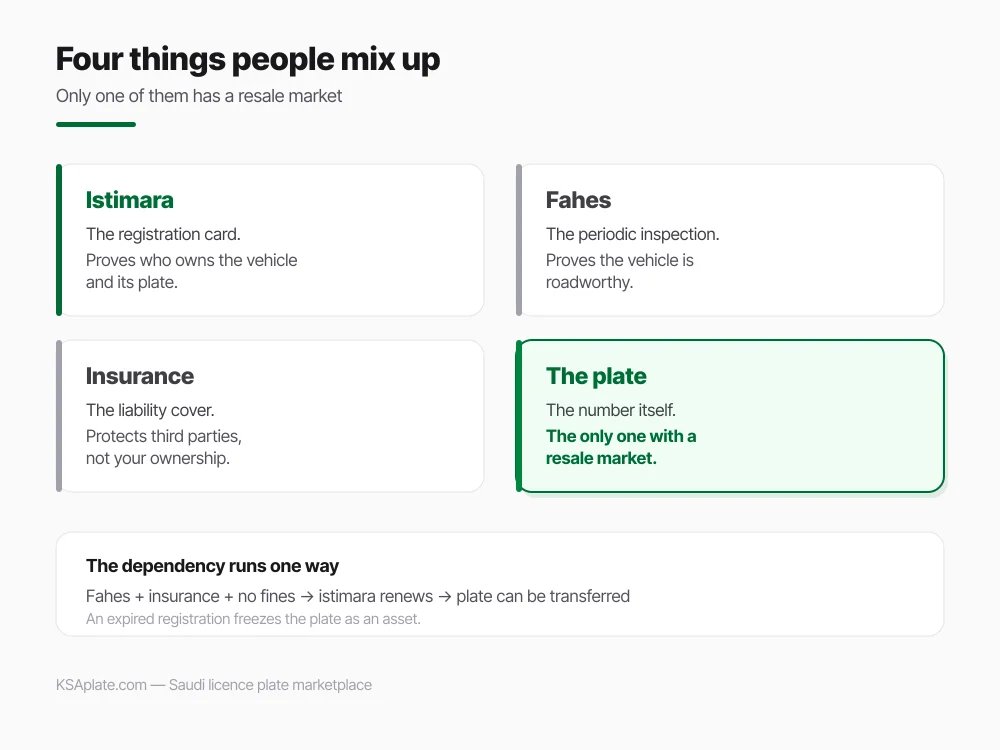
The dependency runs one way. You cannot renew the istimara while the periodic Fahes inspection or the insurance has lapsed, or while traffic fines are outstanding. The registration sits at the end of that chain, which is why an expired istimara is usually a symptom of something else.
Key takeaway: Of the four, only the plate has a resale market. The istimara is what proves you are entitled to sell it.
What's your car worth?
Get a free instant estimate based on real Saudi market data — then sell it on KSAplate with direct WhatsApp contact.
Value My Car — FreeWhy a plate buyer needs to see the seller's istimara
The istimara is the only document that links a licence plate to a named owner, which makes it the single most important check before paying for a distinctive plate. Everything else a buyer can verify — the value, the fines, the transfer status — is useful. None of it answers the question that actually loses people money: does this person own what they are selling?
Plate fraud in the Kingdom rarely involves a forged plate. It involves someone advertising a plate they have seen, taking a deposit, and disappearing. The defence takes four steps and about five minutes.
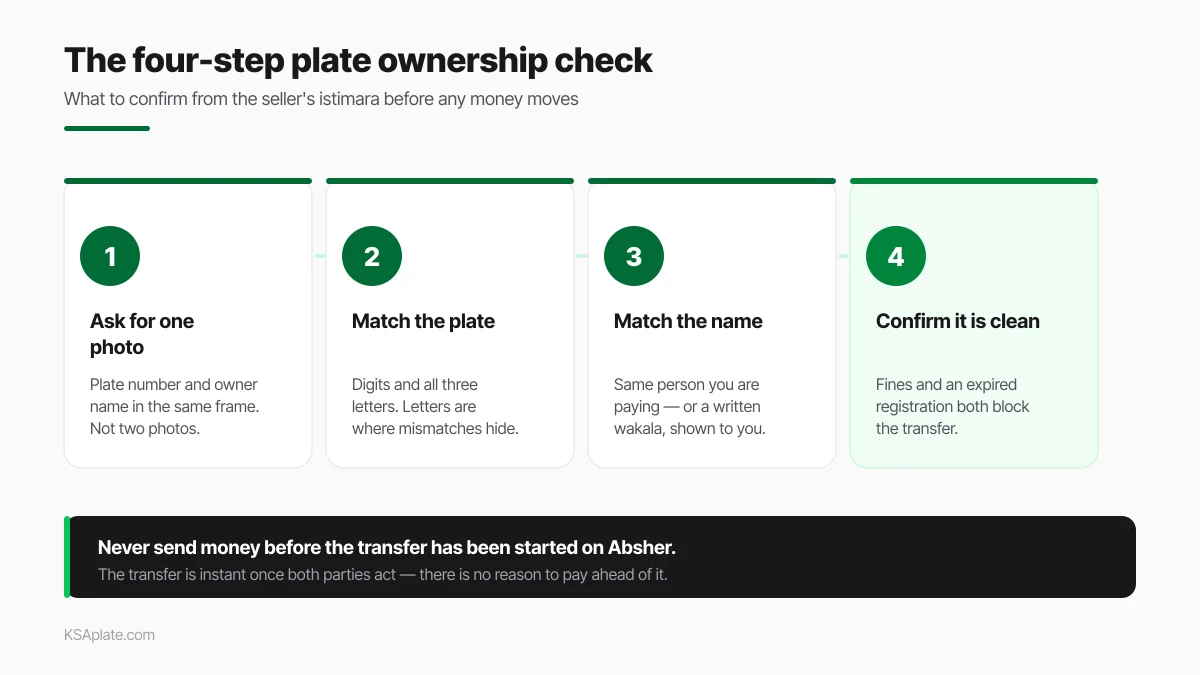
The four-step ownership check
- Ask for a photo of the istimara showing the plate number and the owner name in the same frame. Not two photos. One frame, both fields legible. A seller who crops the name is telling you something.
- Match the plate on the card against the plate in the advert — digits and all three Arabic letters. Letters are where mismatches hide, because a buyer focused on the number will skim them.
- Match the owner name against the person you are talking to. If the names differ, there must be a wakala (power of attorney), and you should see it. A relative selling on someone's behalf without one cannot complete the transfer.
- Confirm the record is clean before any money moves. Outstanding fines and an expired registration both block the transfer. Our guide to checking a Saudi plate covers the Absher and Tam lookups for this.
In practice the first step filters out most of the problem. A seller with a real plate sends the photo within a minute; the rest produce reasons.
Never send money before the official transfer has been started on Absher. A deposit paid against a photo is a deposit paid against nothing. The transfer itself is instant once both parties act — there is no legitimate reason to pay in advance of it.
For the mechanics of moving the plate once you are satisfied, see transferring a plate through Absher. And if you want a second opinion on the price before you commit, the free plate value calculator gives you a range in seconds.
The digital istimara in Absher and Tawakkalna
The digital istimara is the same registration record shown inside a government app rather than on a plastic card, and it is accepted at checkpoints. Saudi Arabia has moved most vehicle paperwork onto Absher, the Ministry of Interior's e-services platform, and the registration appears there under the vehicle's record.
Practically, this means three things. You can show the digital version instead of carrying the card. You can check the expiry date without digging through the glovebox. And when you are buying a plate, a seller can screenshot the record directly from Absher rather than photographing a worn card — which is both clearer and harder to fake convincingly.
The National Platform lists vehicle registration renewal as a standalone government service, which is the authoritative reference if you want to confirm current requirements rather than take a blog's word for it.
Key takeaway: The digital istimara is not a copy or a substitute. It is the same record, and for a plate transaction it is the better thing to ask a seller for.
Validity, expiry and what an expired card blocks
A Saudi istimara is issued for a fixed term and must be renewed before it expires, and an expired one blocks far more than driving. The renewal itself is an online process; what makes it fail is almost always something upstream.
An expired registration stops you from transferring the vehicle, from transferring the plate, from renewing insurance cleanly, and from selling either the car or the plate. That last consequence catches plate sellers out regularly: the plate may be worth six figures, but if the registration attached to the vehicle has lapsed, the transfer will not go through until it is sorted.
The renewal path, the fees and the order of operations are covered in detail in our guide to renewing the istimara. The short version: clear fines, pass Fahes if due, hold valid insurance, then renew through Absher.
Key takeaway: An expired istimara does not just risk a fine. It freezes the plate as an asset until it is renewed.
Istimara in Urdu, Hindi, Tagalog and Bengali
"Istimara" is an Arabic word that millions of Saudi residents encounter in a language that is not their first, and the translation is rarely provided. Google's related searches for this topic include "istimara meaning in Urdu" — a query that every page currently ranking answers only in English.
Saudi Arabia's expatriate workforce is largely South and Southeast Asian, and a driver from Karachi, Kochi, Manila or Dhaka meets the word on day one. Here is the same document across the languages KSAplate publishes in:
| Language | Term | Literal sense |
|---|---|---|
| Arabic | استمارة | Form |
| English | Vehicle registration card | Registration |
| Urdu | گاڑی کی رجسٹریشن | Vehicle registration |
| Hindi | वाहन पंजीकरण कार्ड | Vehicle registration card |
| Tagalog | Rehistro ng sasakyan | Vehicle registry |
| Bengali | যানবাহন নিবন্ধন কার্ড | Vehicle registration card |
One caution on transliteration: you will see istimara, istemara, estemara and isthimara used interchangeably online, including by government-adjacent sites. They are the same word. Spelling variation is not a sign that you are looking at the wrong document.
Key takeaway: There is no separate Urdu or Hindi term. The document is called the istimara in Saudi Arabia regardless of the speaker's language — the translations above describe it, they do not replace it.
Istimara elsewhere in the Gulf
The word istimara is used for vehicle registration in Saudi Arabia and Qatar, but not across the whole Gulf. In the United Arab Emirates the same document is the mulkiya (ملكية), which literally means "ownership". Google's related questions for this topic include "What is Istimara in Qatar?", which suggests the cross-border confusion is real.
This matters more than a vocabulary note if you are buying a plate from someone who has moved between Gulf states. A UAE mulkiya does not register a vehicle in Saudi Arabia, and a Saudi plate cannot be transferred on the strength of a foreign document. Cross-border plate purchases are a separate process — our GCC plate market comparison covers how the systems differ.
Key takeaway: Saudi Arabia and Qatar say istimara. The UAE says mulkiya. Same purpose, different systems, and no document from one country registers a vehicle in another.
Five mistakes people make with the istimara
Most istimara problems are not paperwork failures — they are timing failures. These five come up repeatedly among people buying and selling plates on KSAplate.
- Accepting a cropped photo. A photo showing only the plate number proves nothing. The owner name must be in the same frame.
- Assuming the plate transfers with the car automatically. It does, by default — which is the problem. If the number is distinctive and you want to keep it, you must request retention before the sale. Our guide on keeping your plate when you change car covers the sequence.
- Letting the registration lapse while a plate is listed. The listing stays up, buyers make contact, and then the transfer will not complete. Renew first, list second.
- Confusing the chassis number with the plate. Buyers sometimes verify the VIN and think they have verified the plate. The VIN identifies the car; only the plate field identifies the plate.
- Paying a deposit against a screenshot. A screenshot is evidence, not security. The transfer is instant once both parties act on Absher — wait for it.
What the plate market looks like behind the card
The istimara is administrative; the plate on it is an asset with a measurable price. Because KSAplate operates the marketplace, we can state what plates are actually being asked for rather than estimate it.
From our own live listing data on 28 August 2026, across 10,103 genuine plate listings, of which 9,817 carry a visible asking price:
- Median asking price across all priced listings: 4,600 SAR
- Four-digit plates: median 3,300 SAR (7,965 listings)
- Three-digit plates: median 26,500 SAR (1,466 listings)
- Two-digit plates: median 36,000 SAR (515 listings)
- Single-digit plates: median 140,000 SAR (157 listings)
- Half of all single-digit listings carry no price at all, which is why that median rests on 78 plates rather than 157
Demand splits far harder than price does. A single-digit plate is opened 12.2 times a day against 1.7 for a four-digit plate — a gap our study of what plate buyers actually look at measures across the same listing base.
For context at the top of the market, the highest publicly reported Saudi auction result is SAR 21 million for the plate ع 1 at an Absher electronic auction in April 2024 — reported by Gulf News and traceable to a named outlet, unlike most figures circulating on plate forums. Every sourced auction result we could verify is listed on our market data page, each row linking to the publication that reported it.
Those medians are asking prices from live listings, not confirmed sale prices, and we label them that way wherever they appear. We publish no average time-to-sale, because we cannot measure one honestly: Absher publishes no auction results archive and our own records do not confirm when a private sale closes. Anyone presenting a smooth price history or a tidy "sells in X days" figure for Saudi plates is drawing it rather than measuring it.
Frequently asked questions
What does istimara mean in Arabic?
What is an istimara card?
Is the istimara the same as a driving licence?
What is the difference between istimara and Fahes?
Does the istimara prove I own the licence plate?
Is there a digital istimara?
Why do I see it spelled estemara or istemara?
Is the istimara the same in Qatar and the UAE?
Do I need my own istimara before I can buy a distinctive plate?
What to do next
If you are here because you were verifying a plate seller, the istimara photo is the check to insist on — plate number and owner name, one frame, before any money moves.
If you are here because you own a plate worth more than the car it is bolted to, the useful next step is finding out what it is actually worth. The free plate value calculator gives you a range from the letters and number alone, and listing on KSAplate costs nothing with no commission on the sale.
Written by Khalid Al-Rashid, who has covered the Saudi distinctive-plate market and its paperwork for KSAplate since 2026. Market figures in this article come from KSAplate's own live listing data; auction figures are sourced to named publications and listed with their sources on the market data page.
Last reviewed on 28 August 2026 by the KSAplate editorial team. Regulations and fees change — confirm current requirements on Absher before acting.