


Last updated: May 2026 | 15 min read
Most guides about Saudi license plate buying assume both buyer and seller are physically in the Kingdom. That assumption fails for a fast-growing share of the market: Saudis living abroad, GCC investors based in Dubai or Doha, expats on rotation, and busy executives who simply cannot fly to Riyadh for a plate purchase. The legal mechanism that unlocks all of these cases is the same one Saudi families have used for centuries — the wakala, or power of attorney — now delivered digitally through the Ministry of Justice's Najiz portal and integrated end-to-end with Absher.
This guide walks through the complete 2026 wakala workflow for license plate transactions: which type of power of attorney you need, how to issue it from inside or outside Saudi Arabia, what to include so a traffic agent will actually accept it, the realistic timeline and costs, and the specific risks that catch first-time remote buyers off guard.
1. Quick Answer: Do You Need a Wakala?
You need a wakala if you cannot personally log into Absher with your own Nafath credentials to accept or initiate a plate ownership transfer. Most Saudi plate transactions are concluded directly by buyer and seller through Absher; no wakala is needed when both parties have active digital identities and one of them can complete the Absher steps on each side. A wakala becomes necessary when you are overseas, when an institutional buyer needs an agent to act, or when an heir authorizes another family member to handle an inherited plate.
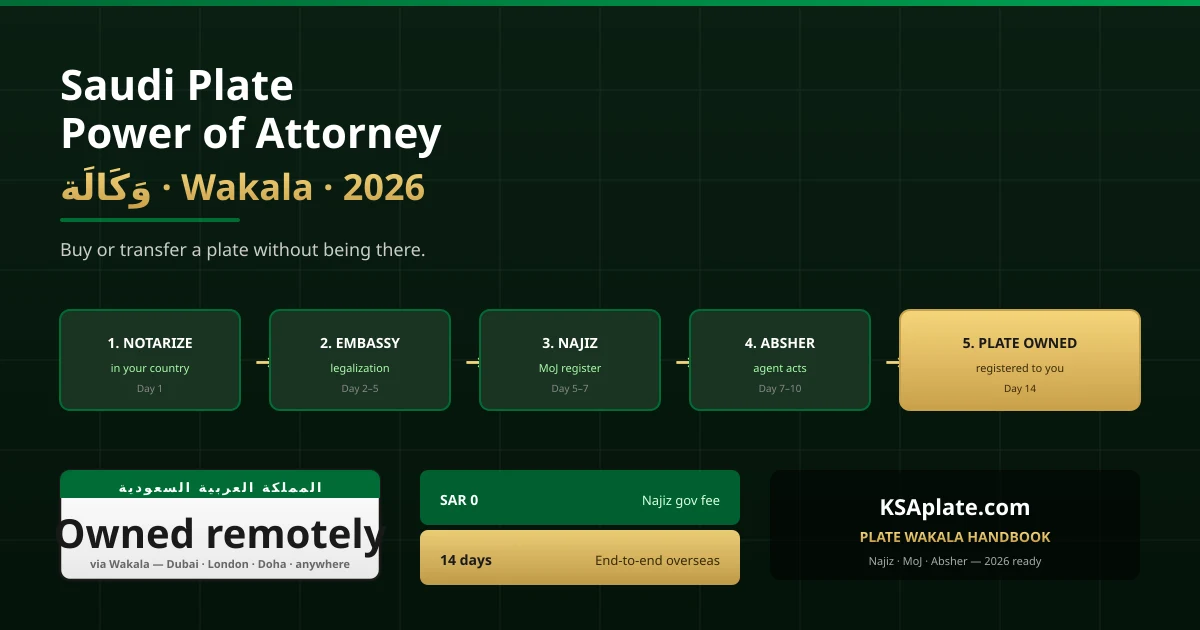
A correctly drafted Saudi license plate power of attorney in 2026 costs nothing at the Najiz portal if you are resident inside the Kingdom and is typically issued within an hour. For buyers abroad, the wakala must be notarized in the country of residence and legalized through the Saudi Embassy and the Ministry of Foreign Affairs before it can be entered into Najiz — that consular leg is what extends the realistic timeline to 3–4 weeks.
2. What a License Plate Wakala Actually Is
A wakala is a legally binding power of attorney under Saudi civil law that authorizes one person (the agent, or wakeel) to act on behalf of another (the principal, or muwakkil) for clearly defined matters. For license plate transactions, the wakala is the legal instrument that lets the agent represent the principal at every step the Absher platform expects to see the plate owner in person — initiating transfer, accepting transfer, paying fees, and signing post-transfer registration.
Since 2019, Saudi Arabia has digitized wakala issuance through the Ministry of Justice's Najiz portal. The portal accepts Nafath-verified digital identities for both principal and agent and issues the wakala instantly as a QR-coded electronic document that any government counter or Absher process can verify in real time. Paper wakalat issued before the digital transition remain valid but are increasingly replaced for any new plate-related transaction in 2026.
"The wakala is what turns a phone call from Dubai into a completed plate transfer in Riyadh. Without it, no amount of trust between parties can substitute for the buyer's physical presence at Absher."
— Licensed plate broker, Eastern Province
3. Three Types of Wakala Used for Plate Transactions
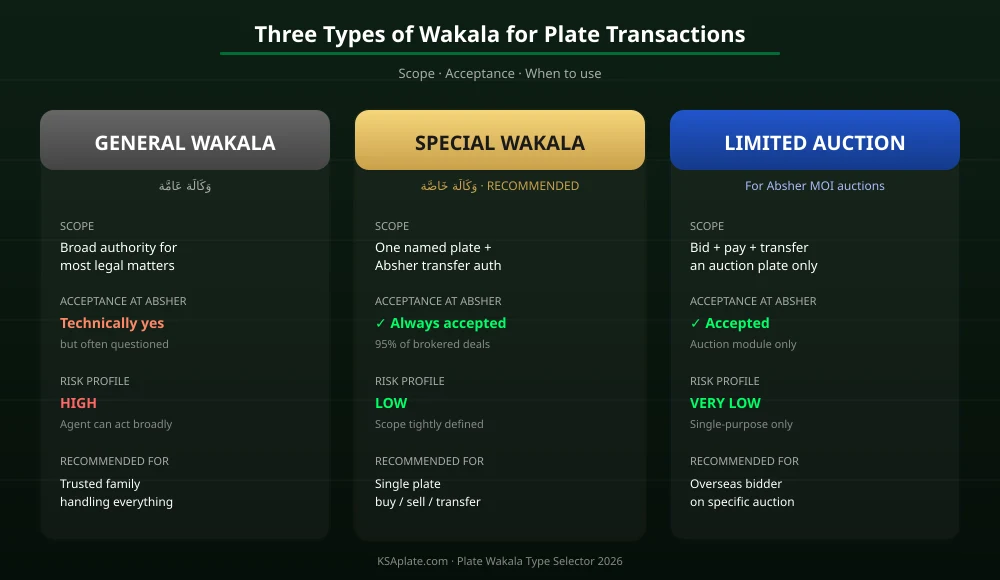
Najiz issues three forms of power of attorney relevant to license plates. Each has a different scope and different risk profile. Picking the wrong one is the most common reason transfers stall at the traffic department.
3.1 General Wakala (Wakala Aamah)
A General Wakala authorizes the agent to act broadly on the principal's behalf for most legal matters — buying, selling, signing contracts, handling banking. Traffic agents technically accept a general wakala for plate transfers, but in practice many Absher service centers prefer a more specific instrument because the broad authority creates ambiguity about whether the principal actually intended to part with the specific plate.
3.2 Special Wakala (Wakala Khassah) — RECOMMENDED
A Special Wakala restricts the agent's authority to a clearly defined matter. For plate transactions, a properly drafted special wakala names the exact plate (Arabic letters + number), the vehicle it is currently registered to, the explicit authority to sell or buy it via the Absher platform, and the price ceiling or floor where relevant. This is the form used in 95% of brokered plate transactions in 2026. Najiz processes it under "Special Power of Attorney for a Specific Vehicle / Plate" in the dropdown menu.
3.3 Limited Plate-Auction Wakala
A relatively new variant introduced after Absher integrated the online plate auction system, the limited plate-auction wakala authorizes the agent specifically to place bids, win, pay for, and transfer a plate from an MOI online auction. This narrow scope is preferred by international buyers who only want to grant their agent the authority to bid on their behalf with no other powers.
What's your plate worth?
Get an instant, free estimate with our plate value calculator.
Calculate My Plate's Value4. Issuing the Wakala From Inside Saudi Arabia (Najiz)
For residents of Saudi Arabia with active Nafath digital identity, issuing a plate wakala takes about 30 minutes and costs nothing in government fees. The full process:
- Open the Najiz portal at najiz.sa and authenticate via Nafath.
- Select Powers of Attorney → Issue Power of Attorney → Special Power of Attorney.
- Enter the agent's national ID or Iqama number. Najiz pulls their name automatically from the Nafath registry.
- Select the purpose category "Vehicle / License Plate" from the dropdown.
- Specify the plate details: Arabic letters, plate number, vehicle VIN, and the authority you grant (sell, buy, transfer ownership, sign documents).
- Set an expiry date — most plate wakalat are issued for 3 to 12 months. Avoid open-ended wakalat for security.
- Sign electronically using Nafath biometric confirmation.
- The agent receives an SMS prompting them to accept the wakala via their own Nafath. Once accepted, the wakala is live and can be verified at the MoJ verification service.
5. Issuing the Wakala From Outside Saudi Arabia
If you are outside Saudi Arabia, you cannot directly use Najiz to issue a wakala — Nafath verification requires a Saudi-registered phone number and active residency. The workaround is the consular legalization route, which adds two to three weeks to the timeline but is the only legally recognized path.
5.1 Step One: Draft and Notarize Locally
Draft a wakala in English and Arabic at a notary public in your country of residence. The wakala must contain all the essential clauses listed in Section 6 below. The notary signs and stamps the document. Cost varies by country: AED 200–500 in the UAE, USD 25–100 in the United States.
5.2 Step Two: Authenticate at the Foreign Ministry
The notarized wakala must be authenticated by the foreign ministry of the issuing country. In the UAE this is the Ministry of Foreign Affairs and International Cooperation (MoFAIC). In the United States it is the Department of State authentication office. This step confirms the notary's seal is genuine.
5.3 Step Three: Saudi Embassy Legalization
Submit the foreign-ministry-authenticated wakala to the Saudi Embassy or Consulate in your country. The embassy attests that the document is fit for use inside Saudi Arabia. Typical processing: 2–5 business days. Fees: USD 30–100 depending on jurisdiction.
5.4 Step Four: Registration at the Saudi Ministry of Justice
Once back in Saudi Arabia, the agent (or a delegated lawyer) submits the embassy-legalized wakala to the Ministry of Justice for entry into the Najiz system. The wakala is then assigned a Najiz reference number and is recognized identically to a domestically-issued wakala for all Absher purposes.
6. Essential Clauses Every Plate Wakala Must Contain
A plate wakala that omits any of these clauses can be rejected at the Absher service counter. Use this checklist before signing or paying for notarization.
- Full legal names of the principal and agent, including national ID or Iqama numbers.
- Exact plate identification: Arabic letters (all three, with diacritics if applicable), Western digits, vehicle make and VIN.
- Specific authority granted — the words "to sell," "to buy," "to transfer ownership via the Absher platform," "to receive or pay funds for the plate."
- Price authority — either a maximum price the agent may pay (for buying) or a minimum acceptable price (for selling). Leaving this open invites disputes.
- Validity period — start and end date. Najiz defaults to one year; international wakalat can be shorter.
- Revocation clause — language confirming the principal may revoke the wakala at any time via Najiz.
- Governing law — declare Saudi Arabia as the applicable jurisdiction. Foreign-drafted wakalat must include this.
- Signature blocks for both parties and for the notary or Najiz e-signature placeholder.
7. Realistic Timeline + Cost Table
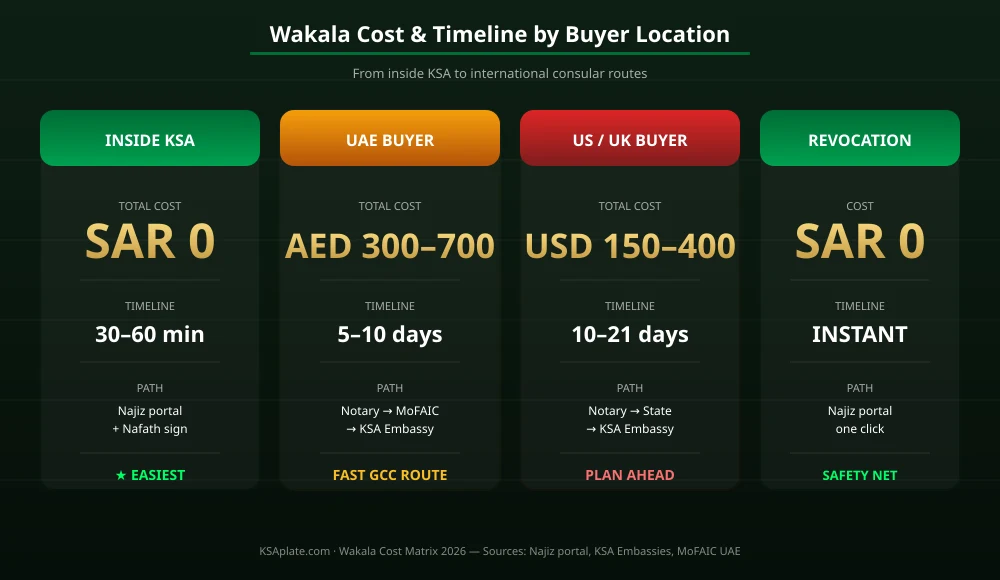
| Scenario | Total Timeline | Out-of-Pocket Cost | Bottleneck |
|---|---|---|---|
| Resident Saudi → Najiz special wakala | 30–60 min | SAR 0 | Agent acceptance lag |
| Expat in KSA → Najiz special wakala | 30–90 min | SAR 0 | Iqama validity check |
| UAE-based buyer → consular route | 5–10 business days | AED 300–700 | Embassy queue |
| US / UK buyer → consular route | 10–21 business days | USD 150–400 | State Dept + courier time |
| Anywhere → revocation of existing wakala | 5 min (Najiz) | SAR 0 | Instant |
8. Worked Example: Dubai Buyer Winning an Absher Auction
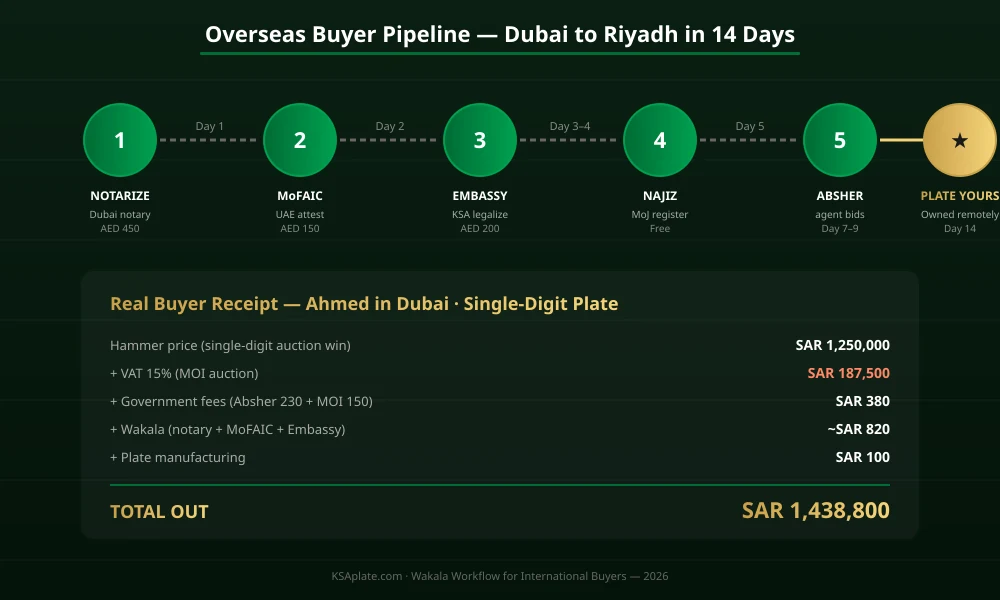
A practical illustration. Ahmed, a Saudi national living in Dubai, sees a single-digit plate scheduled for the next Absher auction with an opening price of SAR 800,000. He cannot fly to Riyadh in time.
- Day 1: Ahmed retains a Riyadh-based broker (his cousin Saud) as wakeel. They draft a Limited Plate-Auction Wakala in English/Arabic at a Dubai notary. Cost: AED 450.
- Day 2: Wakala authenticated at UAE MoFAIC. Cost: AED 150.
- Day 3–4: Saudi Embassy in Dubai legalizes the document. Cost: AED 200.
- Day 5: Saud submits the legalized wakala to the Najiz office in Riyadh. Najiz issues a digital reference number the same afternoon.
- Day 7: Absher auction begins. Saud bids on behalf of Ahmed using his own Nafath credentials, with the wakala attached to the bidder profile. Ahmed wires the SAR 1,000 auction deposit to Saud's account beforehand.
- Day 9: Saud wins the auction for SAR 1,250,000. Ahmed transfers the full balance plus VAT (15%) plus government fees (SAR 630 — SAR 400 in traffic fees for the vehicle the plate will go on, plus the SAR 230 Absher service fee) to Saud the same day, total SAR 1,438,130.
- Day 10: Saud completes the Absher payment within the five-day auction deadline. The plate is registered under Ahmed's national ID via the wakala authority.
- Day 14: Ahmed receives plate ownership confirmation in his own Absher account when he checks in via Nafath.
End-to-end elapsed time: 14 days. Total cost beyond plate price: SAR 630 government fees + SAR 187,500 VAT + AED 800 wakala costs (~ SAR 820) + optional broker commission.
9. Absher Step-by-Step When Acting Under Wakala
Once the wakala is in Najiz, the agent uses Absher exactly as a normal user — with one extra step at the beginning of each plate-related transaction.
- Log into Absher with the agent's own Nafath credentials.
- Navigate to My Services → Acting on Behalf of Another.
- Search for the principal by national ID or Iqama. Najiz auto-fills the active wakala for that principal-agent pair.
- Select the wakala. Absher confirms the scope (plate transfer authority) and switches the session into "acting on behalf of [principal name]" mode — visible in the header throughout.
- Proceed with the plate transfer normally: select Vehicle → Plate Transfer → enter buyer details → pay fees via SADAD → confirm.
- The system logs both the agent's actions and the underlying wakala reference, creating an audit trail visible to the principal in their own Absher account.
10. Five Wakala Pitfalls That Block Transfers
- Scope too narrow. A wakala that authorizes "buying a plate" but not "completing Absher transfer" can be rejected at the transfer step. Always include the explicit Absher language in Section 6.
- Wakala expires mid-transaction. If the agent wins an auction on day 25 of a 30-day wakala, the five-day payment window can run past expiry. Issue wakalat with at least 90-day validity for auction use.
- Foreign wakala not consular-legalized. A wakala notarized abroad but missing embassy legalization is not enforceable in Saudi Arabia even if the notarization is otherwise correct.
- Principal's Nafath inactive. If the principal's Saudi digital identity has expired, the wakala cannot be issued in Najiz even with the agent ready. Renew Nafath before starting.
- Agent overreach. An agent acting beyond the wakala's stated authority creates civil liability and can void the underlying plate transaction. Match scope precisely to intent.
11. How to Verify a Wakala Before Trusting Your Agent
Whether you are the principal worried about your agent's actions, or the seller transacting with an agent on the other side, verification of any Saudi wakala is a free, real-time service.
Visit the Ministry of Justice's Power of Attorney Verification page. Enter the wakala reference number and the principal's national ID. The portal returns the wakala's status (active / expired / revoked), its scope text, and the agent's name. Always verify before completing any transfer step that depends on the wakala's existence.
For added security on high-value plate purchases, ask your agent to share a screenshot of the active wakala on their own Najiz portal — this proves the wakala is still listed under their name and has not been revoked by the principal.
12. Frequently Asked Questions
Can a non-Saudi citizen issue a wakala to buy a Saudi license plate?
Yes. Any natural person with legal capacity can issue a wakala. Foreign citizens use the consular route described in Section 5. The agent receiving the wakala can be Saudi or non-Saudi, provided they hold active Nafath digital identity in the Kingdom.
How much does a Saudi license plate wakala cost in 2026?
If issued through Najiz inside Saudi Arabia, the government fee is SAR 0. Foreign-issued wakalat cost USD 150–400 in total notarization, foreign ministry, and embassy legalization fees, depending on jurisdiction.
Can I revoke the wakala after my agent has already won an auction?
You can revoke a wakala at any time via Najiz, but a revocation that occurs after the agent has lawfully committed funds on your behalf does not unwind that commitment. The plate transaction itself stands and you must complete payment. Revocation only stops future actions.
How long is a Saudi plate wakala valid?
Najiz allows wakalat to be issued for any period the principal chooses, with one year being the most common default. Auction wakalat are typically issued for 3–6 months. Open-ended wakalat are technically permitted but strongly discouraged for security reasons.
Do I need a different wakala for each plate I want my agent to buy?
If you have a Limited Plate-Auction Wakala that specifies the plate, then yes — a new wakala per plate. A Special Wakala can cover multiple plates if drafted to grant authority over "any plate the agent acquires on the principal's behalf within the specified budget."
Can a wakala holder also pay the plate's VAT and government fees from their own funds?
Yes if the wakala authorizes the agent "to pay or advance funds related to the plate." Otherwise the principal must transfer the fees to the agent before the agent acts. Always include explicit payment language.
What happens if the principal dies during an active plate wakala?
A wakala terminates automatically on the principal's death under Saudi civil law. Plate ownership transfers to the heirs under the Shariah inheritance regime. See our plate inheritance guide for the heir transfer procedure.
Is a wakala required to participate in an Absher plate auction?
Only if you cannot personally hold an active Nafath identity. Saudis abroad with valid Nafath can bid directly from anywhere. The wakala route is needed when your Nafath is inactive or you prefer a local broker to bid on your behalf.
Can two people be appointed as joint agents in a single wakala?
Yes. A wakala can name multiple agents and specify whether they act jointly (both must consent) or severally (either may act). For high-value plate transactions, joint wakalat add a layer of fraud protection.
Does the agent's commission count as VAT-able in Saudi Arabia?
If the agent is a VAT-registered business (a licensed broker), the commission they charge the principal is subject to 15% VAT. Personal favors between family members are not commercial transactions and carry no VAT. See our plate fees, taxes and VAT guide for the full breakdown.
13. Conclusion & Next Steps
A Saudi license plate wakala is the legal bridge that lets you participate in the Kingdom's plate market from anywhere on earth. The infrastructure is now fully digital inside Saudi Arabia and reliable through consular channels from abroad. The cost is minimal. The timeline is predictable. The risks are well understood and mitigated by precise scope language and Najiz's instant verification.
For prospective overseas buyers, the practical takeaway is twofold. First, line up a trusted Riyadh-based agent before you bid on a plate — not after. Second, draft a Special Wakala with the explicit Absher transfer language, an adequate validity window, and a clear price ceiling. With these two pieces in place, you can compete for any Saudi plate from any city in the world.
Ready to browse plates with confidence that the wakala route will work? Browse plates on KSAplate.com →
Want to confirm a plate's market value before instructing your agent? Use our free plate value calculator →
Buying through an MOI auction? Read our complete Absher auction bidding guide →
Last updated: May 2026. Procedures verified against the Najiz portal, the MoJ verification service, and Absher Vehicle Ownership Transfer documentation. Always reconfirm wakala status with the Ministry of Justice before completing any transfer.