TL;DR — The 5 Things Heirs Must Know
- Nothing moves until the court issues the Heirs Certificate (Sakk Hasr Al Wirathah). It is applied for through Najiz, the Ministry of Justice portal.
- The vehicle transfer itself is not a self-service Absher flow. The General Directorate of Traffic's own guidance is that the heirs' authorised representative attends a traffic department with the death certificate, the court's heirs document and powers of attorney from the heirs.
- A premium plate can be moved off the inherited vehicle and sold separately, which is often the rational outcome for a valuable estate — but that is a plate transfer, and it needs a vehicle on each side.
- We could not source an inheritance-specific fee or exemption. An earlier version of this page quoted a "SAR 100 plate-detachment fee" and a waiver of the SAR 380 ownership fee; neither had a source, and both are gone.
- Sharia fixed shares apply to the plate's value, and the share list comes from the court's certificate — not from us and not from a calculator.
Saudi license plate inheritance is the legal process by which heirs of a deceased registered owner transfer or sell that owner's vehicle plate through the Personal Status Court and the Absher platform. It requires a court-issued Heirs Certificate (Sakk Hasr Al Wirathah), unanimous consent from all first-degree heirs, and a separate Absher workflow if the plate is to be detached from the inherited vehicle and sold on the open market. The process typically takes 30–60 days end to end and follows Sharia inheritance shares for any sale proceeds.
Table of Contents
- What Is Saudi License Plate Inheritance?
- The Legal Basis: Sharia, the Personal Status Court & Absher
- Step 1: Obtain the Heirs Certificate (Sakk Hasr Al Wirathah)
- Required Documents Checklist for 2026
- Step-by-Step: Transfer an Inherited Plate via Absher
- Detaching the Plate from the Vehicle to Sell Separately
- Sharia Share Math: How Plate Value Is Split
- Inheritance Transfer Fees & Exemptions in 2026
- Realistic Timeline: 30, 60, 90 Days
- Joint-Heir Decisions: Sell, Buy-Out, or Keep
- Special Cases: Expat Heirs & Heirs Outside KSA
- 7 Mistakes That Delay Plate Inheritance
- Frequently Asked Questions
What Is Saudi License Plate Inheritance?
Saudi license plate inheritance is the legal and administrative process that transfers ownership of a registered vehicle plate from a deceased Saudi resident to their lawful heirs. Under Saudi law, a license plate is treated as a movable asset attached to the vehicle's Istimara (registration document). When the registered owner dies, the plate does not automatically transfer — the heirs must first establish their legal status through the Personal Status Court, then process the transfer through Absher.
For a standard four- or five-digit plate this is mostly paperwork. For premium plates — single-digit, two-digit, some three-digit, or rare letter combinations — the financial stakes change everything. On our own live listings the median single-digit ask is SAR 300,000, with nine in ten under SAR 1.5 million and the highest at SAR 7.45 million. A plate in that range can be one of the largest single assets in an estate, and how the heirs handle it changes what they end up with.
The Legal Basis: Sharia, the Personal Status Court & Absher
Three legal systems intersect when you inherit a Saudi license plate.
1. Sharia (Islamic Law)
Saudi Arabia applies Sharia inheritance rules under the Hanbali school. The fixed shares are set by law rather than by the deceased's preference: a bequest (wasiyyah) can direct up to one third of the estate to someone who is not an heir, but it cannot alter the shares of those who are. In the standard case a son inherits twice a daughter's share, a wife receives one eighth where the deceased leaves descendants, and a husband one quarter in the same situation. These shares attach to the market value of the plate, not to the object — you cannot give one heir "the front of the plate". The authoritative statement of who inherits what in your family is the court's certificate, not this page.
2. The Personal Status Court
The Personal Status Court (Mahkamat Al-Ahwal Al-Shakhsiyyah) is the only authority that issues the Heirs Certificate, formally known as Sakk Hasr Al Wirathah. Without this document, no Saudi government entity — including Absher and the General Directorate of Traffic — will process any transfer of the deceased's assets. Selling, gifting, or even physically transferring the plate before the certificate is issued is unlawful and can void the eventual transfer.
3. Absher and the Ministry of Interior
Absher is where vehicle records live, and it is where a plate transfer between two living owners is carried out. Inheritance is the exception: the General Directorate of Traffic's guidance for a deceased owner's vehicle points to an in-person visit by the heirs' authorised representative, not to a self-service flow. The services this page previously named — an Absher "Vehicle Plates Exchange" — do not exist under that name; the real ones are the plate transfer (نقل اللوحات) and the digital plate wallet (محفظة لوحات المركبات الرقمية).
A note on a quotation we removed. This spot used to carry a sentence in quotation marks — "It is not legally permissible to sell any property belonging to the deceased before obtaining the Heirs Certificate" — credited to "Saudi Personal Status practice". We could not find a source for it as a quotation. The underlying point is sound and we state it in our own words above: without the certificate, no government entity will process a transfer of the deceased's assets.
Step 1: Obtain the Heirs Certificate (Sakk Hasr Al Wirathah)
Everything starts with the Heirs Certificate. The certificate is a court-issued document that lists every legitimate heir of the deceased and their share. It is the foundation for every subsequent step — bank accounts, real estate, vehicles, and license plates all follow it.
How to apply
The application is filed through Najiz (najiz.sa), the Ministry of Justice's e-services platform: log in with your National Access account, then Electronic Services → Social Status → Documentation of a Deceased Person's Heirs (توثيق ورثة متوفى). The applicant must be one of the heirs or an authorised agent. You provide the death certificate, the deceased's national ID, the family registry book (Daftar Al-A'ila), and the IDs of the heirs. Saudi law firms describe the process as running largely online, with a court session at the end.
What the court does
The court verifies the family relationships, publishes a notice giving any unknown heir the chance to come forward, and — if nobody contests — issues the Sakk Hasr Al Wirathah naming every heir and their share. How long that takes is not published as an official service level. Saudi legal practitioners describe uncontested applications with complete documents as closing in anything from a few days to about two weeks, and contested or incomplete ones as taking considerably longer. An earlier version of this page gave "14 to 45 days" as though it were a rule; it was not sourced. Keep the certificate; you will need it repeatedly.
What's your plate worth?
Get an instant, free estimate with our plate value calculator.
Calculate My Plate's ValueRequired Documents Checklist for 2026
Have everything ready before you log into Absher. Missing one document restarts the queue.
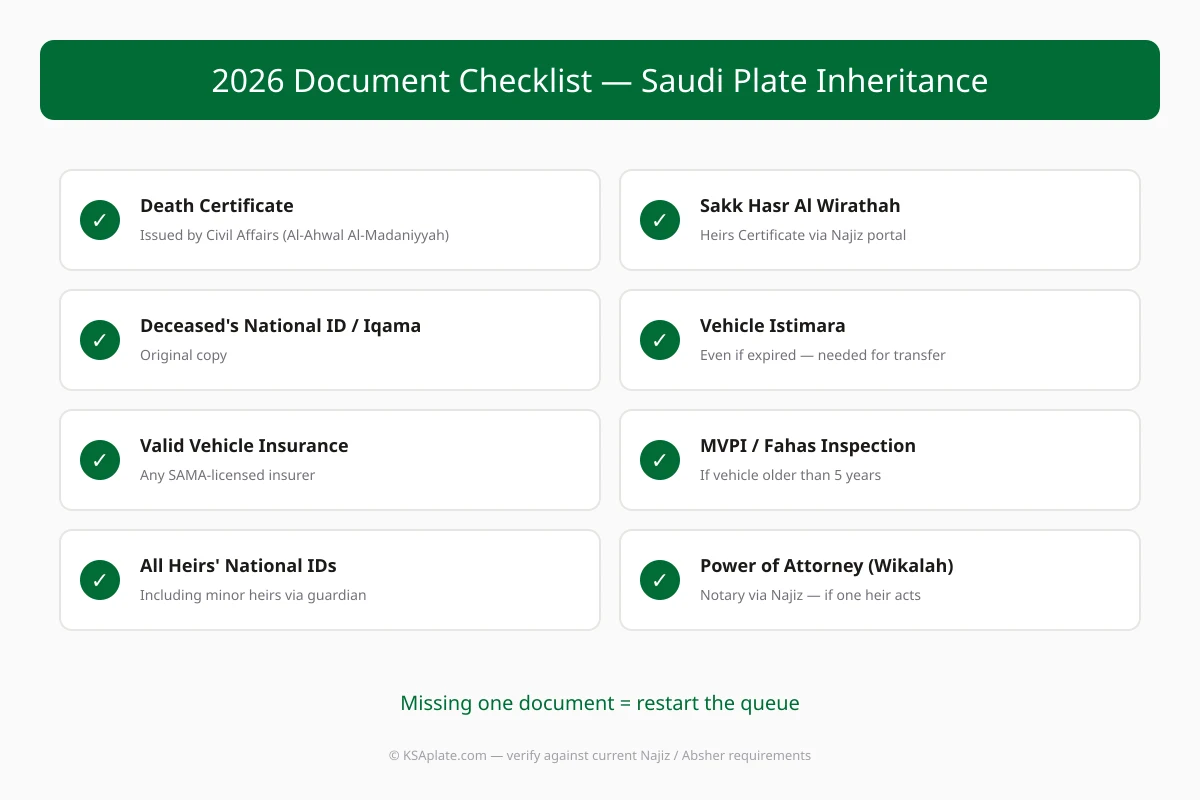
| Document | Issued By | Notes |
|---|---|---|
| Death Certificate | Civil Affairs (Al-Ahwal Al-Madaniyyah) | Original, attested |
| Heirs Certificate (Sakk Hasr Al Wirathah) | Personal Status Court via Najiz | Mandatory; nothing proceeds without it |
| Deceased's National ID / Iqama | Civil Affairs / Jawazat | Original copy |
| Vehicle Istimara | General Directorate of Traffic | Bring it even if expired |
| Valid vehicle insurance | Any SAMA-licensed insurer | Required at transfer time |
| Periodic inspection (Fahes) certificate | MVPI / Fahes centres | New private vehicles are exempt for their first three years from first registration, then inspected annually |
| All heirs' national IDs | Civil Affairs | Including minor heirs (via guardian) |
| Powers of Attorney (Wikalah) | Notary Public via Najiz | From the heirs to whoever will act for them — the traffic department asks for these |
Step-by-Step: Transfer an Inherited Plate via Absher
With the Heirs Certificate issued and the documents in order, the vehicle side can proceed. Read the next section carefully, because it is the part this page previously got wrong.
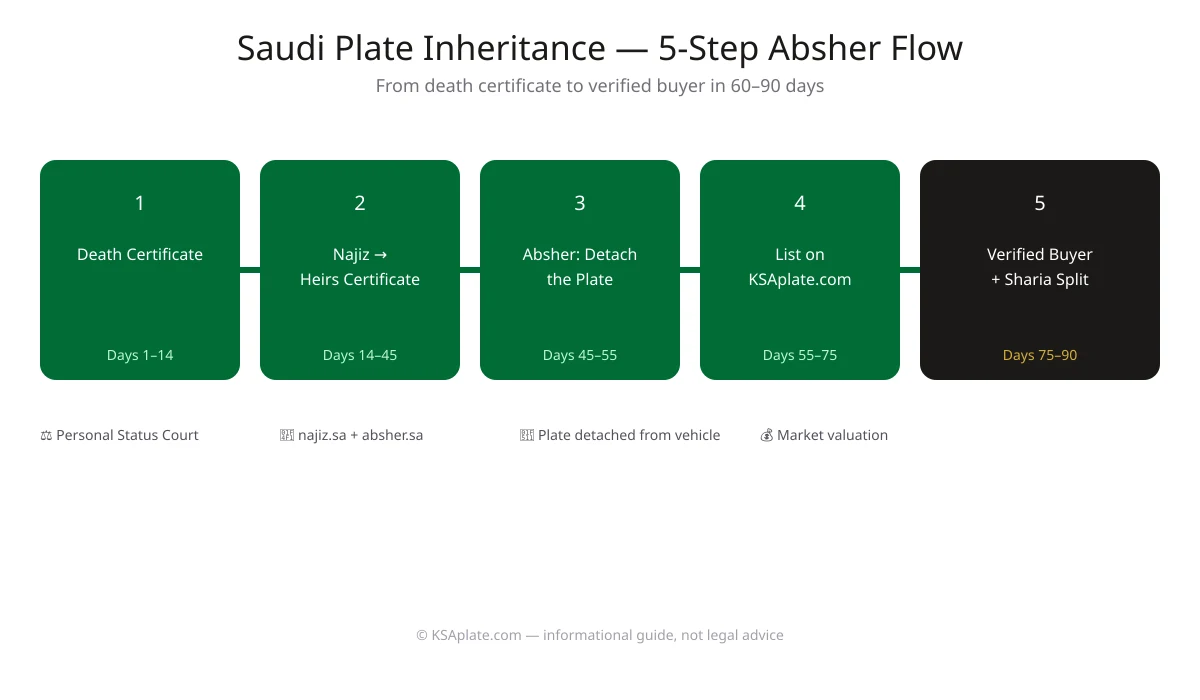
- Start from the court document, not from an app. Everything below assumes the Sakk Hasr Al Wirathah is already issued.
- Agree who will act for the heirs, and have the others give that person a Wikalah through the notary service in Najiz. The traffic department's guidance is framed around an authorised representative of the heirs, so this step is not optional bureaucracy — it is the mechanism.
- Attend a traffic department (Moroor) with the file. Asked directly how a deceased person's vehicle is transferred to an heir, the General Directorate of Traffic's answer was that the heirs' authorised representative should visit the nearest traffic department and submit the request. Bring the death certificate, the court's heirs document, the powers of attorney, the Istimara, insurance and inspection.
- Clear anything that blocks a transfer first. Outstanding fines, lapsed insurance and an expired inspection stop the process the same way they stop any other transfer.
- Decide the destination before you go: the vehicle and plate together to one heir, or the plate separated from the vehicle so it can be sold on its own.
- Correction: an earlier version of this page described a seven-step self-service flow inside Absher — an "inheritance pathway", an automatic cross-check of the heirs list against the National Information Center, and per-heir approval by in-app notification. We could not source any of it, and the traffic department's own answer points to an in-person process. It has been removed rather than left standing because a reader following it would have wasted the trip.
Detaching the Plate from the Vehicle to Sell Separately
Here is where premium plates change everything. Most ordinary plates stay attached to the inherited car and move with it. But if the plate has independent market value — single-digit, two-digit, some three-digit, or a striking letter combination such as three identical letters — heirs are often better off separating the plate from the vehicle and selling it on its own. Be aware of what that involves: moving a plate number between two vehicles is a plate transfer, so a receiving vehicle has to exist on the other side.
The relevant services are the plate transfer (نقل اللوحات) and Absher's digital plate wallet (محفظة لوحات المركبات الرقمية), which lets a plate be held without being registered on a vehicle. An earlier version of this page called it a "Vehicle Plates Exchange" service; that is not what it is called. Saudi press coverage of the wallet notes an annual renewal fee without naming an amount, so we do not name one either.
Worth separating in your head: moving the plate off the vehicle is not the sale. It is the step that makes a separate sale possible. Heirs regularly conflate the two and spend weeks on the wrong form. (This paragraph previously appeared in quotation marks with no speaker; it is our own observation, so it is no longer dressed up as a quote.)
Sharia Share Math: How Plate Value Is Split
Sharia shares attach to the plate's market value, not to the object. If a plate sells for SAR 1,200,000, the proceeds are divided by the fixed shares that follow from the surviving family structure. The worked example below is the textbook case — a wife, two sons and a daughter — and it is an illustration of how the arithmetic runs, not a determination about your family. That comes from the court.
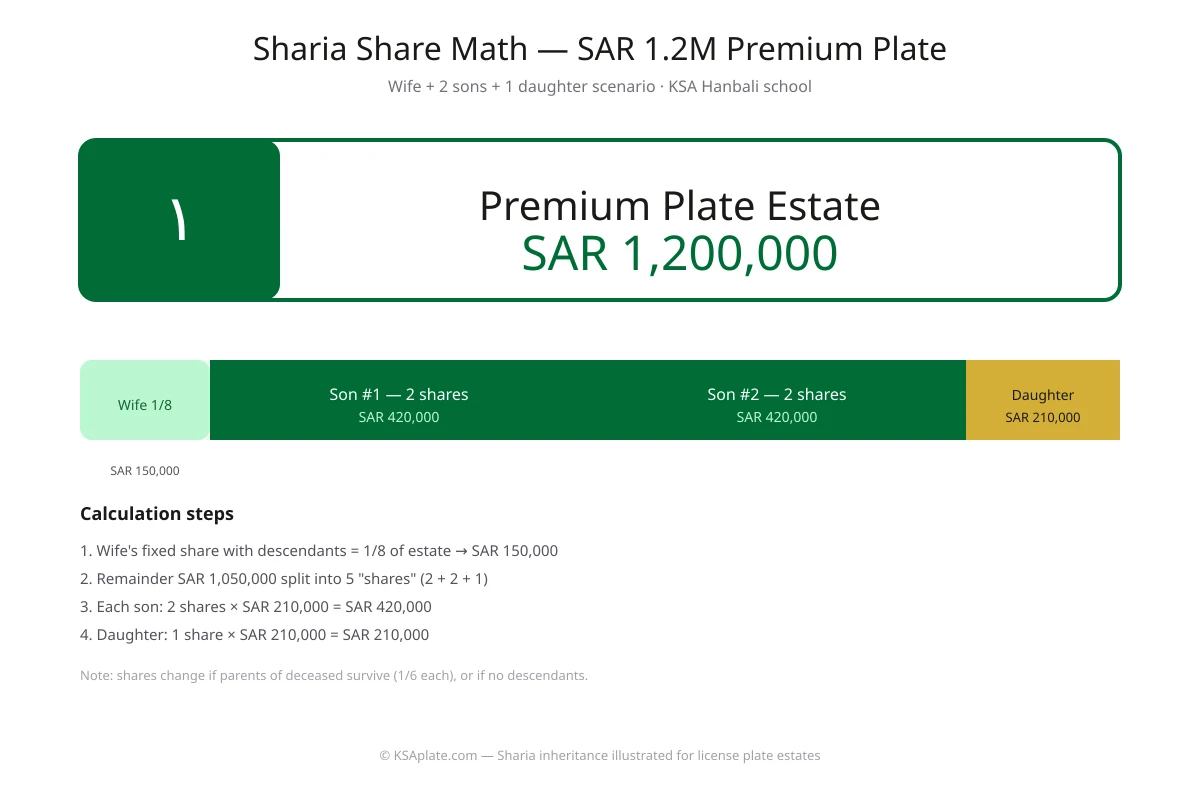
| Heir | Sharia Share | On SAR 1,200,000 Plate |
|---|---|---|
| Wife | 1/8 (with descendants) | SAR 150,000 |
| Son #1 | 2 shares of remainder | SAR 420,000 |
| Son #2 | 2 shares of remainder | SAR 420,000 |
| Daughter | 1 share of remainder | SAR 210,000 |
How the arithmetic runs: the wife's one eighth is SAR 150,000. The remaining SAR 1,050,000 is divided into five equal parts (2 + 2 + 1) of SAR 210,000 each; each son takes two, the daughter one. The four figures add back to SAR 1,200,000.
It stops being textbook quickly: surviving parents of the deceased each take a sixth, the picture changes again when there are no children, and it changes again when the deceased is a woman. This page is not the place to work out your case, and neither is a spreadsheet — the Heirs Certificate states the shares, and a qualified Saudi inheritance lawyer can read it with you before anything is disbursed. Small share errors turn into permanent family disputes.
Inheritance Transfer Fees & Exemptions in 2026
Here is what is actually published, and what is not. A standard vehicle ownership transfer (مبايعة المركبات) between private individuals costs SAR 380: a SAR 150 government fee plus a SAR 230 Absher service fee. Moving a plate number between two vehicles is a different service and costs SAR 400 per private vehicle plus a single SAR 230 Absher service fee — SAR 1,030 for two cars. For inheritance specifically, we could not source a published fee or exemption, and we are not going to invent one.
| Service | Government Fee | Absher Service Fee | Total |
|---|---|---|---|
| Vehicle ownership transfer, private vehicle | SAR 150 | SAR 230 | SAR 380 |
| Plate transfer between two private vehicles | SAR 400 per vehicle | SAR 230 once | SAR 1,030 |
| Transfer to an heir | No published fee or exemption we could source. Ask at the traffic department when you attend. An earlier version of this page claimed the fee was "often waived" and that a SAR 100 detachment charge applied; both were unsourced and have been removed. | ||
| Holding a plate in the Absher plate wallet | Saudi press coverage describes an annual renewal fee; no amount that we could source. Absher shows it when you use the service. | ||
Saudi Arabia does not levy a capital gains tax on individuals, and there is no estate tax. VAT at 15% applies to supplies made in the course of a business, which is why an auction result is quoted before VAT and settled after it — but a one-off sale between private individuals is not a taxable supply. If a licensed dealer is involved, or the estate is large, put the question to a ZATCA-registered accountant rather than to a website.
Realistic Timeline: 30, 60, 90 Days
Most heirs underestimate this, and most guides pretend to know more than they do. Below is a sequence rather than a schedule, because the two long poles — the court and finding a buyer — are not things anyone publishes a duration for.
- First: death certificate issued, family gathers documents, Najiz application filed for the Heirs Certificate. Start this the week the death certificate exists — it is the longest-lead step and nothing else can begin without it.
- Then: the Personal Status Court reviews, publishes its notice, and issues the Sakk Hasr Al Wirathah. Uncontested and complete files are described by Saudi practitioners as taking days to a couple of weeks; contested ones take much longer.
- Then: the heirs' representative attends a traffic department with the file and the vehicle or plate is transferred.
- Then, if the plate is being sold: list it, find a buyer, complete the transfer and distribute the proceeds by the shares in the certificate. How long a buyer takes is not something anyone can promise you — the top of the plate market is thin.
Disputed heirs, missing documents or heirs living outside the Kingdom stretch all of this out. An earlier version of this page gave day counts for each stage — "Days 1–14", "Days 14–45", "Days 45–55" — as though they were fixed. They were not sourced and they are gone.
Joint-Heir Decisions: Sell, Buy-Out, or Keep
When multiple heirs inherit a single premium plate, there are exactly three rational outcomes. Pick deliberately; family conflicts almost always come from drift.
Option A — Sell on the open market and split proceeds
The cleanest path. Detach via Absher, list on KSAplate.com to establish a defensible market price, finalize with a buyer, distribute proceeds per the Sakk Hasr Al Wirathah. Sharia shares are honored automatically.
Option B — One heir buys out the others
One heir wants to keep the plate (often eldest son for sentimental reasons). They pay each co-heir their Sharia share in cash, then receive the plate via standard Absher transfer. Always document the buy-out in a notarized Wikalah — verbal family agreements unwind ten years later.
Option C — Keep on the inherited vehicle, register it under one heir
Less common with valuable plates. The vehicle and plate transfer together to one heir, who pays the others their share in cash from outside funds. Same documentation requirement as Option B.
Special Cases: Expat Heirs & Heirs Outside KSA
If one or more heirs live outside Saudi Arabia, a Wikalah (power of attorney) authenticated by the Saudi embassy in their country of residence is mandatory. The document is then super-attested by the Saudi Ministry of Foreign Affairs and uploaded to Najiz alongside the Heirs Certificate application.
Female heirs do not require a male guardian to inherit or to sign Absher transfers since the 2019 reforms — they act independently using their own Absher Individual accounts. Minor heirs (under 18) require a court-appointed guardian, typically the surviving parent, who acts on their behalf and holds the proceeds in trust until majority.
7 Mistakes That Delay Plate Inheritance
- Trying to sell before the Sakk Hasr Al Wirathah is issued. Nothing can be transferred without it, so any agreement made beforehand cannot be completed.
- Filing Najiz from several heirs' accounts at once. Agree one primary applicant.
- Letting the deceased's vehicle insurance lapse. A transfer will not go through without valid insurance.
- Letting the Istimara expire during the court process. It is renewable, but it is another queue.
- Arriving at the traffic department without powers of attorney from the other heirs. The process is built around an authorised representative; without the Wikalah documents the trip is wasted.
- Assuming the vehicle transfer happens inside Absher. The traffic department's own guidance is that the heirs' representative attends in person.
- Accepting the first private offer without checking the market. Comparable live listings are the reference you have; there is no published record of what plates sold for, so anyone quoting you a "market price" — including a valuation tool — is giving you an estimate.
Frequently Asked Questions About Saudi License Plate Inheritance
Can I drive my late father's car before the inheritance transfer is complete?
The vehicle remains registered to the deceased until the transfer is done, so driving it is a registration problem even for an heir. Most Saudi families leave the car parked until at least the Sakk Hasr Al Wirathah is in hand. If it has to be moved, move it on a flatbed.
How long does the Sakk Hasr Al Wirathah take?
There is no published service level, and we removed the "14 to 45 days" this page used to state because we could not source it. Saudi law firms describe uncontested applications with complete documents as closing in anything from a few days to about two weeks, with a court session at the end; missing heirs, foreign documents or a contested relationship extend it substantially. Treat any specific number, including those, as an estimate from a practitioner rather than a rule.
Do I need a lawyer to inherit a license plate in Saudi Arabia?
Not strictly — Najiz is designed for direct use by citizens. But if the estate includes a plate worth several hundred thousand riyals, a Saudi inheritance lawyer is cheap insurance against a share miscalculation or a contested transfer. We deliberately do not quote a fee range: this page used to say "typically SAR 5,000–15,000", which was not based on anything, and legal fees vary by firm and by how contested the estate is.
Can heirs sell the plate before receiving the Heirs Certificate?
No. Saudi law does not permit the sale of any deceased person's property before the Sakk Hasr Al Wirathah is issued. Any pre-certificate "sale" — including verbal agreements and informal payments — is legally void and unenforceable in Saudi courts.
Are inherited plates exempt from Saudi VAT?
One-off private heir-to-buyer plate sales are not commercial transactions and fall outside the standard 15% VAT regime. If the plate passes through a licensed plate dealer, the dealer's commission and any commercial markup are VAT-applicable. KSAplate.com is a peer-to-peer marketplace, so private heir sales remain non-VAT.
What happens if heirs cannot agree on selling the plate?
An heir who cannot reach agreement with the others can bring the matter to the Personal Status Court, which is the forum for dividing an estate that the heirs cannot divide themselves. What the court then orders, how it values the asset and how long that takes are matters for the court and for a lawyer — this page previously described a standard procedure with a "neutral evaluator", a "sale agent" and a 60–90 day timeline, and we could not source that.
Can a non-Saudi heir inherit and sell a Saudi license plate?
Inheritance in Saudi Arabia is determined under Sharia rather than by the nationality of the heir, and a non-Saudi heir can be named on the Heirs Certificate. The practical constraints are the ones that apply to any resident: a plate transfer needs a vehicle on each side, and a non-Saudi resident may have at most two private vehicles registered at a time. An heir abroad acts through an authenticated Wikalah. Where the heirs are not all of the same religion the position is more complicated than a marketplace page should summarise — that is a question for a Saudi inheritance lawyer.
What if the deceased had outstanding traffic fines on the plate?
Outstanding Sahir or municipal fines must be cleared before any Absher transfer — inheritance does not waive them. They are paid from the estate, not from the heirs personally, and reduce the net distributable plate value pro rata.
Can the plate be transferred to a charitable trust (waqf)?
Endowing inherited property as waqf is a recognised concept in Saudi law and is handled through the courts and the notary service, not through a vehicle-services form. Whether it can be done with a specific plate, what all the heirs must agree to and how the deed is drawn are questions for a lawyer. An earlier version of this page answered "yes, with unanimous consent and a notarised waqf deed" as though the procedure were settled and routine; we could not source that and have replaced it with the honest answer.
Conclusion & Next Steps for Heirs
Inheriting a Saudi plate is one of the few estate situations where what the family ends up with depends heavily on how the process is handled — mostly because the paperwork must be done in the right order, and because a plate sold in a hurry to the first person who asks is unlikely to be sold well. We are not going to put a percentage on that gap: this page used to say informal sales clear "30–50% lower", and that number was invented.
The sequence is always the same: death certificate → Sakk Hasr Al Wirathah through Najiz → powers of attorney from the heirs → the traffic department for the vehicle or plate transfer → list the plate if it is being sold → distribute the proceeds by the shares in the certificate.
Check the plate against the live market first
Before accepting any private offer, look at what comparable plates are currently asking. Our free calculator gives a modelled estimate built from listing prices — it is not a valuation, and no one can give you a valuation from sold prices, because private Saudi plate sales are not published. Used with that in mind, it is a useful reference point in a conversation with co-heirs.
Open the plate value calculator →Last updated: 3 May 2026 · This guide is information, not legal, religious or tax advice, and KSAplate.com is a plate marketplace rather than a law firm — we benefit when plates are listed and sold here, so read anything above that sounds like a recommendation with that in mind. Inheritance shares are determined by the Personal Status Court and stated in the Heirs Certificate. For anything specific to your estate, consult a Saudi inheritance lawyer or Najiz support.