


TL;DR:
- The SUV is the default family car of Saudi Arabia for structural reasons — highway distances, desert weekends, three-generation households, and a used market that rewards the segment better than any other. This guide is the full decision path, from size class to test drive.
- Size class decides more than badge: a compact crossover carries a young family; a mid-size five-seater fits most; a genuine three-row is a different machine with different costs — and the third row you actually use is the one adults can survive.
- Our market curves make the money case: the big family SUVs hold value like nothing else here — a Land Cruiser gives up only ~8% a year, a Fortuner runs an almost perfectly straight SAR 10,000-per-year ladder — which changes the new-vs-used math in the buyer's favor.
- The family test drive is its own discipline: bring the child seat, load the stroller, put an adult in the third row, and test the rear AC at midday — ten minutes of checks that catalogs and salespeople never volunteer.
- Buy in a window, sell before the wave: SUV demand spikes with the school year; the smart family times the swap against the market calendar, not the school run.
Quick answer: The best family SUV in Saudi Arabia depends on one honest question — how many people ride at once. Two children fit a mid-size five-seater (Fortuner, Santa Fe, Tucson class) with money to spare; three-across child seats or six-plus people need a genuine three-row (Land Cruiser, Patrol, Tahoe, Expedition class). Check ISOFIX positions and measure the bench before buying, insist on rear AC vents that reach the last row, and note that the large desert-proven SUVs hold their value better than any other segment in the kingdom — our market curves put the Land Cruiser at roughly 8% depreciation per year, which makes a well-kept 2–4 year example the sanest family purchase in the market.
Why the SUV is the Saudi family default
In most markets the family SUV is a preference; in Saudi Arabia it is closer to a fit-for-purpose answer. The distances are real — Riyadh to the Eastern Province is a routine family weekend, Jeddah to Taif a casual climb — and they are driven at 120–140 km/h with luggage, children, and often grandparents aboard. The desert is not scenery here but a destination: dunes on Friday, a farm outside the city, an unpaved last kilometer that a low sedan negotiates twice and then goes up for sale.
Three structural facts shape the segment locally:
- Households are bigger. Three children is unremarkable, a live-in driver or grandmother common — seven seats in the kingdom are used as seven seats, not as an insurance policy.
- The climate punishes small margins. A struggling AC, a cramped third row against sun-heated glass, an underpowered engine at GCC summer temperatures — weaknesses that a test drive in mild weather hides and July exposes. GCC-spec cooling packages exist for a reason; the differences are covered in our GCC-spec vs American-spec guide.
- The market votes with residuals. The desert-proven big SUVs are the kingdom's automotive reserve currency — the resale section below puts our own numbers on it.
None of this makes the biggest SUV the right answer for every family — the opposite. The guide's first real job is the size question, because that is where most money is won or wasted.
The three size classes, honestly compared
Marketing blurs the classes; ownership does not. Sort candidates into three honest boxes before comparing badges:
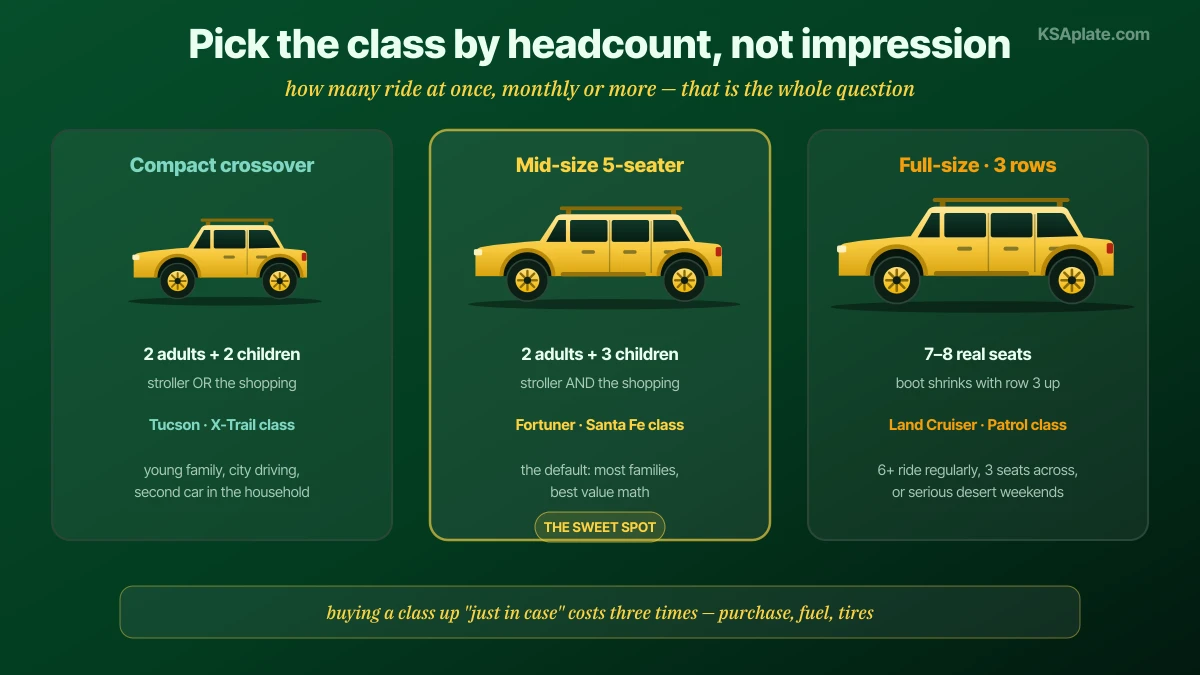
| Class | Typical examples | Real capacity | Choose it when |
|---|---|---|---|
| Compact crossover | Tucson, X-Trail, CX-5 class | 2 adults + 2 children; boot fits a stroller or the shopping | Young family, city driving, second car in a two-car household |
| Mid-size 5-seater | Fortuner, Santa Fe, Sorento, Pajero class | 2 adults + 3 children; stroller and shopping | The default: most families, most budgets, best value math |
| Full-size / 3-row | Land Cruiser, Patrol, Tahoe, Expedition class | 7–8 real seats; luggage for all of them behind row three only in the longest versions | 6+ people ride regularly, three child seats across, or serious desert use |
The honest sizing question is not "what might we need someday" but how many people ride at once, monthly or more often. Buying a class up "just in case" costs real money three ways — purchase, fuel, tires — and the market data below shows the one case where the premium partly pays itself back. Two edge notes: three child seats across is a width problem more than a row-count problem (some mid-size benches take three narrow boosters; measure — the technique is in our child car seats guide), and if the third row will carry adults weekly, treat the class table's "7–8 real seats" claim as something to verify with your own knees in the test drive.
What our market data says about SUV value
We maintain valuation curves for the Saudi market built from thousands of real local listings — the same data that powers our free car value calculator — and the family-SUV segment is where they tell the clearest story in the entire market:
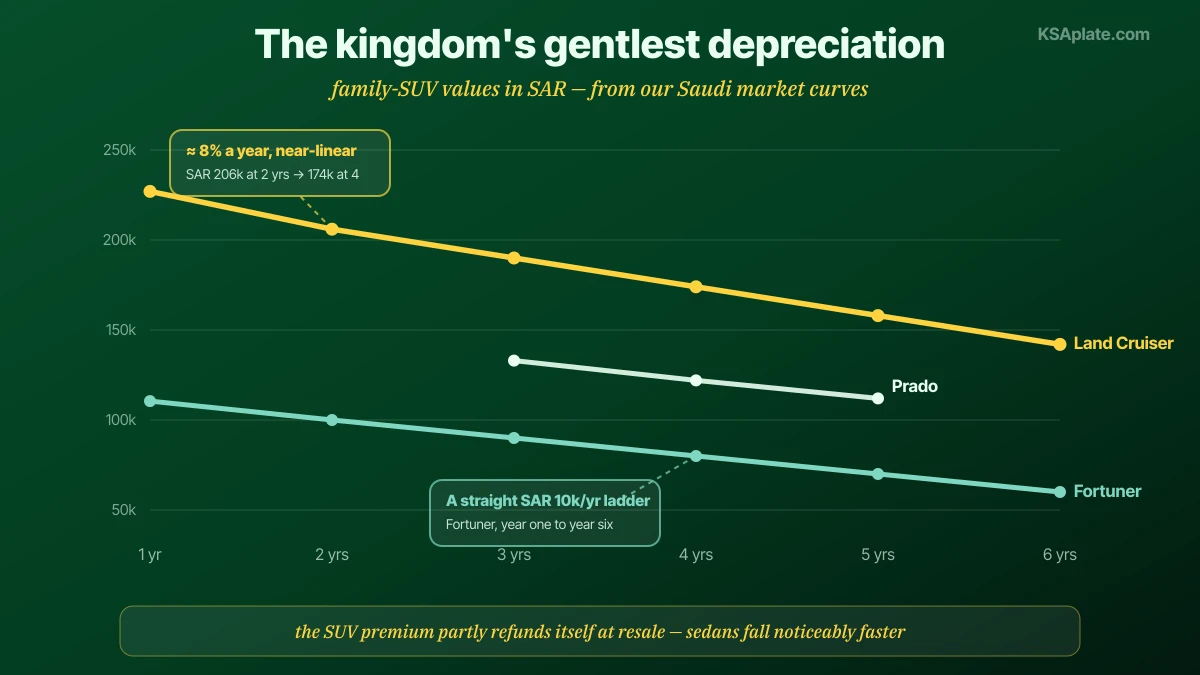
| Model (from our curves) | Value at 2 yrs | Value at 4 yrs | What it means |
|---|---|---|---|
| Toyota Land Cruiser | ≈ SAR 206,000 | ≈ SAR 174,000 | ~8% a year, almost linear — the segment's benchmark |
| Toyota Fortuner | ≈ SAR 100,000 | ≈ SAR 80,000 | A straight SAR 10,000-per-year ladder from year one to six |
| Toyota Prado (3→5 yrs) | ≈ SAR 133,000 at 3 | ≈ SAR 112,000 at 5 | Same gentle slope in the middle years |
| Mid-size sedan reference | ≈ 85–90% kept | ≈ 65–70% kept | Noticeably steeper — the SUV premium partly refunds itself at resale |
Read the table as a financing statement: a Fortuner costs its owner roughly SAR 10,000 a year in depreciation at almost any age, which means the difference between buying at two years and buying new is mostly the first owner's registration paperwork. The Land Cruiser's curve is so flat that when you buy matters more than how old — a point our best-time-to-buy guide develops into a full calendar. The flip side deserves equal honesty: these residuals price the models high on the used market, so the "cheap used Land Cruiser" does not exist — what exists is a used Land Cruiser that will also sell well for you in four years.
What's your car worth?
Get a free instant estimate based on real Saudi market data — then sell it on KSAplate with direct WhatsApp contact.
Value My Car — FreeSeats, ISOFIX and the third-row truth
Family capacity is specification work, not impression work:
- ISOFIX positions. Nearly every SUV sold here in the last decade has anchors in the two outboard rear positions; the useful differences are a third anchor set (center or front passenger) and top-tether points that remain reachable with the boot loaded. Verify per car, not per brochure — anchors and installation discipline are covered in depth in the child car seats guide.
- The three-across test. Bench width at cushion level, not shoulder level, decides whether three restraints fit. Bring the actual seats to the viewing, click all three, and check the middle one still installs tight — five minutes that settles the single most common family-capacity question.
- The third-row truth. In most three-row SUVs, row three is sized for children and short trips; the genuine full-size machines seat adults there, but their boot behind row three can still be smaller than a hatchback's. If school-run logistics need seven seated and five school bags, check the boot with the row up — this is the specification that quietly eliminates half the shortlist.
- Access matters daily. A parent buckling a toddler forty times a week cares about door opening angles, step-in height, and whether the middle row tilts with a child seat installed (many do not). These are two-minute checks at the showroom and daily friction for five years afterward.
Heat: the AC test that decides everything
In the kingdom, air conditioning is not a comfort feature of a family SUV; it is the difference between a car the family uses in August and one it argues about. The specification points that separate adequate from excellent:
- Rear vents are non-negotiable — and for a three-row, that means third-row vents (ceiling or pillar), not just console outlets for row two. A rear evaporator (true rear AC, not just ducting) is what keeps the back cold at a red light in July.
- Test at temperature, not at dawn. Park the candidate in the sun during the viewing, then measure the honest number: how many minutes until the last row is comfortable? The cooling sequence and cabin-heat physics are laid out in our child seats guide's heat chapter — the same oven math applies to every passenger.
- Glass and color are part of the AC system. Light exterior colors, light interiors, and quality rear film within the legal limits (see the tinting rules guide) reduce the load the compressor fights. A dark-on-dark full-size with bare glass is a beautiful showroom object and a daily grievance.
- Check the AC's service history like an engine's. On used candidates, weak cooling is a negotiation-grade defect in this market — compressor and evaporator work is real money, and "needs a regas" is often the hopeful description of a dying compressor.
Safety kit that matters for families
Beyond the child-seat fundamentals, the equipment list worth insisting on — in rough order of real-world value on Saudi roads:
- Autonomous emergency braking (AEB) — the single highest-value assist at highway speeds and in stop-start city traffic alike.
- Blind-spot monitoring and rear cross-traffic alert — a tall SUV full of children has real sightline problems; these two remove the worst of them, especially reversing out of mall parking.
- 360° camera or at minimum a clear reversing camera — the around-the-car view is a child-safety feature in driveways, not a parking toy.
- Stability control with trailer/off-road logic intact — standard on modern stock, worth verifying on imports and modified used examples.
- Speed-assist realism: assists supplement attention at 140 km/h, they do not replace it — camera enforcement and limit logic live in our Saher guide.
On used candidates, verify the airbag ecosystem after any accident history — a history check (how-to here) plus an OBD scan for stored airbag faults is the two-step that catches the expensive silent problem.
Running costs: fuel, insurance, tires
The purchase price is the loud number; the quiet ones decide whether the SUV stays loved:
- Fuel. Even at Saudi pump prices, the step from a 2.5L four to a V6, and from V6 to V8, is felt monthly on a school-run-plus-highway profile. A full-size V8 family hauler can double a compact crossover's fuel line. Octane requirements differ by engine too — check the filler flap against our 91 vs 95 octane guide rather than paying for premium out of superstition.
- Insurance. Comprehensive premiums scale with value and repair cost; the big SUVs cost more to insure in absolute terms but often less as a percentage of value, and their parts networks (Toyota and Nissan above all) keep repair quotes sane. Market mechanics are in the insurance guide.
- Tires. The forgotten line item: a set of 20-inch full-size-SUV tires costs multiples of a crossover's 17s, and desert heat ages rubber on a schedule. Budget a set every 3–4 years and check date codes on any used purchase.
- The full ledger — depreciation, fuel, insurance, maintenance, registration — is assembled with worked examples in our cost of ownership guide; run your shortlist through it before falling for a trim level.
New or used — and which age to buy
The general decision framework lives in new vs used in Saudi Arabia; the SUV-specific twist comes from the flat curves above:
- Flat curve = smaller penalty for buying new. On a Land Cruiser-class machine losing ~8% a year, the classic "let someone else eat the depreciation" argument is weaker than for sedans — if the budget reaches, new is defensible here as almost nowhere else.
- Flat curve = safer used purchase. The same flatness protects the used buyer: a 3–4 year example has predictable remaining value, and the 2–4 year sweet spot still applies wherever a first owner absorbed the drive-off drop.
- Where the used SUV market punishes: hard desert use hides in underbodies and suspension. On any used candidate: underbody inspection for sand-blasting and impact marks, diff and transfer-case service history, and the full flood-and-history discipline from the used car buying guide. A desert toy dressed as a school-run car is the segment's classic trap.
- Time the purchase. SUV demand peaks with the school year (September) and family listings swell in early summer — the calendar arbitrage is mapped month by month in the timing guide.
The family test drive, step by step
Salespeople run the adult test drive; nobody runs the family one unless you bring it. It takes fifteen minutes and settles more than any brochure:
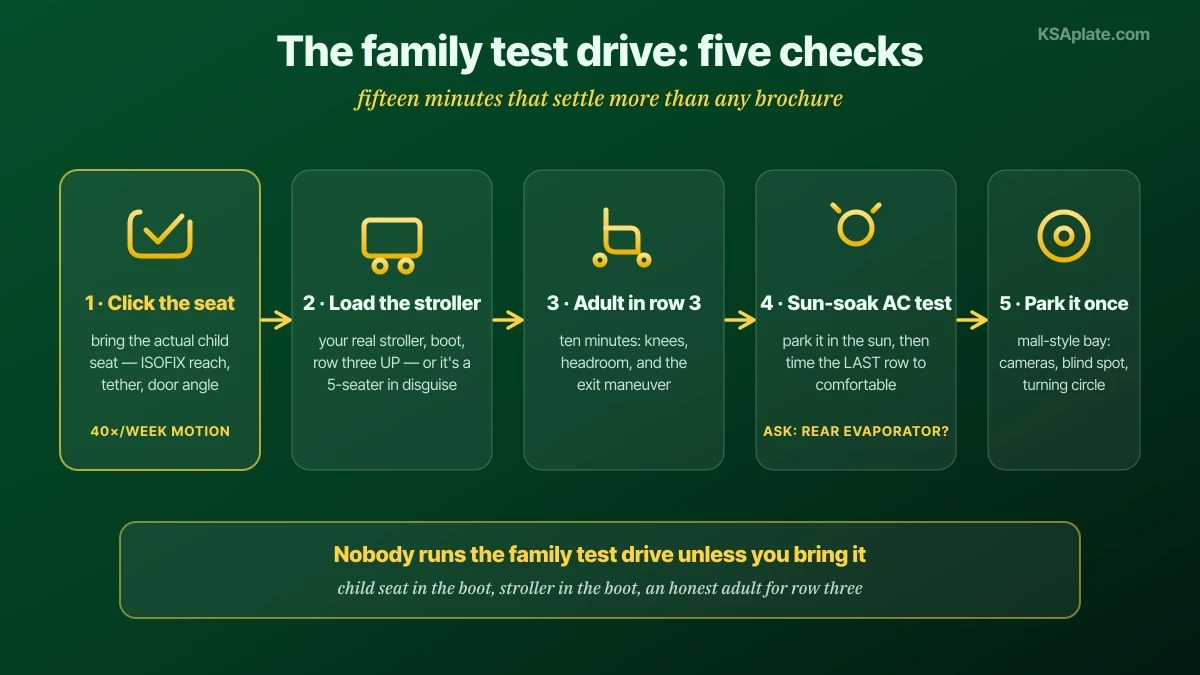
- Bring the child seat and click it in. ISOFIX reachability, tether points, door angle for the lift — the forty-times-a-week motion, tested once before paying.
- Load your actual stroller with row three up. If it only fits with the row folded, you have a five-seater with occasional extra chairs — decide if that is what you are paying for.
- Put an adult in row three for ten minutes. Knees, headroom, and the exit maneuver. Children graduate to that row eventually; teenagers hold grudges.
- Run the sun-soak AC test. Car parked in the sun, then time the last row to comfortable. Ask directly whether the car has a rear evaporator or only ducts.
- Do one real parking maneuver. Mall-style bay, camera coverage, blind-spot behavior, turning circle. The tall body's daily costs and gifts all show up in ninety seconds of parking.
On used candidates, this family layer sits on top of the mechanical one — daylight inspection, history pull, transfer-then-pay — from the buying guide.
Doing the deal: buying and selling smart
The family-SUV swap is usually a two-sided transaction — the outgrown car funds the bigger one — and both sides reward the same discipline:
- Anchor both prices in data. Run the exact outgoing car and the exact candidate through the free car value calculator, then compare against current listings across Saudi Arabia. The spread between the two honest numbers is your real budget — showroom trade-in "generosity" is usually your own resale value handed back to you.
- Sell the outgoing car properly. A family sedan or compact SUV with documented service history is exactly what the next young family is searching for — list it for free with the ISOFIX anchors, non-smoking history and service file in the first lines. The private-vs-trade-in math is worked through in the comparison guide; the convenience discount is largest precisely when family-car demand is hottest.
- Mind the season on both legs. Buy the SUV in a discount window, sell the outgoing car before the summer listing glut — the two moves together are commonly worth a five-figure riyal swing on a full-size purchase.
- Browse wide before deciding. The live listings show what trims and colors actually circulate here — a shortlist built from real local supply beats one built from global reviews of trims the kingdom never imported.
Frequently asked questions
What is the best family SUV in Saudi Arabia?
Which SUV holds its value best in Saudi Arabia?
Is a 7-seater necessary for a family of five?
Are third-row seats safe for children?
New or used family SUV — which is smarter in Saudi Arabia?
What should I check on a used SUV that may have been in the desert?
How many ISOFIX positions do family SUVs have?
What does a full-size SUV cost to run per month in Saudi Arabia?
Is rear AC really necessary in a family SUV here?
When is the best time to buy a family SUV in Saudi Arabia?
Should I check an SUV's market value before negotiating?
Conclusion
The family-SUV decision compresses into an honest sequence: count who actually rides, pick the class that carries them (not the one that flatters the driveway), verify the family layer with your own seats and stroller and knees, test the AC like the safety equipment it is here, and let our market curves — not showroom instinct — set both prices in the swap. Do those five things and the segment rewards you twice: a car the family genuinely fits, and the kingdom's gentlest depreciation working for you instead of against you.
When the moment comes, run the numbers first on the free value calculator, shop the live listings with a measuring tape and a child seat in the boot, and list the outgrown car for free — service file photographed, ISOFIX anchors in the first line. Somewhere in the kingdom tonight, a parent is searching for exactly the car you are about to outgrow. The family-SUV market runs on that handover; enter it with the numbers in your hand.