


TL;DR:
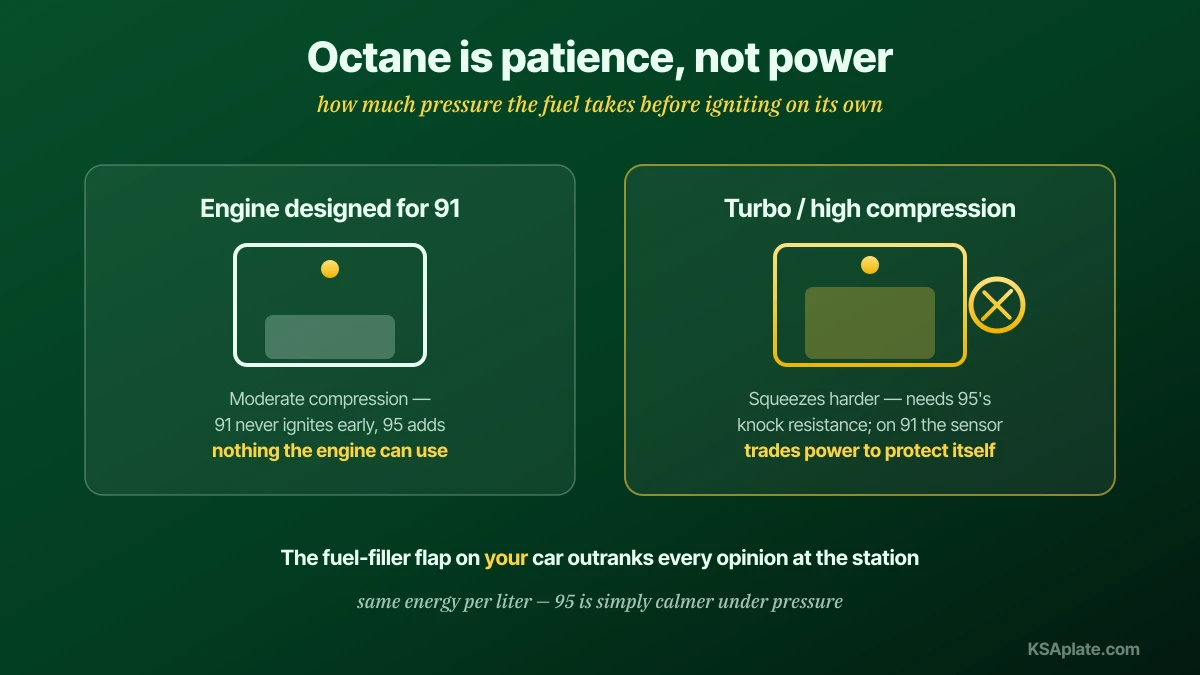
- Octane is knock resistance, not power. 95 does not make a car faster or cleaner — it lets high-compression and turbocharged engines run their designed ignition timing without knocking.
- Your engine, not the pump, decides. The fuel-filler flap and the owner's manual state the minimum octane; a car specified for 91 gains nothing from 95, and a car specified for 95 slowly harms itself on a steady diet of 91.
- Mixing 91 and 95 is harmless — you simply get an in-between octane. One wrong fill in a 95 car is almost never an emergency: drive gently and fill with 95 next time.
- The real fuel savings in Saudi Arabia are behavioral: tire pressure, smooth throttle, AC discipline on the highway and removing roof racks beat any octane decision — worth 10–20% versus roughly 7% price difference between grades.
- Heat changes the math: summer AC load can add noticeably to consumption, hot tires lose pressure accuracy, and short trips on a heat-soaked engine burn more — the section below turns each into a habit, not a worry.
Quick answer: Use the octane written on your fuel-filler flap or owner's manual. In Saudi Arabia that means 91 for most economy and mid-range cars and 95 for most turbocharged, high-compression and luxury engines. 95 in a 91-spec car buys nothing measurable; 91 in a 95-spec car risks knock and long-term damage, especially in summer heat and under load. Mixing grades is safe, and a single wrong fill is fixed by driving gently and refilling correctly.
What octane actually is
Octane rating measures one thing: how much compression and heat a fuel can take before it ignites on its own instead of waiting for the spark plug. That uncontrolled early ignition is knock — a pressure spike that hammers pistons and, repeated over months, shortens an engine's life.
Higher octane does not contain more energy. Liter for liter, 91 and 95 hold essentially the same energy; 95 is simply more patient under pressure. That patience only matters in engines built to squeeze the mixture harder — high compression ratios, turbochargers, aggressive ignition timing. In those engines, 95 lets the design run as intended. In a modest-compression engine tuned for 91, the extra patience is never called upon, which is why the upgrade buys nothing.
Modern engines add one complication worth knowing: knock sensors. When the sensor hears knock beginning, the computer retards ignition timing to protect the engine. That protection works — but it quietly trades away power and efficiency. This single mechanism explains most of the honest answers in this guide: a 95-spec engine on 91 usually will not grenade itself; it will just run permanently below its design, slightly weaker and slightly thirstier, with the margin thinnest on the hottest days.
91 or 95: how to know what your car needs
Three places give the answer in under a minute, in this order of authority:
- The fuel-filler flap. Most cars sold in the Kingdom state the minimum octane right where you fuel. "91" or "95 min" ends the debate.
- The owner's manual — search "fuel recommendation". Note the wording: minimum 91 means 91 is fine; recommended 95 with a 91 minimum means the car runs on 91 but performs and consumes as designed on 95.
- The engine's spec sheet. Turbocharged or supercharged? High compression (roughly 11:1 and above)? Performance or luxury badge? Default to 95 unless the manual explicitly blesses 91.
Rules of thumb for the Saudi market: the volume sellers — the compact sedans, the naturally aspirated family cars, most pickups and older SUVs — are 91 cars. Most European luxury models, most modern turbo engines regardless of size, and most performance trims are 95 cars. GCC-spec versions of a model are often calibrated for the local 91 where the same car elsewhere asks for higher octane — one more reason the flap on your car outranks advice about the model in general, and one of several differences covered in our GCC-spec vs imported guide.
The myths, tested against physics
Fuel is one of the most myth-rich corners of car ownership. The table separates station-forecourt folklore from what actually happens in the cylinder.
| Claim | Verdict | What's actually true |
|---|---|---|
| "95 gives more power in any car" | Myth | Only engines designed (or knock-limited) for higher octane gain anything; a 91-spec engine runs identically. |
| "95 cleans the engine" | Mostly myth | Cleaning comes from detergent additive packages, not octane. Grades at the same station typically share the additives. |
| "91 will destroy a 95 car immediately" | Exaggerated | Knock sensors protect short-term; the real cost is chronic — reduced power, higher consumption, and long-term risk under heat and load. |
| "Mixing grades is dangerous" | Myth | Mixing yields an intermediate octane. Half 91, half 95 behaves like ~93. |
| "95 burns slower so you save fuel" | Myth in 91 cars | Consumption differences appear only where the engine can exploit the octane — i.e., in 95-spec engines previously fed 91. |
| "Morning fueling gives you more fuel" | Practically myth | Station tanks sit underground at stable temperature; the volume difference is negligible. Fuel whenever suits you. |
What's your car worth?
Get a free instant estimate based on real Saudi market data — then sell it on KSAplate with direct WhatsApp contact.
Value My Car — FreeWrong fuel in the tank: what to do
The two scenarios are not symmetrical, and neither justifies panic:
- 91 into a 95 car (the common mistake). Do not race the engine. Drive gently — light throttle, no heavy loads, no hard acceleration up flyovers in afternoon heat — and refill with 95 as early as practical, diluting the tank upward. The knock sensor is your safety net for one tank driven sensibly. If you hear metallic rattling under acceleration (knock you can hear), ease off further and shorten the dilution timeline.
- 95 into a 91 car. No risk at all. You spent a few extra riyals; the engine neither knows nor cares. Enjoy the placebo and return to 91 next fill.
The genuinely serious mistake is a different one — diesel into a petrol car or the reverse. If that happens, do not start the engine; a tank drain at a workshop is cheap compared with a fuel-system rebuild. It is rare at Saudi pumps thanks to nozzle sizing and clear labeling, but rental cars and unfamiliar stations are where it happens.
What actually cuts fuel consumption
Here is the honest hierarchy — the boring mechanical habits outperform every fuel-grade debate, and none of them costs anything.
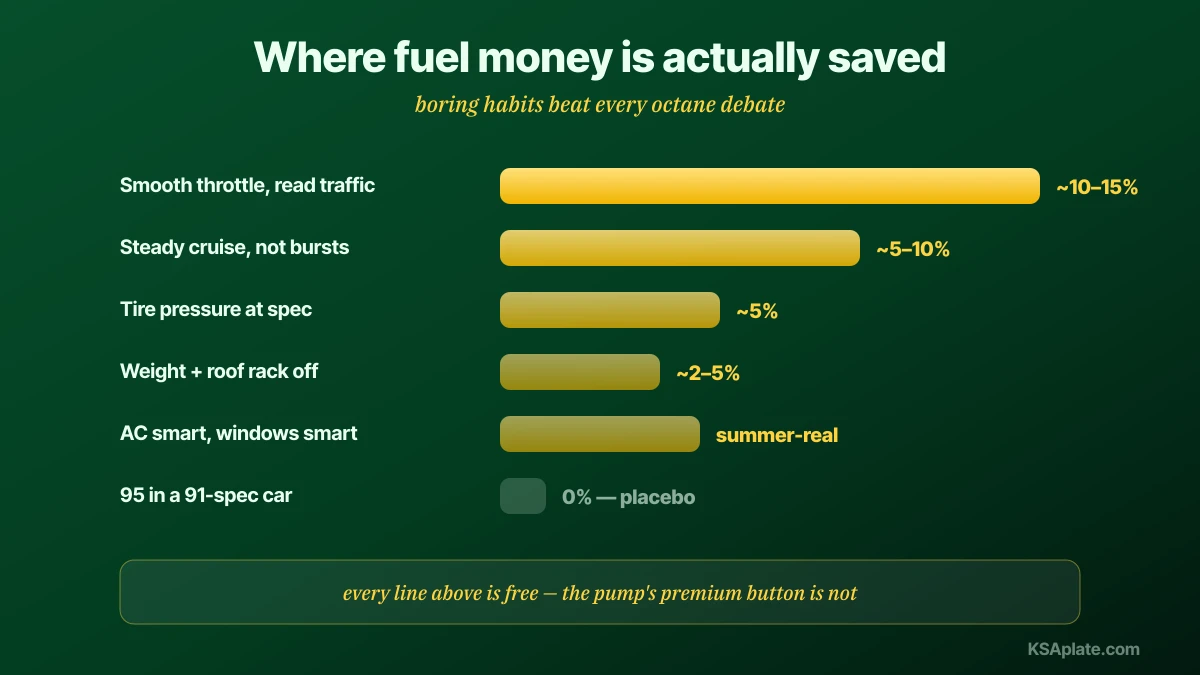
| Habit | Typical effect | The Saudi-specific note |
|---|---|---|
| Tire pressure at spec, checked monthly | up to ~5% | Check cold, mornings — afternoon asphalt adds phantom pressure |
| Smooth throttle, reading traffic ahead | ~10–15% in city | The single biggest lever on Riyadh and Jeddah commutes |
| Steady cruise near the limit | ~5–10% vs aggressive bursts | Consumption climbs steeply above 120 km/h — the limit is also the efficient zone |
| Weight and roof racks off | ~2–5% | Roof boxes punish highway runs between cities the most |
| AC used smartly | meaningful in summer | Above city speeds, AC beats open windows — see the heat section |
| Right octane, not premium octane | ~7% of fuel spend | The price gap between 91 and 95, saved instantly by 91-spec cars |
Maintenance multiplies all of it: a clogged air filter, tired spark plugs or old oil quietly tax every kilometer. The upkeep rhythm that protects both consumption and engine health is laid out in the Saudi car maintenance guide.
Fuel and the Saudi summer
Heat rewrites three fuel behaviors, and knowing which ones matter keeps you from optimizing the wrong thing:
- AC is a real load — use it strategically, not ascetically. Compressor drag raises consumption noticeably in stop-and-go summer traffic. But the alternative — windows open at highway speed — costs more through aerodynamic drag once you are moving quickly. The efficient pattern: windows for the first minutes to dump cabin heat, then AC on recirculate at a moderate setting.
- Park in shade like it's money. A cabin at extreme temperature demands minutes of maximum AC; a shaded or covered car starts the trip several degrees ahead, every single time.
- Knock risk rises with heat. Hot intake air makes engines knock-happier — which is precisely why a 95-spec engine tolerates 91 worst in August with a full load of passengers and luggage. If you ever compromise on octane, winter is forgiving; summer is not.
One summer non-worry to retire: fuel "evaporating from the tank" in modern sealed systems is negligible. Where fuel actually disappears in summer is the idling car left running for the AC — thirty minutes of parked idling burns fuel for zero kilometers, the worst consumption figure a car can produce.
At the station: quality, additives, habits
Saudi fuel is refined to national specification, and grade-for-grade the product is consistent — the practical differences between stations are operational, not chemical. What is worth caring about:
- Busy stations turn their fuel over fast — fresh stock, well-maintained pumps, and filters changed on schedule. The remote station with one dusty pump is where water-in-fuel stories come from.
- Additive "premium" branding promises cleaning benefits; the detergent packages in standard Saudi grades already meet spec. If your engine idles rough, the fix is diagnosis, not a magic nozzle.
- Do not top up after the click. Forcing extra fuel can flood the vapor-recovery system (the carbon canister) — a real repair bill in exchange for half a liter.
- Keep receipts if you suspect bad fuel. Rough running that starts within kilometers of one specific fill is the pattern; a workshop can confirm water or contamination, and the receipt is your paper trail.
The 91-vs-95 cost math, honestly
At the time of writing, 95 costs roughly 7% more per liter than 91 at Saudi pumps (grades are repriced periodically — the pump sign is always the source of truth; the ratio moves slowly even when prices move). What that gap means over a year:
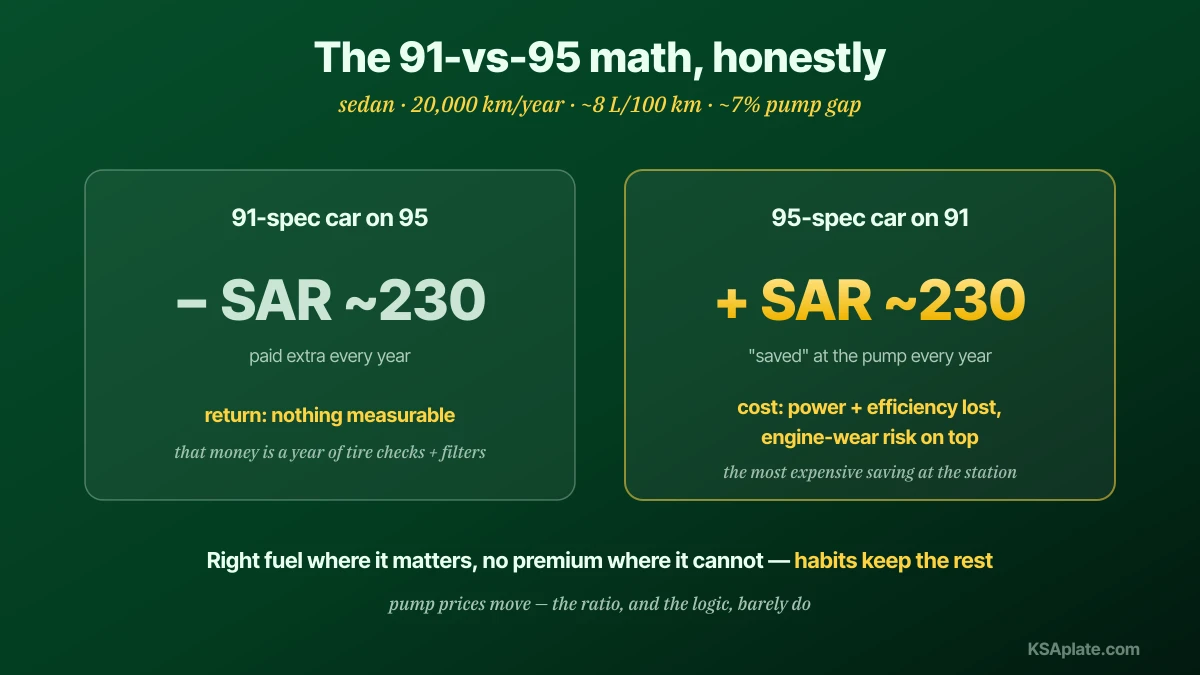
- A 91-spec sedan, 20,000 km at ~8 L/100 km: about 1,600 liters a year. Paying the 95 premium out of superstition costs roughly a few hundred riyals annually and returns nothing. That money is a full year of correct tire pressure checks, an air filter and a wash habit — things that actually move consumption.
- A 95-spec car "saving" on 91: the pump saving is the same few hundred riyals — but the engine gives part of it back immediately through knock-retarded efficiency, and holds a long-term repair risk on top. Averaged honestly, feeding a 95 engine cheap fuel is the most expensive saving at the station.
- The break-even question people actually mean — "should my next car be a 91 car?" — is legitimate: over five years, the grade difference on a high-kilometer commute is real money, and it belongs in the same budget line as insurance class and depreciation. Filter your shortlist accordingly — current listings across Saudi Arabia show plenty of 91-spec workhorses — and run the full ownership math from the cost of owning a car guide.
Turbos, imports and older engines
- Turbocharged engines compress intake air and run closer to the knock edge by design — they are the least forgiving audience for under-octane fuel, and the reason so many modern small engines specify 95 despite modest badges.
- Imported cars deserve a specific check: a vehicle built for another market may assume higher-octane fuel than its GCC twin, and its manual — not local habit — is the authority. If you are bringing a car in, put fuel spec on the checklist alongside everything else in the car import guide.
- Older engines with carbon buildup effectively raise their own compression in the deposits' hotspots and can begin knocking on the fuel they lived on for years. If an aging 91 car starts pinging under load, a decarbonizing service and checking ignition timing come first; stepping up to 95 is a legitimate stopgap, not a cure.
- Electric escape hatch: if the yearly fuel math genuinely hurts, the structural answer in the Kingdom increasingly exists — the realities are covered in the electric cars in Saudi Arabia guide.
Fuel habits and resale value
Fuel discipline is invisible on a listing photo but audible in the engine bay. A 95-spec car that lived on 91 tells the story at the test drive — hesitant throttle response, occasional pinging under load, sometimes a stored knock-related code a buyer's OBD scanner will find in thirty seconds. Buyers in the used market pay for engines that feel right, and they discount hard for ones that do not.
When selling, make the invisible visible: fuel receipts alongside service records read as an owner who ran the car correctly, and that credibility converts directly into asking-price defense. Before you set that price, ground it in data — run the exact model, year and mileage through the free car value calculator for the private-sale range, see what comparable cars ask on current listings across Saudi Arabia, and when you are ready, list it for free with buyers contacting you directly on WhatsApp.
FAQ
Is 91 or 95 better for my car in Saudi Arabia?
Does 95 give more power or lower consumption in a 91 car?
What happens if I put 91 in a car that requires 95?
Can I mix 91 and 95 fuel?
Does premium fuel clean the engine?
Is it true that fueling in the morning gives more fuel?
Should I use AC or open windows to save fuel?
Why does my car consume more fuel in the Saudi summer?
My older car has started knocking on 91 — what should I do?
Do I really need 95 in my turbocharged car?
Does fuel choice affect resale value?
Conclusion
The 91-versus-95 question has a one-line answer — run what your engine was designed for — and everything beyond that line is either physics or folklore. Octane is knock resistance, not power; knock sensors turn cheap-fuel damage into quiet inefficiency; mixing is harmless; and the savings that actually show up at the end of the month come from tire pressure, throttle discipline, smart AC use and honest maintenance rather than from the pump's premium button.
Spend where the engine benefits, save where it cannot tell the difference, and let the habits compound. And when the day comes to hand the keys on, those habits become money directly: check what the car is worth on the valuation tool and list it for free — an engine that always got the right fuel has nothing to hide at the test drive.