
TL;DR:
- You can import a car into Saudi Arabia, but it must meet strict rules: generally a recent model year, left-hand drive, not salvaged or flooded, and compliant with Saudi (SASO) standards.
- The real cost is far more than the sticker price abroad — add shipping, about 5% customs duty, 15% VAT, plus clearance, SASO testing and registration fees.
- The process runs: buy → ship to a Saudi port → clear customs (ZATCA) and pay duty + VAT → pass SASO conformity and Fahes inspection → register and get plates on Absher.
- Rules change and vary by case — always confirm the current age limit, duties and documents with Saudi Customs and SASO before you commit.
- For most buyers, a GCC-spec car bought locally wins — it avoids shipping, customs risk, spec problems and the lack of agency warranty that come with imports.
Quick answer: To import a car into Saudi Arabia, the vehicle must qualify (recent model year, left-hand drive, not salvaged, and able to meet SASO standards), then you ship it to a Saudi port, clear it through Customs (ZATCA) paying roughly 5% duty plus 15% VAT, pass SASO conformity and a Fahes inspection, and finally register it and get plates through the traffic department on Absher. Because duty, VAT, shipping and compliance stack up — and imports carry no agency warranty and weaker resale — importing only makes sense in specific cases; most buyers are better off with a GCC-spec car bought locally.
Can you import a car to Saudi Arabia?
Yes — importing a car into Saudi Arabia is allowed, but it is a regulated process with real conditions, real costs and real paperwork. It's not as simple as buying a car abroad and driving it home. The Kingdom controls which vehicles can enter to protect road safety, uphold technical standards, and manage the market, so the first question is never "how do I ship it?" but "does this specific car even qualify?"
Importing tends to make sense for a narrow set of people: someone relocating with a car they already own, a buyer chasing a rare model that isn't sold locally, or an enthusiast who has done the maths and found a genuine saving. For the average buyer who just wants a good, reliable car, importing usually adds cost and hassle without a clear payoff — a point we'll return to honestly at the end. If you're weighing your options broadly, our guide to buying a used car in Saudi Arabia covers the local route.
The import rules that decide eligibility
Before anything else, confirm the car qualifies. A vehicle that fails any core rule can be refused at the border, forcing a costly re-export — so this is the step to get right first.
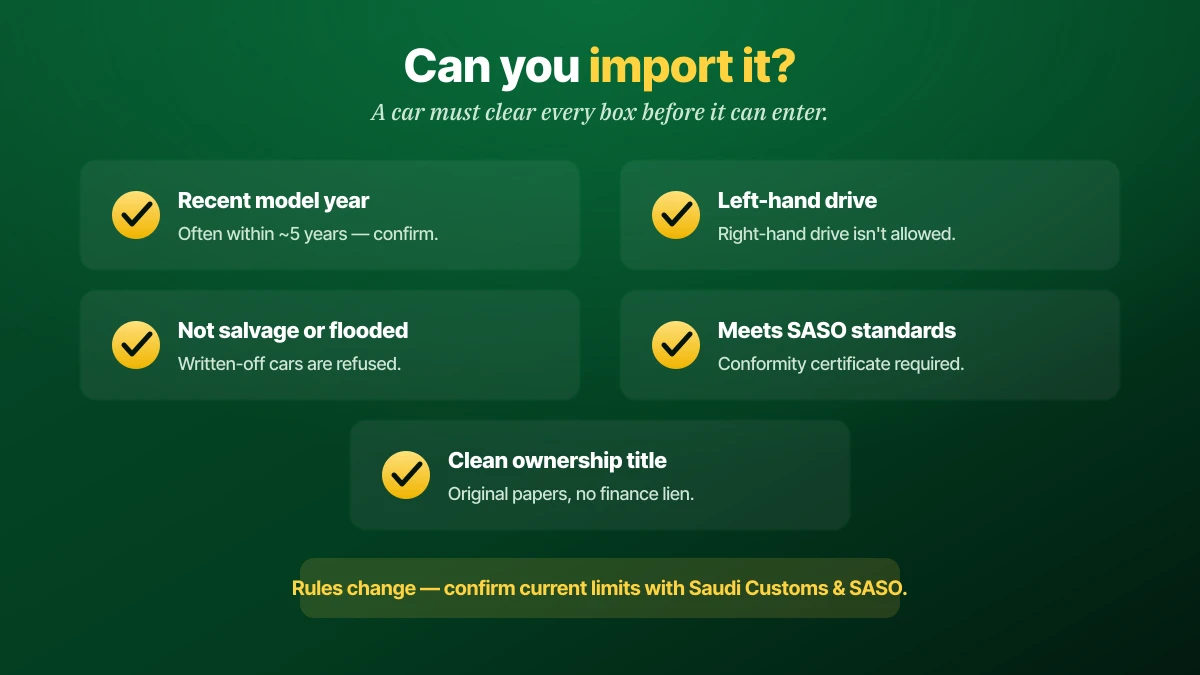
The core eligibility rules generally include:
- Recent model year. Saudi Arabia restricts importing older used cars — the limit is commonly cited as roughly the last five model years, though it varies by category, so confirm the current figure.
- Left-hand drive only. Right-hand-drive vehicles are not permitted for road use, which rules out many cars from the UK, Japan and similar markets.
- Not salvaged, flooded or written off. Cars with a salvage or total-loss history are refused — a key reason to check the record before you buy.
- Meets SASO standards. The car must conform to Saudi Standards (SASO), evidenced by a conformity certificate; vehicles built for markets with very different specs can struggle here.
- Clean ownership title. Original ownership documents, with no outstanding finance or lien on the vehicle abroad.
These rules change and can vary by vehicle type and the importer's status (resident, returning citizen, dealer). Treat any list — including this one — as a starting point, and confirm the current requirements with Saudi Customs (ZATCA) and SASO before committing money. Getting eligibility wrong is the single most expensive mistake in importing.
The real cost of importing
The number that catches people out is the landed cost — the total once the car is legally on Saudi roads, not the price you paid the seller abroad. Import taxes and fees stack on top of each other, and they're calculated on the car's value plus shipping.
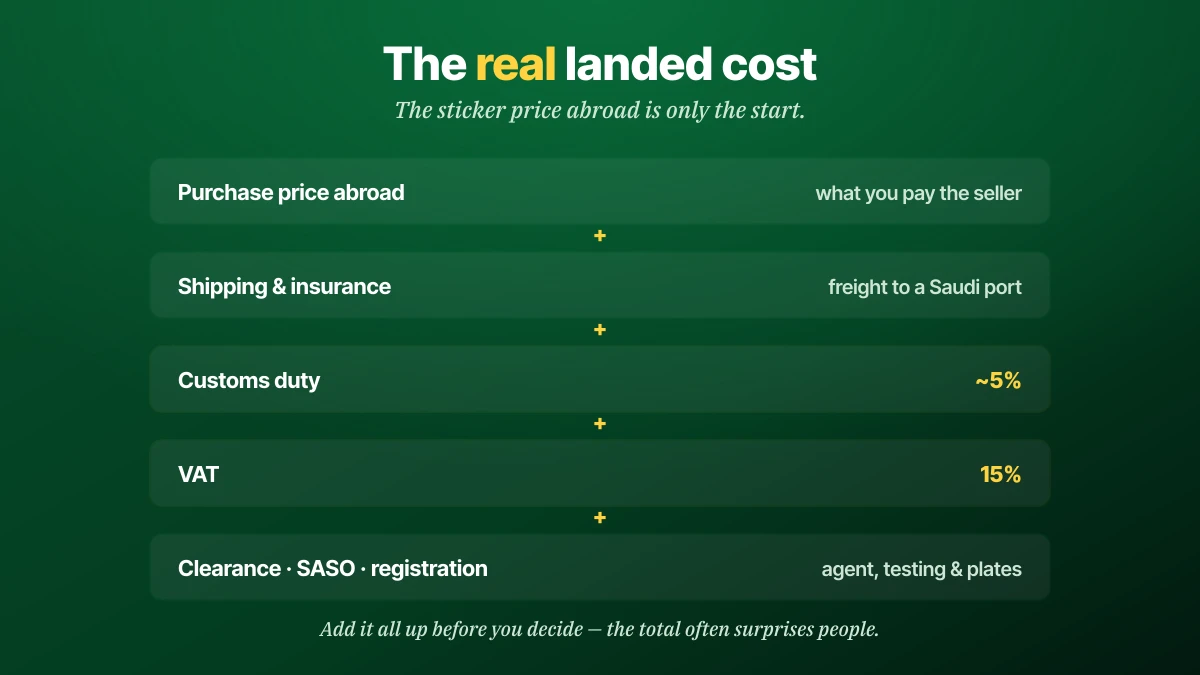
| Cost component | What it is |
|---|---|
| Purchase price | What you pay the seller abroad |
| Shipping & insurance | Freight to a Saudi port (e.g. Jeddah, Dammam) |
| Customs duty | Around 5% of the vehicle's value |
| VAT | 15%, applied to the total |
| Clearance & agent fees | Customs broker and port handling |
| SASO & inspection | Conformity testing and Fahes inspection |
| Registration | Plates and registration via the traffic dept |
The two big ones are the ~5% customs duty and 15% VAT, which together add roughly a fifth to the value before you've paid a single local fee. On top of that come shipping (which varies enormously by origin), a customs clearing agent, SASO conformity, the Fahes test, and finally registration. Any modifications needed to meet local standards add more still. Add every line up before you decide — the honest total is often much closer to (or above) the price of an equivalent car sold locally than people expect. For how ongoing costs then stack up once it's on the road, see our cost of owning a car guide.
What's your car worth?
Get a free instant estimate based on real Saudi market data — then sell it on KSAplate with direct WhatsApp contact.
Value My Car — FreeHow to import a car, step by step
Once you've confirmed the car qualifies and totalled the landed cost, the process itself follows a clear sequence. Each step must be completed before the next.
- Confirm eligibility and buy. Verify the model year, left-hand drive, clean (non-salvage) history and SASO-compatibility before you pay, then complete the purchase abroad with full original documents.
- Arrange shipping. Book freight (container or roll-on/roll-off) to a Saudi port and insure the car for the voyage.
- Clear customs (ZATCA). On arrival, a customs clearing agent submits the paperwork; you pay the customs duty and VAT on the assessed value plus shipping.
- Pass SASO conformity. Provide or obtain the conformity certificate showing the car meets Saudi standards.
- Take the Fahes inspection. The vehicle passes the periodic technical inspection, as any car on Saudi roads must — see our Fahes guide.
- Insure it. Arrange valid Saudi car insurance before registration — our car insurance guide explains the options.
- Register and get plates. Register the vehicle with the traffic department and receive your Saudi plates and Istimara, handled through Absher.
A reputable customs clearing agent makes the middle steps far smoother; most people importing a single car use one rather than navigating clearance alone.
Documents you'll need
Missing paperwork is the most common cause of a car sitting stuck at the port, racking up storage fees. Gather these early:
- Original ownership title / registration from the country of origin, in your name.
- Purchase invoice showing the price paid.
- Bill of lading from the shipping company.
- Your ID — national ID for citizens, or a valid Iqama for residents.
- SASO conformity certificate (or the documentation to obtain it).
- Customs declaration, prepared with your clearing agent.
- Proof the car is not salvaged and is free of any finance lien abroad.
Because an imported car's history happened somewhere you can't easily see, verifying it is essential — this is exactly where salvage-title problems hide. Read our guide on a car history check and, if you're buying to import, on avoiding used-car scams before you pay anyone abroad.
Verify the title and history before you ship, not after. A salvage car refused at the border is the most expensive lesson in importing.
Importing from a GCC country vs elsewhere
Where the car comes from changes the difficulty dramatically. There are broadly two cases:
- From another GCC country (UAE, Kuwait, Qatar, Bahrain, Oman): this is the simplest route. GCC-market cars are already built to regional standards, so SASO conformity is rarely an issue, and moving a vehicle within the Gulf is far more straightforward than shipping from another continent.
- From outside the GCC (US, Europe, Japan, etc.): more complex. The car must be proven to meet Saudi standards, right-hand-drive origins are ruled out, sea freight is longer and pricier, and spec differences are more likely to cause problems.
This is closely tied to the GCC-spec vs American-spec question. A US import is an American-spec car with all the trade-offs that brings — weaker resale, no local agency warranty, and cooling tuned for a milder climate. Our guide to GCC spec vs American spec cars explains why that matters, and it's central to whether importing is a good idea for you.
SASO conformity & inspection
SASO is the Saudi Standards, Metrology and Quality Organization, and its standards are the technical gatekeeper for imported vehicles. A car has to demonstrate it conforms — covering things like safety equipment, lighting, emissions and specifications suited to the region — usually evidenced by a conformity certificate.
Practically, this means a car built for a very different market may need modifications to comply, or may not qualify at all. It's why a vehicle that's perfectly legal abroad can still be turned away here. After conformity, the car goes through the standard Fahes periodic inspection like any Saudi vehicle, confirming it's roadworthy. Because standards and procedures are updated over time, confirm the exact conformity route for your car with SASO or your clearing agent rather than assuming last year's process still applies.
Clearing customs & registering plates
The final stretch turns an imported car into a legal Saudi vehicle. After the car lands and customs duty plus VAT are paid through ZATCA (the Zakat, Tax and Customs Authority), and once SASO conformity and the Fahes inspection are cleared, you register it with the traffic department (Moroor).
Registration is where the car finally becomes yours on paper: it's entered into the system, you arrange insurance, and you're issued Saudi plates and an Istimara (vehicle registration). Much of this is handled through Absher, the same platform used for local ownership transfers and renewals. From that point the car behaves like any other in the Kingdom — you'll renew the Istimara annually, and if you ever sell, you'll transfer ownership the usual way. If your import is an EV, our guide to electric cars in Saudi Arabia covers charging and running costs.
Is importing worth it?
Here's the honest assessment most import guides skip. For a specific, narrow set of situations, importing genuinely pays off. For most buyers, it doesn't.
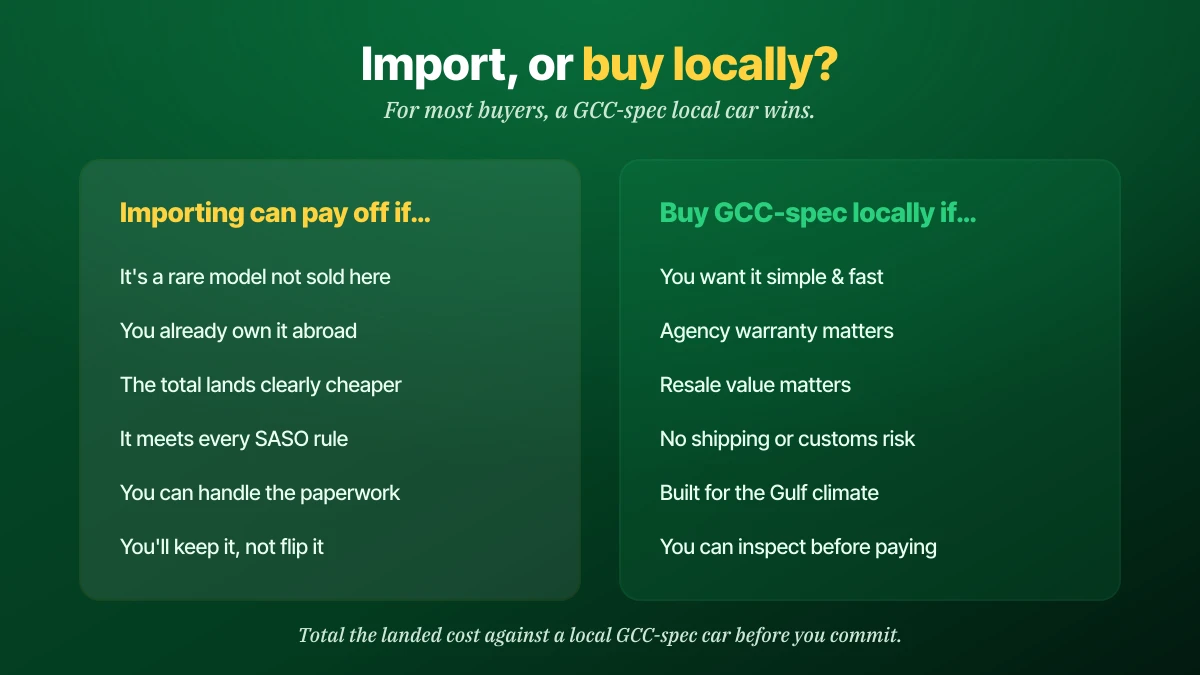
Importing can pay off if it's a rare model not sold in Saudi Arabia, you already own the car abroad and are relocating, the fully-landed total is clearly cheaper than a local equivalent, the car meets every SASO rule, and you're comfortable managing shipping and paperwork for a car you'll keep long-term.
Buying a GCC-spec car locally wins if you want the process simple and fast, you value the agency warranty and stronger resale, you'd rather avoid shipping and customs risk entirely, you want a car engineered for the Gulf climate, and you'd like to inspect it before paying. For the majority, that's the better deal once every import cost is counted. When you're ready, you can value a car, then browse the KSAplate marketplace or sell your current one — no shipping, no customs, no salvage surprises.
Mistakes to avoid
Importing punishes shortcuts. Avoid these and you'll spare yourself the most expensive mistakes.
- Shipping first, checking eligibility later. Confirm the car qualifies before it leaves — a non-compliant car can be refused entry.
- Ignoring the landed cost. The abroad price is not the real price; total duty, VAT, shipping and fees before deciding.
- Skipping the history check. A hidden salvage or flood title can both refuse entry and mean you overpaid for a wreck.
- Assuming any car meets SASO. A car legal abroad may still fail Saudi standards — verify conformity first.
- Forgetting the warranty gap. An import almost never carries local agency warranty; see our car warranty guide.
- Underestimating resale. Imported, non-GCC-spec cars sell for less and slower — factor that into the total.
Frequently asked questions
Can I import a car into Saudi Arabia?
How much does it cost to import a car to Saudi Arabia?
What are the rules for importing a used car into Saudi Arabia?
How old can a car be to import into Saudi Arabia?
Do I pay customs duty and VAT on an imported car?
Can I import a right-hand-drive car to Saudi Arabia?
Can I import a salvage or accident-damaged car?
Is it cheaper to import a car or buy one in Saudi Arabia?
Do imported cars have a warranty in Saudi Arabia?
Conclusion & next steps
Importing a car into Saudi Arabia is entirely possible, but it rewards preparation and punishes shortcuts. Confirm the car qualifies first — recent model year, left-hand drive, no salvage history, SASO-compliant — then total the real landed cost, including ~5% duty, 15% VAT, shipping and all the clearance and registration fees. Follow the sequence carefully: buy, ship, clear customs, pass SASO and Fahes, insure, and register for plates on Absher. And go in with clear eyes about the trade-offs: no agency warranty, weaker resale, and spec differences. For a rare model or a car you already own, importing can be the right call. For nearly everyone else, a GCC-spec car bought locally is simpler, safer and often no more expensive once everything is counted. Start by valuing a car, compare the routes in GCC spec vs American spec, then browse the KSAplate marketplace or list your car.