TL;DR:
- A used car's value in Saudi Arabia is what a real buyer will pay today — set by make, model, year, mileage, condition, spec and live market demand, not by what you paid for it.
- Depreciation is steep early: a new car loses about 20–30% in year one, then roughly 10–15% each year after.
- Brand decides resale. Toyota keeps ~57% of value after 5 years and Honda ~54%; a Land Cruiser keeps ~83% and a Corolla ~72%. Many other brands fall below 40%.
- GCC-spec cars, a clean Najm accident record and a full service history all push your price up; imported spec, damage and high mileage pull it down.
- Value it in 5 steps: gather details, compare live listings, apply the depreciation curve, adjust for condition, then price and list. Keep your distinctive plate — it can be worth more than the car loses in a year.
Quick answer: To find out how much your car is worth in Saudi Arabia, compare live listings for the same make, model, year and mileage, then adjust for condition, spec and service history. A new car loses about 25% in year one and 10–15% a year after. Strong-resale brands like Toyota and Lexus keep far more. Price against the market, then list to sell.
What "car value" means in Saudi Arabia
A used car's market value in Saudi Arabia is the price a willing buyer will actually pay for it today, in its current condition, in this market. It is not the price you paid, not the loan balance, and not the figure you hope for. The market sets the number; your job is to read it accurately.
Three forces decide that number: the car (make, model, year, trim, mileage, spec), its condition (mechanical health, accident history, service record), and demand (how many buyers want this exact car right now). Get all three right and you price to sell; get them wrong and the car sits unsold or you give money away.
For the Saudi market specifically, two extra factors matter more than almost anywhere else: brand reputation for reliability and whether the car is GCC-spec. Both move the price by thousands.
How to value your car in 5 steps
Valuing a car is a repeatable process, not a guess. Follow these five steps and you arrive at a defensible price a buyer will accept.
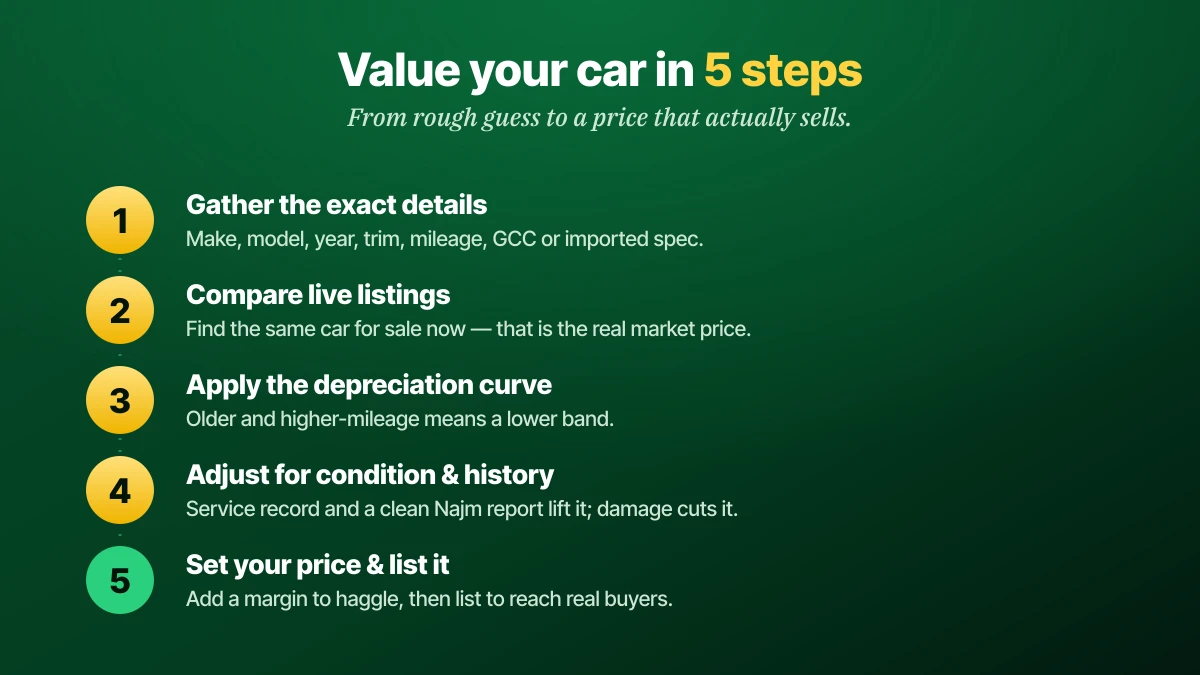
- Gather the exact details. Make, model, year, trim, exact mileage, and whether it is GCC-spec or imported. Small differences here change the price a lot.
- Compare live listings. Find the same car currently for sale and see the asking prices. Live listings are the truest signal of market value — browse cars for sale on KSAplate to find your comparables.
- Apply the depreciation curve. Older age and higher mileage move you into a lower band. Use the year-by-year drop below as your anchor.
- Adjust for condition and history. A full service record and a clean Najm accident record lift the price; body damage, warning lights or a salvage past cut it. A valid Fahes inspection reassures buyers.
- Set your price and list. Add a small margin above your floor for haggling, then list the car to reach buyers.
The single most accurate valuation method is not a calculator — it is three live listings of the same car, this week, in your city. Everything else is an estimate around that number.
How depreciation works
Depreciation is the fall in a car's value over time, and it is the biggest hidden cost of ownership. It starts the moment a new car leaves the showroom and is steepest in the first year.
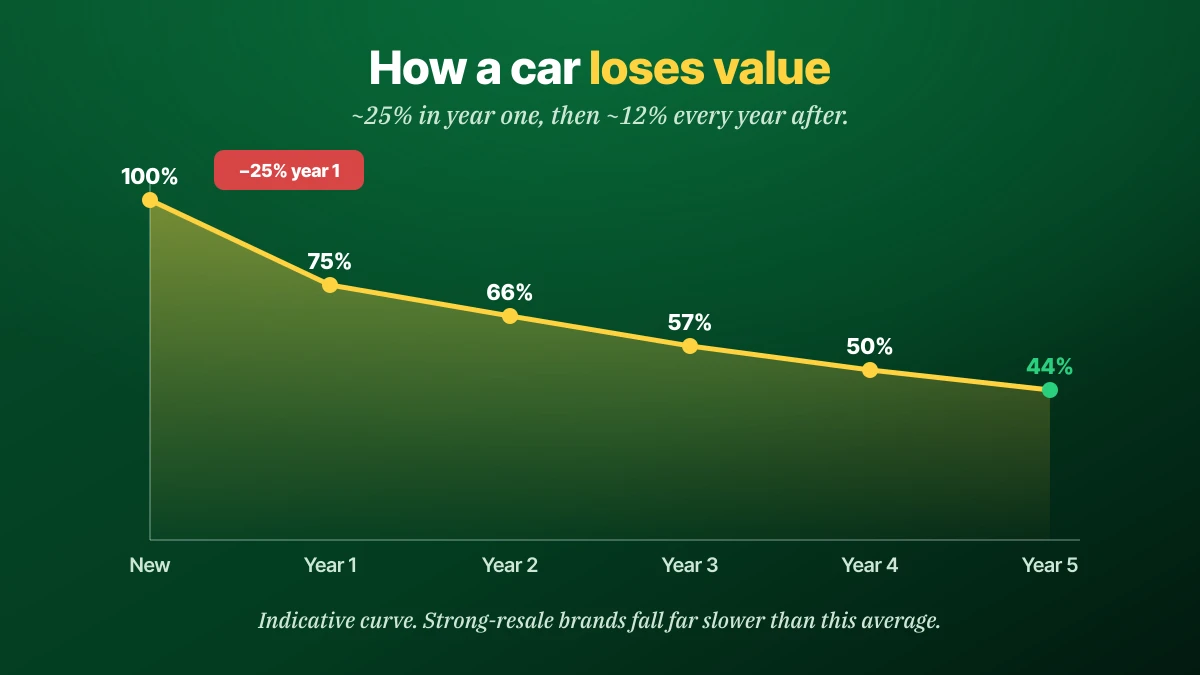
As a rule of thumb, a new car loses about 20–30% in its first year, then roughly 10–15% of its value each year after. By year five, an average car is worth a little under half its original price. This curve is why buying a one-to-two-year-old used car is so much better value than buying new — someone else has already absorbed the steepest drop.
The curve also explains why timing your sale matters. The longer you hold, the less each extra month costs you in depreciation — but the more mileage and wear erode condition. Strong-resale models flatten this curve dramatically.
Put numbers on it. A car bought new for SAR 100,000 is typically worth about SAR 75,000 after one year, around SAR 66,000 after two, and a little over SAR 44,000 by year five on the average curve. A Land Cruiser bought at the same price could still be worth well above SAR 80,000 at year five. That single difference — the badge — can be worth more than thirty thousand riyals at resale, which is exactly why brand choice is a financial decision, not just a taste one.
What's your car worth?
Get a free instant estimate based on real Saudi market data — then sell it on KSAplate with direct WhatsApp contact.
Value My Car — FreeWhat raises and lowers value
The same car can be worth thousands more or less depending on a handful of factors. Knowing them lets you protect your price as a seller and spot a fair deal as a buyer.
- Mileage: lower is better. High kilometres signal wear and drop the price band.
- Accident history: a clean record is worth real money; a logged major accident cuts value sharply.
- Service history: a full, documented service record from a recognised workshop adds buyer confidence and price.
- Condition: paint, tyres, interior and warning lights are judged on sight. Detailing before sale pays for itself.
- Demand: popular models and colours (white, silver) sell faster and hold price; niche specs sell slower.
- Spec: GCC-spec beats imported spec on price and buyer trust in Saudi Arabia.
Two identical models, same year and mileage, can differ by 15–20% in price on accident history and service records alone. Documentation is not paperwork — it is value.
Brands and models that hold value
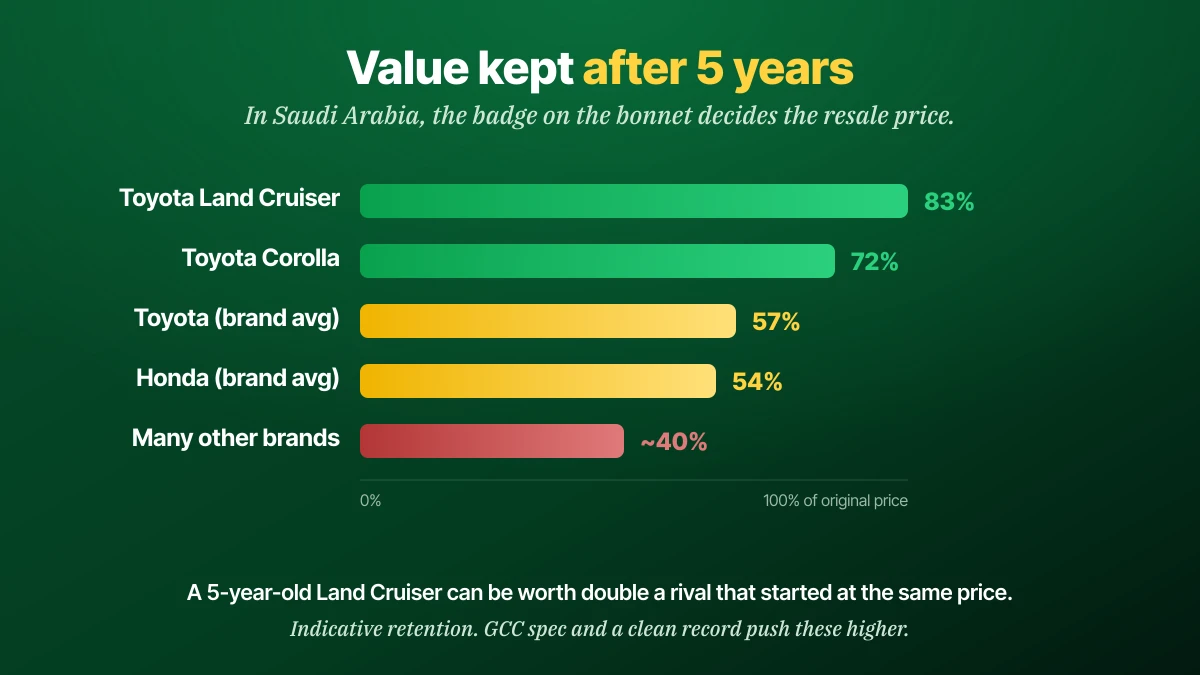
Resale value is the share of the original price a car keeps over time, and in Saudi Arabia it is dominated by reliability reputation. Toyota and Lexus lead, and the gap over weaker brands is large.
| Car | Value kept after 5 years | Notes |
|---|---|---|
| Toyota Land Cruiser | ~83% | Exceptional demand, slow depreciation |
| Toyota Corolla | ~72% | Reliable, cheap to run, easy to sell |
| Toyota (brand average) | ~57% | Strongest mainstream resale |
| Honda (brand average) | ~54% | Close behind Toyota |
| Many other brands | ~40% or less | Faster depreciation, harder resale |
The takeaway for buyers: a strong-resale car costs more up front but gives much of it back at sale. For sellers: if you own a Land Cruiser, Hilux, Corolla or Lexus, your car is worth more than the average curve suggests — price it accordingly.
Typical used car price ranges (2026)
Used car prices in Saudi Arabia span a wide range, with most private sales falling between SAR 25,000 and SAR 150,000. Where your car lands depends on segment, age and brand.
| Segment | Typical used range (SAR) | Example |
|---|---|---|
| Economy sedan | 25,000–60,000 | Corolla, Yaris, Sunny |
| Family SUV / crossover | 50,000–120,000 | RAV4, Pajero, Sonata |
| Full-size SUV / pickup | 90,000–200,000+ | Land Cruiser, Hilux |
| Luxury / premium | 80,000–300,000+ | Lexus, premium German brands |
These are guide ranges, not quotes. Within each segment, a strong-resale badge sits near the top of the range and a weak one near the bottom, even at the same age and mileage. Your exact figure comes from live comparables, which is why step two of the valuation matters most. Read our used-car buying guide for the inspection side of the deal.
GCC spec vs imported: the value gap
GCC-spec is a vehicle built and certified for Gulf conditions, and in Saudi Arabia it is worth noticeably more than the same model imported from elsewhere. Buyers pay a premium for it, and you should price for it.
The reasons are practical. GCC-spec cars are certified to regional standards overseen by the Saudi Standards, Metrology and Quality Organization (SASO), with cooling systems and components tuned for extreme heat, full local dealer support and parts, and a verified regional history. Imported or "American-spec" cars can be cheaper to buy but often sell slower and lower, because buyers worry about warranty, parts and resale. When you value your car, confirm its spec first — it can shift the price by thousands.
Best time to sell for the most money
The best time to sell a car is before its next big depreciation step, while its condition and paperwork are still strong. A few timing rules protect your money:
- Sell before a major mileage milestone (e.g. approaching 100,000+ km), which pushes buyers to a lower band.
- Sell while service history is current and the next costly service is not yet due.
- Sell before warranty expires if the car still has one — it adds buyer confidence and price.
- Clear all traffic fines and keep a valid inspection so the sale and transfer do not stall.
Every extra year you hold a fast-depreciating car costs more than the hassle of selling. If a model loses value quickly, the cheapest day to sell it is usually today.
The plate bonus hiding on your car
Here is value most sellers overlook: the licence plate. In Saudi Arabia a distinctive plate number is a separate asset, and a rare one can be worth more than your car loses in a whole year of depreciation.
By default the plate transfers with the car to the buyer. But if your number is special — a low digit, a repeating or mirrored pattern, a meaningful date — you can detach and keep it, then move it to your next car or sell it on its own. Treating the plate and the car as two separate assets is how informed sellers squeeze the most out of a single sale, sometimes adding tens of thousands of riyals the buyer of the car never sees. Before you let the car go, value your plate on the KSAplate calculator and decide whether it should leave with the car or stay with you.
Mistakes that cost sellers money
Most sellers leave money on the table for avoidable reasons. Knowing the common errors protects your price and your time.
- Pricing on emotion, not the market. What you paid or owe is irrelevant; only live comparables decide the price.
- Hiding the history. Buyers verify accidents and service records anyway. Honesty sells faster than a cover-up that collapses the deal.
- Weak photos. A clean car shot in good light sells for more than the same car in dark, cluttered photos.
- Ignoring spec. Not stating GCC-spec leaves money on the table; buyers pay a premium for it.
- Letting a valuable plate leave by accident. Decide on the number before the transfer, not after.
The most expensive mistake is overpricing into silence. A car listed 15% above the market gets no calls; the same car at market price gets several.
From valuation to a sold car
A valuation only earns you money once the car actually sells. The fastest route from price to payout is to put the car in front of real buyers, priced against the market you just researched.
List it on the KSAplate marketplace: post your car for sale with clear photos, the honest mileage, the spec, and the service and accident history. Your advert goes in front of buyers actively browsing cars across Saudi Arabia, and car dealers can showcase their full stock too. When a buyer agrees, follow our guide to selling a car for the ownership transfer, completed online through Absher, and safe payment.
Price it right and list it where buyers already are. A fair price on a visible listing sells in days; an optimistic price on a hidden one sits for months.
Frequently asked questions
How do I find out how much my car is worth in Saudi Arabia?
How much does a car depreciate in Saudi Arabia?
Which used cars resell for the most in Saudi Arabia?
What makes a used car worth more?
Is GCC-spec worth more than imported in Saudi Arabia?
When is the best time to sell my car?
Does an accident lower my car's value?
Should I sell my car privately or to a dealer?
Can I keep my licence plate when I sell my car?
Conclusion & next steps
Knowing what your car is worth in Saudi Arabia turns a guess into money. Gather the exact details, compare live listings, apply the depreciation curve, and adjust for condition, spec and history — then you hold a price buyers will accept. Remember the two Saudi-specific levers: a strong-resale brand and GCC spec can both add thousands. Do not forget the plate, either, which may carry value the car itself has lost. When your number is set, the next step earns the money: list your car on KSAplate, price it against the market, and let real buyers come to you.