TL;DR:
- Selling a car in Saudi Arabia is finalised by transferring ownership on Absher — the seller starts a Vehicle Sale request, the buyer insures and pays, and ownership moves in about an hour.
- Before you sell, clear the path: a valid Istimara, a valid Fahes inspection (within 30 days), and any car loan settled. A block on any of these stops the transfer. Unpaid traffic fines do not block it, but pay them anyway — they stay on your record.
- The transfer fee is SAR 230 (incl. VAT), paid by the buyer through Sadad. The buyer must hold a new insurance policy in their own name before the transfer completes.
- Best price vs fastest sale is the core trade-off: a private buyer pays most but takes time; a dealer trade-in is instant but lowest.
- You can keep your distinctive plate. By default the number goes with the car — but you can detach and retain it, then move it to your next vehicle or sell it separately.
Quick answer: To sell a car in Saudi Arabia, make sure the Istimara and Fahes inspection are valid, settle any traffic fines, agree a price with the buyer, then transfer ownership on Absher. The seller starts a Vehicle Sale request; the buyer insures the car, pays the price plus the SAR 230 fee, and confirms delivery. Ownership transfers online in about an hour.
What selling a car in Saudi Arabia involves
Selling a car in Saudi Arabia is the process of agreeing a price with a buyer and then legally transferring ownership through Absher, the Ministry of Interior's e-services platform. The handshake is the easy part; the sale is only real once the ownership record moves to the buyer in the government system.
Two parties and one platform run the whole thing. The seller prepares the car and starts the transfer; the buyer insures it and pays; Absher records the change and releases the money. Everything else — where you advertise, how you negotiate, whether you keep your plate — sits around that core transaction.
Get the order right and a sale takes a week of advertising and an hour of paperwork. Get it wrong and a lapsed inspection or an unreleased loan can freeze the transfer on the day you meet the buyer.
Selling your car? List it on KSAplate for free
No commission on the sale, no account needed, and buyers contact you directly on WhatsApp. Keep or sell the plate separately.
List your car free Browse carsGet the car sale-ready
A sale-ready car is one with nothing blocking the ownership transfer. Saudi Arabia's transfer system runs automated checks, and any flag stops the deal cold. Clear these before you advertise, not at the handover.
- Settle every traffic fine. Unpaid fines on the owner do not block the transfer while the Istimara and Fahes inspection are valid, but they stay on your record. Check and pay them anyway — see our guide to checking and paying traffic fines.
- Hold a valid periodic inspection. A current Fahes (MVPI) certificate, generally issued within the last 30 days, is required. Read how Fahes inspection works.
- Keep the registration valid. The Istimara must be current; renew it if it has lapsed.
- Clear any loan or mortgage. A financed or mortgaged car cannot be transferred until the lender releases it.
- Confirm the car is clean. It must not be stolen, wanted, or impounded.
The fastest way to lose a buyer is to discover a lapsed Fahes inspection while they are standing next to you with cash. Clear the blocks the day you decide to sell.
Price your car right
The right asking price is the highest number a real buyer will pay this month — not the figure you wish you could get. Pricing is where most private sellers leave money on the table or scare buyers away.
Anchor your price to evidence. Look at what the same make, model, year, trim and mileage is actively listed for, then adjust for condition and service history. A full dealer service record, a clean accident history and new tyres justify the top of the range. High mileage, body damage or a salvage past pull you to the bottom.
Leave a negotiation margin. Saudi buyers expect to haggle, so set your asking price a little above your real floor and decide that floor in advance. The seller who knows their walk-away number negotiates calmly; the one who does not, caves.
Ready to sell it?
List your car on KSAplate for free — no commission on the sale, and buyers reach you directly on WhatsApp.
List My Car — FreeWhere to sell: four channels
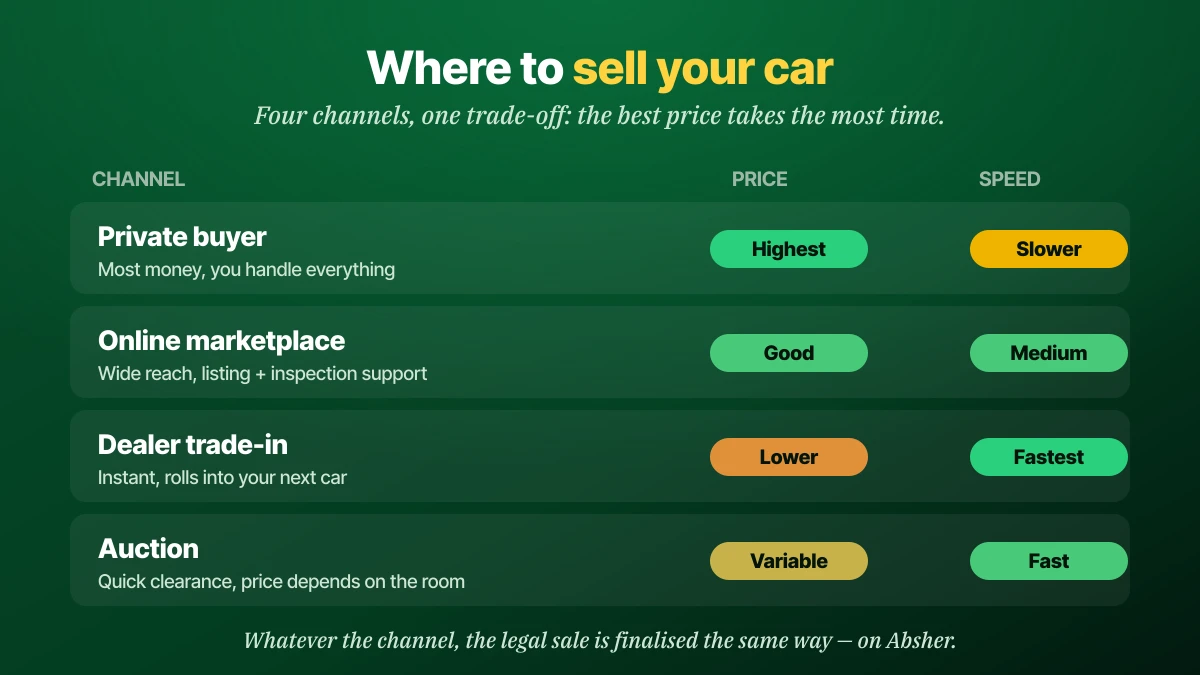
There are four realistic ways to find a buyer in Saudi Arabia, and they trade price against speed. The more money you want, the more time and effort the sale takes.
| Channel | Price you get | Speed | Best for |
|---|---|---|---|
| Private buyer | Highest | Slower | Patient sellers chasing top value |
| Online marketplace | Good | Medium | Wide reach with listing support |
| Dealer trade-in | Lower | Fastest | Buying your next car at the same time |
| Auction | Variable | Fast | Quick clearance, flexible on price |
A private sale earns the most because no middleman takes a margin, but you handle the photos, calls, viewings and the transfer. A dedicated online marketplace widens your reach and often bundles inspection and listing help. A dealer trade-in is the fastest exit and folds neatly into your next purchase, but you accept a wholesale price. An auction clears the car quickly, with a final price that depends on who shows up. Whichever you choose, the legal sale is finalised the same way — on Absher.
The simplest way to combine strong private-sale value with wide reach is to list your car on the KSAplate marketplace. Your advert goes straight in front of buyers browsing cars for sale across Saudi Arabia, you set your own price and keep the full margin, and car dealers can showcase their whole stock from a dealer profile. The legal handover still finishes on Absher.
The keep-your-plate decision
In Saudi Arabia, a distinctive licence plate is an asset that can outlive the car it sits on. By default the plate transfers with the vehicle, so the buyer inherits your number. But if you hold a valuable or meaningful plate, you can detach and keep it.
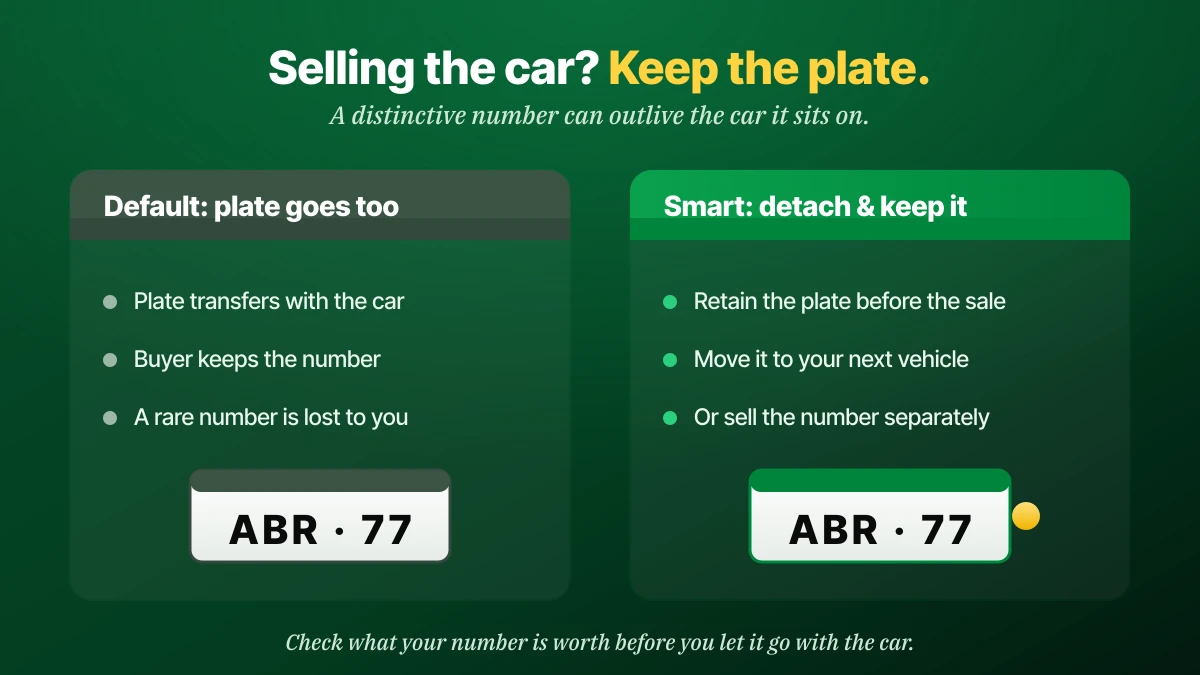
Retaining a plate is a separate step you take before the sale: you move the number off the car you are selling so it does not pass to the buyer. From there you can transfer it to your next vehicle, or sell the number on its own — often for far more than it would add to the car's price. See where to sell a Saudi licence plate for that route.
A rare number — a low digit, a repeating pattern, a meaningful date — can be worth more than the car wearing it. Do not give it away by accident.
Before you let the plate go with the car, find out what it is worth. Value your number on the KSAplate calculator in under a minute, then decide whether to keep it, move it, or sell it separately.
Documents and conditions
The transfer is automated, so the document and eligibility checklist is strict. Have all of this in place before you and the buyer sit down:
- An active Absher account for both the seller and the buyer.
- The original Istimara (vehicle registration), valid.
- A valid Fahes / MVPI inspection certificate.
- Traffic fines checked — unpaid fines on the owner do not block the transfer while the Istimara and inspection are valid, but settle them anyway.
- A car that is not mortgaged, stolen, wanted or impounded.
- An agreed price between SAR 500 and SAR 1,000,000, the system's accepted range.
- New insurance arranged by the buyer in their own name before completion.
The buyer carries the insurance obligation, but as the seller you should confirm they have it ready — without it, the transfer will not complete and your sale stalls at the last step.
Special cases: financed, company and inherited cars
Not every sale is a simple private-to-private deal. Three situations need an extra step before the standard transfer works.
- A financed car. A car still under a loan or lease is mortgaged in the system and cannot be transferred. Settle the finance with the bank and have the lien released first; only then will Absher allow the sale.
- A company-owned car. Vehicles registered to an establishment are sold through the company's commercial record, not a personal account. An authorised signatory completes the transfer, and the buyer still needs insurance in their name.
- An inherited car. A car belonging to a deceased owner must first pass to the heirs through the official inheritance process before it can be sold. Settle the estate transfer, then sell as normal.
In each case the rule is the same: clear the underlying status first, because the transfer engine reads the car's record exactly as it stands.
Transfer ownership on Absher: step by step
The legal handover is done entirely online and usually finishes within an hour once both parties are ready. This is the moment the car stops being yours.
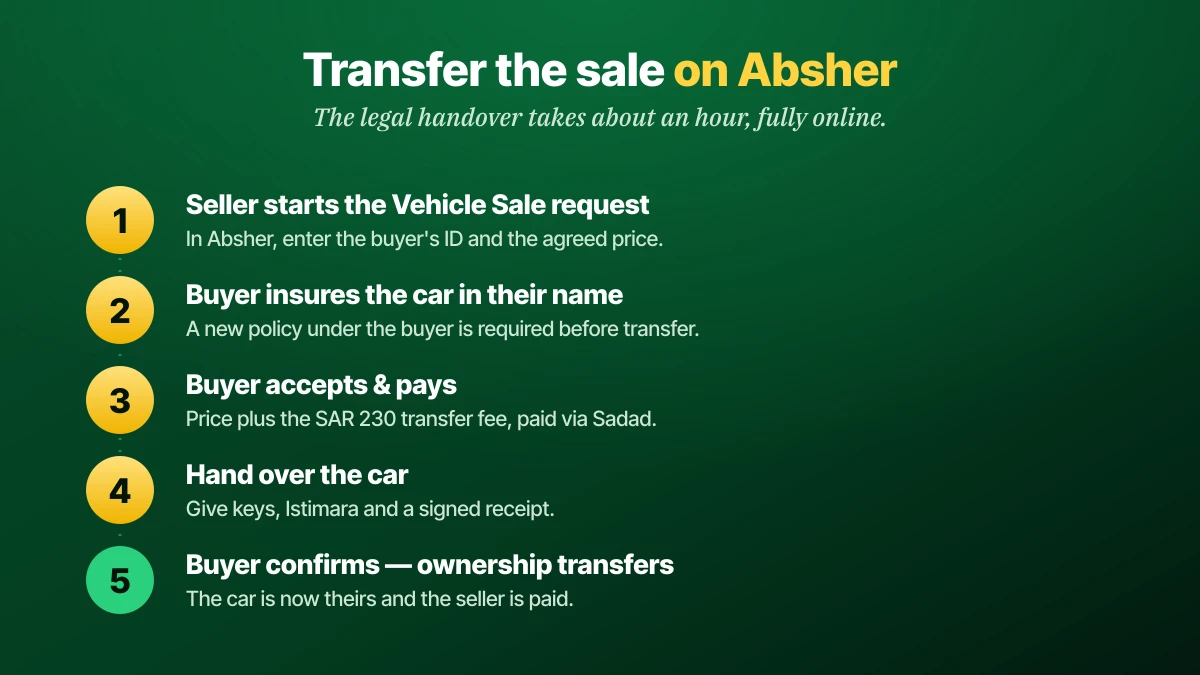
- Seller starts the Vehicle Sale request. Log in to Absher, choose the vehicle-sale service, and enter the buyer's ID and the agreed price.
- Buyer insures the car in their name. The buyer arranges a new policy on the vehicle — a prerequisite the system enforces before transfer.
- Buyer accepts and pays. The buyer confirms the request and pays the price plus the SAR 230 transfer fee through Sadad.
- Hand over the car. Give the keys, the Istimara and a signed receipt recording the price, date and both ID numbers.
- Buyer confirms delivery. The buyer confirms receipt on Absher, ownership transfers, and you are paid. The car is now legally theirs.
For the buyer's side of this same process — and the registration detail behind it — see how to transfer car ownership in Saudi Arabia. If your buyer is new to the market, our guide on buying a used car tells them exactly what to expect.
Fees and who pays what
The official cost of selling a car is small and lands mostly on the buyer. The transfer fee is SAR 230 including VAT, paid by the buyer via Sadad and added on top of the agreed price.
Your costs as the seller are the preparation, not the transfer: a Fahes inspection if yours has lapsed, settling any outstanding fines, and optional detailing to lift the sale price. If you sell through a dealer or marketplace, factor in their margin or commission — the trade-off for speed and reach. There is no separate seller transfer tax beyond clearing what you already owe on the car.
Selling is cheap; not preparing is expensive. The SAR 230 fee is the buyer's. Your real bill is whatever you ignored — an unpaid fine, a lapsed inspection, a loan you forgot to close.
Mistakes and scams to avoid
Most selling problems are avoidable and cluster around payment and paperwork. Protect yourself with a few firm rules.
- Never hand over the car before ownership transfers. Possession without a completed Absher transfer leaves the car, and its fines, in your name.
- Confirm the money is real. Verify a bank transfer has actually cleared into your account before releasing keys — a screenshot is not payment.
- Refuse "transfer later" deals. If the buyer wants to delay the transfer, walk away. Unregistered driving and new fines become your liability.
- Keep a signed receipt. Record the price, date, both ID numbers and the car details. It protects both sides.
- Decide on the plate first. Detach a distinctive number before the sale, not after, when it has already moved to the buyer.
After the sale
Once ownership transfers, the car and its future fines belong to the buyer — but tie off the loose ends. Cancel or transfer your own insurance policy so you stop paying for a car you no longer own; many insurers refund the unused portion. Keep your copy of the receipt and the Absher confirmation in case any dispute arises later.
If you kept your plate, you now have a free-standing asset. Move it onto your next car, or list it for sale. And before you buy your replacement vehicle, run its number and your retained plate through the same valuation lens — the plate you choose can be part of the deal, not an afterthought.
Selling your car? List it on KSAplate for free
No commission on the sale, no account needed, and buyers contact you directly on WhatsApp. Keep or sell the plate separately.
List your car free Browse carsFrequently asked questions
How do I sell a car in Saudi Arabia?
What documents do I need to sell my car?
How much does it cost to transfer a car when selling?
Can I keep my number plate when I sell my car?
Do I have to clear traffic fines before selling?
Does the car need a valid inspection to sell?
Who pays for insurance — the buyer or the seller?
What is the safest way to get paid?
How long does it take to sell a car in Saudi Arabia?
Conclusion & next steps
Selling a car in Saudi Arabia rewards preparation. Clear your fines, hold a valid Fahes certificate and a current Istimara, price the car against real listings, and pick the channel that matches your priority — top price or quick exit. The quickest way to reach real buyers is to list your car on the KSAplate marketplace. Then finalise the sale properly on Absher, get paid before you hand over the keys, and keep the receipt. One decision is easy to forget and expensive to lose: your plate. Before the car drives off with your number on it, value your plate on the KSAplate calculator and decide whether to keep it, move it, or sell it on its own.