TL;DR:
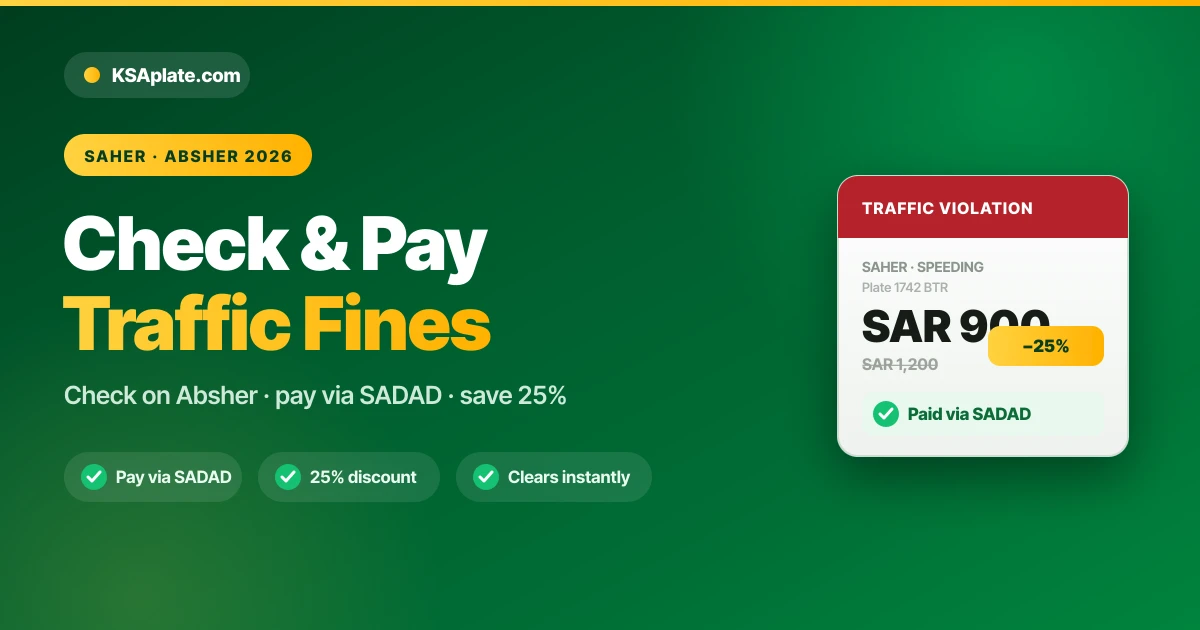
- Traffic fines in Saudi Arabia are issued mainly by the Saher camera network and appear instantly on Absher with an SMS alert.
- Check your fines on Absher or Tawakkalna, and pay through Absher or any banking app via SADAD (biller code 007).
- Pay within 30 days of the notification to get a 25% early-payment discount. The Ministry of Interior also runs periodic waivers of up to 50% on accumulated fines.
- Fines range from SAR 100 to SAR 10,000 — red light SAR 3,000–6,000, phone use SAR 500–900, no seatbelt SAR 150–300, speeding SAR 300–10,000.
- Unpaid fines block your istimara renewal, so clear them before you renew. They do not stop an ownership transfer while the istimara and periodic inspection are valid — but pay them anyway.
Quick answer: To check and pay traffic fines in Saudi Arabia, log in to Absher or Tawakkalna, open Traffic and query your violations, then pay through Absher or a banking app via SADAD. Pay within 30 days for a 25% discount. Unpaid fines stop you from renewing your registration, so settle them first — they do not block a vehicle transfer while the istimara and inspection are valid.
What Saher and traffic fines are in Saudi Arabia
A traffic fine in Saudi Arabia is a financial penalty for a road violation, recorded against the driver and the vehicle in the Ministry of Interior's systems. Most fines are issued automatically by Saher — the national network of road cameras that monitors speed and violations 24 hours a day. When a camera records an offence, the violation is logged instantly through Absher and you receive an SMS notification.
Because the record is centralised, a fine shows up across other vehicle services. An unpaid fine quietly blocks a registration renewal, which is why checking and clearing fines is part of owning a car in the Kingdom — not an afterthought.
How to check your traffic fines
Checking your fines takes under a minute, and you have several official channels. All of them read from the same Ministry of Interior record, so the result is identical.
| Channel | How | Login needed? |
|---|---|---|
| Absher | Services → Traffic → Query Traffic Violations | Yes (ID/Iqama + OTP) |
| Tawakkalna | Traffic/violations section in the app | Yes |
| MOI public inquiry | moi.gov.sa traffic-violation enquiry | No — by ID/plate |
| Banking app | Government payments → traffic violations | Yes (bank login) |
The fastest route for most drivers is Absher or Tawakkalna, because you can check and pay in the same place. For a quick look without logging in, the public inquiry on moi.gov.sa shows whether a plate has outstanding fines.
How to pay your traffic fines
Paying a fine is fully online through the SADAD bill-payment system. You can pay inside Absher or through any Saudi banking app.
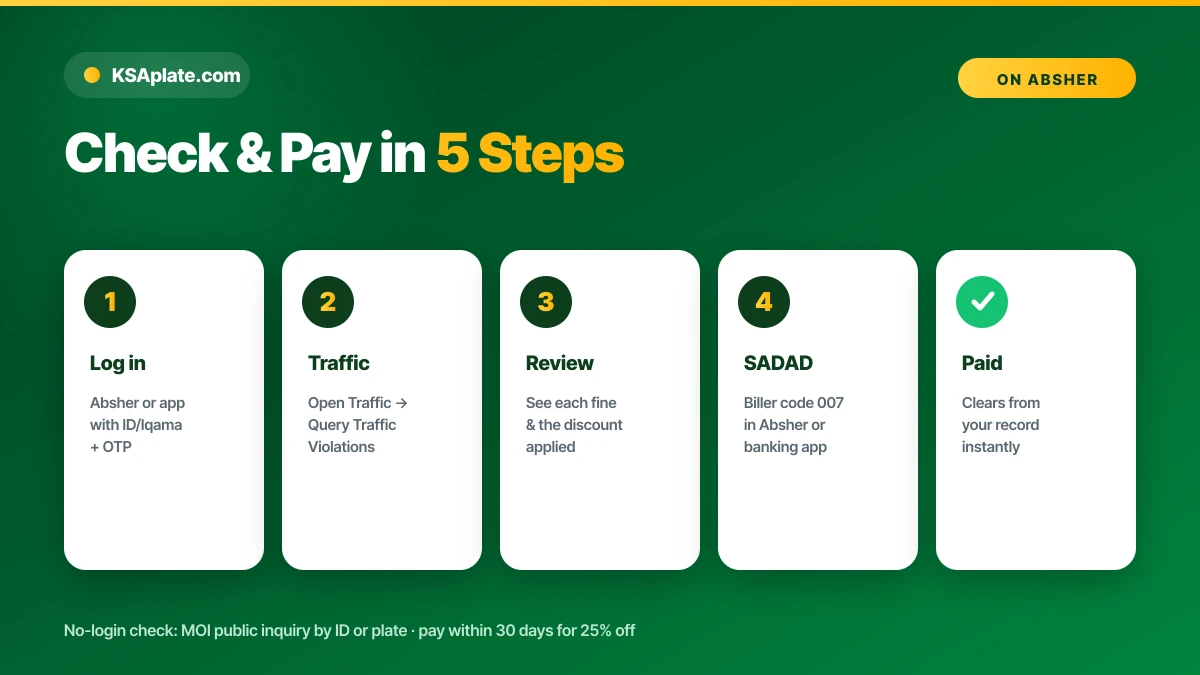
- Log in to Absher (or your banking app) with your ID/Iqama and OTP.
- Open Traffic → Traffic Violations and review the listed fines.
- In a banking app, choose Government Payments → Traffic Violations and enter SADAD biller code 007.
- Confirm the amount, noting any early-payment discount applied.
- Pay. The violation clears from your record immediately, and a receipt is issued.
Pay through SADAD, not a third party. The fine clears against your record instantly — no receipt to chase and nothing left to block a renewal.
What's your car worth?
Get a free instant estimate based on real Saudi market data — then sell it on KSAplate with direct WhatsApp contact.
Value My Car — FreeThe 25% early-payment discount and periodic waivers
Saudi Arabia rewards prompt payment. Any newly issued violation qualifies for a 25% discount if you pay within 30 days of the notification. Miss that window and you owe the full amount. The discount is applied automatically at checkout, so paying early is the single easiest way to cut what you owe.
On top of that, the Ministry of Interior periodically announces waivers of up to 50% on accumulated fines, usually for a limited window. These campaigns come and go, so if you are carrying old fines, check whether a reduction is currently active before you pay. Watch official announcements on the Saudi Press Agency at spa.gov.sa.
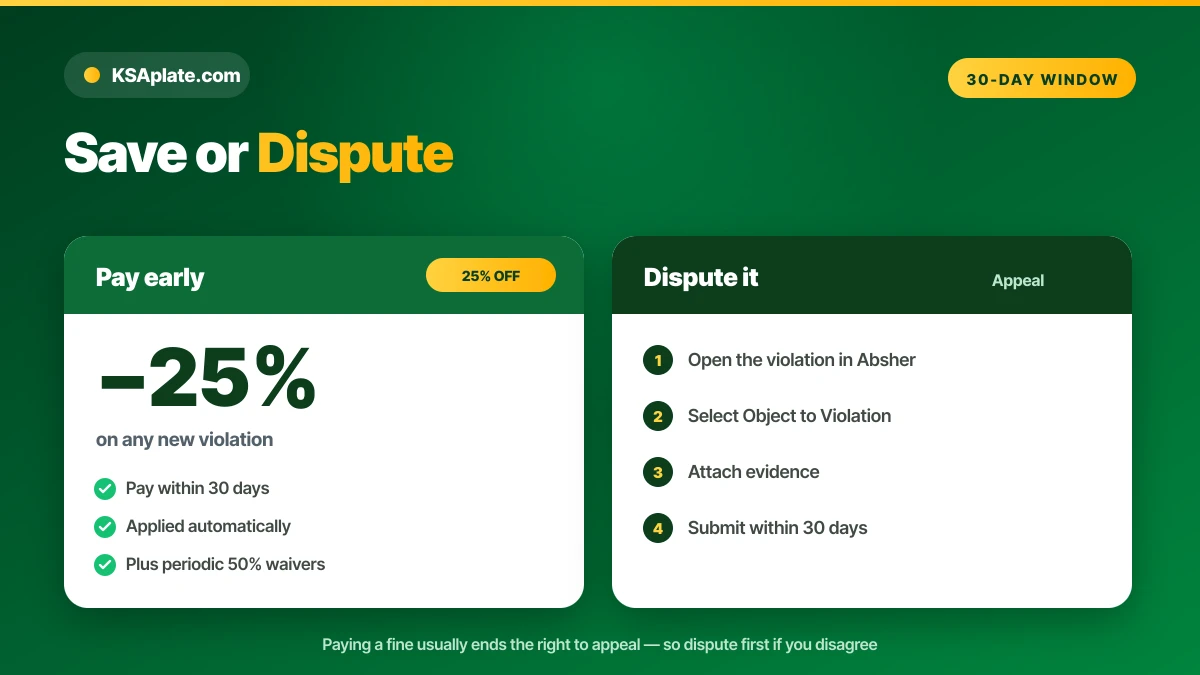
The two discounts can stack in your favour over time: settle new fines inside 30 days for the automatic 25%, and hold any disputable ones for an appeal rather than paying them by reflex. The goal is simple — never pay full price for a fine you could have discounted, disputed, or avoided.
Common traffic fines and their amounts
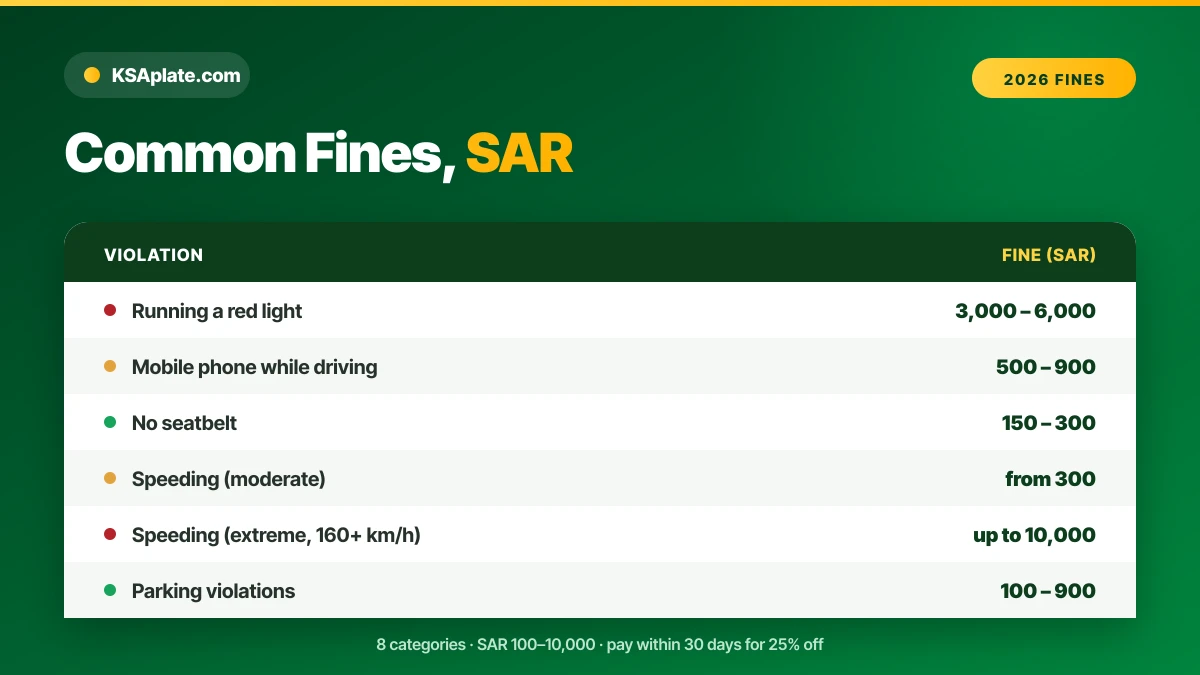
Fines in Saudi Arabia are grouped into categories, with amounts from SAR 100 to SAR 10,000. Here are the violations drivers meet most often.
| Violation | Fine (SAR) |
|---|---|
| Running a red light | 3,000 – 6,000 |
| Using a mobile phone while driving | 500 – 900 |
| No seatbelt (driver or passenger) | 150 – 300 |
| Speeding (up to ~120 km/h zone) | from 300 |
| Speeding (extreme, over 160 km/h) | up to 10,000 + suspension |
| Parking violations | 100 – 900 |
Speeding fines scale with how far over the limit you go, so a small lapse costs little while extreme speeding carries the heaviest penalties and can suspend your licence. The full schedule spans eight categories, from minor parking and documentation offences at the bottom to dangerous driving and extreme speeding at the top. The amounts above are the ranges drivers meet most, but the exact figure on any violation depends on the road, the limit, and the severity recorded by the camera.
How the Saher system works
Saher is an automated enforcement system that uses fixed and mobile cameras to monitor traffic without a police officer present. The cameras read speed, red-light running, and other violations, then match the plate to the registered owner. The fine is generated automatically, posted to Absher, and an SMS is sent to the owner's registered number. Because enforcement is automatic and round-the-clock, the only reliable defence is to drive within the rules — there is no officer to talk to at the roadside.
The network mixes fixed gantry cameras with mobile camera vehicles parked at the roadside, and some corridors use average-speed measurement between two points rather than a single snapshot. That mix is why slowing down only for a visible camera does not work: the system can catch you between cameras, on a quiet road, or at night. Treating every road as monitored is the only reliable approach.
Saher never sleeps. The fine is already on Absher before you reach home, so check your record regularly rather than waiting for a surprise.
How to appeal or object to a fine
You can object to a traffic fine if you believe it was issued in error. The right to appeal runs for 30 days from the notification date.
- Open the violation in Absher and review the details and any photo evidence.
- Select Object to Violation and choose the reason.
- Attach supporting evidence — for example, proof you were elsewhere or that the plate was cloned.
- Submit and track the status; you receive the decision through Absher.
If the objection is rejected or you miss the window, the fine stands. Note that paying a fine usually waives the right to appeal it, so object first if you genuinely dispute it.
Black points and licence suspension
Fines are not the only consequence. Saudi Arabia operates a black points (demerit) system that tracks repeated violations on your record. Each offence adds points, and once you cross the threshold within a set period, your driving licence can be suspended — first for a short spell, then for longer on repeat, with reinstatement conditions after that. The points sit alongside the financial fine, so a habit of small violations is more expensive than it looks: you pay the riyals and you risk the licence.
The practical takeaway is that clearing fines does not erase the behaviour pattern behind them. Treat the points system as the real warning signal, and adjust the driving that triggers Saher in the first place. Extreme speeding is the fastest route to both a four-figure fine and a suspension at once.
Extensions and installments
If a fine is large, you may be able to request more time rather than paying at once. Drivers can apply for a payment extension within the notification window, and in some cases pay in stages. The terms change, so check the current options in Absher before the discount window closes — delaying without a plan simply loses you the 25% saving and risks the fine blocking other services. If you do need time, request it early and in writing through Absher rather than letting the violation drift unpaid.
Why unpaid fines block renewal
Unpaid traffic fines are a hard stop for renewal. You cannot renew your istimara while fines are outstanding. An ownership transfer is different: Saudi traffic police (Muroor) confirm that fines registered on the owner do not prevent it, provided the istimara and periodic inspection are valid — if either has expired, the transfer is blocked. The fines stay on your record either way, so the practical order before any renewal or sale is the same — pay fines, hold valid car insurance, pass the Fahes inspection, then proceed. For the steps that follow, see our guides to renewing the istimara and transferring car ownership.
Check a used car's fines before you buy
Fines are recorded against the vehicle as well as the driver, so a used car's violation history is worth checking before you commit. Before you buy, confirm the car has no outstanding fines and a clean record — the same check sellers and buyers use to verify a plate. Our guide on how to verify a plate before buying walks through the exact lookup, and you can browse listings on the KSAplate marketplace.
Expats and Iqama holders
Expatriates check and pay fines exactly like citizens, using their Iqama number on Absher. The same 25% early-payment discount applies. One point matters more for residents: outstanding fines can complicate an Iqama renewal, a final exit, or an exit-and-re-entry, because vehicle obligations are linked to your record. If you are planning to leave the Kingdom, clear your fines and settle your plate first — our guide on leaving Saudi Arabia and your plate covers what to close before you go.
Rental cars and visitors
Saher does not distinguish between a resident and a visitor — it reads the plate. If you drive a rental car, any fine is recorded against that vehicle, and the rental company will pass the cost (often with an admin fee) to the driver on file. Tourists on a foreign or GCC licence are caught by the same cameras, so the rules that apply to residents apply to visitors too. Before you return a rental, check whether any fines were logged during your hire, and settle them through the rental company so nothing follows you. The lesson is the same for everyone behind the wheel in the Kingdom: the camera bills the plate, and someone always pays.
How to avoid traffic fines
The cheapest fine is the one you never get. Most Saher penalties come from a handful of avoidable habits.
- Watch the limit near cameras — speeding is the most common and most expensive fine.
- Never touch the phone while driving — handling it is a SAR 500–900 violation.
- Belt up, every seat — seatbelt fines are easy to avoid and easy to catch.
- Stop fully at red and amber — red-light running runs into the thousands.
- Keep your plate clean and legal — an obscured or wrong plate is its own offence.
Common mistakes drivers make
- Missing the 30-day window and paying 25% more than necessary.
- Paying a fine you meant to appeal — payment usually ends the right to object.
- Ignoring small fines until they block a renewal.
- Buying a used car without checking its fine record first.
- Paying through an unofficial third party instead of SADAD.
- Not updating your mobile number in Absher, so the SMS alert never arrives.
Frequently asked questions
How do I check my traffic fines in Saudi Arabia?
How do I pay a traffic fine?
Is there a discount for paying traffic fines early?
Can I get 50% off accumulated traffic fines?
How much is a red-light or phone fine in Saudi Arabia?
Do unpaid fines stop me from renewing my istimara?
How do I appeal a traffic fine?
Can an expat check and pay fines on Absher?
Should I check a used car's fines before buying?
Do traffic violations add black points to my licence?
Will I get an SMS when I receive a fine?
Conclusion & next steps
Traffic fines in Saudi Arabia are easy to manage once you know the system: Saher records them, Absher shows them, SADAD clears them, and paying within 30 days saves you 25%. The real cost of ignoring a fine is not just the amount — it is the renewal it quietly blocks later. Check your record now, settle anything outstanding, and you keep the rest of the vehicle lifecycle moving. A two-minute check today can save you the 25% surcharge, a blocked renewal, and the scramble to clear old fines at the worst possible moment. Renewing or selling next? Start with renewing your istimara, or browse the KSAplate marketplace when it is time to buy or sell.