Last updated: 5 August 2026
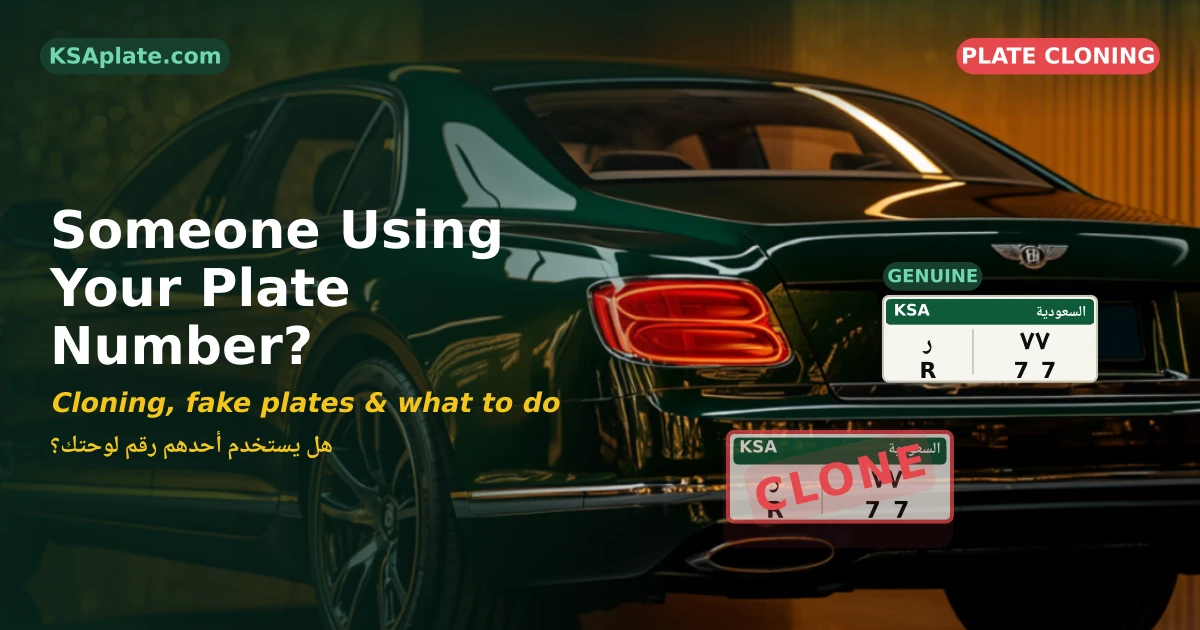
If fines, Saher tickets or toll charges are appearing against your car for roads you never drove, someone may be using your license plate number — a fraud known as plate cloning (تكرار اللوحة). A criminal copies your exact plate number onto another vehicle, usually the same make and colour as yours, so their violations, tolls and even crimes are logged against your registration instead of theirs. This is not the same as losing a physical plate or having your car stolen — your plate is still bolted to your car and your vehicle is sitting in your driveway. What has been stolen is your number, and the damage shows up as wrongful fines, Najm and Absher notifications, and a paper trail that points at you. This guide explains exactly what plate cloning means in Saudi Arabia, how to tell it apart from a genuine Absher error or a stolen physical plate, how to check whether you have been cloned, and the precise steps to report it, dispute the fines and protect yourself.
Before we go deep, keep the map straight: if your physical plate was lost, stolen or damaged, that is a different problem covered in replacing a lost, stolen or damaged Saudi plate, and if your whole car was taken, read car theft prevention in Saudi Arabia. This article is specifically about the duplication of your plate number onto someone else's car.

- It is called plate cloning. A criminal copies your exact plate number (often onto an identical make and colour car) so their fines, Saher tickets and tolls are recorded against your vehicle, not theirs.
- The warning signs are wrongful charges. Fines or Saher tickets for places and times you never drove, unexplained toll deductions, and Absher/Najm notifications that do not match your movements.
- Check first, then report. Review your fines and vehicle record through Absher and the traffic-fines service — see how to check and pay Saudi traffic fines — and compare each violation's location and time against where your car actually was.
- Report a بلاغ to Muroor/police and dispute the fines. Gather evidence (your car's real location, photos, receipts), file a police report, and lodge a formal objection (اعتراض) against each wrongful fine.
- Prevent it. Do not post clear photos of your plate online, blur it when selling — see how to photograph a plate for sale — and know the Saudi plate display and cover rules.
Quick answer: If someone is using your license plate number, your plate has been cloned — copied onto another car so that car's violations land on your record. Confirm it by checking your fines and vehicle history in Absher and matching each violation's location and time against where your car really was; anything you can prove you were nowhere near is evidence of cloning. Then file a police report (بلاغ) with Muroor, submit a formal objection (اعتراض) against every wrongful fine with your evidence attached, keep copies of everything, and report it to Najm if insurance or an accident is involved. Cloning is distinct from a stolen physical plate (your plate is still on your car) and from a genuine Absher data error (which a records correction fixes) — the decision framework further down helps you tell which one you are facing.
What does it mean if someone is using my plate number?
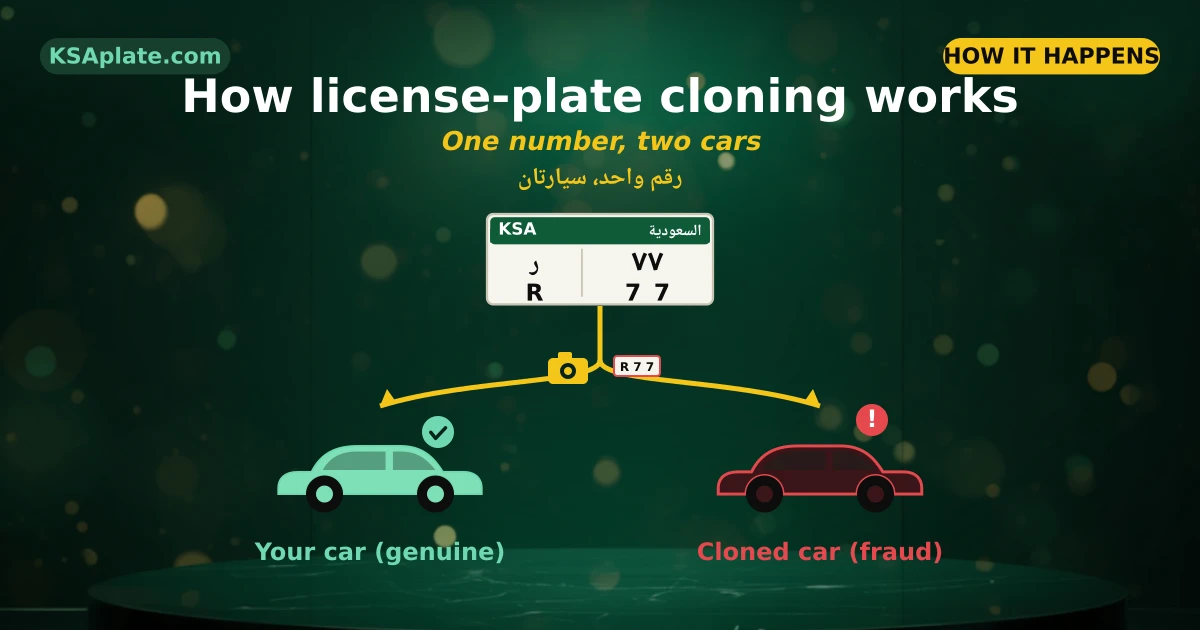
When someone is "using your license plate number," it almost always means your plate has been cloned — in Arabic, تكرار اللوحة (plate duplication). A criminal has produced a counterfeit plate carrying your exact number and letters and fitted it to a different vehicle. From that moment, any traffic camera, Saher system, toll gate or patrol that reads that fake plate records the event against your registration, because as far as the automated systems are concerned, the plate they photographed is yours.
The crucial point is what has and has not been taken. Your physical plate is untouched — still bolted to your car. Your car is untouched — still yours, still where you left it. What the criminal has stolen is your identity on the road: the number that ties a vehicle to you in the Ministry of Interior's systems. That is why cloning is so insidious. There is no broken window, no missing plate, nothing physically wrong to alert you. The first sign is usually a fine, a Saher ticket, or a notification for something you did not do.
Criminals clone plates for concrete reasons. A cloned plate lets them drive without their real number being caught: their speeding fines, red-light violations, toll charges and parking penalties all route to you. If they use the car for something worse — a hit-and-run, smuggling, or a crime scene — the plate on camera points investigators to your name first. In effect, they are borrowing your clean record to hide their behaviour, and you inherit the consequences until you prove the car was not yours.
Cloning is not physical plate theft or car theft
It is worth nailing this down because the three problems are constantly confused. Physical plate theft is when the metal plate is unbolted and taken from your car — you will notice it is missing, and the fix is a replacement plate, covered in replacing a lost, stolen or damaged plate. Car theft is when the whole vehicle is taken, covered in car theft prevention. Plate cloning leaves both your plate and your car exactly where they are; only your number has been copied. The remedy is not a new plate or a stolen-vehicle report — it is proving the wrongful violations were not you and clearing your record.
How plate cloning happens in Saudi Arabia
Understanding the mechanics helps you both spot cloning and prevent it. Cloning is not sophisticated hacking — it is old-fashioned copying, and it starts with a criminal getting hold of a plate number that suits their needs.
Photographing plates in public
The simplest source is a photograph. A plate is on public display all day — in car parks, at traffic lights, outside your home. A criminal looking for a plate to clone will target a specific make and colour of car, photograph the plate, and reproduce the number. This is why a car identical to yours is often chosen: if the cloned car is the same model and colour, the fake plate is far less likely to look wrong to a casual observer or even a patrol.
Plates harvested from online listings
The second major source is the internet. People post photos of their cars — for sale, on social media, in accident or insurance disputes — with the plate fully visible. A clear, well-lit, straight-on photo of a plate is a gift to a cloner: it is easier to copy than a plate glimpsed in traffic. This is the single most avoidable exposure, and it is why blurring your plate before you post is so important. If you are listing a car or a plate for sale, follow how to photograph a Saudi license plate for sale, which shows how to present the plate without handing criminals a usable copy.
Making a counterfeit plate
With a number in hand, the criminal produces a counterfeit plate. Genuine Saudi plates are issued only through the Ministry of Interior, but fake plates can be fabricated to look convincing at a glance and at the resolution of a speed camera. The counterfeit does not need to survive close inspection — it only needs to be read correctly by an automated system or pass a quick visual check, at which point your number is doing the work.
Matching make and colour
The most deliberate cloners match the vehicle. If your number sits on a white sedan of a common model, they fit the fake plate to a white sedan of the same model. Now the cloned car is almost indistinguishable from yours on camera: same plate, same car. This makes the fraud harder to detect and harder to disprove, because a still image of "your" car committing a violation looks entirely plausible. Your defence then rests on proving where your actual car was at that exact time.
Why criminals do it
The motive is always to shift consequences onto someone else. Fines and Saher tickets go to your record instead of theirs. Toll and parking charges are billed to you. If the car is used in a crime, the plate leads investigators to your door first, buying the criminal time and cover. A clean plate — yours — is valuable precisely because it has no flags on it, so the criminal can operate under it until you notice and act.
Warning signs your plate has been cloned
Cloning is invisible until the consequences arrive, so knowing the warning signs is your early-detection system. If you notice any of the following — especially more than one — treat cloning as a live possibility and move to the checking steps.
- Fines or Saher tickets for roads you never drove. A speeding or red-light violation in a city or on a highway you were nowhere near.
- Violations at times your car was elsewhere. A ticket timestamped when your car was parked at home, at work, or in another region entirely.
- Unexplained toll or parking charges. Deductions for gates or lots you did not use.
- A sudden cluster of violations. Several fines appearing together, in a pattern that does not match your driving.
- Absher or Najm notifications that do not fit. Alerts about incidents, accidents or penalties you have no knowledge of.
- Official letters or contact about an incident involving your plate number that you were not part of.
- Two records of "your" car at once. Any indication your number was in two places at the same time is a near-certain sign of duplication.
A single surprising fine is not proof of cloning — you might simply have forgotten a trip, or a camera may have a genuine error. The pattern that signals cloning is violations you can positively place elsewhere: your car demonstrably somewhere its plate says it was not. That is the evidence that turns a suspicion into a provable case, and it is exactly what you gather next.
What's your plate worth?
Get an instant, free estimate with our plate value calculator.
Calculate My Plate's ValueHow to check if your plate is being cloned
Checking is about matching each violation against your car's real movements. You already have the tools — Absher and the Ministry's traffic-fines services — you just need to read them with cloning in mind. Do not re-learn fine mechanics here; this section is about what to look for, and the full how-to lives in the linked guides.
Review every fine and its details
Pull up your traffic fines through Absher or the traffic-fines service and read each one in detail — not just the amount, but the location and time of the violation. The step-by-step for accessing and reading your fines is in how to check and pay Saudi traffic fines. For each fine, ask a single question: could my car have been at that place at that time? Any "no" is a red flag.
Check your vehicle and plate record
Use the plate and vehicle look-up to confirm your registration details and status, so you know exactly what number and vehicle the system has on file for you — see how to check a Saudi license plate. This confirms the record the fines are being attached to is genuinely yours and helps you describe your vehicle precisely when you report.
Match violations to where your car actually was
This is the decisive check. For each suspicious violation, establish where your car really was at that timestamp: parked at home (neighbours, building cameras), at your workplace (entry logs, colleagues), in for service (a garage receipt), or in a different city (fuel receipts, your own travel records, family who can confirm). If your car can be placed away from the violation, the plate that was photographed was not on your car — it was a clone. Collect this proof as you go; it is the backbone of both your police report and your fine objections.
Watch the Saher, Absher, Najm and Tam channels
Keep an eye on the channels that surface violations and incidents — Saher tickets, Absher notifications, Najm contact for accidents, and the Tam/traffic services. A cloned plate tends to generate activity across these because the cloned car is out committing violations under your number. Consistent, unexplained activity across multiple channels strengthens the case that your number is in use on another vehicle.
What to do if your plate is cloned: step by step
Once you suspect cloning and have started gathering evidence, act methodically. The goal is twofold: create an official record that your number is being misused, and stop the wrongful charges from sticking to you. Follow these steps in order.
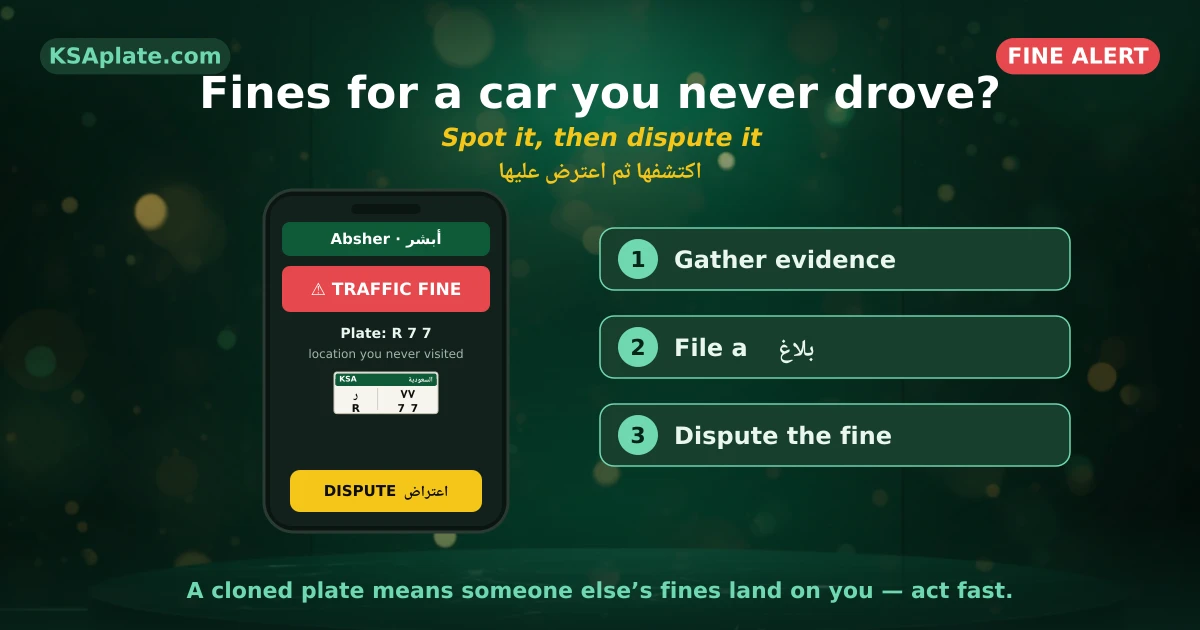
- Gather your evidence first. Before you report, assemble proof for each wrongful violation: the fine details (location, date, time), and evidence of where your car actually was at that moment — receipts, photos with timestamps, building or workplace records, and any witnesses. The stronger your evidence, the faster the resolution.
- Document your own vehicle and plate. Photograph your car and its genuine plate now, showing the number clearly, ideally with a visible date. This establishes that your physical plate is present and correct on your car, which directly contradicts any claim your car committed a distant violation.
- File a police report (بلاغ) with Muroor. Report the suspected cloning to the traffic police / Muroor. Explain that your plate number is being used on another vehicle and present your evidence. This creates the official record that underpins every dispute that follows — without a بلاغ, you are arguing each fine in isolation; with one, you have a documented case of fraud.
- Get documentation of your report. Obtain a reference or copy of the report. You will attach or cite it when you object to fines and when you deal with any other authority, so keep it safe and accessible.
- Dispute every wrongful fine (اعتراض). Lodge a formal objection against each fine you did not incur, attaching your evidence and referencing the police report. The objection process is covered in checking and paying (and disputing) Saudi traffic fines — do that for each wrongful violation, not just the biggest one.
- Notify Najm if an accident or insurance is involved. If any incident under your cloned plate touches an accident or insurance claim, involve Najm so the record reflects that the vehicle was not yours — see reporting a car accident with Najm.
- Keep copies of everything. Every fine, every objection, every receipt, the police report, and all correspondence. Cloning cases can take time and may recur, so a complete file is your protection.
- Take protective steps going forward. Tighten how you expose your plate (see prevention below), monitor your fines regularly, and keep your evidence current so you can respond quickly if new wrongful violations appear.
The two steps people skip are the police report and disputing every fine. It is tempting to just pay a small wrongful fine to make it go away — but paying it is an admission the violation was yours, it does nothing to stop the next one, and it weakens your position if the fraud escalates. Report once, then dispute each fine with the same evidence package.
How to dispute and reverse wrongful fines
Reversing fines you did not incur runs through the official objection (اعتراض) process. This section covers how to frame a cloning dispute specifically; for the general mechanics of accessing and submitting objections, use the traffic-fines guide so we do not repeat it here.
Build the objection around location and time
The heart of every cloning objection is the same argument: my car could not have been at this place at this time, and here is the proof. For each wrongful fine, state the violation's location and timestamp, then present your evidence that the car was elsewhere. Reference your police report (بلاغ) so the authority sees this is a documented cloning case, not a routine "I don't remember this fine" complaint. Specific, dated evidence wins objections; vague denials do not.
Do not pay to make it disappear
Resist the urge to pay a wrongful fine for convenience. Payment is treated as acceptance that the violation was yours, which undermines your cloning case and may complicate reversing it later. Dispute it instead. If a fine has already escalated or been paid before you realised what was happening, raise it in your objection and with the police report — the documented fraud is the basis for seeking correction.
Handle recurring fines together
Because the cloned car keeps driving, new fines can keep arriving. Rather than treating each as a fresh surprise, tie every new wrongful violation back to your existing police report and evidence package, and object promptly. A standing, documented case makes each subsequent objection faster and more credible than starting from scratch every time.
Cloning vs stolen plate vs Absher error
Not every strange fine is cloning. Before you launch a full cloning response, work out which of three situations you are actually in, because each has a different fix. Use the table and the quick decision guide below.
| Situation | What is happening | Tell-tale sign | The right fix |
|---|---|---|---|
| Plate cloning | Your number is copied onto another car; its violations hit your record | Your plate and car are both present, but fines appear for places/times your car was not | Police report (بلاغ) + object to each fine with location/time evidence |
| Stolen physical plate | The metal plate is physically removed from your car | Your plate is visibly missing from your vehicle | Report and replace the plate; report misuse |
| Genuine Absher / data error | A record mistake — wrong plate captured, mis-keyed number, system mix-up | An isolated error with no pattern; your car may match but details are off | Records correction / objection through the official channel; no fraud involved |
Quick decision guide:
- Is your physical plate still on your car? If it is missing, you are dealing with a stolen physical plate — go to plate replacement. If it is present, continue.
- Can you prove your car was elsewhere at the violation's time and place? If yes, and especially if it happens more than once, this is cloning — file a بلاغ and dispute each fine. If it is a one-off with no pattern, consider a genuine error first.
- Does the fine detail simply look mistaken (wrong vehicle description, a clearly mis-keyed number) with no sign of another car using your number? That points to an Absher/data error — pursue a records correction rather than a fraud report.
The distinction matters because the effort and the paperwork differ. A one-off data error is fixed with a correction; cloning needs a police report and a sustained dispute. When in doubt, the "was my car provably somewhere else, repeatedly?" test is the clearest divider between a genuine error and deliberate cloning.
How to prevent plate cloning
You cannot make your number impossible to copy — it is on public display by law. But you can dramatically reduce your exposure and improve your ability to prove innocence if it happens. Prevention is part reducing what a cloner can grab, part keeping your own records tight.
Be careful posting plate photos online
This is the biggest lever you control. A clear online photo of your plate is the easiest possible source for a cloner. When you post your car anywhere — for sale, on social media, in a dispute — blur or cover the plate. If you are selling a car or a plate and need to show it, do it the safe way described in how to photograph a Saudi license plate for sale, which shows how to present a plate for a listing without exposing a usable copy of your number.
Know the rules on plate covers and frames
Plate covers are tempting as an anti-photography measure, but their legality is regulated — an illegal cover can itself earn you a fine, and covers do not stop a determined cloner who simply reads your number in traffic. Know what is and is not allowed before you fit anything, in the Saudi license plate display and cover rules. Treat covers as a minor, rules-bound measure, not a solution.
Photograph and register your own plate
Keep your own dated photos of your car and its genuine plate, and know your registration details cold (via a plate check). This is not about stopping the clone — it is about being ready to disprove it instantly. If you can show your plate on your car with a date, and place your car away from a violation, you can defeat a wrongful fine quickly.
Monitor your fines regularly
The sooner you catch cloning, the less it costs you and the fresher your evidence. Check your fines periodically rather than waiting for a nasty surprise, using the traffic-fines service. Early detection means you can report and dispute while you can still prove where your car was.
One proposed answer to cloning is the plate itself becoming tamper-evident. We looked at whether that is realistic here in our guide to digital licence plates — including why the plate number, not the panel, is the part that holds value.
What cloning means for buyers and sellers
Plate cloning is not only a driver's problem — it matters when plates and cars change hands on a marketplace. If you are buying, you want a number with a clean status; if you are selling, you want to prove yours is clean and avoid exposing it during the sale.
Buyers: verify a plate's clean status before buying
Before you buy a plate or a car, verify the number's status so you are not inheriting a record tangled up in cloning disputes or unresolved wrongful fines. Run the checks in how to verify a Saudi license plate before buying and confirm the plate's standing with a plate check. A clean, verified number is exactly what a reputable marketplace helps you confirm, so you transact with confidence rather than taking a stranger's word.
Sellers: protect the number during the listing
When you list a plate or car, you have to show the number — but you do not have to hand out a pristine copy to every browser. Present it the safe way (see photographing a plate for sale) and share full, clear detail only with a serious buyer through the platform. This protects your number from being harvested for cloning while your listing is public. For the format basics that both sides should understand, the complete Saudi plate guide is the primer.
Who to contact: Najm, Muroor and Absher
Handling cloning means dealing with the right authority for each part of the problem. Here is who does what, so you route each action correctly.
- Muroor (General Department of Traffic) and police — file the بلاغ. The traffic police are where you report the cloning itself. This is the foundation of your case. In an emergency involving a crime or immediate danger, 911 is the emergency number in the main regions (999 elsewhere); for traffic matters and reports, use the Muroor channels and the traffic-services line to lodge and follow up your report.
- Absher — objections and records. Your fines, vehicle record, notifications and the objection (اعتراض) submissions are handled through Absher and the traffic-fines service. This is where you dispute wrongful fines and monitor your record.
- Najm — accidents and insurance. If your cloned plate becomes entangled in an accident or an insurance claim, Najm is the party to involve so the record reflects that the vehicle was not yours — see reporting an accident with Najm.
Route each issue to the right place: the police for the fraud report, Absher for the fines and objections, and Najm for anything touching an accident or insurance. Keeping these lanes straight — and citing your police report across all of them — is what turns a stressful situation into a documented, resolvable case.
Buying or selling a plate? Verify it is clean first
A clean, verified number protects you from inheriting someone else's fines. Browse Saudi plates, check a number's status, and list yours safely for free when you are ready to sell.
Browse Saudi plates Value a plate free
Frequently asked questions
What is plate cloning?
Someone is using my plate number — what do I do?
How do I dispute a fine I didn't get?
Can I find out who cloned my plate?
How do I prove it wasn't my car?
Does a plate cover prevent cloning?
Can expats report plate cloning?
Is plate cloning the same as a stolen plate?
How do I know if it's cloning or just an Absher error?
Should I pay a wrongful fine to avoid trouble?
What if my cloned plate is used in a crime or accident?
How can I check if my plate is being cloned right now?
Does buying a verified plate protect me from cloning disputes?
Reviewed by Khalid Al-Rashid, Saudi License Plate Market Analyst.
Sources: Ministry of Interior and General Department of Traffic (Muroor) violation, reporting (بلاغ) and objection (اعتراض) conventions; Absher platform traffic-fines, vehicle-record and notification services; Najm accident and insurance reporting; and KSAplate marketplace data on plate verification. Plate cloning is a fraud offence — report suspected cases to the authorities, and confirm current reporting, objection and fine procedures through official Muroor, Absher and Najm channels.