
TL;DR:
- Most car theft in Saudi Arabia is opportunistic, not organized — unlocked doors, keys left in the ignition, and valuables visible through the window account for the majority of cases. A few consistent habits close most of that gap.
- Layer your defenses. A visible steering wheel lock deters opportunists, an OBD port lock blocks a common relay-attack method, and a GPS tracker is the one device that actually helps once the car is already gone.
- The first hour matters more than any device. Confirm the car wasn't just moved or towed, file a police report immediately, get the reference number, then notify your insurer — in that order.
- No insurance claim moves without an official police report reference. This is the single document that unlocks everything else, so it comes before any other call you make.
- If you're buying a used car, verify it wasn't previously stolen or salvaged. A history check and matching paperwork protect you from buying someone else's unresolved problem.
Quick answer: Preventing car theft in Saudi Arabia comes down to a handful of consistent habits — always lock the car, never leave keys or valuables visible, park in well-lit and camera-covered areas, and add at least one real tracking device like a GPS tracker alongside cheaper deterrents like a steering wheel lock. If your car is stolen, confirm it wasn't towed or moved, file a police report immediately, get the report reference number, notify your insurance company, and share any GPS or tracker data you have. Insurance claims for theft require that police report, so it's the first call that matters.
How real is car theft risk in Saudi Arabia
It's worth starting honestly: car theft isn't the dominant risk facing vehicle owners in the Kingdom the way it might be marketed elsewhere, and most cars parked normally, locked, with keys out of sight are never touched. That said, "low risk" isn't "no risk," and the cases that do happen follow a predictable pattern worth understanding rather than a random one.
The overwhelming majority of vehicle theft here is opportunistic rather than organized — a thief walks a parking area, tries door handles, and takes whatever is unlocked or has keys visible. Whole-car theft using sophisticated methods (key cloning, relay attacks on keyless entry) does happen but is far less common than simple opportunism. A second, distinct category is parts and contents theft — items left visible inside the car, and less commonly, wheels or badges — which doesn't require taking the whole vehicle and is harder to prevent with any single device.
The practical takeaway: the habits in the next section close off the opportunistic majority almost entirely, and the devices further down handle the more determined minority. Neither is complicated or expensive, which is exactly why skipping them is the actual risk, not the city or neighborhood you live in.
Daily habits that prevent most theft
Before any device or subscription, these cost nothing and stop most opportunistic theft on their own.
- Lock the car every time, even for a minute. "I was only inside for a second" is the setup for a huge share of thefts and break-ins. Make locking automatic, not a judgment call you make each time.
- Never leave keys in the ignition or visible. This sounds obvious and gets ignored constantly — warming up a car unattended, or leaving keys on a seat while loading groceries, hands a thief the easiest possible theft.
- Keep valuables out of sight, not just out of reach. A bag, phone, or laptop visible through a window invites a broken window even when the item inside isn't worth much — the damage and hassle of a smashed window often costs more than what was taken.
- Close windows and the sunroof completely. A gap large enough for an arm is a gap large enough for a thief.
- Don't leave your Istimara or ID documents in the car. Beyond the inconvenience of losing them, documents left in a stolen car complicate both the police report and your insurance claim.
Anti-theft devices worth having
Habits handle most risk for free; a small layer of devices handles the rest, and covers you if a habit slips on a bad day.
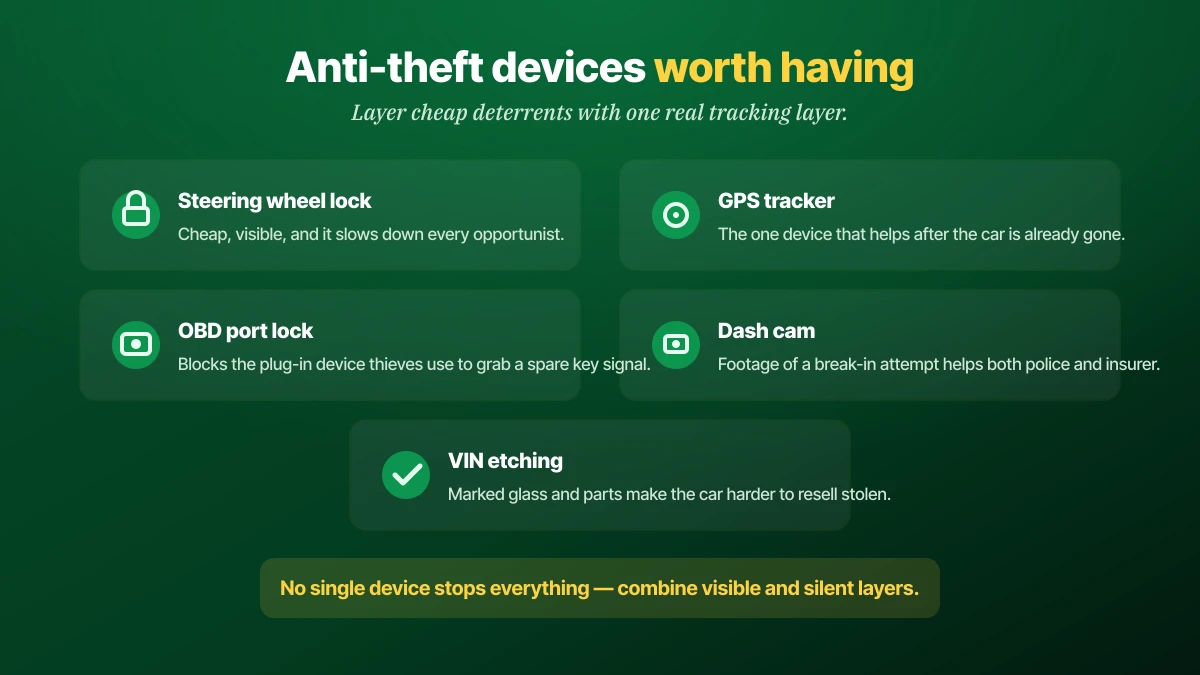
| Device | What it actually stops | Typical cost tier | Install |
|---|---|---|---|
| Steering wheel lock | Opportunistic theft — visible deterrent | Low | None — clips on in seconds |
| OBD port lock | Relay/key-cloning theft via the diagnostic port | Low | DIY, a few minutes |
| GPS tracker | Recovery after the car is taken — not prevention | Low–medium plus subscription | DIY or professional |
| Dash cam | Evidence for break-ins and disputes, not theft itself | Low–medium | DIY |
| VIN etching / marked parts | Resale of a stolen car — deters, doesn't prevent the theft | Low | Professional, one-time |
Notice the pattern: most of these deter or assist recovery rather than physically stopping a determined thief — which is exactly why the habits above and the parking choices below carry more of the real weight than any single gadget.
A spare only helps if it exists before you need it. Our guide to replacing a lost car key in Saudi Arabia covers what a coded key costs and how long a dealer takes.
What's your car worth?
Get a free instant estimate based on real Saudi market data — then sell it on KSAplate with direct WhatsApp contact.
Value My Car — FreeChoosing & installing a GPS tracker
Of everything on this page, a GPS tracker is the device that actually changes the outcome if a theft happens — it's the difference between a police report with no leads and a location the police can act on within minutes.
- Subscription vs one-time devices. Most useful trackers require an ongoing data subscription for live location — a one-time "black box" that only logs data after the fact is far less useful in an active theft. Budget for the subscription as part of the real cost, not an optional extra.
- Hidden installation beats a visible one. A tracker a thief can spot and remove in thirty seconds defeats the purpose. Professional installation tucked into the wiring harness or a non-obvious location is worth the extra cost over a plug-and-play unit sitting in the OBD port.
- Check the app and alert setup before you need it. Confirm you can actually pull a live location from your phone, and set up movement or geofence alerts so you notice unauthorized movement quickly rather than the next morning.
- Know what you're sharing and with whom. A tracker means a company holds your location history — reasonable for most people, but worth being a deliberate choice rather than an assumption.
If your car is financed, it's also worth checking whether your financing agreement already includes tracking — some do, which can save you a separate purchase. For everything else about how financing interacts with your car, see our guide to selling a financed car.
Parking choices that matter
Where you park changes your odds more than almost anything else on this list, because it changes how much time and privacy a thief has to work with.
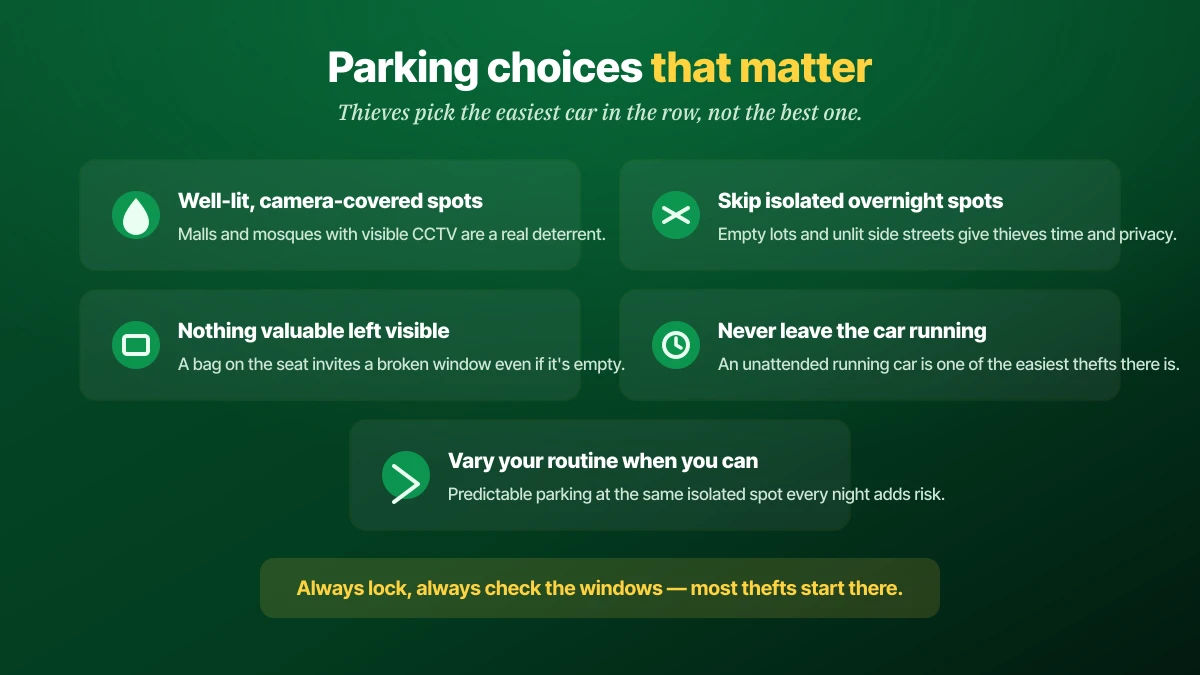
Favor spots with visible CCTV and foot traffic — mall and mosque parking with active cameras is a genuine deterrent, not just a feeling of safety. Avoid isolated, unlit spots for overnight parking whenever there's a reasonable alternative, even if it's a slightly longer walk. If you park in the same spot every night out of habit, especially somewhere quiet, a predictable pattern is exactly what makes a car an easy, low-risk target for someone watching. None of this requires a garage or paid parking — just choosing the busier, better-lit option over the empty one at the end of the street.
The first hour after discovering your car is stolen
What you do in the first hour affects how quickly the car might be recovered and whether your insurance claim goes smoothly — get this sequence right before making any other calls.
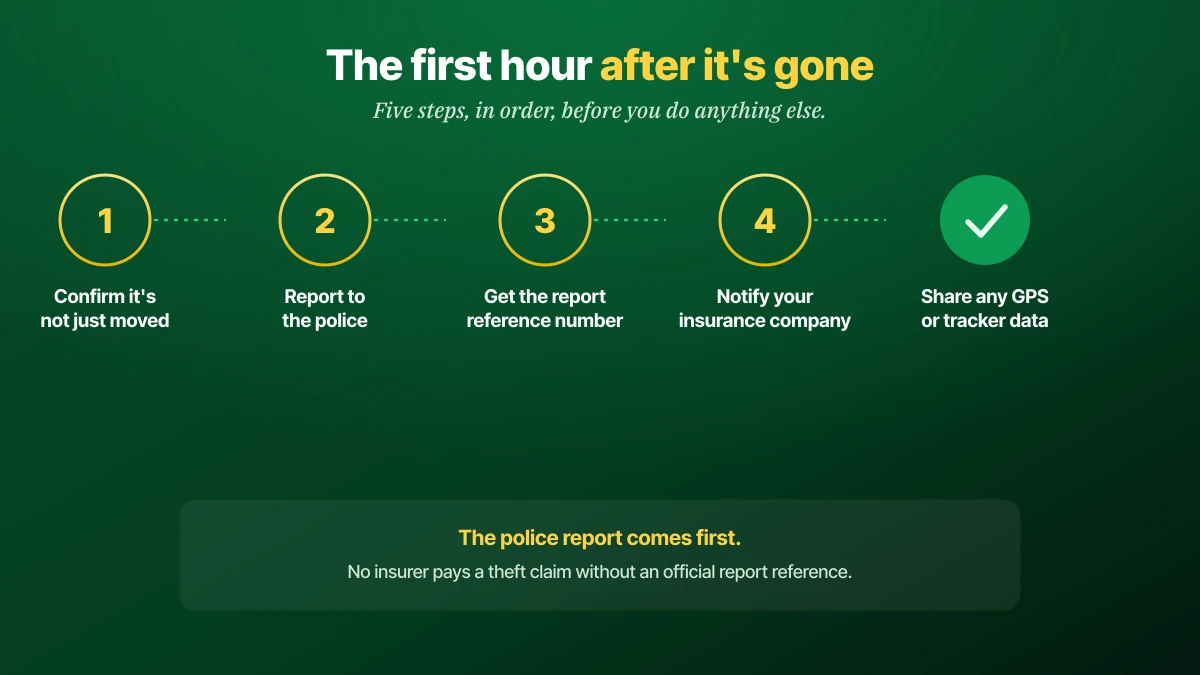
- Confirm it wasn't moved or towed first. Check with building security, mall management, or whoever might have relocated it for a legitimate reason before assuming theft — this takes a few minutes and saves an unnecessary police report.
- Report it to the police immediately. Don't wait to see if it "turns up" — the sooner a stolen vehicle report exists, the sooner it can be flagged at checkpoints and to traffic cameras.
- Get the official report reference number. This is the single document every subsequent step depends on — your insurance claim cannot proceed without it, so confirm you have it in hand or know how to retrieve it before you leave.
- Notify your insurance company the same day. Most policies have a reporting window, and prompt notification avoids any question later about why you waited.
- Share any GPS or tracker data immediately. If you have a live location, that goes to the police as part of the report, not just to your own phone — a location you're sitting on helps no one.
Filing an insurance claim for a stolen car
Whether theft is covered at all depends entirely on your policy type, which makes this worth understanding before you need it, not after.
| Coverage type | Theft covered? | What typically happens |
|---|---|---|
| Comprehensive | Yes, typically | Claim processed against the vehicle's assessed value, subject to your policy's terms and any excess |
| Third-party only | No | Third-party covers damage you cause to others — your own stolen vehicle isn't compensated |
If you carry comprehensive cover, the police report reference is the document your insurer will ask for first — have it ready before you call. Insurers typically also want the vehicle's registration details, your policy information, and an account of when and where the car was last seen. There's usually a waiting period before a stolen vehicle is formally treated as a total loss for payout purposes, since recovery within the first days or weeks isn't unusual. For everything else about how coverage levels and exclusions work day to day, our car insurance guide covers the broader picture; this section is specifically about the theft scenario within it.
If your car is recovered
A recovered vehicle isn't automatically back to normal — treat the return itself as a checklist, not a relief.
- Have it inspected before you drive it normally. Stolen vehicles are sometimes used hard, involved in other incidents, or stripped of parts before recovery — a proper inspection catches damage that isn't obvious at a glance.
- Check the plate is still attached and matches your records. If it was removed, lost, or damaged during the theft, our guide to replacing a lost, stolen or damaged plate covers that process directly.
- Update your insurer whether or not you'd already been paid out. A recovery after a claim has been processed has its own procedure, and how it's handled depends on how far your claim had already progressed.
- Consider a full history check on the car itself once it's back, particularly if it was gone for any meaningful length of time — it's the same check a buyer would run, and it's worth running on your own car too after an incident like this.
- Decide honestly whether you still want the car. Some owners are uneasy driving a recovered vehicle even once it checks out mechanically — if that's you, there's no obligation to keep it, and listing it for sale with the full, honest history disclosed is a reasonable path once repairs and paperwork are settled.
Buying a used car: verifying it wasn't stolen
If you're on the buying side rather than dealing with your own theft, the risk is different but related: unknowingly buying a vehicle with an unresolved theft or salvage history attached to it. Shopping on a marketplace that surfaces seller and vehicle details up front — like browsing cars on KSAplate — makes this easier than a random classified ad, but the verification habits below matter regardless of where you find the car.
A few checks cover most of this risk. Confirm the name on the Istimara matches the seller and that the VIN on the vehicle matches its paperwork exactly — mismatches are the clearest signal something hasn't been fully resolved. Run a proper vehicle history check before you commit to anything, since this is exactly the kind of issue a rushed private sale can leave buried. The patterns overlap significantly with what our used car scams guide covers more broadly — a seller who's evasive about a car's history, oddly motivated to sell fast, or unable to produce clean paperwork is worth walking away from regardless of how good the price looks.
Mistakes to avoid
The same handful of errors show up repeatedly in both prevention and after-the-fact handling.
- Treating "I'll only be a minute" as safe. Quick stops are exactly when cars get left unlocked or running, and exactly when opportunistic theft happens.
- Buying a tracker and never checking it works. A tracker with a lapsed subscription or an app you've never actually tested is a false sense of security, discovered at the worst possible moment.
- Calling your insurer before the police. Without a police report reference in hand, the claim conversation stalls immediately — get the report first.
- Assuming third-party insurance covers theft. It doesn't. Confirm your actual coverage level before you need it, not while you're filing a claim.
- Skipping the inspection after a recovery. A returned car can carry damage or issues that aren't visible without a proper check.
- Buying a used car without a history check because the price is good. A steep discount is sometimes exactly why the price is good — the seller needs the car gone before questions get asked.
Frequently asked questions
How common is car theft in Saudi Arabia?
What is the best anti-theft device for a car in Saudi Arabia?
Does a GPS tracker prevent car theft?
What should I do in the first few minutes after realizing my car is missing?
Does car insurance cover theft in Saudi Arabia?
What documents does my insurer need for a stolen car claim?
How long does it take for a stolen car to be declared a total loss?
My car was recovered — is it safe to drive right away?
What if my license plate was lost or damaged during a theft?
How do I check if a used car I'm buying was previously stolen?
Should I leave my car running to warm it up while I go inside somewhere?
Conclusion & next steps
Protecting a car in Saudi Arabia isn't about expensive technology — it's about a handful of habits that cost nothing, one or two devices that layer in real protection, and knowing the exact sequence to follow if the worst happens. Lock the car every time, keep valuables and keys out of sight, choose well-lit parking over convenient parking, and add a GPS tracker if you want a real chance at recovery rather than just deterrence. If theft does happen, the police report comes before every other call — it's the document everything else depends on.
If you're shopping for a car and want to start with one that's easy to protect and easy to verify, browse the marketplace with a history check as part of your process. And if you're getting ready to sell, a clean, well-documented car — with no unresolved questions about its past — is worth more to a buyer; list it on KSAplate when you're ready.