
TL;DR:
- Saudi Arabia has five distinct car-auction channels — judicial auctions on the government Infath platform, government-fleet disposals, bank repossession sales, insurance salvage auctions, and private auction houses — and they carry very different risk levels.
- Auction cars are sold as-is: no warranty, no test drive, and usually no return. The discount you see is payment for the risk you accept.
- The hammer price is not the final price. Add the buyer's premium (commonly 2.5–5%), VAT on the premium, transport, transfer fees, inspection and immediate maintenance — a realistic 8–15% on top.
- Your maximum bid is a calculation, not a feeling: market value minus repairs, minus fees, minus a safety margin. Decide it before the bidding starts and never cross it.
- The paperwork after the hammer matters as much as the bid — ownership transfer, technical inspection and insurance all have deadlines, and skipping the sequence can leave you with a car you cannot register.
Quick answer: To buy a car at auction in Saudi Arabia, register on the platform (government judicial auctions run through Infath; private houses have their own registration), pay the refundable deposit, inspect the car during the viewing window, set a maximum bid from its market value minus repairs and fees, and bid within your limit. If you win, pay within the deadline, collect the sale documents, then complete ownership transfer, inspection and insurance before driving it.
The Saudi car-auction landscape
"Car auction" in Saudi Arabia is not one market — it is at least five, and the channel a car comes through tells you most of what you need to know about its condition and its risk before you ever open the listing. Treat the channel as your first filter.
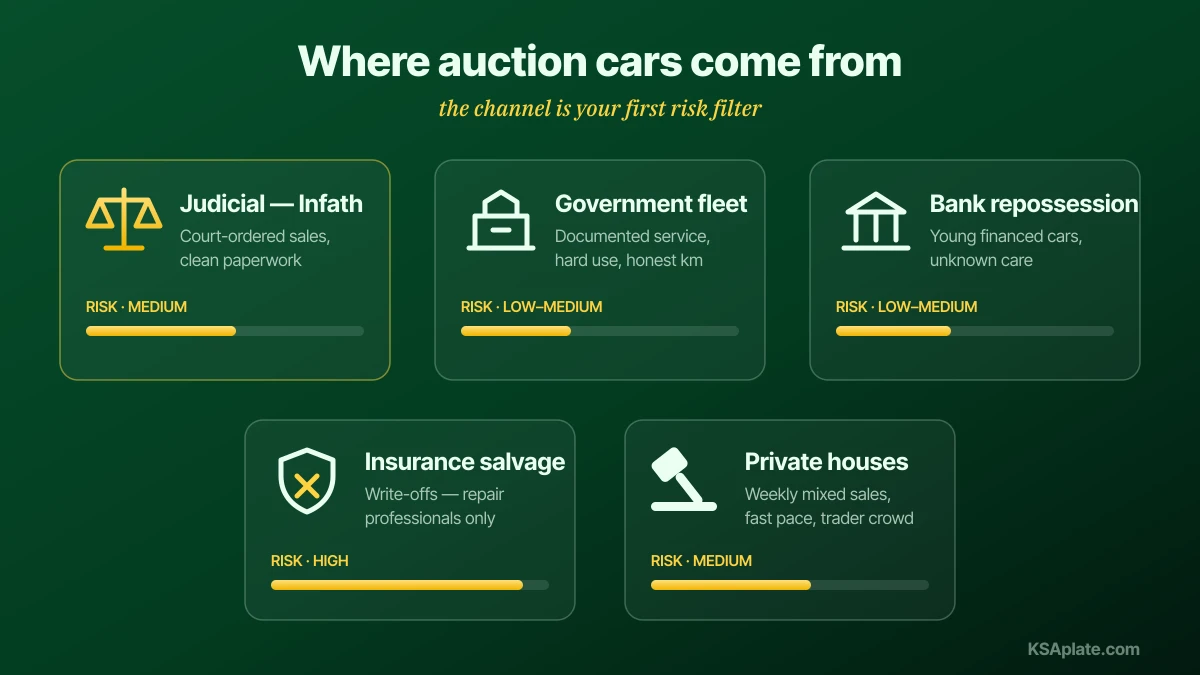
Judicial and enforcement auctions run through Infath, the government platform that liquidates court-ordered assets — including vehicles — through scheduled online auctions. Government bodies also dispose of fleet vehicles in batch sales. Banks auction repossessed cars, usually through appointed auction houses. Insurers sell accident write-offs through salvage auctions. And private auction houses in Riyadh, Jeddah and Dammam run weekly physical and online sales that mix dealer stock, fleet retirements and consignment cars.
| Channel | Typical cars | Condition risk | Best for |
|---|---|---|---|
| Judicial (Infath) | Enforcement and estate vehicles, all ages | Medium — sold as-is, storage time varies | Patient buyers who inspect carefully |
| Government fleet | Ministry and utility cars, high mileage | Low–medium — documented service, hard use | Budget workhorses |
| Bank repossession | 1–4 year old financed cars | Low–medium — young cars, unknown care | Late-model value hunters |
| Insurance salvage | Accident write-offs | High — structural damage possible | Repair professionals only |
| Private auction houses | Dealer trade-ins, fleet, consignment | Medium — mixed quality, faster pace | Experienced buyers, traders |
The pattern to remember: the cheaper the channel looks, the more expertise it assumes. Salvage discounts are real, but they price in repair work that only a professional can estimate. A first-time auction buyer is usually best served by bank-repossession or government-fleet lots, where the story of the car is at least partly documented.
Government and judicial auctions
Infath (the Enforcement Authority's platform) is the closest thing Saudi Arabia has to an official public car auction. Vehicles arrive there through court enforcement — unpaid debts, liquidations, estates — and are sold in time-boxed online auctions that anyone with a verified account can join.
Three things distinguish the government channel. First, identity and payment run through verified rails: you register with your national ID or Iqama, and deposits and settlements move through SADAD, which removes the "is this auction real?" question entirely. Second, the paperwork is clean by construction — a court-ordered sale extinguishes the previous owner's claims, and the transfer paperwork is issued by the authority itself. Third, the discount reflects process, not charity: cars may have sat in storage for months, batteries are often dead, tires flat-spotted, and there is no seller standing next to the car answering questions.
Expats can participate with a valid Iqama. Read each auction's terms page carefully: deposit amounts, viewing days, payment deadlines and collection windows differ per auction, and missing a payment deadline typically forfeits your deposit.
How a car auction works, step by step
Whatever the channel, the mechanics follow the same eight-step skeleton. Walk it once on paper and the process loses its intimidation factor.
- Register and verify. Government platforms verify against Absher; private houses take copies of your ID or Iqama and contact details.
- Pay the deposit. A refundable security — commonly a fixed amount in the thousands of riyals or a percentage of your intended bidding ceiling — activates your bidder number.
- Study the catalogue. Each lot lists the VIN, mileage as-shown, and photographs. Shortlist three to five lots, never just one.
- Attend the viewing. Physical inspection windows run one to three days before the sale. This is the only quality control you will get — use it (see the inspection section).
- Set your maximum bid per lot, in writing, before the auction starts.
- Bid. Online auctions run for a fixed window with anti-sniping extensions; live auctions move fast, often under a minute per car.
- Pay within the deadline. Winning bids are typically due in full within 24 hours to 7 days depending on the house. Late payment forfeits the deposit.
- Collect and transfer. Take the sale documents, arrange transport (the car may not be road-legal yet), and complete the ownership transfer.
What's your car worth?
Get a free instant estimate based on real Saudi market data — then sell it on KSAplate with direct WhatsApp contact.
Value My Car — FreeThe real cost of an auction car
The number on the hammer is the beginning of the invoice, not the end. Budget every line below before you bid, because each one is payable whether or not you planned for it.
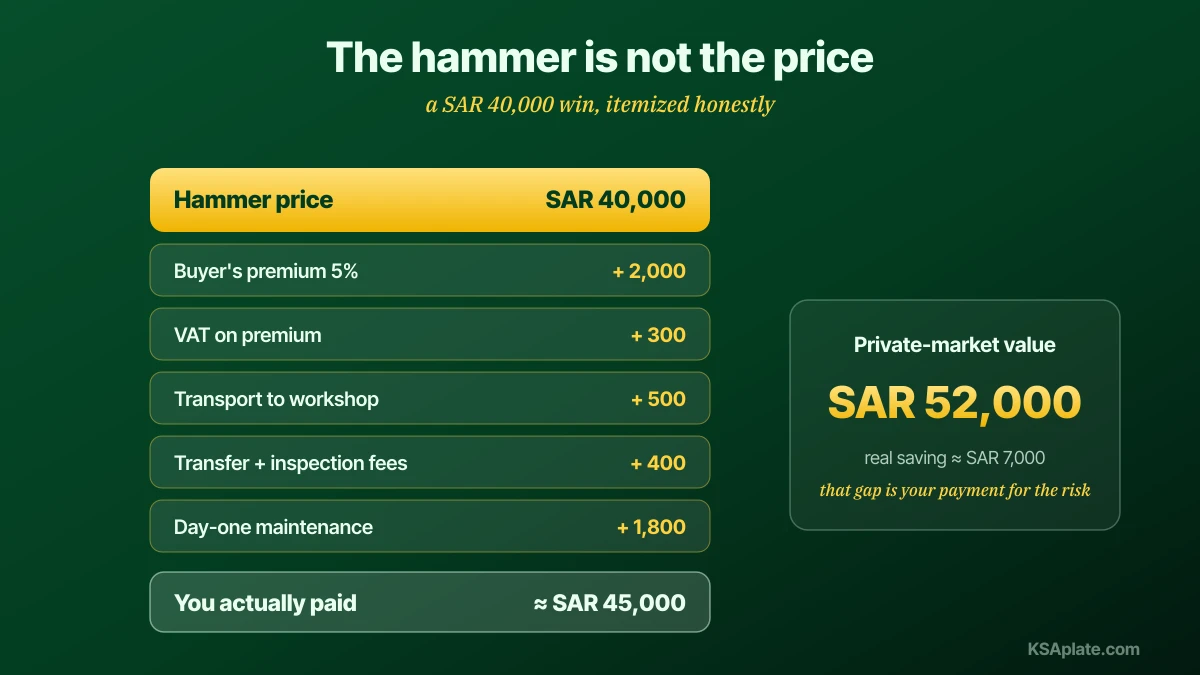
| Cost line | Typical size | Example on SAR 40,000 hammer |
|---|---|---|
| Hammer price | — | SAR 40,000 |
| Buyer's premium (السعي) | 2.5–5% | SAR 2,000 |
| VAT on the premium | 15% of premium | SAR 300 |
| Transport / tow to workshop | SAR 300–800 in-city | SAR 500 |
| Transfer + inspection fees | SAR 300–500 | SAR 400 |
| Immediate maintenance | SAR 1,000–4,000 | SAR 1,800 |
| Realistic total | +8–15% | ≈ SAR 45,000 |
Note the pattern: on a mid-priced car the overhead lands around ten percent. That is precisely why the auction only makes sense when the hammer price sits clearly below private-market value — a discount that merely equals the overhead buys you nothing except risk.
Inspecting a car you cannot test drive
Auction inspection is a different discipline from a normal used-car check, because the two best diagnostic tools — a test drive and a seller you can question — are missing. You are reading the car's history from physical evidence in a parking lot, often with a dead battery.
- Paint and panel gaps first. Sight down each side in daylight. Mismatched orange-peel texture, overspray on rubber seals and uneven gaps between panels are accident repairs announcing themselves.
- Open everything. Hood, trunk, all doors. Check the radiator support and inner fenders for kinks or fresh welds — the skeleton tells the truth the paint hides.
- Fluids in place of a test drive. Milky oil residue under the cap, burnt-smelling transmission fluid and rusty coolant are each a four-digit repair speaking softly.
- Tires as a diary. Uneven wear across one axle suggests alignment or suspension damage; four aged tires with flat spots say long storage — budget replacements.
- Electronics on jump power. Most auction yards will jump a car for you. Warning lights that stay on, an odometer that disagrees with the wear on pedals and steering wheel, and non-working AC all move your maximum bid down.
- Run the VIN. Pull the accident and registration history before bidding — our car history check guide shows exactly how to do it in minutes.
If you cannot attend the viewing in person, pay a mobile mechanic to go for you. Two hundred riyals of professional eyes on a five-figure purchase is the cheapest insurance in this entire process.
Setting your maximum bid
Every profitable auction purchase is decided before the auction opens, with arithmetic. The formula is short:
Maximum bid = market value − repair estimate − all fees − safety margin.
Start with what the car is actually worth in the private market. Run the exact model, year and mileage through our free car value calculator — it prices from real Saudi market data and gives you a private-sale range plus a quick-sale floor, which is the honest benchmark for an auction car you may want to resell. Then subtract the repair estimate from your inspection, subtract the 8–15% cost stack from the table above, and subtract a margin for what you could not see — 10% of market value is a sane default on a clean car, more on anything with question marks.
Worked example: market value SAR 52,000, visible repairs SAR 2,500, fees ≈ SAR 4,500, margin SAR 5,000 → maximum bid SAR 40,000. If bidding passes it, the correct move is to stop — there will be another car next week.
Bidding strategy that survives auction fever
Auctions are engineered excitement: countdown clocks, visible rival bids, one-minute lots. The house's business model is that adrenaline outbids arithmetic. Your counter-strategy is boring on purpose.
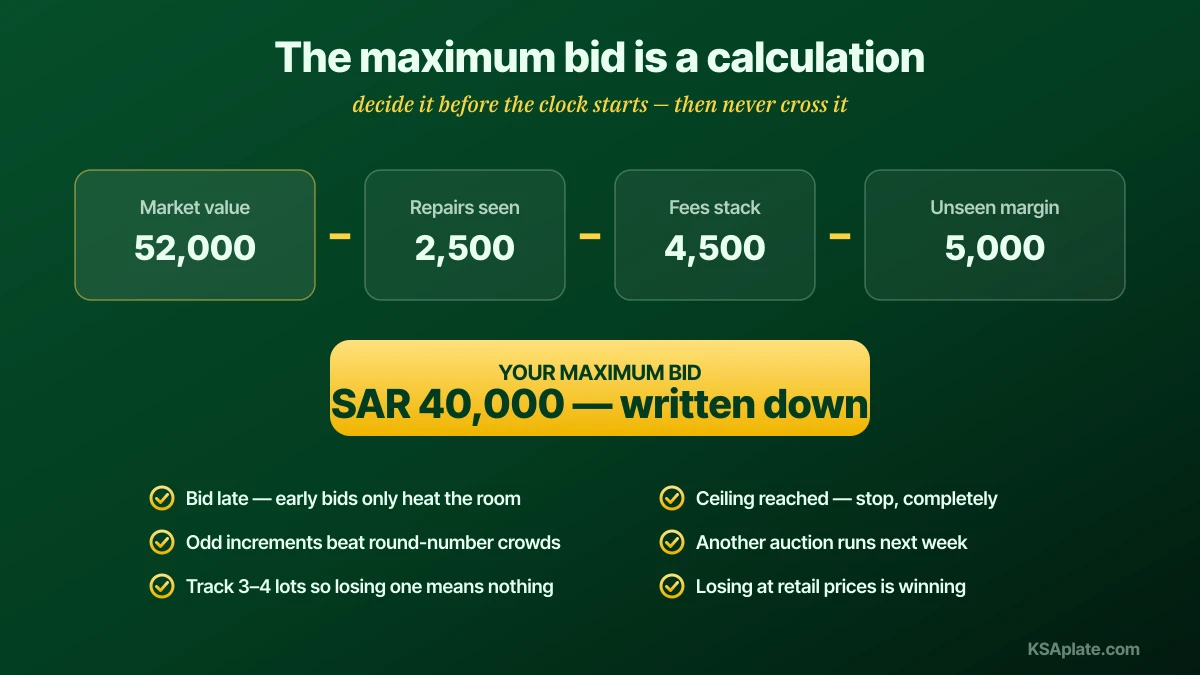
- Write the ceiling down and treat it as a contract with yourself. The single biggest auction mistake in any country is raising a limit mid-bidding "just one step".
- Bid late. Early bids only heat the room. In timed online auctions, enter in the final stretch and expect anti-sniping extensions rather than trying to beat the clock.
- Use odd numbers. A ceiling of 40,300 beats the crowd stacked at 40,000 without costing you a real step.
- Track lots, not a lot. With three or four acceptable cars in the same sale, losing one is a shrug, not a defeat — and shrugging is a negotiating superpower.
- Losing is a result. If every lot passed your ceiling, the market paid retail plus risk. You did not fail; the other bidders overpaid.
After the hammer: transfer, inspection, insurance
The hours after winning are process, and the sequence matters because each step gates the next.
- Pay and collect the file. Settle within the deadline and take every document the house issues — sale certificate, release note, and the vehicle's registration record.
- Move the car legally. Until it is registered to you and insured, tow it rather than drive it.
- Pass the periodic inspection if the registration requires renewal — our Fahes inspection guide covers what is tested and how to pre-check.
- Insure it. A policy in your name is a prerequisite for transfer — third-party at minimum, comprehensive if the value justifies it (see the insurance guide).
- Transfer ownership. Judicial sales issue authority paperwork; private-house sales transfer like a normal private sale through Absher — the full walkthrough is in our ownership transfer guide.
- Service it before trusting it. Fresh oil, coolant, brake fluid, battery test and tire decision on day one — storage is hard on cars in this climate.
Risks and red flags
The auction discount is compensation for a specific list of risks. Most are manageable with the inspection and arithmetic above; a few are walk-away signals.
- Salvage sold as "clean". If chassis welds or airbag warning lights contradict a tidy description, walk — the paperwork follows the car forever and resale buyers will find what you found.
- Odometer disagreement. A 60,000 km reading with a polished-smooth steering wheel and collapsed driver's seat is telling you which number to believe.
- Outstanding obligations. Confirm before bidding how the channel handles unpaid fines and fees. Judicial sales clear them by process; elsewhere, ask in writing.
- Deposit and refund terms. Know exactly when your deposit returns if you win nothing, and what forfeits it. Slow-refund houses are telling you something about themselves.
- "Runs and drives" theater. A car jumped to life five minutes before viewing proves it starts, not that it drives. Price the unknown drivetrain accordingly.
- Auction fever — yours. The most dangerous red flag stands in your shoes. The ceiling you wrote down is the cure.
Selling at auction vs. listing it yourself
Auctions cut both ways: as a seller, you trade price for speed. The house takes its commission from your side too, the buyer pool is discount-hunting by definition, and the hammer typically lands near the quick-sale floor — commonly 15–20% under private-market value once fees are counted.
That trade makes sense for fleet clearances, inherited cars nobody wants to manage, or genuine deadline pressure. For a normal car in normal circumstances, a direct listing captures the private-sale price the auction gives away: run the number in the valuation tool, browse what similar cars ask on the market, and list it yourself for free with photos and direct WhatsApp contact — no commission on either side of the sale.
A sensible hybrid: try a correctly priced direct listing for two to three weeks first; the auction remains available as the fallback, but the sequence never runs backwards.
FAQ
Can expats buy cars at auction in Saudi Arabia?
What is Infath and how do its car auctions work?
Are auction cars cheaper than the used-car market?
Can I test drive a car before the auction?
What is the buyer's premium (السعي)?
What happens if I win and don't pay?
Do auction cars come with outstanding traffic fines?
Are salvage auction cars worth buying?
How much deposit do car auctions require?
Should I buy at auction or from the used-car market?
How do I know what an auction car is actually worth?
Conclusion
Car auctions in Saudi Arabia reward exactly one kind of buyer: the one who treats them as arithmetic with a countdown clock attached. Pick the channel that matches your skill level, inspect like the test drive does not exist — because it does not — build your maximum bid from market value rather than hope, and let the process after the hammer run in its proper order: pay, tow, inspect, insure, transfer, service.
Done that way, the auction is a legitimate way to buy below the market. Done on adrenaline, it is the most expensive discount in the Kingdom. Before your first bid, spend two minutes establishing what the car is really worth on the valuation tool — and if you are on the selling side and the auction's 15–20% haircut sounds expensive, list your car directly for free and keep the private-sale price the hammer would have given away.