
Last updated: 6 August 2026
Digital license plates are electronic plates that replace a painted metal panel with a connected display — usually an e-ink or LED screen — that can update the plate remotely, show messages, and link to services like registration renewal, tolls and theft alerts. Saudi Arabia has digitised almost everything around the plate — auctions, ownership transfer, the digital istimara — but as of 2026 it has not issued digital display plates. The number still lives on a physical embossed aluminium plate that follows the GCC standard. That gap between digital plate services and a digital plate screen is the single most misunderstood thing about this topic, and getting it straight tells you exactly what a Saudi driver can and cannot do today.
This distinction matters because the phrase "digital license plate" is used two completely different ways. One means a physical plate replaced by a screen (the US Reviver RPlate, Dubai's tested smart plate). The other means managing an ordinary physical plate entirely online (Absher, Muroor e-services). Saudi Arabia is a world leader in the second and has not adopted the first. Below, both meanings are separated cleanly so you know where the Kingdom actually stands.
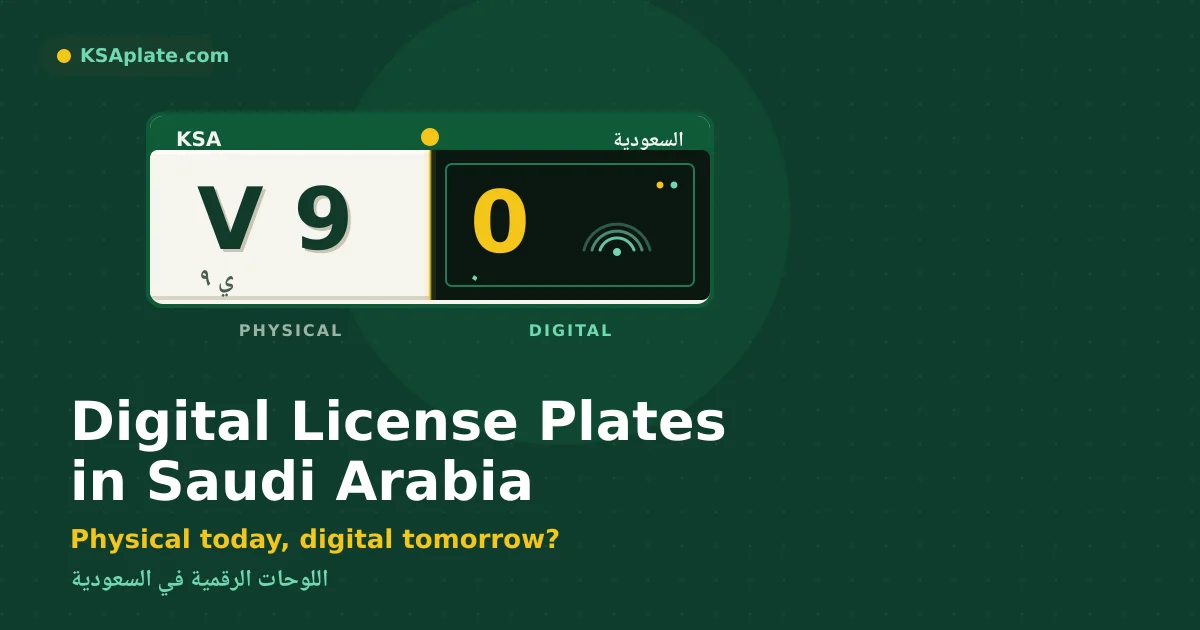
- A digital license plate is an electronic display plate. Instead of embossed metal, it uses an e-ink or LED screen that can update remotely and connect to services like renewal, tolls and theft alerts.
- Saudi Arabia does not use digital display plates as of 2026. There is no public mandate or rollout. Physical embossed aluminium plates following the GCC standard remain the only legal plates.
- Saudi Arabia has digitised plate services, not the plate itself. Online plate auctions, digital ownership transfer, e-registration and the digital istimara are all live on Absher and Muroor — this is the real Saudi "digital plate" story.
- Global reference points are real but limited. Dubai's RTA announced and tested smart digital plates around 2018; a few US states (California, Arizona, Texas) permit Reviver digital plates. None of this is Saudi law.
- The number is the asset, not the format. Whether a plate is metal or a screen, the value sits in the number itself — which stays yours and portable, and is what you buy, sell and hold on the plate as an investment.
Quick answer: Digital license plates are electronic display plates that swap embossed metal for a connected e-ink or LED screen able to update remotely and tie into services like renewal, tolls and theft alerts. Does Saudi Arabia have them? No. As of 2026 there is no public mandate for digital display plates in the Kingdom; physical embossed aluminium plates on the GCC standard remain the law. What Saudi Arabia does have is deeply digitised plate services — online auctions, e-transfer of ownership and the digital istimara through Absher and Muroor.
What are digital license plates?
A digital license plate is an electronic vehicle plate that replaces the traditional embossed metal panel with a connected display, typically an e-ink or LED screen. Where a normal plate is a fixed piece of stamped aluminium, a digital plate is a small computer: it holds the registration number on a screen, can be reprogrammed remotely, and connects to a network so it can talk to registration systems, toll gates and its owner's phone.
A digital license plate turns the plate from a passive label into a live device — the number is displayed on a screen that an authority or the owner can update over the air, without unbolting or reprinting anything. That single change is what makes features like remote renewal, digital registration stickers, and stolen-vehicle flags possible on the plate itself.
The best-known example is the Reviver RPlate in the United States, which uses an e-ink display much like an e-reader so the number stays sharp and readable in daylight while drawing very little power. The plate can switch its lower banner between a registration status message and, in some versions, a personalised message, and it reports its own renewal state back to the driver.
Digital plate services vs digital display plates
Digital plate services and digital display plates are two entirely different things, and Saudi Arabia has one but not the other. Digital services mean managing an ordinary physical plate online; a digital display plate means the physical plate is itself a screen. Confusing the two is why people wrongly assume the Kingdom has electronic plates on its cars.
Saudi Arabia leads the region in digital plate services and has not deployed digital display plates. The number is managed online; the plate on the bumper is still embossed metal.
What Saudi Arabia already does digitally
The Kingdom has moved almost every plate-related process online through Absher and the Muroor (General Department of Traffic) e-services. Vehicle ownership transfer, registration renewal, the digital istimara (vehicle registration), and even government plate auctions run through digital channels — you can bid for and win a distinctive number without visiting a counter, as covered in how Saudi government plate auctions work. This is a genuine Vision 2030 digital-government achievement, and it is what "digital plates" honestly means in a Saudi context today.
What Saudi Arabia has not done
What the Kingdom has not done is replace the physical plate with an electronic screen. There is no e-ink RPlate on Saudi cars, no connected LED plate, and no public mandate to introduce one. The number you win at auction or transfer online is still manufactured as an embossed aluminium plate to the GCC standard and bolted to the car in the normal way. For how that physical plate is structured and read, see how to read a Saudi license plate.
Physical vs digital plates: the differences
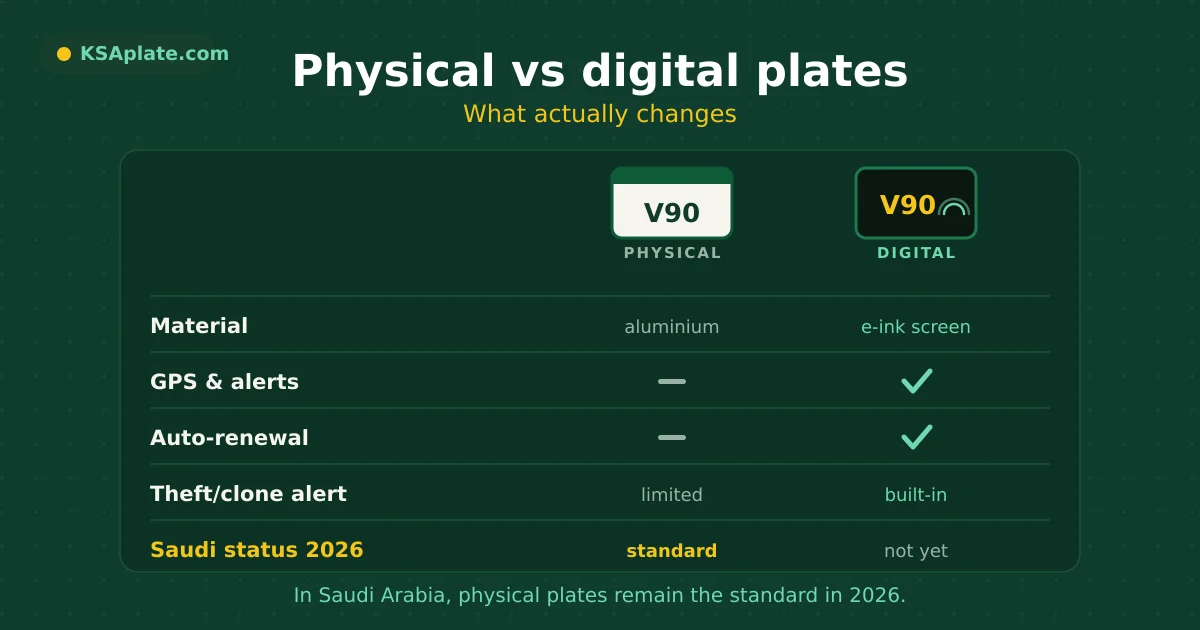
The difference between a physical and a digital plate is the difference between a printed label and a connected screen. A physical plate is a fixed, offline, embossed metal panel; a digital plate is a powered, networked display that can change what it shows and report data back. Each has real trade-offs in cost, durability, privacy and function.
A physical plate never needs power, never loses connectivity and cannot be hacked, but it also cannot update itself, alert you when stolen, or renew online at the plate. A digital plate can do all of those things, at the price of a battery, a data connection, a much higher upfront cost, and new privacy questions. Neither is simply "better" — they optimise for different priorities.
| Feature | Physical plate (Saudi standard) | Digital display plate |
|---|---|---|
| Material | Embossed aluminium, GCC standard | E-ink or LED screen in a housing |
| Power | None required | Battery or vehicle power |
| Connectivity | Offline | Cellular / Bluetooth connected |
| Renewal | Online via Absher; sticker or record | Updates on the plate over the air |
| Theft alert | No | Yes, can flag a stolen vehicle |
| Upfront cost | Low, standard issue fee | High, plus subscription in most markets |
| Privacy exposure | Minimal | Location and data questions |
| Saudi legal status (2026) | Standard and required | Not issued, no public mandate |
What's your plate worth?
Get an instant, free estimate with our plate value calculator.
Calculate My Plate's ValueHow digital display plates work
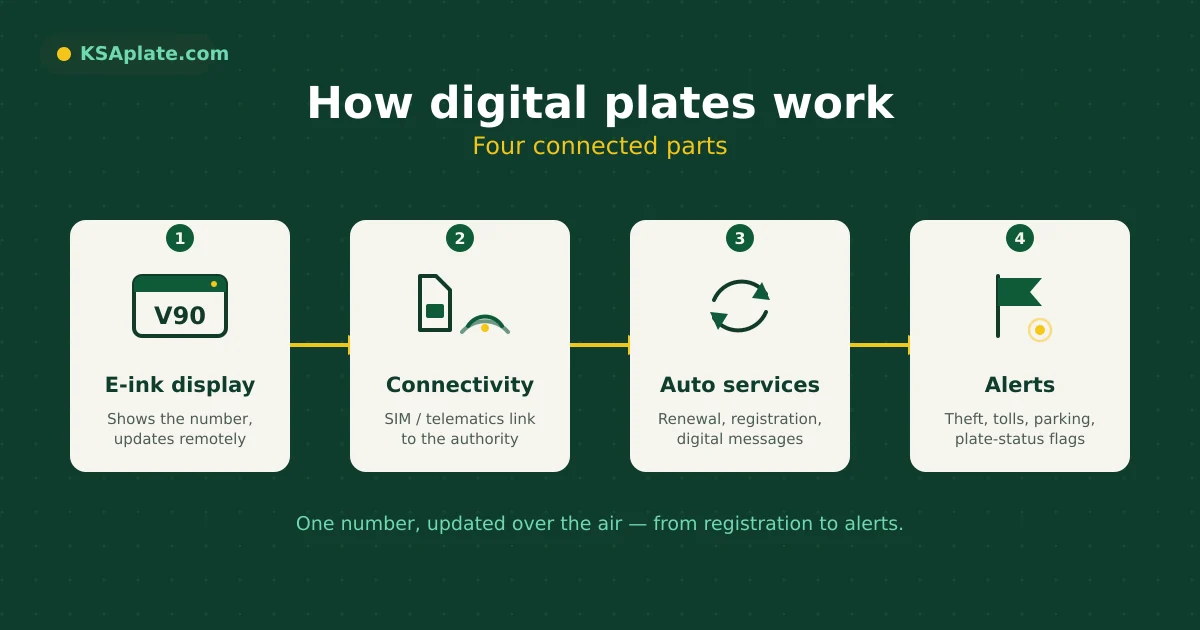
A digital display plate works by combining an electronic screen, a power source and a network connection into a single bolt-on unit that behaves like a small connected device. The screen shows the registration number, the power source keeps it lit, and the connection lets it exchange data with registration systems and the owner's app.
In practical terms, the plate receives its number and status from a backend system, displays them on an e-ink or LED panel, and reports back events such as a renewal or a stolen-vehicle flag; some models add GPS location and toll integration. The owner interacts with it through a phone app rather than a screwdriver.
The core features
- Electronic display. An e-ink or LED screen shows the plate number and a status banner instead of embossed characters, staying readable in sunlight.
- Connectivity. A cellular or Bluetooth link ties the plate to a backend, so its content can be updated over the air.
- Automatic renewal. Registration status is refreshed on the plate itself when the owner renews, replacing the paper or sticker step.
- Theft alerts. If a vehicle is reported stolen, the plate can display a stolen flag and, with GPS, help locate the car.
- GPS and telematics. Some plates add location tracking, mileage and fleet features aimed at businesses.
- Tolls and payments. In some markets the plate links to toll and parking accounts so charges settle automatically.
- Personalised banner. A lower message area can show a custom line or emergency alerts, depending on local rules.
How you would check plate status today in Saudi Arabia
Because Saudi plates are physical, status lives in the online services rather than on the plate. Here is how a driver checks it now:
- Log in to Absher with your credentials and open the vehicle services section.
- Open your vehicle record to see the registration (istimara) status, expiry and any flags.
- Check fines and status for the plate, cross-referencing the number against your record — the walkthrough is in how to check a Saudi license plate.
- Renew or transfer online if needed, entirely through the digital channel, then keep the digital istimara on your device.
Where digital plates are used: Dubai and the US
Digital display plates exist today mainly in the United States and were publicly tested in Dubai, but they remain a niche rather than a global standard. Only a handful of jurisdictions permit them, and even there they are usually optional and paid. Understanding these real reference points prevents the common mistake of assuming digital plates are already everywhere.
Dubai's RTA smart plate
Dubai's Roads and Transport Authority (RTA) announced and tested a "smart" digital number plate around 2018, featuring a digital screen and connectivity concepts such as reporting accidents, handling fines and communicating with other drivers. It drew wide coverage as a Vision-style smart-city initiative. Details of the RTA's transport programmes are published on the authority's own site at rta.ae. Importantly, Dubai's tests are a UAE matter and say nothing about Saudi law.
Reviver digital plates in the US
In the United States, the company Reviver makes the RPlate digital plate, and a small number of states — including California, Arizona and Texas — have passed laws allowing digital plates as an option. Reviver publishes its product and state availability at reviver.com. Even in those states, the plate is a paid, opt-in alternative to a standard metal plate, not a replacement mandated for every car.
No Gulf country, including Saudi Arabia, has made digital display plates standard. The live examples are optional pilots and paid US programmes — useful reference points, not a regional norm.
Digital plate status in Saudi Arabia (2026)
As of 2026, Saudi Arabia has no public mandate for digital display plates and continues to issue physical embossed plates on the GCC standard. The digitisation the Kingdom is known for sits in the services layer — Absher and Muroor — not in the plate hardware. This is the accurate, current status, stated plainly so no one mistakes service digitisation for an electronic plate.
The honest position is that a Saudi driver in 2026 manages a physical plate through excellent digital services. You can auction, buy, transfer and renew a number online, carry a digital istimara, and check status from your phone — but the plate that gets bolted to your car is still stamped metal. Anyone claiming Saudi Arabia has rolled out screen plates is conflating the service layer with the plate itself.
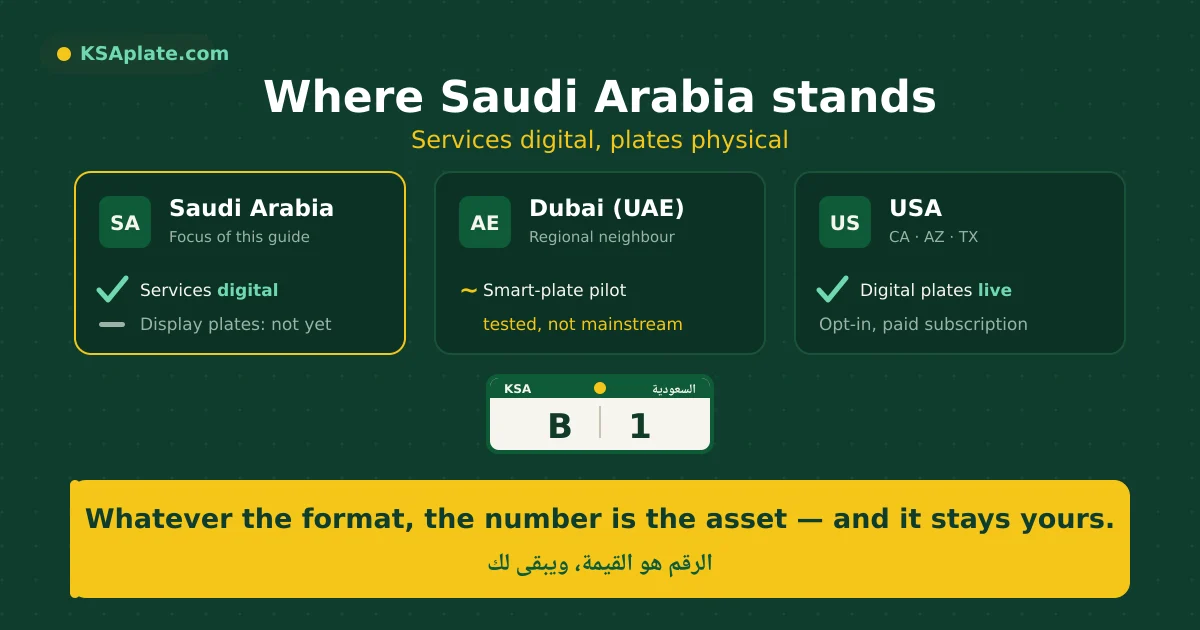
| Country / market | Digital display plates | Digital plate services |
|---|---|---|
| Saudi Arabia | Not issued; no public mandate | Advanced — Absher/Muroor auctions, e-transfer, digital istimara |
| Dubai (UAE) | Announced and tested (~2018); not universal | Advanced — RTA and UAE Pass e-services |
| United States | Optional in some states (CA, AZ, TX) via Reviver | Varies by state DMV |
This status connects to Vision 2030 truthfully: the goal is digital government and paperless services, which the plate services deliver, rather than any announced plan to screen-enable plates. Treat digital-plate hardware in Saudi Arabia as a possibility for the future, not a fact of the present.
Pros and cons of digital plates
The pros and cons of digital plates come down to convenience and connectivity on one side against cost, power and privacy on the other. Digital plates add useful features a metal plate cannot offer, but they also add failure points and questions a simple embossed plate never raises. A clear-eyed list helps you judge whether the trade is worth it.
For most everyday drivers, the practical verdict is that digital plates solve problems Saudi Arabia has largely already solved with software — renewal and status are handled online anyway — while introducing new costs and privacy exposure. The strongest case for them is fleets and businesses that value tracking, not individual owners.
Advantages
- Over-the-air renewal updates registration on the plate without a sticker or visit.
- Theft alerts can flag a stolen vehicle and, with GPS, help recover it.
- Toll and parking integration can settle charges automatically in some markets.
- Fleet management gains location, mileage and status data in one place.
Disadvantages
- High upfront cost plus, in most markets, an ongoing subscription.
- Power and connectivity dependence — a dead battery or lost signal is a new failure mode.
- Privacy and tracking concerns from a connected, potentially GPS-enabled plate.
- Security surface — a networked device can, in principle, be attacked or spoofed.
Anti-cloning, privacy and security
Digital plates change the security picture in both directions: they can make some fraud harder while opening new digital risks. A screen that reports its own status could, in theory, make a mismatch between a plate and its record easier to spot — but a connected plate is also a data device with location and hacking concerns a metal plate never had.
On the anti-fraud side, the appeal is that a plate tied to a live backend is harder to fake convincingly than a stamped copy, and a stolen-vehicle flag can surface instantly. That does not end plate cloning, though — a criminal can still photograph a number and produce a counterfeit metal plate, which is the exact fraud explained in plate cloning and fake plates in Saudi Arabia. Digital hardware does not stop someone copying your number onto another car.
A digital plate can flag a stolen vehicle, but it cannot stop your number being photographed and cloned onto a counterfeit metal plate. The number, not the format, is what fraudsters copy.
The privacy trade-off
A connected plate with GPS raises real questions about who can see a vehicle's location and history, how that data is stored, and whether it can be compromised. For a privacy-conscious market, a plate that is offline metal has a genuine advantage: it reveals nothing until a camera reads it. Any future digital-plate proposal would have to answer these data-governance questions before adoption.
What digital plates cost
Digital plates cost far more than a physical plate, both upfront and over time. Where a standard Saudi plate carries a modest issue fee, a digital display plate in markets that allow it typically runs to a few hundred US dollars for the hardware plus an annual subscription for the connected features. That gap is one reason adoption stays limited.
In the US, Reviver's digital plates have been offered in wired and battery versions with prices commonly cited in the hundreds of dollars, alongside a recurring fee — a meaningful premium over a metal plate that costs a fraction of that once. For a Saudi buyer, this reframes the value question: the money that would go into plate hardware is often better placed in the number itself, which holds value regardless of format.
The hardware depreciates; the number does not. A screen plate is a gadget with a subscription — a distinctive number is an asset that can appreciate.
Why the plate number is the real asset
The durable value of a license plate is the number, not the panel it is printed on. Metal or screen, the thing people pay for, remember and compete over is the sequence of digits and letters — a short, memorable or meaningful number is scarce, and scarcity is what holds value across any format change. This is the point that survives every technology shift.
If Saudi Arabia ever moves to digital plates, a premium number does not lose its worth — it simply appears on a different surface. The scarcity of a low, repeating or culturally lucky number is unchanged by whether it is embossed or displayed, which is exactly why numbers are treated as an asset class in Saudi plate investment and why buyers chase specific sequences in Saudi plate numerology and lucky numbers.
This is why the format debate should not distract a buyer or seller. Whether you hold a plate for pride or for resale, you are holding a number, and that number is portable across metal and screen alike. For the full grounding on how Saudi plates are structured, priced and traded, the complete guide to Saudi license plates is the starting point, and a marketplace lets you value and trade the number independently of any hardware.
Will Saudi Arabia adopt digital plates?
Whether Saudi Arabia adopts digital display plates is genuinely open — there is no announced plan either way as of 2026, so any firm prediction would be guesswork. The Kingdom clearly has the digital-government appetite and infrastructure to do it, but it has also already captured most of the practical benefit through software, which weakens the case for expensive hardware.
A measured read is that Saudi Arabia could pilot digital plates in the future, most plausibly for fleets or as an optional premium, but there is no basis in 2026 to claim a rollout is coming. The safe expectation for now is continuity: physical GCC-standard plates, managed through ever-improving Absher and Muroor services. Anyone stating a firm launch date is inventing it.
Frequently asked questions
Does Saudi Arabia have digital license plates?
What is a digital license plate?
Are electronic plates legal in Saudi Arabia?
What is the difference between digital and physical plates?
Do digital plates stop plate cloning?
How much do digital license plates cost?
Will Saudi Arabia adopt digital plates?
Does my premium plate number change if plates go digital?
Is a digitised istimara the same as a digital plate?
Where are digital license plates actually used?
Reviewed by Khalid Al-Rashid, Saudi License Plate Market Analyst.
Sources: Absher digital government platform (absher.sa) for vehicle, registration and plate e-services; Dubai Roads and Transport Authority (rta.ae) for its smart-plate testing and transport programmes; and Reviver (reviver.com) for US digital-plate product and state-availability information. Saudi plate status described as of 2026: physical GCC-standard plates remain standard with no public mandate for digital display plates. Confirm current registration and plate rules through official Absher and Muroor channels, as regulations can change.