TL;DR:
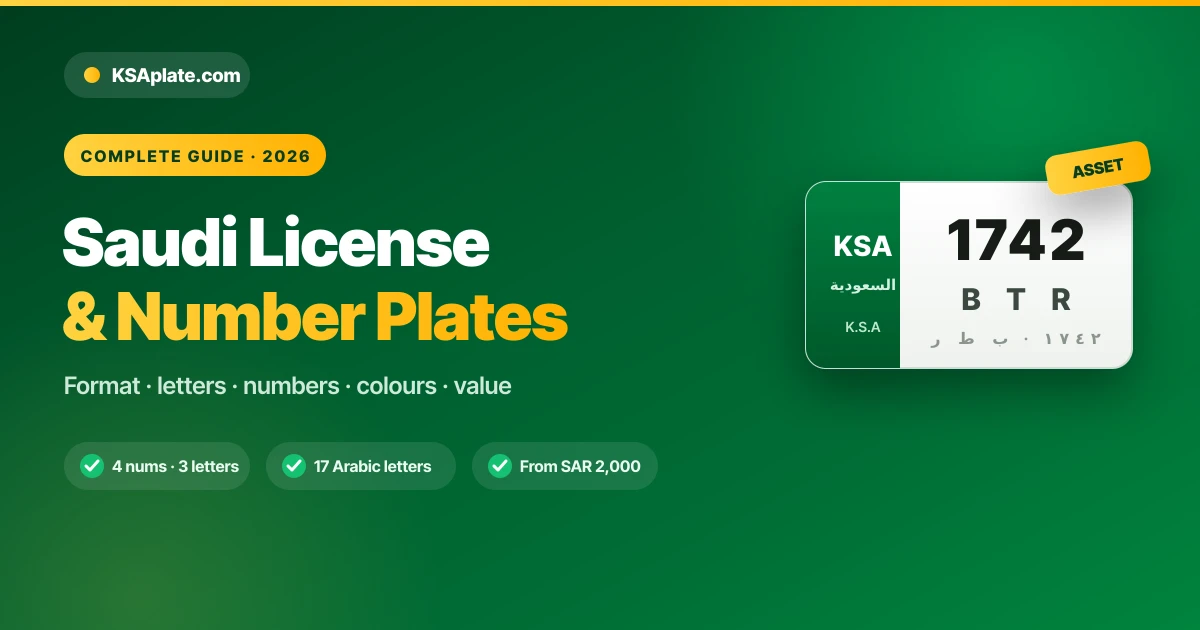
- A Saudi license plate (also called a number plate) shows up to 4 digits and up to 3 letters, printed in both Arabic and Latin/Western characters.
- Only 17 Arabic letters are allowed on Saudi plates — a deliberate anti-forgery rule that also makes certain combinations rare and valuable.
- Plate colour signals the vehicle class: white (private), yellow (taxi/transport), blue (commercial), green (diplomatic), silver (temporary).
- A plate's value comes from its combination: short numbers, repeated digits, and meaningful letters can be worth from a few thousand to millions of riyals.
- You buy, sell, and transfer plates through a marketplace plus Absher; the number stays with you, not the car.
Quick answer: A Saudi license plate is the official vehicle number plate issued by the General Directorate of Traffic. It carries up to four numbers and up to three of 17 permitted Arabic letters, shown in Arabic and Latin. The colour marks the vehicle type, and the specific number-and-letter combination sets the plate's market value, which ranges from a few thousand riyals to millions.
What a Saudi license plate is
A Saudi license plate — known interchangeably as a number plate — is the official identifier the General Directorate of Traffic (Moroor) assigns to a registered vehicle in Saudi Arabia. It links a specific car to its owner in the Ministry of Interior's records and must be displayed on the front and rear of the vehicle. "License plate" and "number plate" mean the same thing; Saudi and Gulf drivers use both terms.
What makes the Saudi system distinctive is that the plate is also an asset. Because each plate carries a unique combination of numbers and letters, a desirable combination can be bought, sold, and transferred between owners — independently of the car it sits on. That dual nature, part legal identifier and part tradable property, is the thread running through this guide.
This is why Saudi Arabia has one of the most active private number-plate markets in the world. A plate is mandatory, permanent, and personal, and a scarce combination is effectively a small piece of luxury you can register, display, and resell. Understanding that single idea — the plate is both a requirement and an investment — is the key to everything that follows.
A quick history of the Saudi plate system
The modern Saudi plate system is the product of decades of standardisation. Saudi Arabia has issued vehicle plates since the mid-twentieth century, and the format evolved into today's dual Arabic-and-Latin layout to serve a growing, increasingly international driving population. The bilingual design is deliberate: it lets a plate be read by Arabic speakers and by the millions of expatriate residents and visitors on Saudi roads.
That history matters for value, too. Early, low-number plates from the system's first decades are scarce by definition, and collectors prize them. For the full timeline from the 1950s to today, see our Saudi license plate history.
The Saudi plate format explained
The Saudi plate format is up to four digits on one side and up to three Arabic letters on the other, with each element shown twice: once in Arabic script and Arabic-Indic numerals, and once in Latin letters and Western numerals. This dual rendering lets both Arabic and non-Arabic readers identify the plate.
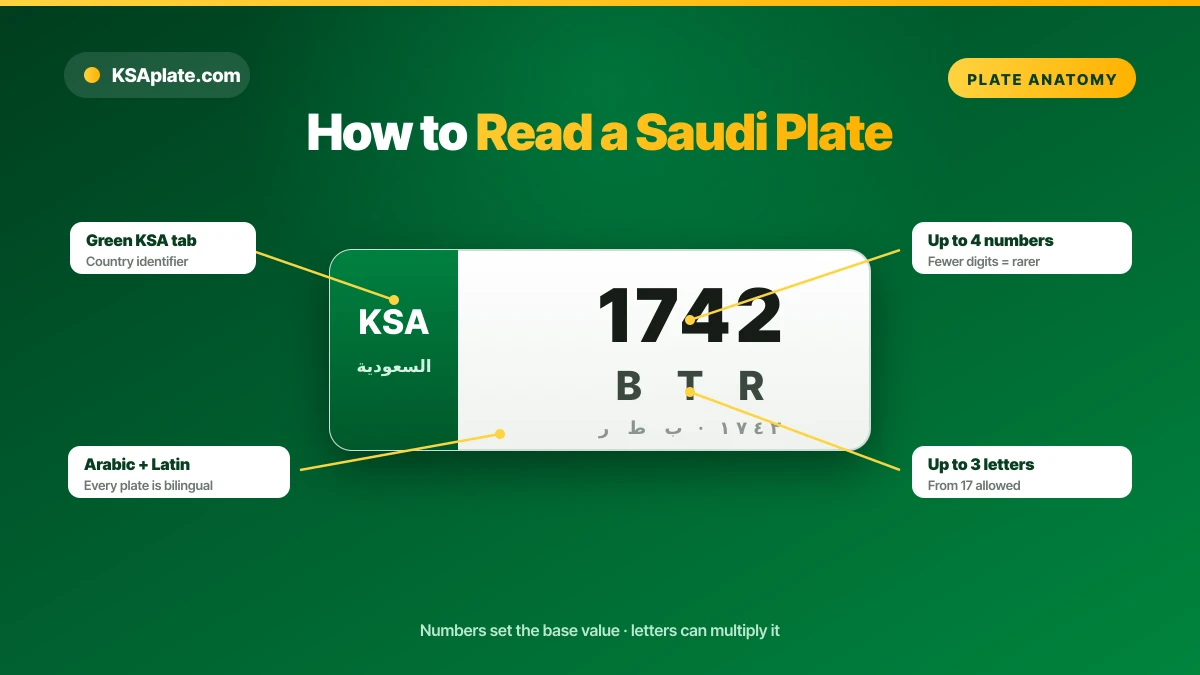
Reading a plate is simple once you know the layout. The numbers identify the registration sequence, while the letters act as a series code. A plate can have fewer digits — and fewer digits usually means a scarcer, more valuable plate. For the deeper detail on how combinations are read and priced, see our guide to Saudi plate number patterns.
What's your plate worth?
Get an instant, free estimate with our plate value calculator.
Calculate My Plate's ValueThe 17 Arabic letters allowed on Saudi plates
Saudi license plates use only 17 of the 28 Arabic letters. The traffic authority restricts the set on purpose: it excludes letters that look too similar to one another, which makes plates harder to forge or alter. Each permitted Arabic letter has a fixed Latin equivalent printed alongside it.
Some combinations are also banned. Since 2009, the authorities have blocked letter groups that spell offensive or inappropriate words in either Arabic or their Latin transliteration. The flip side of a restricted alphabet is scarcity: because there are only 17 letters, certain prized groupings — especially triple identical letters or letters that spell a word — are genuinely rare. Our complete breakdown of the 17 Arabic letters and their most valuable combinations covers every letter and its market premium.
The 17-letter rule is an anti-forgery measure first and a value driver second — but it is exactly why a clean triple-letter plate is so scarce.
The numbers and what they mean
The numeric part of a Saudi plate is where most of the value is decided. As a rule, fewer digits are rarer and more expensive: a single-digit plate is among the scarcest objects on the road, while a random four-digit number is common and inexpensive. Beyond digit count, the pattern matters — repeating numbers (7777), sequences (1234), and mirror/palindrome numbers (12321) all carry a premium.
Cultural meaning adds another layer. Numbers seen as lucky or significant change hands for more, which is why our guide to lucky plate numbers exists. If you want a fast estimate for a specific number, the free plate value calculator scores it instantly using the same factors the market uses.
Plate colours and vehicle types
The colour of a Saudi license plate tells you the vehicle's category at a glance. Each colour is reserved for a class of vehicle, and the rules are consistent nationwide.
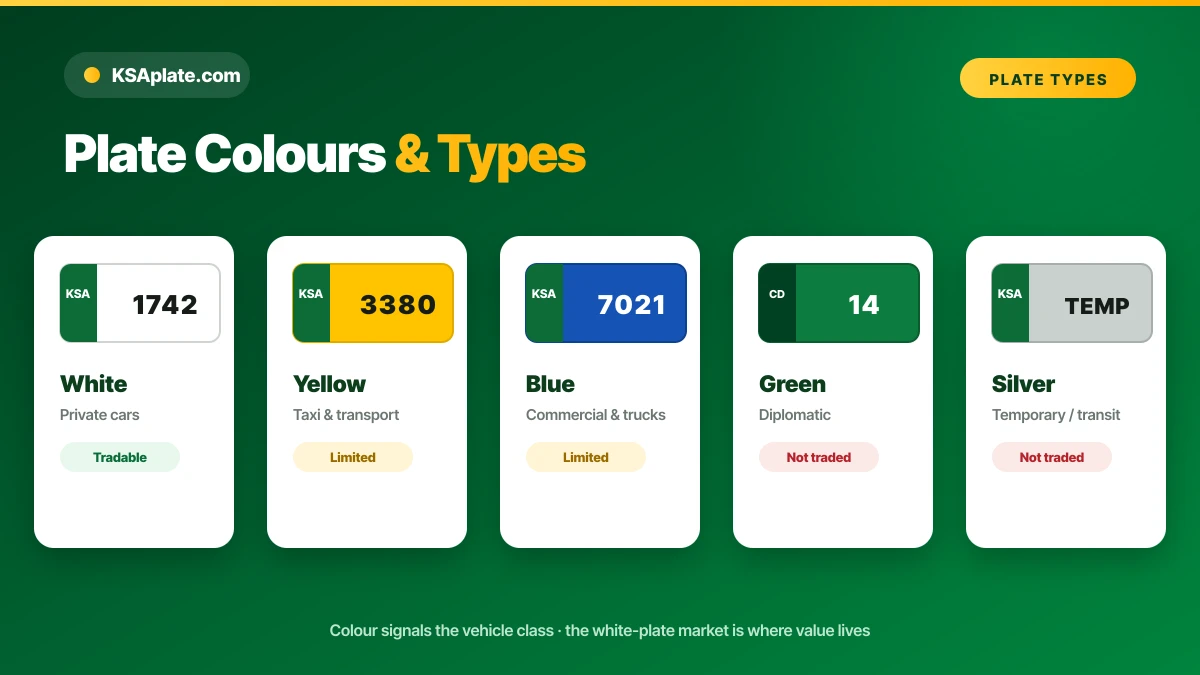
| Colour | Vehicle type | Tradable value? |
|---|---|---|
| White | Private passenger cars | Yes — the main market |
| Yellow | Taxis & public transport | Limited |
| Blue | Commercial vehicles & trucks | Limited |
| Green | Diplomatic missions (country code) | No |
| Silver | Temporary / transit / new vehicles | No |
The vast majority of plate trading happens on white plates, because they sit on private cars and can carry the short, clean combinations buyers want. For the full colour and category breakdown, see our guide to the 7 types of Saudi plates and what each colour means.
What makes a Saudi plate valuable
A Saudi plate's value is set by its combination, not by the car it is attached to. Five factors decide the price, and they stack: a plate that hits several at once is worth far more than the sum of its parts.
- Digit count — one, two, and three-digit plates are the scarcest and priciest.
- Number pattern — repeating (7777), sequential (1234), and mirror (12321) numbers command premiums.
- Letters — triple identical letters and letters that spell a word or name are the most sought-after.
- Cultural meaning — lucky or symbolic numbers attract higher bids.
- Demand — a combination tied to a region, tribe, or brand can spike in value.
The car depreciates the moment it leaves the showroom; a strong plate can appreciate every year. That is why Saudis treat premium plates as a store of value.
To understand how these factors translate into riyals, read how to calculate your plate's value, then check a specific plate on the calculator.
How much Saudi plates cost (2026)
Saudi plate prices span an enormous range because value is combination-driven. A common four-digit white plate can sell for a few thousand riyals, while a single-digit or word-spelling plate reaches the hundreds of thousands or millions. The table below shows realistic 2026 bands.
| Plate profile | Typical 2026 value (SAR) |
|---|---|
| Random 4-digit, ordinary letters | 2,000 – 10,000 |
| 3-digit or nice pattern | 10,000 – 80,000 |
| 2-digit / strong letters | 80,000 – 500,000 |
| 1-digit / word-spelling / iconic | 500,000 – millions |
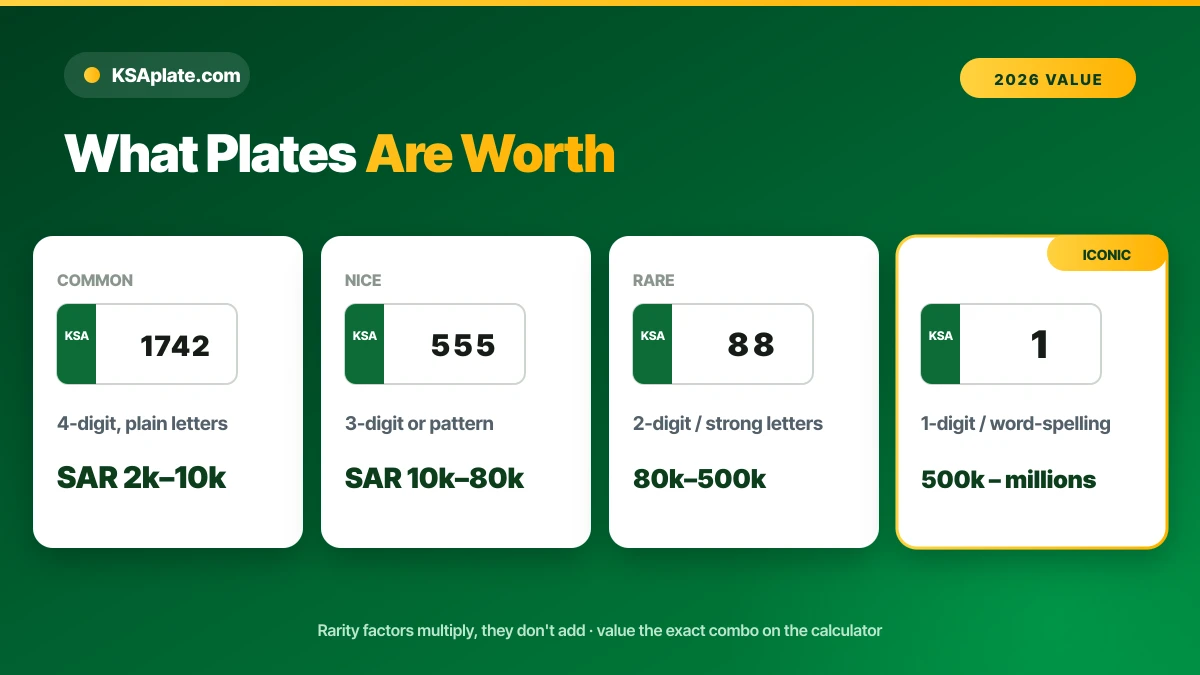
A worked example shows how the factors stack. A plate reading 5 5 5 5 with a clean letter set is not just a four-digit plate — it is a repeating-number plate, which lifts it from the bottom band into the tens or hundreds of thousands. Drop a digit to 5 5 5 and add a triple letter, and the same logic pushes it higher again. Each rarity factor multiplies rather than adds.
These are market ranges, not fixed prices — the only way to value a specific plate is to score it. Our 2026 plate price guide breaks the bands down by type, and the calculator gives an instant estimate for your exact combination.
How to buy a Saudi license plate
Buying a Saudi plate means acquiring a specific number-and-letter combination and transferring it to your name. The cleanest, safest route is a dedicated plate marketplace, then an Absher transfer once you have agreed terms.
- Decide your combination and budget. Use the calculator to know fair value before you shop.
- Find the plate on a marketplace built for plates, where listings show the number, letters, city and price.
- Verify the seller and the plate's record before paying — confirm it is clean and transferable.
- Agree terms in writing and pay only through a traceable method.
- Transfer ownership on Absher once payment clears, so the plate moves to your name.
Our full buyer's guide walks through each step, and you can browse live listings on the KSAplate marketplace.
How to sell your Saudi plate
Selling a Saudi plate is the mirror image of buying: you list the combination, agree a price, take payment, and transfer it via Absher. Because the plate is separate from the car, you can sell a valuable number while keeping or selling the vehicle separately. The biggest decision is where to list — a dedicated plate marketplace reaches motivated buyers and charges a flat fee instead of a commission.
For the channel comparison and the full process, see where to sell your Saudi license plate. When you are ready, list your plate in a few minutes.
Transferring a plate via Absher
Plate ownership in Saudi Arabia transfers online through Absher, the Ministry of Interior's e-services platform. After a sale, the seller initiates the transfer, the buyer accepts, the fee is paid, and the plate's record updates to the new owner — no traffic-department visit required. The number stays intact; only the registered owner changes.
Money first, transfer second. A cleared payment is the only proof a buyer is real — never transfer a plate on a promise.
The exact mechanics, including keeping a plate when you change cars, are covered in our guide to transferring a license plate via Absher.
Can expats own a Saudi plate?
Yes — expatriates with a valid Iqama can own, buy, and sell Saudi license plates. An Iqama holder who is the registered owner of a vehicle uses Absher exactly like a citizen, at the same fees, to buy a plate, transfer it, or sell it on. Residency status does not change the value of a plate or the process for trading it; it only requires that your Iqama and vehicle registration are valid. Expats are an active part of the premium-plate market, both as collectors and investors.
Common mistakes to avoid
- Confusing the plate with the car. The number is a separate asset — you can sell it on its own.
- Skipping valuation. Listing or buying without checking the calculator leaves money on the table.
- Transferring before payment clears. The single most expensive seller mistake.
- Ignoring the letters. A strong letter combination can matter as much as the number.
- Buying on informal channels without verifying the plate's record.
What is your plate worth?
Score any Saudi number plate instantly with the free calculator — then list it or browse the marketplace.
Value my plate free Browse platesFrequently asked questions
What is a Saudi license plate?
Is a license plate the same as a number plate?
What is the standard layout of a Saudi plate?
Why do Saudi plates use only 17 Arabic letters?
What does each plate colour signify?
What makes a Saudi plate valuable?
How much does a Saudi number plate cost?
Can I sell my plate without selling my car?
How is a plate transferred to a new owner?
Do the rules differ for expats and citizens?
Are letters or numbers more important for a plate's value?
What do the Latin letters and Western numbers on the plate represent?
Conclusion & next steps
A Saudi license plate is two things at once: the legal identifier on your car and a tradable asset whose value lives in its combination. Learn the format, respect the 17-letter rule, read the colour, and judge a plate by its numbers and letters — and you understand the entire market. Whether you want to value a number, buy a clean combination, or sell one you already own, start with the free plate value calculator, then browse or list a plate on the KSAplate marketplace.