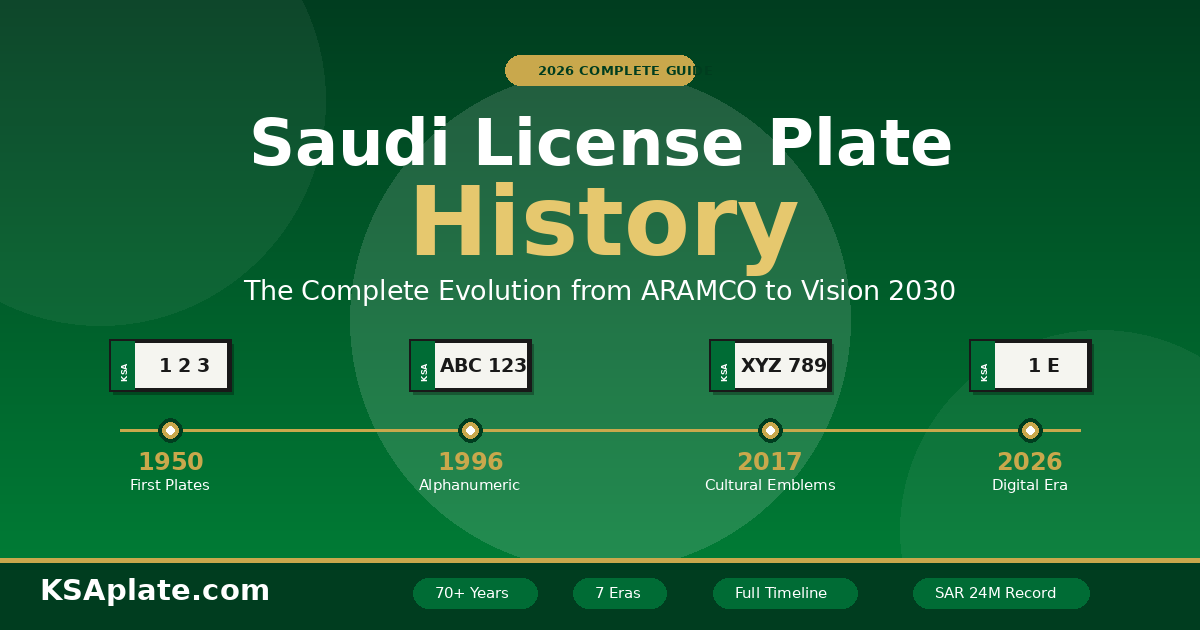
Introduction: A Strip of Metal That Became a Kingdom's Treasure
Few objects in Saudi Arabia carry as much cultural, legal and financial weight as a licence plate. What began as an administrative tool has become a market where single plates change hands for millions: the record is ع 1, sold in an Absher auction on 17 April 2024 for SAR 21 million at the hammer, SAR 24.15 million all-in (Gulf News). The story of the Saudi plate runs alongside the Kingdom's own transformation — though, as the next paragraph explains, much of that story is far less documented than guides like this one usually pretend.
A note on sourcing, before the history starts. Saudi Arabia publishes no archive of its plate-system history, and very little of the pre-2000 story is documented anywhere we can point you to. What follows separates the two clearly: dates and formats we can cite are marked as such, and the surrounding narrative is a reconstruction from how the system visibly changed — not a documented record. An earlier version of this page gave phase boundaries, material thicknesses and plate dimensions with a precision none of us can actually support, and those have been removed.
The Pre-Registration Era: Vehicles Without Identity
The first automobiles reached the Arabian Peninsula in the early twentieth century, and by the 1930s and 1940s the discovery and extraction of oil by the Arabian American Oil Company (ARAMCO) had brought large numbers of commercial and personal vehicles into the country. We cannot source the specific anecdotes that usually open this story — the exact year a first car was gifted to King Abdulaziz, or the internal registration practices of the period — so this page no longer states them as fact.
What is clear from the shape of the later system is that registration in this era was not national. Vehicles were concentrated in a handful of settlements — Riyadh, Jeddah, Mecca, Medina, Dammam and the ARAMCO compound towns near Dhahran — and no standardised plate format applied across them. The details of how each locality handled it are not documented in anything we could verify.
The pressure for a national system came from growth: as vehicle numbers rose, local record-keeping could no longer track ownership and movement across an expanding territory. That much follows from what replaced it; the precise timeline does not survive in any source we can cite.
The Earliest Documented Format: All-Numeral Plates
The oldest Saudi plate format that is actually documented used a seven-numeral combination, shown in both Western and Arabic-Indic numerals, with "Al-Saudia" written above in Arabic only (Wikipedia). That is the earliest design description we can point you to. The frequently repeated claim that a first national system launched "in 1950–1952 under the Ministry of Communications", with plates of a specific thickness and size, is not something we can source — and this page used to state it as established fact.
What can reasonably be said about the earliest plates:
- Numerals only — the documented early format carried numbers, not the letter series used today
- Dual numeral systems — the same number appeared in Western and Arabic-Indic digits
- Country name only — "Al-Saudia" in Arabic above the number; no Latin transliteration of the registration itself
- Low numbers came first — sequential issuance is why the lowest numbers are the oldest, and why they are scarce today
Whether early registration was administered municipally or centrally, and whether two cities could issue the same number, are questions we have seen asserted confidently in many places and documented in none. We are not going to add to that.
What is not in doubt is the consequence. Single-digit plates are the scarcest category in the system, and they command the highest prices at auction — the SAR 21 million paid for ع 1 in April 2024 being the clearest example. Whether any particular single-digit plate traces to the founding era or to a named family is the kind of provenance claim that gets repeated without evidence, so treat it with caution wherever you read it.
What's your plate worth?
Get an instant, free estimate with our plate value calculator.
Calculate My Plate's ValueColour Coding by Vehicle Category
Older Saudi plates used a coloured background to mark the vehicle category, and Wikipedia records the scheme directly: trucks blue, public transport yellow, diplomatic green. That is the same logic the current design still follows — the colour now appears in a vertical strip beside the number rather than as a full background, with white for private vehicles and silver for temporary registration.
This matters because the scheme is very widely misreported, including by an earlier version of this page:
- Blue is commercial and heavy transport — not diplomatic, which is the mistake most often made
- Green is diplomatic — not temporary registration
- Yellow is taxis and public transport
- White is private, and silver marks a temporary registration
- For export plates and motorcycle plates — both real, separate official categories — no source we could verify states a colour, so we no longer claim one
Alongside the official categories, an informal premium for memorable numbers emerged well before any regulated marketplace existed — a driver paying to keep a short number, a business owner seeking a number matching a founding year. When exactly that began is not recorded anywhere we can cite; that it long predates the online market is evident from how established the practice already was when auctions went digital.
The Pre-1996 Format: Three Letters and Three Numbers
The format that immediately preceded the modern plate used three numbers and three letters, with no Latin translation (Wikipedia). This is the detail most often stated backwards: the three-letter-plus-three-numeral combination is what came before 1996, not what 1996 introduced.
One structural change from this era shaped everything that followed, and it is worth stating plainly even though we cannot date it precisely: the number became detachable from the vehicle. Once an owner could keep a registration number and move it to a new car, a desirable sequence acquired permanent value independent of any particular vehicle. That is the single decision that turned a plate into a tradeable asset — everything in the rest of this article follows from it.
- Current plate size: 520 × 110 mm is the standard dimension (Wikipedia), with a 335 × 155 mm "US size" and a 550 × 110 mm "EU size" also available
- Reflectorisation and enforcement: the move to retroreflective plates accompanied the spread of automated traffic enforcement, though we cannot date the requirement
- Centralised issuance: the General Directorate of Traffic (Moroor — مرور) is the single national issuing authority today
- Number retention: the change that made the number itself the asset
We have removed the earlier version's specific historical dimensions for front and rear plates, its dating of national standardisation to "1980–1995", and its list of colour codes for that period. None of it could be sourced, and part of it contradicted the colour scheme that is documented.
1996 and 2006 — The Two Changes That Are Actually Dated
Two dates in the modern history are documented, and they are commonly conflated. 1996 is the boundary after which plates stopped using the old three-number/three-letter format without translation. 2006 is when the current plates were introduced (Wikipedia) — the bilingual layout, the restricted 17-letter set with Latin equivalents, and the design still on the roads today. An earlier version of this page called 1996 "the single most significant transformation" and credited it with the current design; the current design dates to 2006.
What the modern format actually established:
- Bilingual display: the same registration shown in Arabic script and Arabic-Indic numerals, and again in Latin characters and Western digits, so the plate is readable by both.
- A restricted letter set: 17 of the 28 Arabic letters, each paired with a distinct Latin character — assigned for uniqueness rather than sound, which is why م maps to Z and ح to J.
- Up to four digits and up to three letters, on a white plate with the category marked by a coloured strip and a symbol under the national emblem.
A correction worth making explicitly: an earlier version of this page said the 1996 change was driven by Saudi Arabia having signed the Vienna Convention on Road Traffic. The chronology does not work — Saudi Arabia acceded to that convention on 12 May 2016, twenty years later (UN treaty register). Bilingual plates plainly do serve international legibility; the treaty was not the reason for them.
What the modern format did do for the market is make desirability legible. A short number, a repeated numeral, or letters that read as a word became something anyone could recognise at a glance — and price differences between combinations began to show up in transactions long before any formal marketplace existed.
Government, Diplomatic, and Special-Category Plates
Running parallel to the evolution of private plates, the Saudi government developed an increasingly detailed system of special-category plates:
- Royal and government plates: vehicles of the royal family and of state entities carry their own registrations, and these are not available for private purchase or transfer.
- Diplomatic plates: issued for accredited missions in coordination with the Ministry of Foreign Affairs, and carrying the green category colour. They never enter the private market.
- Taxis and public transport: the yellow category, required for for-hire passenger vehicles.
- Commercial and heavy transport: the blue category.
- Temporary registration: the silver category, for vehicles not yet permanently registered.
- Export plates: a separate official category for vehicles leaving the Kingdom permanently. We state no colour for it — none is documented.
- Motorcycle, historic-vehicle and public-works plates: further official categories listed by Saudipedia, again without a documented colour.
Phase 5 — The Collectors Market and Online Auctions (2007–2016)
Rising wealth through the 2000s created buyers with both capital and an appetite for status objects that were specifically Saudi. A sports car or a watch could be bought anywhere; a single-digit Saudi plate could only be owned by someone in the Saudi system. That scarcity argument is real and it still holds — it is the one genuinely durable thing about this market.
A secondary market formed over this period. We can describe its shape but not date its stages, so we no longer attach years to them:
- Classified listings — plate sales appearing alongside general classifieds, with inspection and transfer completed at a Moroor office
- Brokers — intermediaries maintaining buyer and seller networks and taking a commission
- ABSHER digitisation — once registration and transfer moved onto the national e-government portal, ownership could be verified and transfers requested digitally, which is what opened the market to buyers who were not in the room
- Auction events — dedicated distinctive-plate auctions, which gave the top of the market its first visible price discovery
An earlier version of this page reported that a single-digit plate "5" traded for SAR 5 million in 2013. We could not find that sale in any named publication and have removed it. The properly sourced records all sit later and are listed further down this page.
Phase 6 — Cultural Identity, Vision 2030, and Emblem Plates (2017–Present)
Vision 2030 launched in 2016, and the plate system picked up a cultural dimension shortly afterwards. The documented change is specific: from 21 February 2022, Absher has offered plates carrying a national or cultural emblem alongside the standard registration, at SAR 800 each, in five designs approved by the Ministry of Culture (Arab News).
- The national emblem — the crossed swords and palm tree
- Vision 2030 — the official transformation logo
- Hegra (مدائن صالح) — the UNESCO World Heritage site at AlUla
- Diriyah — At-Turaif — the first Saudi capital, also UNESCO-listed
- A fifth approved design in the same set, offered in coloured and black versions
Two claims from the earlier version have gone. There is no separate "Founding Day", "AlUla" or "NEOM" plate series that we could verify — the launch coincided with Founding Day, which is likely how that got started. And emblem plates do not "command a 15–40% premium": the emblem is a visual option on an existing registration, and we have no evidence it changes what a plate sells for.
Record Prices and the Investment Market (2020–2026)
The market is now discussed in business media as an asset class. What follows are the sales we can trace to a named publication. Absher publishes no archive of auction results, so a figure without a source should be treated as unverified — including figures this page used to carry.
Landmark transactions and market milestones include:
- ع 1 — SAR 21 million at the hammer, SAR 24.15 million all-in, Absher electronic auction, 17 April 2024 (Gulf News). The highest publicly reported Saudi plate result.
- م ل ك 1 — SAR 13.4 million at the hammer, SAR 15.745 million all-in, Riyadh Car Show, December 2025 (Gulf Insider). The difference is 15% VAT plus commission.
- 1 V — SAR 10 million, Absher electronic auction at the turn of 2024. Widely attributed in Saudi media to rally driver Yazeed Al Rajhi, who never confirmed it.
- أ أ أ 1111 — SAR 6.4 million, 27 November 2007, the first Saudi distinctive-plate auction.
- ط 1 — SAR 4.15 million, 15 March 2023.
For context on where the everyday market sits rather than its ceiling: across the 12,101 priced listings on KSAplate.com, the median four-digit plate asks SAR 3,400 and the median single-digit plate asks SAR 285,000. The price bands this page used to give for double-digit plates (SAR 1–5 million) and triple-digit repeaters (SAR 300,000–2 million) were not drawn from any data — the actual medians are SAR 42,000 and SAR 36,000.
Is a Plate a Good Store of Value? What We Can and Cannot Say
An earlier version of this section told you that Saudi plates are a Shariah-compliant investment and answered "yes" to whether they are halal. That was not ours to say. Whether a particular transaction is permissible is a question for a qualified scholar who knows the specifics, not for a marketplace with an interest in the answer. What we can set out are the factual attributes — you and your advisor can weigh them.
- Tangible and registered — a distinctive plate is recorded against a named owner in the Ministry of Interior system, and ownership is verifiable in Absher.
- A direct exchange — buying a plate is a purchase of a known, identified asset at an agreed price. No financing structure is inherent to it, though of course one can be added.
- Genuinely fixed supply at the top — there will never be more than nine single-digit numbers per letter combination. That constraint is real and permanent, and it is the strongest argument in this market.
- Low holding costs — no storage, no maintenance, no plate-specific insurance.
- Uncertain liquidity — this cuts the other way. Below the rarest tier, selling at a given price can take weeks or months, and there is no market maker.
- No return series exists — an earlier version of this page claimed "appreciation of 20–50% over five-year holding periods". Nobody publishes a price index for Saudi plates, private sale prices are not reported, and we do not track completed transactions. That figure was invented, and no honest one can replace it.
How the Transfer Process Works Today
A transfer today runs through Absher, and which fee applies depends on what is moving. Selling a whole vehicle (مبايعة) costs SAR 150 in government fees plus a SAR 230 Absher service fee — SAR 380. Moving a plate alone between two vehicles costs SAR 400 per vehicle plus one SAR 230 service fee — SAR 1,030. Earlier versions of this page used SAR 380 and SAR 400 interchangeably for a plate transfer; both understated it.
- Buyer and seller agree a price — privately, through a broker, or via a marketplace listing.
- Each side pays the government fee for its own vehicle through SADAD, plus the Absher service fee.
- The seller initiates the transfer in Absher, entering the buyer's national ID or Iqama number.
- The buyer accepts in their own Absher account.
- Confirm in your own account that the plate has actually moved. A screenshot the other party sends you proves nothing, and the transfer is irreversible once accepted.
We no longer state how long the Moroor takes to process a transfer. The Absher step itself completes on acceptance; what actually determines the timeline is how quickly the other party accepts and the fees clear. The "within one business day" this page used to promise had no source.
Looking Ahead: The Future of Saudi License Plates
Some closing perspective, clearly labelled as such. The items below are directions the market could take — not announcements, not forecasts, and not things we can source. An earlier version of this page presented several of them as established trends.
- More special series — the 2022 emblem set showed there is appetite for culturally themed plates. Whether further series follow is speculation.
- Digital or electronic plates — discussed in several countries. We previously said Saudi Arabia had begun trials; we could not source that and have removed it.
- GCC interoperability — greater cross-border recognition of registrations would change who can realistically buy a Saudi plate. We know of no concrete proposal.
- Better auction infrastructure — documented provenance and catalogue records are what turned art and coins into investable markets. Saudi plates have none of that yet, which is precisely why no return series exists.
- Institutional buyers — sometimes claimed, never evidenced. If family offices are buying plates at scale, it is not visible in anything published.