
TL;DR:
- Owning a car in Saudi Arabia costs far more than the sticker price — the real monthly cost is depreciation + fuel + insurance + maintenance + registration + (if financed) profit.
- Depreciation is the biggest cost and the one most people forget: a typical car loses 35–45% of its value over the first few years, even while parked.
- Running costs are low by global standards: petrol 91 is about SAR 2.18/litre, Istimara renewal around SAR 100/year, and a small sedan burns roughly SAR 190/month in fuel.
- A realistic all-in figure for a mid-range car runs about SAR 1,500–2,500 per month once depreciation, fuel, insurance, servicing and registration are added.
- The cheapest car to own is a reliable, value-holding model bought at a fair price — check its real value before you buy, not just the monthly payment.
Quick answer: The cost of owning a car in Saudi Arabia is the total of six things across a year: depreciation (the value it loses), fuel (~SAR 190–580/month by engine size), insurance (~4–6% of the car's value), maintenance and tyres, registration and inspection (Istimara ~SAR 100/year plus Fahes), and finance profit if you didn't pay cash. For a mid-range car, expect roughly SAR 1,500–2,500 per month all-in — with depreciation, not fuel, usually the largest slice.
What "cost of ownership" really means
The cost of owning a car in Saudi Arabia is everything the car takes from your account across the years you keep it — not the price you paid at the showroom. Economists call this the total cost of ownership, and it is the only honest way to compare two cars or decide what you can really afford.
Most buyers focus on the monthly finance payment and the petrol bill. Those matter, but they hide the biggest cost of all — the value the car quietly loses — and several smaller, predictable costs that add up. Once you see the full picture, you can budget accurately and avoid the classic mistake of buying "too much car."
The good news: Saudi Arabia is one of the cheaper places in the world to run a car, thanks to low fuel prices, modest registration fees and no annual road tax. The trap is treating the purchase price as the whole story.
The 6 costs, by share
Six categories make up the cost of owning a car. Their relative weight shifts with the car's value and how you drive, but the order is fairly consistent — and depreciation almost always leads.
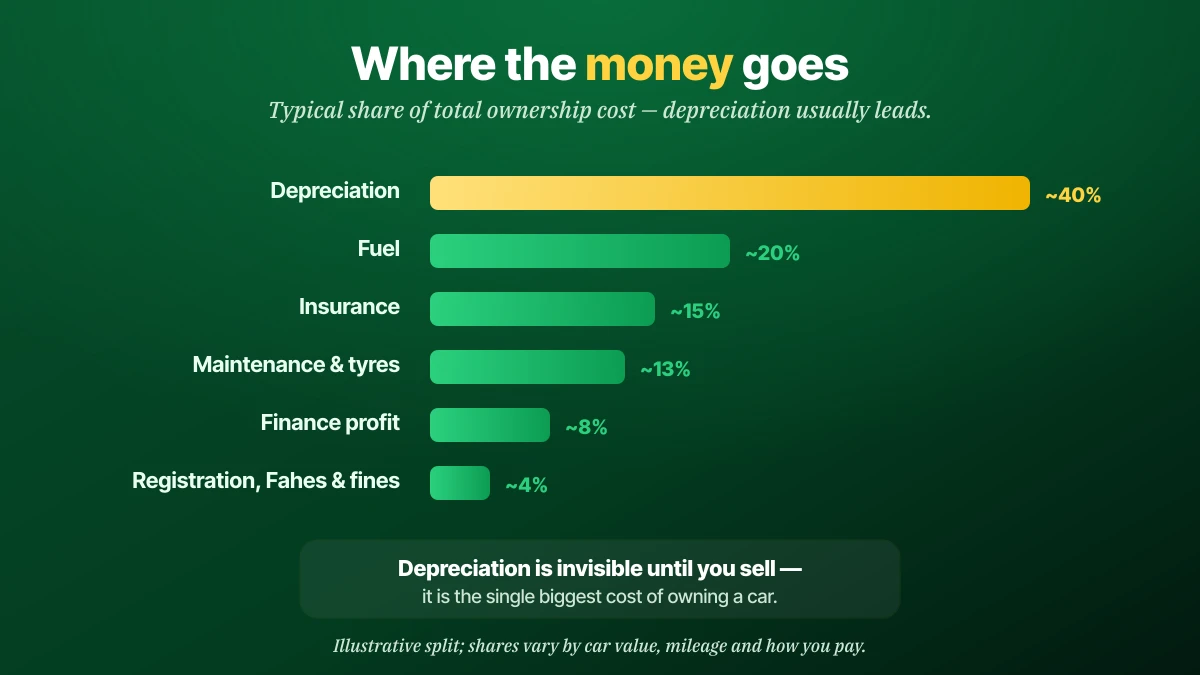
| Cost | What it is | Typical weight |
|---|---|---|
| Depreciation | Value the car loses over time | Largest |
| Fuel | Petrol for your real mileage | High |
| Insurance | Mandatory cover, yearly | Medium |
| Maintenance & tyres | Servicing, repairs, rubber | Medium |
| Finance profit | Markup if you didn't pay cash | Variable |
| Registration, Fahes & fines | Istimara, inspection, Saher | Small |
Notice that the two costs people obsess over — fuel and the monthly payment — are not the whole story. The largest single cost is invisible until the day you sell. Let's take each in turn.
Depreciation: the hidden number one
Depreciation is the value your car loses between buying and selling, and it is the single biggest cost of ownership in Saudi Arabia. It is "hidden" because you never see a bill for it — you only feel it when you sell or trade in.
A typical car keeps only around 55–65% of its value after five years, and the steepest drop happens in the first three. On an SAR 100,000 car, that can mean SAR 35,000–45,000 of value gone — far more than you will ever spend on petrol in the same period. This is exactly why a value-holding model and a fair purchase price matter more than any other single decision.
The cheapest car to own is rarely the cheapest to buy — it is the one that loses the least value while you own it. Check a model's real worth with our used-car value guide before you commit.
Two ways to shrink this cost: buy a model with strong resale demand (Toyota and Nissan lead in the Kingdom), and consider a lightly used car so the first owner absorbs the steepest early drop — our new vs used guide breaks down the maths.
What's your car worth?
Get a free instant estimate based on real Saudi market data — then sell it on KSAplate with direct WhatsApp contact.
Value My Car — FreeFuel: what you'll actually pay
Fuel is the most visible running cost, and in Saudi Arabia it is cheap by world standards. Petrol 91 sits at roughly SAR 2.18 per litre and 95 around SAR 2.33, with prices reviewed monthly. Your monthly bill depends almost entirely on engine size and how far you drive.
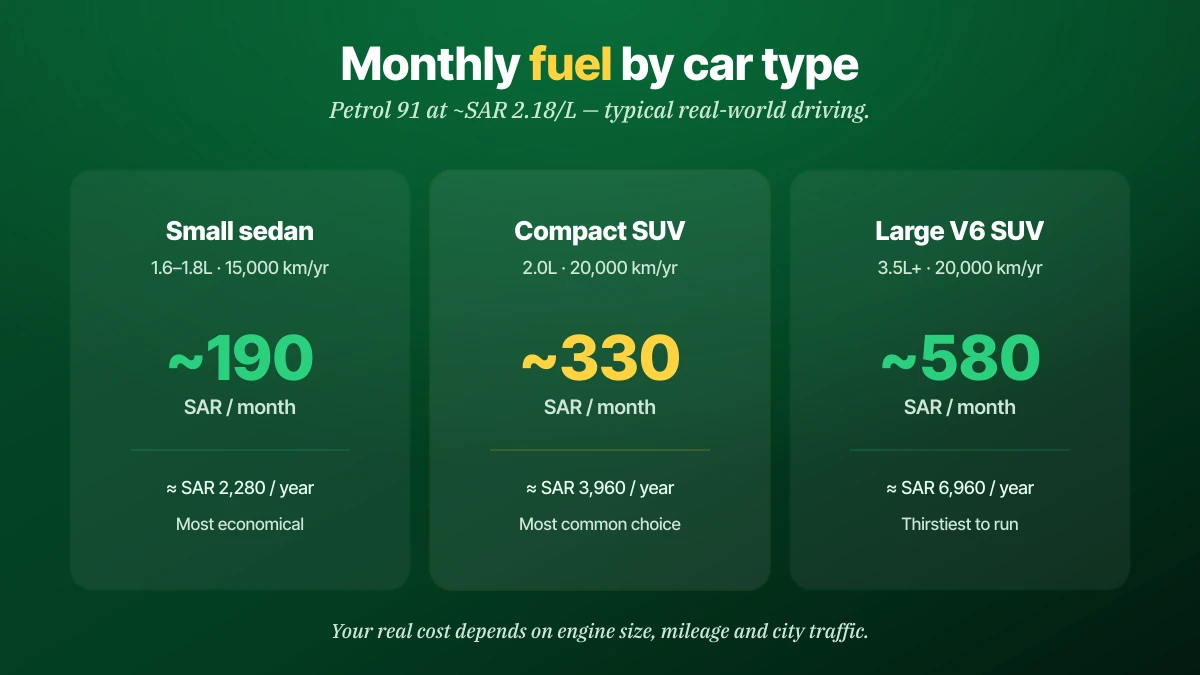
| Car type | Engine & mileage | Fuel / month |
|---|---|---|
| Small sedan | 1.6–1.8L, 15,000 km/yr | ~SAR 190 |
| Compact SUV | 2.0L, 20,000 km/yr | ~SAR 330 |
| Large V6 SUV | 3.5L+, 20,000 km/yr | ~SAR 580 |
The lesson is simple: engine size is the fuel dial you control at purchase. Choosing a four-cylinder sedan over a thirsty V6 can save you several thousand riyals a year, every year you own the car. If your driving is mostly city commuting, a smaller, efficient engine pays you back monthly.
Insurance
Car insurance is mandatory in Saudi Arabia and is a recurring yearly cost tied to your car's value. Third-party liability is the legal minimum; comprehensive cover — which protects against theft, fire and accident damage — costs more and is required while a car is financed.
As a rough guide, expect to pay in the region of 4–6% of the car's value per year for cover, with the exact premium driven by the car's value, your age and claims history, and the level of cover. A newer, more valuable car costs more to insure; an older one costs less. Because premiums vary widely between insurers, shopping around at each renewal is one of the easiest ways to save. Our car insurance guide explains the cover types and how to compare quotes.
Maintenance, servicing & tyres
Maintenance is the cost of keeping the car running safely: scheduled servicing, wear-and-tear repairs, and tyres. It is modest on a reliable, well-chosen car and rises with age and neglect.
A basic service at an independent garage typically runs SAR 65–300, while a major dealer service at the 20,000/40,000/60,000 km intervals can cost SAR 600–1,800 for popular Japanese and Korean models. On top of that, budget for tyres (a full set is a periodic but significant outlay), brakes, battery and the occasional repair. A practical rule of thumb is to set aside a small monthly amount — even SAR 150–300 — so a big service or a new set of tyres never catches you out.
Servicing on time is cheaper than repairing on breakdown. Skipping scheduled maintenance to save SAR 300 today is how you end up with an SAR 3,000 repair later.
This is also where buying right pays off: a model with cheap, widely available parts and a strong reliability record keeps this cost small for years. If you are buying used, verify the car's service and accident history first with a car history check.
Registration & inspection
Registration and inspection are small, predictable annual costs, but they are mandatory and carry penalties if you miss them. Two things matter here: the Istimara (vehicle registration) and the Fahes (periodic technical inspection).
- Istimara renewal costs around SAR 100 per year for a private car (more for larger and commercial vehicles), and you can renew up to 180 days before expiry on Absher. See our step-by-step Istimara renewal guide.
- Fahes — the periodic inspection — is required to renew registration on older cars, and costs a modest fixed fee per visit. Our Fahes inspection guide covers what gets checked and how to pass first time.
Renewing your Istimara also requires valid insurance, so these three — registration, inspection and insurance — are linked. Renew early and online to avoid late penalties, which are an avoidable cost.
Finance profit & the extras
If you didn't pay cash, finance adds a real cost: the profit (markup or rent) the lender charges across the term. It can be a meaningful slice of your total, so always judge a deal on the total amount payable, not the monthly figure — our car finance guide explains the Shariah-compliant structures and your SAMA rights.
Then there are the small, often-forgotten extras that quietly add up:
- Traffic fines from Saher cameras — entirely avoidable, but they add up fast if you ignore the limits. Check and clear them with our traffic fines guide.
- Tyres, battery and consumables — periodic but predictable; budget for them.
- Parking and tolls — generally low in Saudi Arabia compared with many countries, but city-centre and airport parking can add a little.
- Cleaning and accessories — minor, but real over a year.
A full monthly example in SAR
Numbers make it concrete. Take a popular compact SUV bought for SAR 100,000, driven 20,000 km a year and kept for five years. Here is a realistic all-in monthly estimate.
| Cost | Estimate / month |
|---|---|
| Depreciation (value lost, averaged) | ~SAR 650 |
| Fuel (2.0L, 20,000 km/yr) | ~SAR 330 |
| Insurance (~5% of value) | ~SAR 420 |
| Maintenance & tyres (set aside) | ~SAR 250 |
| Registration & Fahes (Istimara + inspection) | ~SAR 15 |
| Finance profit (if financed) | ~SAR 250 |
| All-in total | ~SAR 1,900 / month |
Two things stand out. First, depreciation is the biggest line — bigger than fuel and insurance — even though you never receive a bill for it. Second, if you pay cash, you remove the finance line and lower the total. Pay cash for a value-holding car and the all-in cost drops meaningfully. Run this same table on the specific car you want before you buy — value it first with our used-car value guide, then browse cars on KSAplate to see what your budget really buys.
If the monthly payment fits but the all-in cost doesn't, you can't afford the car. Budget on total cost of ownership, not the instalment alone.
How to cut your running costs
You can lower the cost of owning a car without skipping essentials like insurance or servicing. The biggest savings come from decisions you make before you buy, plus a few good habits afterwards.
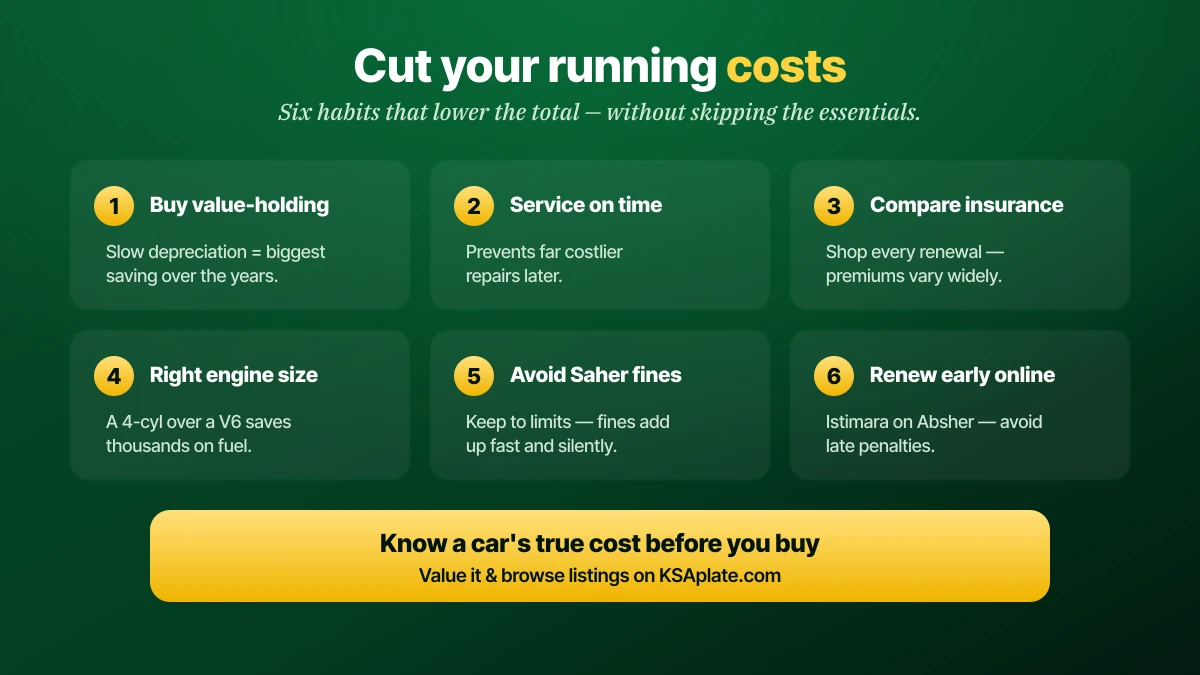
- Buy a value-holding model. Slow depreciation is the single biggest saving over the years, so resale strength should top your shortlist.
- Choose the right engine size. A four-cylinder over a V6 saves thousands in fuel across ownership — pick the smallest engine that suits your needs.
- Service on time. Scheduled maintenance is far cheaper than emergency repairs, and protects resale value.
- Compare insurance every renewal. Premiums vary widely between insurers; ten minutes of comparing can cut hundreds of riyals.
- Avoid Saher fines. Keep to the limits — fines are a pure, avoidable cost that also raises future premiums.
- Renew Istimara early and online. Use Absher before expiry to dodge late penalties.
Most of all, buy the right car at the right price. A reliable, value-holding model bought fairly is cheaper to own for years than a flashier car bought badly. When you're ready, browse cars on KSAplate, and if you're upgrading, list your current car to put its value toward the next one.
Frequently asked questions
How much does it cost to own a car in Saudi Arabia per month?
What is the biggest cost of owning a car?
How much is petrol in Saudi Arabia in 2026?
How much is car insurance per year?
How much is Istimara renewal?
Is it cheaper to own a car in Saudi Arabia than abroad?
Does paying cash make a car cheaper to own?
What's the cheapest car to own in Saudi Arabia?
How much should I budget for maintenance?
Conclusion & next steps
The cost of owning a car in Saudi Arabia is the sum of six things — depreciation, fuel, insurance, maintenance, registration and finance — and for a mid-range car it lands around SAR 1,500–2,500 a month all-in. The surprise for most owners is that depreciation, the cost no one bills you for, outweighs the petrol they watch so closely. Budget on the full picture, not the monthly payment, and the single most powerful move is buying a reliable, value-holding car at a fair price. Start there: value the model you want, weigh new against used, then browse cars on KSAplate and buy with the real cost of ownership in mind.