
Last updated: 13 August 2026 · 13 min read
If your car's AC blows cool at speed but warm at idle, or cools for a week after a regas and then fades, you almost certainly have a refrigerant leak or a heat-rejection problem — not a system that simply "needs gas". In Saudi Arabia the air conditioner works harder than almost anywhere on earth: ambient air near 50°C, a parked cabin that can pass 70°C, and fine dust that blankets the condenser. Those three forces cause most Saudi AC failures, and each has a different fix and a very different price.
Topping up refrigerant without finding the leak is not a repair. It is renting cold air for a few weeks, and the compressor pays the bill later.
- Low gas always means a leak. A sealed AC system does not consume refrigerant. If it needed gas, something is leaking — find it, or you will be back next summer.
- Cold at speed, warm at idle points to poor heat rejection: a dust-packed condenser or a failing cooling fan, not an empty system.
- Test it in five minutes. A healthy system should push vent air roughly 10–15°C below cabin temperature once settled. Anything less is a real fault.
- Costs vary hugely by fault: a cabin filter is a small job, a condenser is mid-range, and a compressor replacement is the one that hurts. Diagnose before you authorise.
- AC is the first thing a Saudi buyer tests. A weak system knocks thousands off your resale price — often more than the repair would have cost.
Why car AC fails faster in Saudi Arabia
Car air conditioning is a closed loop that moves heat from the cabin to the outside air — and its capacity depends entirely on how much hotter the cabin is than the air outside. In Saudi Arabia that margin nearly disappears. When the National Center for Meteorology records highs in the high forties, a system designed around 35°C ambient is running at the edge of its design envelope every afternoon.
Three local forces do the damage. Heat raises system pressures and cooks the rubber O-rings and hose seals that hold refrigerant in. Dust coats the condenser at the front of the car, and a condenser that cannot shed heat cannot make cold. Long idling in traffic removes the airflow the system relies on, so faults that stay hidden in cooler countries show up here as warm air at every red light.
Key takeaway: Saudi AC problems are rarely random. They are almost always heat-accelerated seal leaks or dust-blocked heat rejection — the same two root causes behind the heat-related battery failures and accelerated tyre ageing that define motoring in the Kingdom.
- Summer highs across much of the Kingdom sit in the mid-to-high 40s °C, with the Eastern Province adding humidity that raises the cooling load further.
- A car parked in direct sun can reach a cabin temperature well above 70°C — far hotter than the outside air.
- R134a refrigerant has a global warming potential of roughly 1,430; the newer R1234yf is under 1, which is why regulators pushed the switch.
The 5-minute driveway AC test
The driveway AC test is a simple vent-temperature check that tells you whether your system has a real fault before a workshop tells you it does. It costs nothing but a cheap thermometer, and it converts a vague complaint — "the AC is weak" — into a number you can defend when you get a quote.
Run it with the car parked in shade, engine at idle, after the cabin has purged its trapped heat:
- Purge the oven first. Open the doors for a minute. Testing a 70°C cabin measures the heat soak, not the AC.
- Set it up properly. Engine running, AC on max cold, fan on high, recirculation ON, windows closed.
- Wait five minutes. Let the system settle. Judging it in the first thirty seconds is how people misdiagnose a healthy AC.
- Measure at the centre vent. Put the thermometer in the vent. Compare it to cabin air temperature away from the vents.
- Now rev gently to about 1,500 rpm and watch. If the vent gets noticeably colder as revs rise, note it — that single observation is the most useful clue you can hand a technician.
A healthy system settled in shade should deliver vent air roughly 10–15°C below cabin temperature. A delta under about 8°C is a genuine fault worth diagnosing. If cold only arrives with revs, suspect heat rejection — condenser or fan — rather than an empty system.
Walk into a workshop saying "vent air is only six degrees below cabin, and it improves when I rev" and you will get a diagnosis. Walk in saying "AC is weak" and you will get a regas.
Key takeaway: measure before you spend. A number turns you from a customer into a witness.
Symptom → cause → cost matrix
Most AC complaints fall into a small number of patterns, and each pattern points at a different part of the system. This matrix maps what you actually experience to the most likely cause and the rough scale of the bill, so you can sanity-check a quote before you approve it.
| What you notice | Most likely cause | Cost scale |
|---|---|---|
| Cold at speed, warm at idle | Dust-blocked condenser or failing cooling fan | Low–medium |
| Weak airflow, air smells musty | Clogged cabin air filter or dirty evaporator | Low |
| Cold for days after a regas, then fades | Refrigerant leak (O-rings, hoses, condenser) | Medium |
| No cold at all, compressor never engages | Empty system, pressure switch, relay or electrical fault | Low–high (diagnose first) |
| Loud rattle or squeal when AC switches on | Failing compressor clutch or bearing | High |
| Cools on one side only (dual-zone cars) | Blend door actuator, not the AC circuit | Medium |
| Water pooling in the passenger footwell | Blocked evaporator drain | Low |
Two entries deserve attention. "No cold at all" spans the widest cost range in the whole table — it can be a cheap relay or a dead compressor, which is exactly why a paid diagnosis is cheaper than a guessed repair. And the footwell water case is not an AC fault at all; it is a blocked drain, and it is often mistaken for a leak from the heater.
Key takeaway: the symptom pattern, not the age of the car, tells you which repair you are facing.
What's your car worth?
Get a free instant estimate based on real Saudi market data — then sell it on KSAplate with direct WhatsApp contact.
Value My Car — FreeWhy "just regas it" is usually wrong
A car air conditioning system is sealed, which means it does not consume refrigerant the way an engine consumes oil or fuel. If your system is low on gas, refrigerant has escaped somewhere — so a regas without leak detection treats the symptom and ignores the disease.
This matters financially, not just mechanically. Refrigerant carries the oil that lubricates the compressor. Run the system low and the compressor runs starved; keep doing that across a Saudi summer and you convert a modest seal repair into the most expensive job on the whole system. A shop that offers to "top it up" without a dye test or an electronic sniffer is selling you a few weeks of comfort and a future compressor.
Compare the two paths. Leak found and fixed: one visit, a seal or hose, and a system that holds for years. Repeat regassing: a smaller bill each time, three or four times a year, and eventually a compressor replacement that dwarfs everything you spent avoiding it.
Key takeaway: ask for the leak-test result before you pay for gas. "It holds pressure and we found no dye" is a legitimate answer; silence is not.
R134a or R1234yf: which does your car use?
R134a and R1234yf are the two refrigerants used in modern car air conditioning, and they are not interchangeable. Broadly, cars built before roughly 2017 use R134a, while many models from 2017 onward use R1234yf — the switch was driven by environmental rules, since R134a has a global warming potential around 1,430 against under 1 for R1234yf.
You do not have to guess. There is a sticker under the bonnet, usually near the service ports, that names the refrigerant and the charge weight. Check it before booking any AC work, because the two systems use different service equipment and different port fittings, and mixing them contaminates the system.
| R134a | R1234yf | |
|---|---|---|
| Typical cars | Built before ~2017 | Many built ~2017 onward |
| Global warming potential | ~1,430 | Under 1 |
| Refrigerant cost | Low | Several times higher |
| Service equipment | Widely available | Dedicated equipment required |
| Service price impact | Baseline | Noticeably more expensive |
One Saudi-specific note: cars arriving through different import routes are not always specified identically, so verify the sticker on your actual vehicle rather than assuming from the model year — the same logic that makes GCC spec versus American spec worth checking before you buy. Parts and refrigerants sold in the Kingdom fall under the standards regime administered by the Saudi Standards, Metrology and Quality Organization.
Key takeaway: read the under-bonnet sticker first. It decides both what your car needs and what the bill will look like.
What AC repairs cost in Saudi Arabia
AC repair costs in Saudi Arabia depend almost entirely on which component failed, not on how cold the air feels. The ranges below are indicative 2026 workshop scales for a mainstream car — always get a written quote, because price varies sharply by city, by car, and by whether parts are genuine, aftermarket or used.
| Job | Relative cost | Notes |
|---|---|---|
| Cabin air filter replacement | Lowest | Often DIY; a summer essential in dusty cities |
| Condenser clean / fin straightening | Low | Cheap insurance, big effect at idle |
| Leak diagnosis (dye or sniffer) | Low | Buy this before any gas |
| O-ring / hose seal repair + regas | Low–medium | The most common genuine fix |
| Cooling fan or fan motor | Medium | Classic "warm at idle" culprit |
| Condenser replacement | Medium | Often stone-damaged or corroded |
| Expansion valve / drier | Medium | Usually replaced alongside other work |
| Evaporator replacement | High | Labour-heavy: dashboard usually comes out |
| Compressor replacement | Highest | Flush the system or the new one dies too |
The single most important line is the diagnosis. Paying for a proper leak test is the cheapest item on this list and it is the one that stops you buying the most expensive item on it. Fold AC into your wider budget using the real cost of owning a car in Saudi Arabia, and if the car is still covered, check what your warranty includes before paying out of pocket.
The cheapest AC repair in the Kingdom is the leak you fixed in April. The most expensive is the compressor you replaced in August after ignoring it.
Dust: the condenser and cabin filter
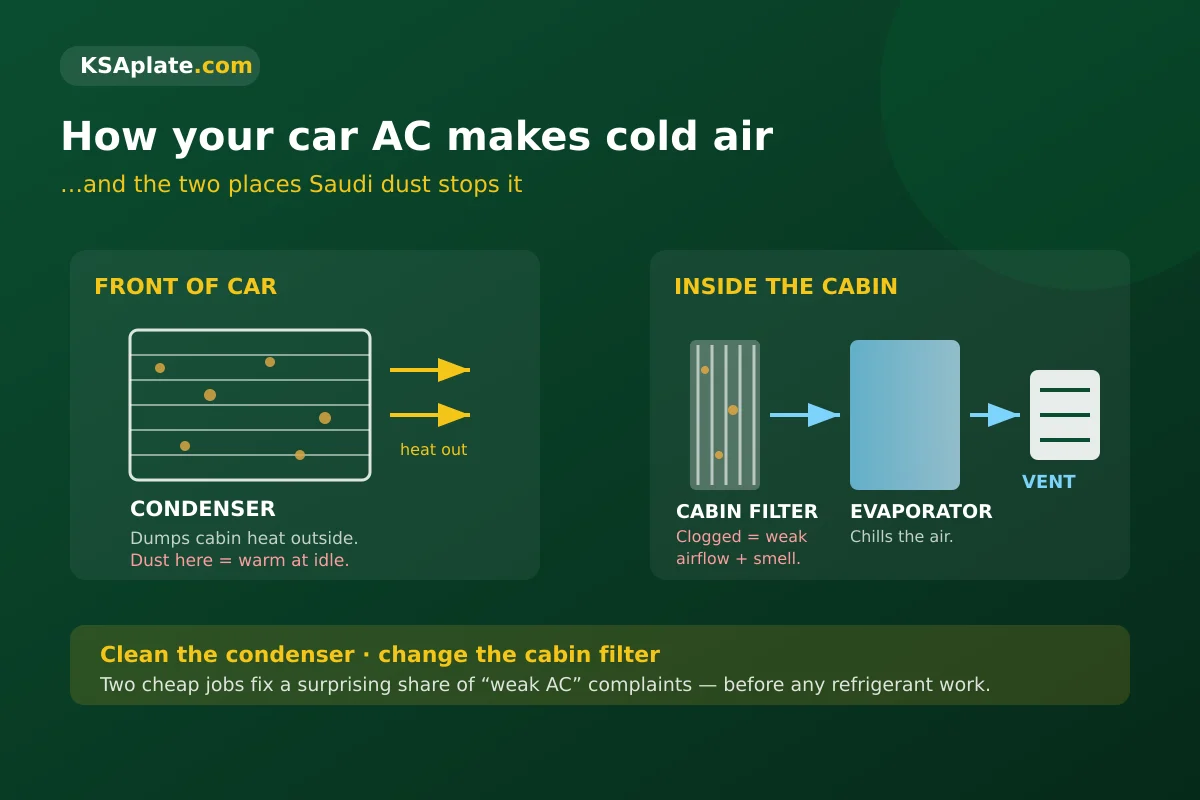
The condenser is the radiator-like unit at the front of your car that dumps cabin heat into the outside air, and in Saudi Arabia it is the component most often quietly disabled by dust. Fine sand packs between its fins, insulating the surface that is supposed to shed heat, and the result is a system that is mechanically healthy but functionally weak.
The tell is the idle test. With airflow from driving, a partly blocked condenser still works; sitting in traffic, it cannot cope, and the cabin warms at exactly the moment you need cold most. Cleaning it gently — low-pressure water, fins never bent — restores performance that people routinely misattribute to low gas. A pressure washer held too close will flatten the fins and make the problem permanent.
The cabin filter is the other half. It sits behind the glovebox on most cars, it is cheap, and in dusty Saudi conditions it loads up far faster than the service book suggests. A blocked filter starves airflow, so the air that reaches you is cold but thin, and the evaporator behind it stays damp and starts to smell. Replacing it is one of the highest-return jobs in the Saudi maintenance schedule.
Key takeaway: before authorising any refrigerant work, clean the condenser and change the cabin filter. Two cheap jobs fix a surprising share of "weak AC" complaints.
Parked-car heat load and the pre-cooling purge
Heat load is the amount of heat your AC must remove before the cabin feels comfortable, and in Saudi Arabia most of it is created while the car is parked, not while you drive. A closed car in direct sun behaves like a solar collector: glass admits sunlight, trapped air and hot trim re-radiate it, and cabin temperature climbs far above the outside air.
That is why the first two minutes matter more than the AC setting. If you get into a 70°C cabin, close the doors and switch to recirculation immediately, you have asked the system to chill a cabin full of superheated air. Purge that air first and the same AC feels dramatically stronger — not because anything was repaired, but because you removed the load.
The sequence that works:
- Open the windows for the first 30–60 seconds and run the fan on high with AC on and recirculation OFF. You are pushing the oven air out.
- Then close the windows and switch recirculation ON. Now the system chills already-cooled cabin air instead of fresh 48°C air, which is far more efficient.
- Park to reduce the load in the first place — shade where possible, a sunshade where not, and legal window tint within the Saudi tinting rules.
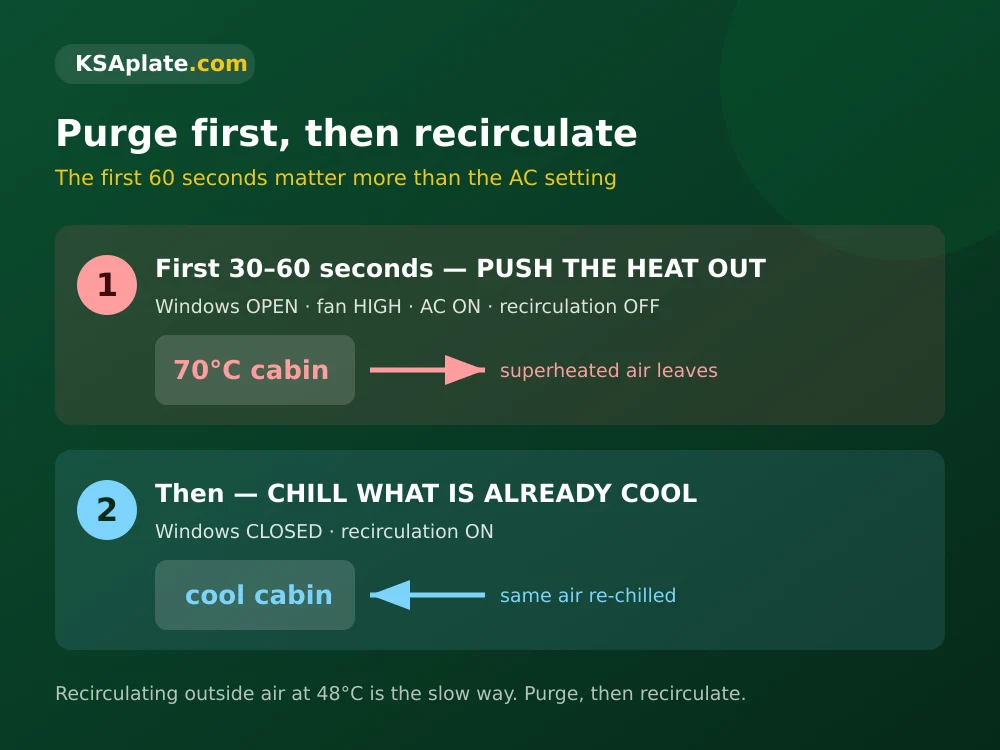
Key takeaway: recirculation is right for steady-state cooling and wrong for the first minute. Purge, then recirculate.
The pre-summer AC checklist
The pre-summer AC check is a short inspection done in spring — ideally March to May — that catches small faults before the heat turns them into breakdowns. Workshops are also less busy then, which means better attention and shorter waits than a walk-in during a July heatwave.
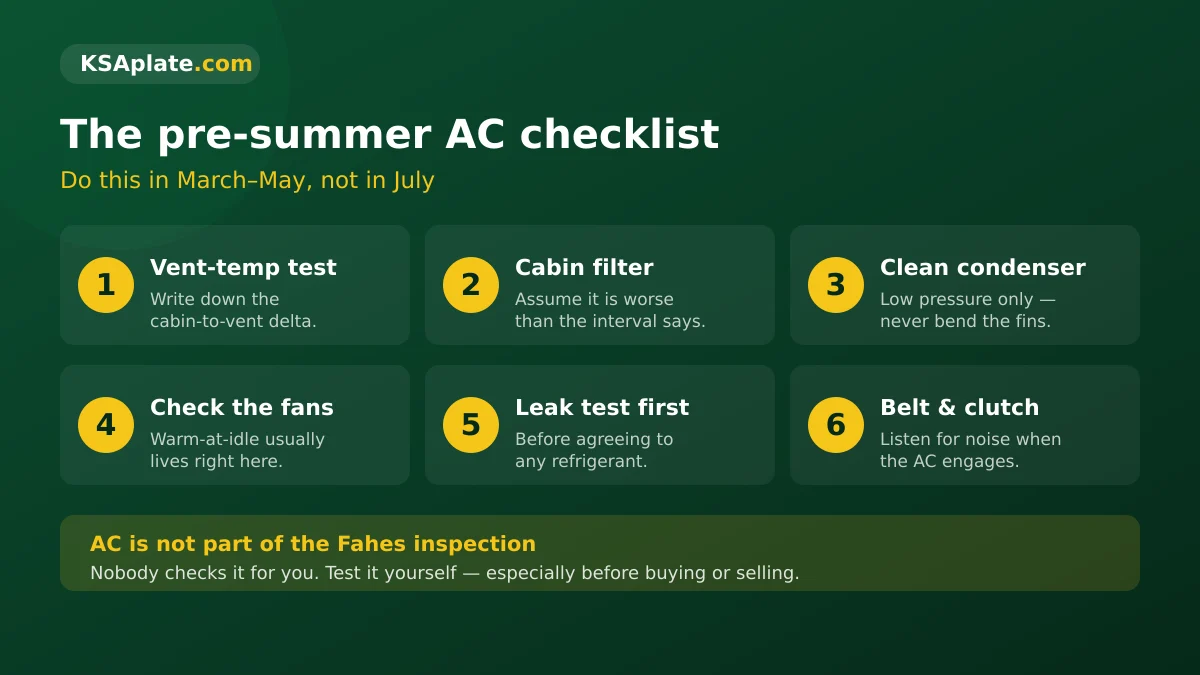
- Run the driveway test above and write down the vent-to-cabin delta.
- Inspect and replace the cabin filter. Assume it is worse than the interval says.
- Clean the condenser gently and check for stone damage and bent fins.
- Confirm both cooling fans run when the AC is switched on. Warm-at-idle usually lives here.
- Ask for a leak test if performance dropped over the winter, before agreeing to any gas.
- Check belts and the compressor clutch for noise when the AC engages.
Bundle this with your other seasonal checks — battery health, tyre age and coolant — so the car faces summer as a whole. It is the same preparation logic behind a long Saudi road trip, and it is far cheaper than a roadside breakdown in August. Note that AC performance is not part of the Fahes periodic inspection, so nobody will catch it for you.
AC and what your car is worth
Weak air conditioning is one of the most expensive faults a Saudi seller can ignore, because it is the first thing almost every buyer tests. A buyer who sits in your car, switches the AC to max and feels lukewarm air will not price the repair — they will price their suspicion, and that discount is usually far larger than the actual fix.
The maths is unforgiving. A seal-and-regas repair is a modest bill; the discount a buyer demands for "the AC isn't cold" routinely runs into thousands of riyals, because they assume the worst-case compressor job. Fixing it before listing, and keeping the invoice to show, converts a bargaining chip against you into evidence of a cared-for car — the same documentation effect that protects you against ordinary depreciation and lifts your number in any valuation.
If you are preparing to sell, fix the AC first, then photograph and list. Our guide to selling a car in Saudi Arabia covers the paperwork, and buyers should run the same vent test from this article as part of a proper used-car inspection. One detail sellers forget: your distinctive plate is a separate asset that does not have to leave with the car.
Key takeaway: repair cold air before you list. It is one of the few car repairs that reliably returns more than it costs.
Cold AC fixed? Now sell it properly
List your car on the only Saudi marketplace that is also a plate market — and check what your distinctive plate is worth before it drives away with the car.
List my car Value my plateFrequently asked questions
Why is my car AC cold when driving but warm at idle?
How often should a car AC be regassed in Saudi Arabia?
How cold should my car AC blow?
Is it cheaper to repair the AC or sell the car as is?
Can I use R134a in a car that takes R1234yf?
Why does my car AC smell bad when I switch it on?
Does running the AC hurt fuel economy in Saudi Arabia?
Should I use recirculation or fresh air?
Is car AC checked during Fahes inspection?
My compressor was replaced and the AC failed again. Why?
Reviewed by Khalid Al-Rashid, Saudi Car & License Plate Market Expert. Cost scales are indicative 2026 market observations, not quotes — always confirm in writing with your workshop, and confirm any regulatory detail with the relevant Saudi authority.
Sources: National Center for Meteorology (ncm.gov.sa) for Saudi summer temperature context; Saudi Standards, Metrology and Quality Organization (saso.gov.sa) for the standards regime covering automotive parts and refrigerants; published refrigerant global-warming-potential figures for R134a and R1234yf; KSAplate workshop and listing observations, 2026.