TL;DR:
- In Saudi Arabia, tyres age from heat, not just from mileage. The Kingdom's 45–50°C summers and 70°C+ tarmac dry out the rubber, so a set of tyres here should be replaced every 4 to 5 years regardless of tread — years before the same tyres would "wear out" in a mild climate.
- Read the age before you trust the tread. The DOT code on the sidewall ends in four digits — the week and year of manufacture (for example 2523 = week 25 of 2023). A tyre with deep tread but a five-year-old date is a blowout waiting for a hot highway.
- Six things say "replace now": tread at or below 1.6mm (the dirham test), sidewall cracks or dry rot, any bulge or blister, vibration or pulling, uneven wear across the tread, or an age past five years.
- Pressure is a summer safety issue. Check it cold, first thing in the morning, to the figure on the driver's-door sticker (usually 30–35 psi) — under-inflated tyres overheat and blow out, which is the single most common cause of highway tyre failure in the Gulf.
- A car that keeps eating tyres and parts is sending a financial signal. A sound car deserves a fresh, heat-rated set; a car stacking up bills is telling you to check its value and move it on while it still drives straight and true.
Quick answer: Car tyres in Saudi Arabia should be replaced every 4 to 5 years even if the tread looks fine, because the extreme heat dries and cracks the rubber (dry rot) long before the tread wears out. Replace them sooner if the tread reaches 1.6mm (check with a dirham coin), if you see sidewall cracks, bulges, or uneven wear, or if the DOT date code shows the tyre is over five years old. Keep them inflated to the pressure on the driver's-door sticker — checked cold — because under-inflation and heat together cause most summer blowouts. For the Saudi climate, choose GCC-spec tyres from a heat-tolerant brand with a high temperature rating.
Why heat is a tyre's worst enemy in Saudi Arabia
A tyre is not just rubber — it is a carefully cured blend of rubber compounds, oils, steel belts and fabric, engineered to stay flexible and grip the road. Heat is the enemy of that chemistry. A tyre is designed to run warm, but the Saudi environment pushes it far beyond comfortable. Summer air in Riyadh, Jeddah and Dammam routinely hits 45–50°C, and the asphalt a tyre actually touches can exceed 70°C. Drive on that surface at highway speed and the tyre's own internal temperature climbs higher still. That relentless heat attacks a tyre in three ways at once.
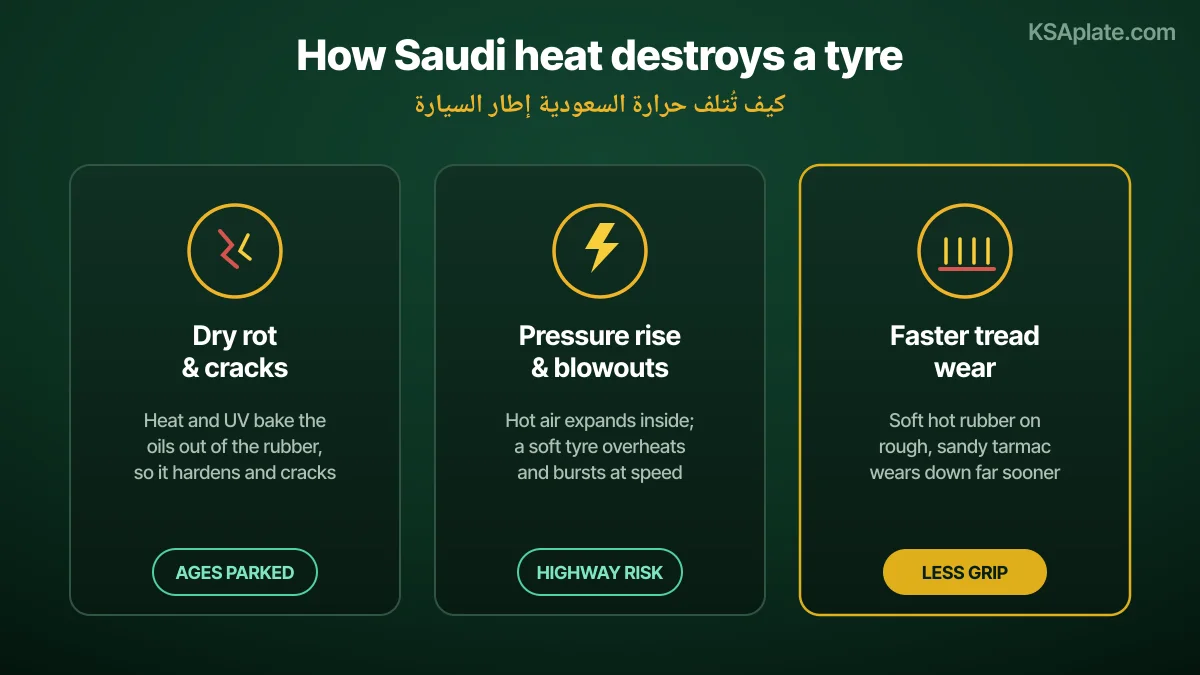
It dries and cracks the rubber (dry rot). Rubber stays supple thanks to oils and anti-ageing compounds mixed into it. Prolonged heat and ultraviolet sunlight bake those oils out, and the rubber hardens, loses elasticity and develops fine cracks — first in the sidewall and between the tread blocks. This "dry rot" happens even while the car is parked, which is why a barely-used tyre in Saudi Arabia can be dangerous simply because it is old. The tread can look almost new while the rubber underneath has gone brittle.
It raises the internal pressure and invites blowouts. As a tyre heats up, the air inside expands and the pressure rises. A tyre that is under-inflated to begin with flexes more as it rolls, and that flexing generates even more heat — a runaway loop that ends in the tread separating or the tyre bursting at speed. Blowouts on Saudi highways spike every summer for exactly this reason: old or soft tyres meeting hot tarmac at 120 km/h.
It accelerates tread wear. Hot rubber is softer rubber, and soft rubber abrades faster against rough, sun-baked asphalt. Add the fine sand that acts like a mild abrasive on many roads, and tread that might last 60,000 km in a temperate country can be worn smooth far sooner here. Every one of these effects is invisible until you look for it — which is why knowing what to check matters so much.
How long do tyres last in Saudi Arabia?
Plan to replace tyres every 4 to 5 years — by age, not just by tread. Tyre and safety bodies worldwide advise replacing tyres at 5 to 6 years regardless of wear, and inspecting them closely every year after five. In the Gulf heat, treat the earlier end of that range as the rule. Many Saudi drivers find their tyres cracking or "squaring off" in their fourth summer, well before the tread is legally worn. The table below shows how conditions change the real-world figure.
| Climate / condition | Realistic tyre life |
|---|---|
| Mild climate, average mileage | 5–6 years (or until tread wears) |
| Saudi Arabia, garaged & driven normally | 4–5 years |
| Saudi Arabia, parked outdoors in the sun | 3–4 years |
| High-mileage highway driving | Tread wears out first, often in 2–3 years |
| Car left standing for months outdoors | Dry rot can ruin tyres in 3–4 years unused |
The lesson is the one that surprises people most: a tyre can expire from old age even if you barely drove on it. Low mileage is no protection against the Saudi sun. This is exactly why the manufacture date on the sidewall matters as much as the tread depth — and why buying "nearly new" used tyres can be a false economy if they are already several years old.
How to read a tyre's age (the DOT code)
Every tyre sold legally carries a DOT code moulded into the sidewall, and the last four digits tell you exactly when it was made. This is the most useful thirty seconds of inspection you can do — before a road trip, and especially before buying any used tyre or used car.
Find the letters DOT followed by a string of characters ending in four digits. Read those four digits as two pairs:
- The first two digits are the week of the year (01–52).
- The last two digits are the year.
So a tyre stamped 2523 was made in week 25 of 2023. A tyre stamped 0821 was made in week 8 of 2021 — already old for the Gulf. If you only see three digits at the end, the tyre was made before 2000 and should be thrown away, not fitted. Use the code two ways: check the date on your own tyres to plan replacement, and check it on any tyre a shop tries to sell you as "new" — a genuinely new tyre should be no more than a year old. A brand-new tyre that has sat in a hot warehouse for two years has already lost part of its life before it touches your car.
What's your car worth?
Get a free instant estimate based on real Saudi market data — then sell it on KSAplate with direct WhatsApp contact.
Value My Car — Free6 signs you need new tyres
Tyres, like a battery, warn you before they fail — but only if you look. Walk around the car once a month and before any long road trip, and watch for these six signs. Any one of them means it is time to replace, not to wait.
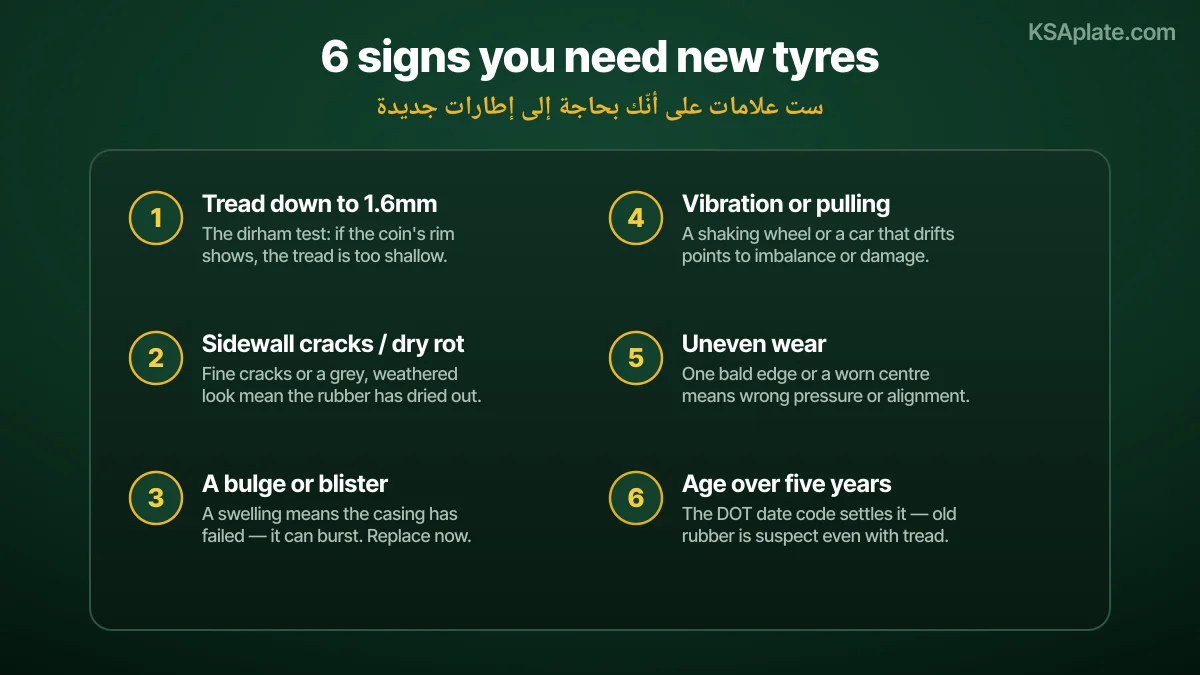
- Tread worn to the limit. The legal and safety minimum is 1.6mm. Do the dirham test: insert the coin's edge into the tread groove; if the outer rim of the coin stays visible, the tread is too shallow. Most tyres also have moulded "tread wear bars" between the blocks — when the tread is flush with those bars, the tyre is finished.
- Sidewall cracks or dry rot. Fine spider-web cracks or a dull, greyish, weathered look on the sidewall mean the rubber has dried out. This is heat ageing, and it weakens the tyre from the inside even if the tread is deep.
- A bulge or blister. A bubble or swelling on the sidewall means the internal structure has failed and air is pushing through the damaged casing. This tyre can burst without warning — replace it immediately and do not drive far on it.
- Vibration or pulling. A steering wheel that shakes at speed, or a car that drifts to one side, can mean a tyre is out of balance, damaged internally, or wearing unevenly. It is also a comfort and safety warning worth investigating at once.
- Uneven wear. If one edge is bald while the other is fine, or the centre is worn while the edges aren't, the cause is usually wrong pressure or bad wheel alignment. Fix the cause or the new tyres will wear out the same way.
- Age over five years. Even with good tread, a tyre past five years in this climate should be treated as suspect and replaced. The DOT code settles the argument.
Correct tyre pressure in the Saudi heat
Pressure is where most drivers accidentally create their own blowout — and where a two-minute habit prevents one. The correct pressure for your car is printed on a sticker inside the driver's door frame (or in the owner's manual), not on the tyre itself. The number on the tyre's sidewall is its maximum, not its recommended pressure. For most passenger cars the correct figure is around 30–35 psi.
Three rules matter in the heat:
- Check it cold. Measure pressure first thing in the morning, or after the car has been parked for at least three hours. Driving heats the air and raises the reading by several psi, so a "hot" reading fools you into under-inflating.
- Don't chase the heat by letting air out. It is normal and safe for pressure to rise as the tyre warms on the road. Never bleed air out of a hot tyre to "correct" it — you'll be dangerously under-inflated once it cools.
- Under-inflation is the real danger. A soft tyre flexes, overheats and fails. If anything, keeping to the exact door-sticker figure — or the slightly higher "loaded" figure when the car is full for a trip — is the safest habit in summer.
If your car has a TPMS (tyre-pressure warning light), never ignore it — but still check with a gauge, because the light usually only triggers once pressure is already well low. Keeping pressures right is one of the cheapest, highest-value parts of routine car maintenance in the Kingdom.
Choosing the right tyres for the climate
When you replace tyres, buy for the Saudi environment, not just the lowest price. A cheap tyre that cracks in three summers is dearer than a good one that safely lasts five.
| What to check | Why it matters in Saudi Arabia |
|---|---|
| GCC specification | GCC-spec tyres are built and rated for Gulf heat. Imported "US-spec" or grey-market tyres may not be — and can void warranty support locally. |
| Temperature rating (A/B/C) | The UTQG temperature grade measures heat resistance. Choose A, the highest, for Saudi conditions. |
| Load & speed rating | Match or exceed the ratings on your door sticker. A heavy, fully-loaded SUV on a hot highway needs the correct load index. |
| Manufacture date | Insist on tyres less than a year old (check the DOT code). "New" old stock has already aged. |
| SASO / energy-efficiency card | Tyres sold in the Kingdom must meet SASO standards and carry an efficiency label covering fuel economy, wet grip and noise. |
Established brands widely sold and serviced in the Kingdom — such as Michelin, Bridgestone, Continental, Goodyear, Hankook and Dunlop — all offer lines rated for hot climates. Brand loyalty matters less than getting a genuine, in-date, GCC-spec tyre with the right ratings, correctly fitted and balanced. Always replace tyres in pairs (both fronts or both rears) at minimum, and ideally as a full matched set, so the car handles and brakes predictably.
What tyres cost and where to buy
Budget roughly SAR 250 to SAR 900 per tyre, fitted, depending on size, brand and rating. Fitting, balancing and valve stems are usually included at a proper tyre shop; wheel alignment is a small extra worth doing with a new set. As a guide for 2026:
| Car type | Typical tyre size | Approx. price each, fitted (SAR) |
|---|---|---|
| Small sedan / hatchback | 14–15 inch | 250–400 |
| Family sedan (Camry, Accord) | 16–17 inch | 350–600 |
| Large SUV / pickup | 17–20 inch | 500–900 |
| Premium / performance | 19 inch and up | 800–2,000+ |
Where to buy, cheapest to most expensive:
- Neighbourhood tyre shops. Specialist shops fit, balance and align on the spot, often at the best price, and can advise on the right size and rating for your car.
- Tyre chains & auto-service centres. Branded chains and hypermarket auto sections carry a wide range with clear warranties and fitting bays — reliable and mid-price.
- Mobile tyre-fitting services. Some providers will come to you and change tyres wherever you're parked, for a call-out fee — handy for a damaged tyre or an awkward vehicle.
- Dealership service centres. The most expensive route, but convenient if you're already there for service and want factory-matched tyres.
Wherever you buy, keep the receipt and the warranty, and check the DOT date before you drive away. A road-hazard warranty (covering punctures and blowouts) is worth asking about given Saudi road conditions.
Blowouts, spares and repairs
If a tyre blows out at speed, the instinct to brake hard is the wrong one. Hold the wheel firmly, keep straight, ease off the accelerator, and let the car slow gradually before steering gently onto the hard shoulder. Braking hard on a burst tyre can spin the car. Once stopped safely, put out a warning triangle well behind the car and change the tyre only if you can do so away from traffic — otherwise call for help.
Know your spare before you need it. Many modern cars carry a space-saver spare (limited to about 80 km/h and short distances) or, increasingly, no spare at all — just a repair kit or run-flat tyres. Check which you have, and check the spare's pressure and age too; a spare that has sat under the boot for eight years is not the safety net you think it is. A small puncture in the central tread can often be safely plugged and patched by a shop, but damage to the sidewall, a bulge, or a blowout means the tyre must be replaced, not repaired. A flat far from town is exactly the kind of situation a proper roadside emergency plan is for.
Tyres and the Fahes inspection
Tyres are a standard checkpoint in the mandatory Fahes periodic inspection (MVPI). Worn tread below the legal limit, visible cord or canvas, cracks, bulges, or mismatched tyre sizes across an axle can all fail the inspection — and you can't renew your istimara (vehicle registration) without passing. Beyond the test, worn tyres are a direct traffic-safety issue: braking distances lengthen dramatically on bald tyres, especially on the rare wet day when oil and dust turn Saudi roads slick. Sorting your tyres before the inspection is cheaper and less stressful than a failed test and a re-check. It's the same logic as keeping up with routine service rather than waiting for something to break.
When constant tyre bills are a sell signal
A fresh set of tyres is normal maintenance, not a reason to sell a car. On a sound vehicle, spending SAR 1,200–2,500 on four good tyres buys years of safe driving and better fuel economy, and you should do it without hesitation. Tyres, by themselves, are never a sell signal.
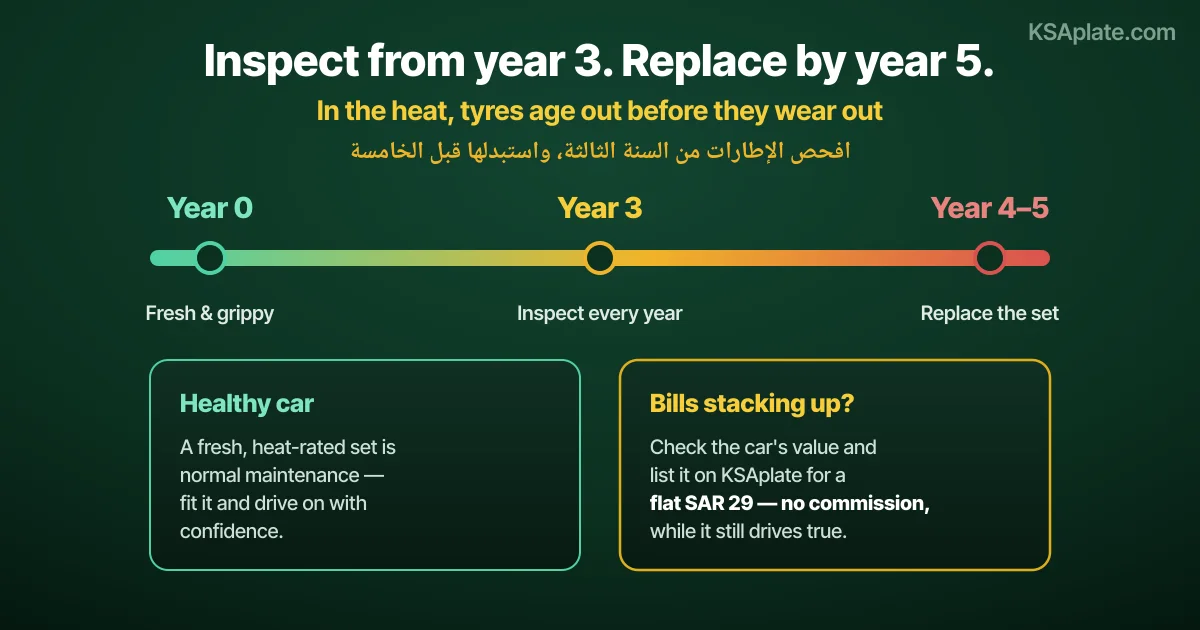
The calculation changes when tyres are the newest line on a growing repair bill. If this year already brought an AC fix, a run of maintenance, and now a full set of tyres on top of an alignment and a suspension part, the tyres aren't the real story — the car is. That's the moment to run the numbers honestly: total what you've spent and are about to spend, and weigh it against what the car is worth today.
Do it in two minutes: check your car's current value in the free car value calculator, and see what similar cars are selling for on the live KSAplate marketplace. If a year of repairs is starting to rival the resale price, keeping the car is the expensive choice. And a car on fresh, straight-running tyres shows and sells far better than one that shudders on the test drive — good tyres are one of the first things a careful buyer checks. When you're ready, you can list your car on KSAplate for free, no commission — and the full method is in our guide to selling a car in Saudi Arabia.
Frequently asked questions
How often should I replace my car tyres in Saudi Arabia?
How do I check how old my tyres are?
Why do tyres crack in Saudi Arabia even with low mileage?
What is the correct tyre pressure in hot weather?
How do I know when my tyre tread is too worn?
How much do car tyres cost in Saudi Arabia?
Should I buy GCC-spec tyres or are imported tyres fine?
Can a punctured tyre be repaired, or must it be replaced?
What should I do if a tyre blows out while driving?
Do I need to change all four tyres at once?
Does tyre pressure really affect fuel economy and safety?
Can expats and Iqama holders buy tyres the same way?
My car keeps needing tyres and repairs — should I fix it or sell it?
Conclusion
Tyres are the only part of your car that actually touches the road, and in Saudi Arabia they live under constant attack from heat, sun and abrasive tarmac. The result is a simple rule that catches many drivers out: here, tyres age out before they wear out. Learn the two checks that matter — the dirham test for tread and the DOT code for age — keep them inflated to the door-sticker figure measured cold, and replace the set at four to five years even if the tread still looks fine. Do that, and you'll never meet the version of this problem that arrives as a blowout on a hot highway an hour from anywhere.
And when a set of tyres is the third bill this year, listen to what the car is telling you. Handle the safety essentials, then ask the bigger question honestly. Check what the car is worth in the value calculator, look at the live market, and if the repairs are starting to rival the resale, list it on KSAplate for free while it still drives straight and true — because the best tyre problem, like the best breakdown, is the one you prevented before it ever left you stranded.