
TL;DR:
- Saudi Arabia is a "severe conditions" country for cars. Extreme heat, fine dust and long highway runs push oil, batteries, tires, filters and cooling parts harder than the mild-climate schedules printed in most owner's manuals assume.
- Follow the maker's severe-duty schedule, then tighten it around the climate: a battery test every six months, an AC and coolant check before every summer, and filters inspected more often than the book suggests.
- Batteries are the most common failure here — in Gulf heat they often last only two to three summers, and they usually die suddenly rather than gradually.
- Dealer service isn't automatically required, but documented, on-schedule service is — both for warranty claims and for the price your car fetches later.
- A stamped service history is money. When you sell, a complete paper trail defends your asking price better than any polish — buyers in a heat-stressed market pay for proof.
Quick answer: Maintaining a car in Saudi Arabia means following the manufacturer's severe-conditions service schedule, not the relaxed mild-climate one: oil and filters on time or early, a battery test every six months, an AC, coolant, belt and hose check before summer, tire pressure checked monthly and tire age watched from year four, and air filters inspected frequently because of dust. Keep every invoice and stamp — a documented history protects your warranty and measurably strengthens your resale price.
Why maintenance works differently here
Most maintenance advice on the internet is written for mild climates, and it quietly fails in the Kingdom. The service schedule printed in an owner's manual usually has two columns — "normal" and "severe" conditions — and almost everything about driving in Saudi Arabia lands in the severe column: sustained high ambient temperatures, fine airborne dust, stop-and-go city traffic in summer, and long, fast highway runs between cities.
None of this destroys a car quickly. That's exactly the trap. Heat and dust are slow, cumulative forces: they thin oil, harden rubber, clog filters, fade paint and shorten battery life — quietly, over months. The cars that reach year eight or ten in strong condition here aren't lucky; they're the ones whose owners treated the climate as part of the schedule.
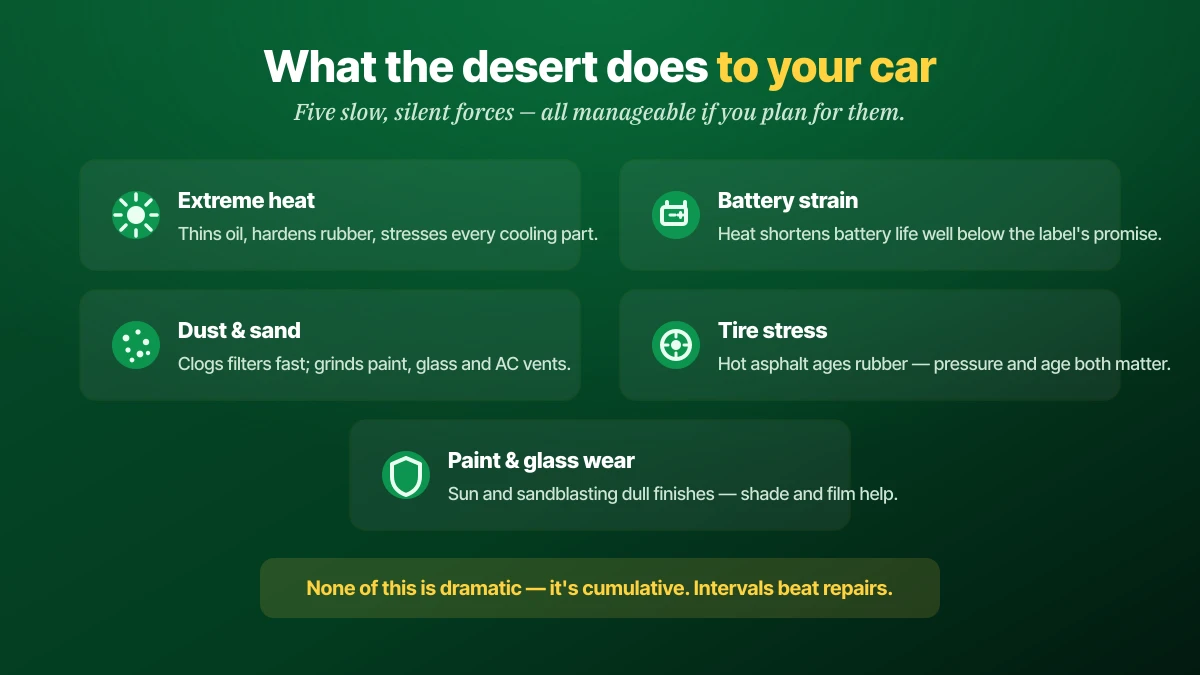
There's a second reason maintenance deserves attention here: the used market rewards it unusually well. Because every buyer knows what heat does to neglected cars, a documented, on-schedule history separates your car from the listing next to it — something we'll come back to in the resale section. If you're currently shopping rather than owning, our guide to buying a used car in Saudi Arabia shows the same logic from the buyer's side. It's also worth knowing that GCC-spec cars ship with upgraded cooling and AC packages precisely because of these conditions — one more reason spec matters when you buy.
The service schedule that fits Saudi driving
Start with your manufacturer's handbook — it outranks any generic advice, including this article. Then apply one adjustment: read the severe conditions column as your normal, and treat the intervals as ceilings rather than targets. From there, a workable rhythm looks like this.
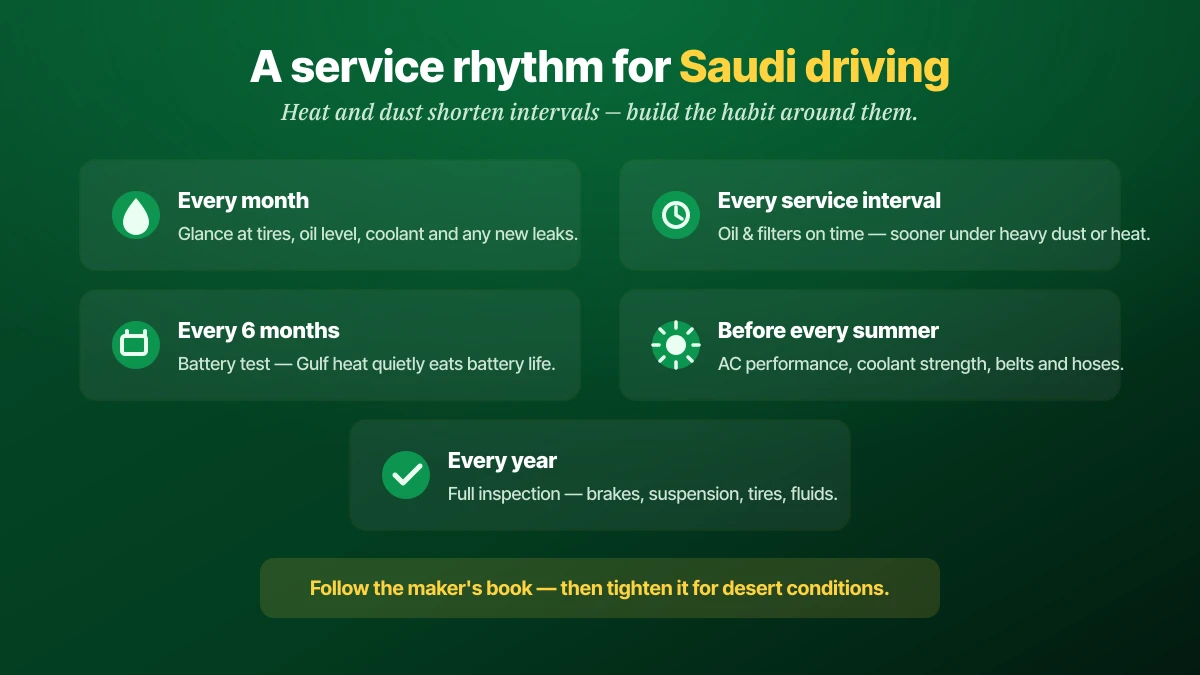
| Interval | What to do | Why it matters here |
|---|---|---|
| Every month | Check tire pressures cold, glance at oil and coolant levels, look under the car for fresh leaks | Heat magnifies small problems quickly — a slow leak in April is a breakdown in August |
| Every service interval | Engine oil and filter, per the severe-duty column — earlier if you drive dusty roads daily | High heat degrades oil faster; dust that gets past the filter ends up in it |
| Every 6 months | Battery load test, wiper blades, cabin filter check | Gulf heat shortens battery life sharply, and failure usually comes without warning |
| Before every summer | AC performance, coolant condition and strength, belts, hoses, radiator and condenser cleaning | Summer is the season that finds every weak part — this is the single highest-value check of the year |
| Every year | Brakes, suspension, alignment, all fluids, tire condition and age | Catches wear before it becomes a repair — and before Fahes catches it for you |
If your car is due for its periodic Fahes inspection, schedule the annual service shortly before it: the overlap between what a workshop checks and what the inspection tests (brakes, tires, lights, emissions) means one well-timed visit prepares you for both, and the same discipline keeps your Istimara renewal paperwork moving without surprises.
Heat: battery, cooling system & AC
Heat is the defining maintenance fact of the Kingdom, and it concentrates its damage on three systems.
The battery is the most common casualty. High ambient temperature accelerates the chemistry inside a lead-acid battery, and the result is a service life of commonly two to three summers — noticeably shorter than the same battery achieves in a mild climate. Worse, heat-aged batteries rarely fade gracefully; they start the car normally on Tuesday and are dead on Wednesday. That's why a twice-yearly load test (many workshops do it in minutes) is worth building into your routine: it converts a surprise breakdown into a planned replacement. If your car starts hesitantly, the dashboard lights dim at idle, or the battery is past its second summer, treat replacement as due rather than optional.
The cooling system works closer to its limits here than almost anywhere. Coolant doesn't just top up — it ages: its additives deplete and its boiling protection weakens. Have its strength tested before summer, not after the temperature gauge climbs. Belts and hoses harden and crack in heat, and a failed hose on a summer highway is an engine-risk event, not an inconvenience. A radiator and AC condenser packed with dust also can't shed heat — cleaning them is cheap insurance.
The AC is a safety system in a Saudi summer, not a comfort feature. If cooling weakens, the honest diagnosis order is: cabin filter (dust-clogged filters choke airflow), then condenser cleanliness, then refrigerant level. A system that needs regular topping up has a leak — repeated recharges without fixing it are money down the drain. Testing AC performance in spring, while workshops are quiet, beats discovering a fault in July when everyone else does.
What's your car worth?
Get a free instant estimate based on real Saudi market data — then sell it on KSAplate with direct WhatsApp contact.
Value My Car — FreeDust & sand: filters, paint & glass
Dust is the second climate force, and filters are where it shows up first. The engine air filter protects your engine from exactly what Saudi air carries most; check it at every oil change and expect to replace it more often than the handbook's mild-climate suggestion. The cabin filter fills even faster — a clogged one weakens AC airflow and brings dust inside — and after any serious sandstorm it's worth a look regardless of schedule.
Paint and glass wear more gradually. Sun bakes clear-coat; wind-driven sand acts like slow abrasive on leading edges and windscreens. The practical defenses are unglamorous: shaded or covered parking whenever you can get it, prompt washing after sandstorms (dust mixed with morning humidity turns mildly corrosive), a coat of wax or a protective film on cars you plan to keep, and windscreen wipers replaced yearly — rubber hardens fast here, and hardened blades drag grit across the glass. None of this is cosmetic vanity: paint condition is one of the first things a buyer reads as a proxy for overall care.
One more dust habit that pays: don't run the washer-less wipe. A dry wiper pass over a dusty windscreen is sandpaper. Keep washer fluid topped up and use it generously.
Tires: pressure, age & rotation
Tires carry the harshest workload in the Kingdom: asphalt surface temperatures in summer far exceed air temperature, and heat is the main enemy of tire rubber. Three habits cover most of the risk.
- Pressure, checked cold, monthly. Underinflation makes a tire flex more and run hotter — the classic recipe for a highway blowout in summer. Check before driving, not after, and don't bleed air from warm tires; the pressure rise when hot is normal and accounted for.
- Age, not just tread. Heat ages rubber from the inside; a tire can look healthy and be brittle. Read the DOT date code on the sidewall, start inspecting closely from year four, and be skeptical of any tire past five years in this climate regardless of tread depth. Apply the same check to the spare — a ten-year-old spare is a false sense of security.
- Rotation and alignment. Rotate on the handbook interval and align annually or after any hard pothole strike. Uneven wear shortens tire life and is one of the specific things Fahes looks at.
Before any long intercity drive — the Riyadh–Dammam or Jeddah–Makkah runs that define Saudi driving — give the tires five minutes: pressures, a visual for bulges or cracks, and a glance at the spare and jack. It's the highest-value five minutes in this article.
Dealer vs independent workshop
Both have a legitimate place, and the honest answer depends on the car's age, warranty status and your priorities.
| Dealer service center | Independent workshop | |
|---|---|---|
| Typical cost | Higher | Lower, sometimes much lower |
| Parts | Genuine, from the brand's supply chain | Genuine, OEM-equivalent or aftermarket — you choose, so ask |
| Records | Stamped digital/paper history tied to the VIN | Invoices you must keep and organize yourself |
| Warranty fit | Simplest — no questions about compliance | Workable if service follows the schedule and is documented — check your warranty's terms |
| Best for | Cars under warranty, complex diagnostics, recalls | Out-of-warranty cars, routine services, older vehicles |
A sensible pattern many owners settle on: dealer service while the warranty runs, then a trusted independent workshop afterwards — keeping the same documentation discipline throughout. If you go independent, insist on itemized invoices that name the parts and oil grade used, and keep them together; that folder is what a future buyer will want to see. What you're paying a dealer for, beyond parts, is the stamp's unquestioned credibility; what you're paying an independent for is the same physical work at a better price. Both are rational purchases — just know which one you're making.
Maintenance and your warranty
New-car warranties in Saudi Arabia come with a condition that surprises people at claim time: the warranty protects you if the car was maintained on schedule, and the burden of showing that falls on you. Missed or late services — even harmless-seeming ones — are the classic reason claims get contested.
The protective routine is simple. Service on time, every time, with the severe-conditions intervals as your reference. Keep every invoice and stamp, whether dealer or independent. Make sure each record shows the date, mileage and work performed. And before you pay for any repair that might be covered, check the claim first — retroactive claims are far harder. The full picture of what's covered, what voids coverage and how extended warranties behave is in our dedicated car warranty guide; the one-line summary is that a complete service file is the difference between a warranty that pays and one that argues.
What maintenance actually costs
Exact prices vary by brand, engine and city, so any specific number would mislead — but the cost structure is consistent and worth understanding.
- Routine services are the cheap part. Oil, filters, and inspection-type visits are the predictable baseline of ownership, and choosing an independent workshop for them is the single biggest lever on price.
- Climate consumables are the Saudi-specific line. Batteries every two to three years, tires on an age schedule rather than a tread schedule, AC attention, extra filters — this is the layer mild-climate cost guides omit.
- Deferred maintenance is the expensive part. Almost every big repair bill here is a small bill that was postponed: coolant that was never tested becomes an overheating event; a humming bearing becomes a highway callout. The cheapest repair is the one bought early.
Budget-wise, the honest approach is to treat maintenance as a fixed monthly cost of ownership rather than an occasional surprise — set aside a consistent amount and let the quiet months fund the battery-and-tires months. Where maintenance sits inside the full financial picture — alongside fuel, insurance, registration and depreciation — is mapped in our cost of owning a car in Saudi Arabia guide. Depreciation dwarfs maintenance for most cars, and good maintenance is one of the few levers that actually slows it.
Service records & resale value
Here's where the discipline converts to money. In a market where every buyer knows what heat does to neglected cars, proof of care is a pricing instrument.
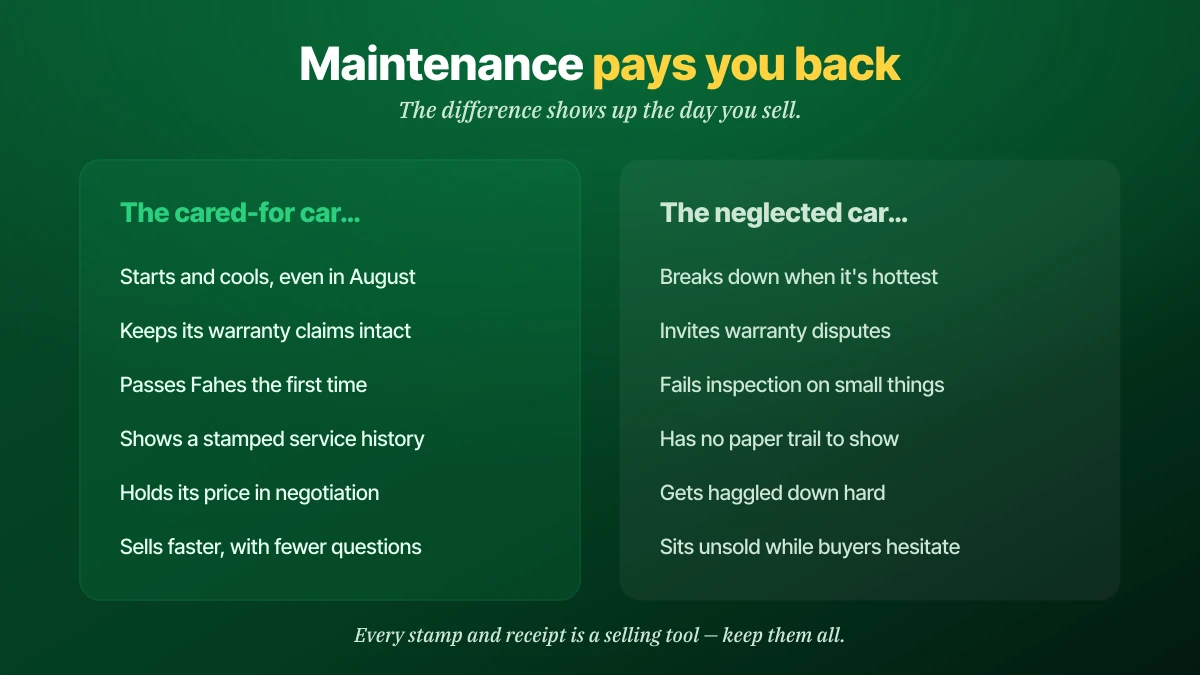
A complete file — stamped booklet or dealer digital history, plus organized invoices for everything since — does three concrete things when you sell. It answers the buyer's real question (how has this car lived?) with evidence instead of assurances. It removes the discount a buyer mentally applies for uncertainty; our used car value guide shows how condition and history feed directly into price. And it speeds the sale itself, because a documented car survives the buyer's history check without contradictions — while gaps and mismatched mileage records raise exactly the flags our used-car scams guide teaches buyers to walk away from.
Two practical habits: keep a single folder (physical or photographed) with every service record, Fahes certificate and repair invoice from day one; and when a major consumable is fresh — new battery, new tires — time your sale to advertise it, because "new battery, four new tires, full history" is a headline that moves listings. When that day comes, our guide to selling a car in Saudi Arabia covers the process end to end, and you can list your car on KSAplate with the history front and center. Buyers on the other side of that equation can browse the marketplace knowing exactly which questions to ask.
Mistakes to avoid
The same handful of errors accounts for most avoidable repair bills in the Kingdom.
- Running the mild-climate schedule. The "normal conditions" column in the handbook wasn't written for 45-degree summers and dust. Use the severe-duty intervals.
- Treating the battery as fine until it fails. Here it fails suddenly, usually in summer, usually somewhere inconvenient. Test twice a year; replace on age, not on death.
- Ignoring coolant because the gauge looks normal. Coolant condition, not just level, is what saves an engine in August.
- Judging tires by tread alone. In this climate, age and heat kill tires that still look legal. Check the DOT date, especially on the spare.
- Recharging a leaking AC every season. A recharge that doesn't last has told you the diagnosis — pay for the repair, not the ritual.
- Skipping services in year one or two "because the car is new." That's precisely when the warranty depends on the paper trail.
- Throwing away invoices. Every receipt you keep is a rial you recover at resale; every one you lose is a question a buyer answers in their own favor.
Frequently asked questions
How often should I service my car in Saudi Arabia?
How long does a car battery last in Saudi Arabia?
Does the heat really change oil change intervals?
My AC is getting weaker — does it just need a refrigerant top-up?
How often should tires be replaced in Saudi Arabia?
Do I have to service at the dealer to keep my warranty?
Is independent-workshop service bad for resale value?
What should I check before a long highway trip?
How is maintaining an electric car different in Saudi Arabia?
Should I service my car right before selling it?
What actually happens if I skip or delay services?
Conclusion & next steps
Car maintenance in Saudi Arabia isn't more complicated than anywhere else — it's just less forgiving. The climate quietly stresses five things: oil, battery, tires, filters and the cooling system. Respect the severe-duty schedule, test the battery before it tests you, treat every summer as an event you prepare the car for, and write everything down. That last habit is the quiet one that pays twice — once when a warranty claim goes through without argument, and again when a buyer opens your service folder and stops negotiating.
If your car is well past the point where maintenance makes economic sense — repair bills arriving faster than the car's value justifies — run the numbers honestly: our used car value guide will tell you what it's worth today, and selling it while it still runs and cools is worth more than selling it after the next breakdown. From there, list it on KSAplate with your history as the headline, and browse the marketplace for its successor — ideally one whose seller kept a folder as good as yours.